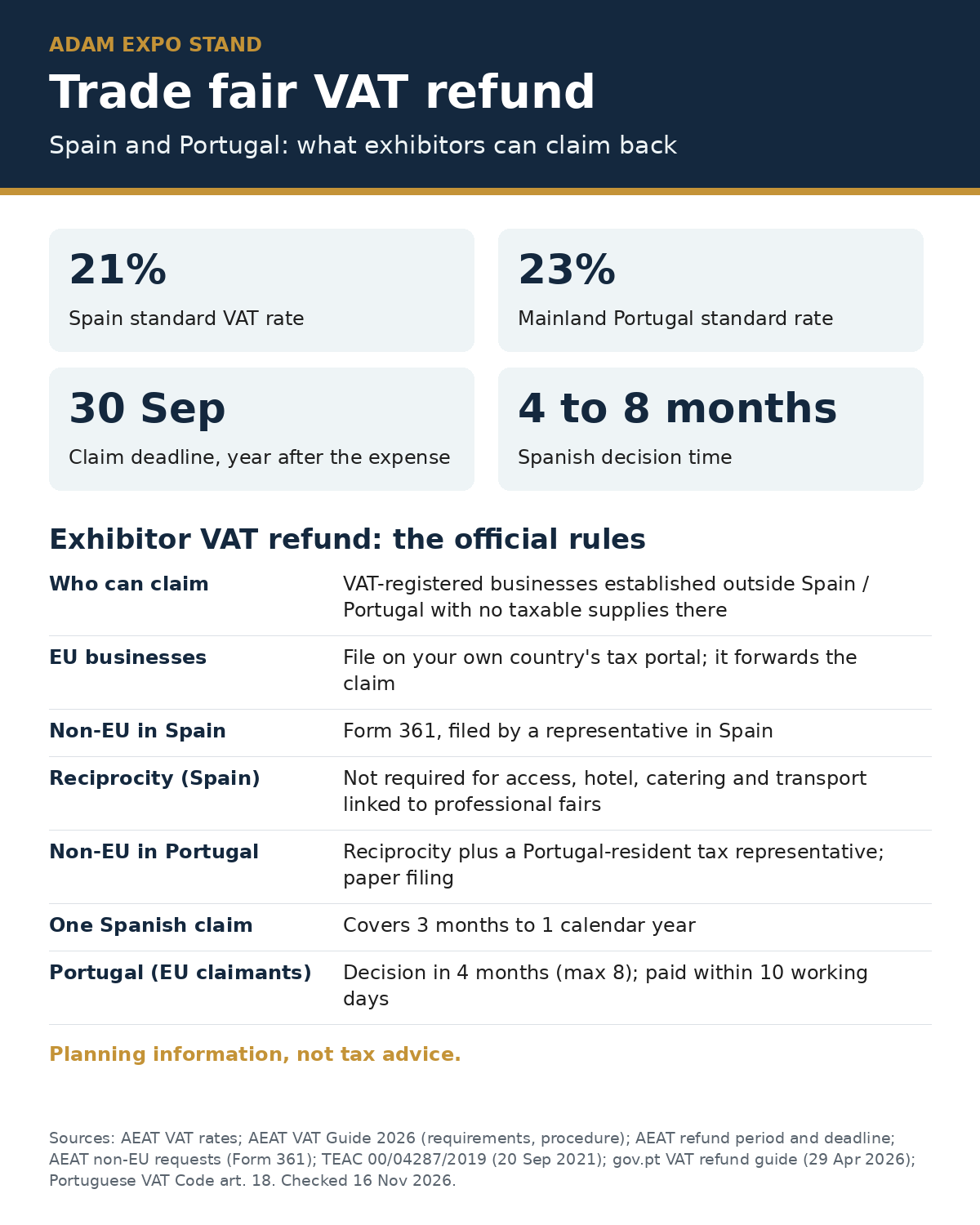
Yes: when you exhibit at a trade fair in Spain or Portugal, local VAT (IVA) can appear on organizer and supplier invoices, at a 21% standard rate in Spain and 23% on the Portuguese mainland. A VAT-registered business established elsewhere can usually claim that VAT back through the refund procedure by 30 September of the year after the expense, but a business that is not registered for VAT in its own country generally cannot.
Last updated: November 2026
This guide answers a question exhibitors ask, put plainly in a Reddit thread: “Is VAT applicable to an exhibitor at a conference?” Below, we apply it to fairs in Spain and Portugal and explain the trade fair VAT refund in Spain and Portugal step by step, using only the official tax agency rules. It is planning information, not tax advice. Your tax adviser has the final word.
Do exhibitors pay VAT at trade fairs in Spain and Portugal?
Often, yes. Spain’s standard VAT rate is 21%, with reduced rates of 10% and 4% for some goods and services, according to the Spanish Tax Agency (AEAT). Portugal’s Article 18 of the VAT Code sets 23% as the standard rate on the mainland, with 13% and 6% for listed items (Portal das Finanças).
Whether a specific invoice carries local VAT depends on what is being supplied and to whom. Examples include space rental, access, hotels, catering and local transport. Spain’s Central Economic-Administrative Court looked at exactly this case. A US company paid Spanish VAT on the rental of a space to take part in a professional congress, and the TEAC ruling of 20 September 2021 confirmed that this VAT fell under the refund exception for trade fairs.
Stand design and construction is a different question. Depending on the place-of-supply rules, a supplier may charge local VAT or invoice under the reverse-charge mechanism, where you account for the VAT yourself. Do not guess. Ask every supplier to state the VAT treatment on the quote, and have your adviser confirm it.
Key statistics: VAT refunds for exhibitors in Spain and Portugal
| Data point | Value | Source | Date checked |
|---|---|---|---|
| Standard VAT rate, Spain | 21% (reduced: 10% and 4%) | AEAT, VAT rates | 16 Nov 2026 |
| Standard VAT rate, mainland Portugal | 23% (also 13% and 6%) | VAT Code, Art. 18 | 16 Nov 2026 |
| Deadline to claim Spanish VAT | 30 September of the year after the VAT was paid | AEAT, period and deadline | 16 Nov 2026 |
| Refund period covered by one claim (Spain) | 3 months to 1 calendar year | AEAT, period and deadline | 16 Nov 2026 |
| Spanish decision time | 4 months; up to 8 months if more information is requested | AEAT VAT Guide 2026, procedure | 16 Nov 2026 |
| Deadline to claim Portuguese VAT | 30 September of the year after the refund period | gov.pt guide (updated 29 Apr 2026) | 16 Nov 2026 |
| Portuguese payment after approval (EU claimants) | Within 10 working days | gov.pt guide | 16 Nov 2026 |
Quotable summary: Exhibitors who pay VAT at fairs in Spain (21% standard rate) or mainland Portugal (23%) have until 30 September of the following year to claim it back, and Spain must decide within four months, or eight if it asks for more information.
Who can get a trade fair VAT refund in Spain?
The AEAT’s 2026 VAT Guide lists the conditions. In short, your business must:
- Be a VAT taxpayer, or pay a similar tax, in the country where it is established.
- Have no permanent establishment in mainland Spain or the Balearic Islands that makes supplies there.
- Not have made taxable supplies in that territory during the claim period, apart from reverse-charge purchases and certain exempt transport services.
That first condition answers the Reddit poster, a sole trader who was not VAT-registered. Without a VAT registration at home, the refund route is generally closed, so the VAT on your invoices is a real cost. Budget for it from day one.
EU businesses do not file in Spain. They submit the claim on the online portal of the tax authority in their own Member State, which passes it on. The same works in reverse: a Spanish company exhibiting in Lisbon or Porto claims Portuguese VAT through the Spanish Tax Agency’s online portal. The deadline is 30 September of the calendar year after the VAT was paid. One claim can cover three months to a full calendar year, so you can file soon after a spring fair instead of waiting.
The refund only covers VAT on costs used for activities that give a right to deduct, under the rules of both your home country and Spain. If your company only deducts part of its VAT at home, a pro rata applies.
What changes for non-EU exhibitors in Spain?
Companies from outside the EU file Form 361 electronically. It must be submitted by a representative established in Spain, whom you appoint by notarized power of attorney. That representative is jointly liable for any unjustified refund, so expect them to check your paperwork closely.
As a rule, Spain also requires reciprocity: your country must refund VAT to Spanish businesses on similar terms. There is an important exception for exhibitors, though. Reciprocity is not required for VAT on access, accommodation, catering and transport services linked to attending trade fairs, congresses and exhibitions of a commercial or professional nature held in Spain.
The TEAC ruling applied that exception to a US pharmaceutical company that rented space at a professional congress. The court read “access” and “attendance” as covering exhibiting companies as well as visitors. For a non-EU exhibitor, that makes the fair-related part of the bill recoverable even without a reciprocity agreement.
Hypothetical example: a Canadian software firm takes a stand at a congress in Madrid. Its space invoice, hotel bills, team dinners and local taxis carry Spanish VAT. Its Spanish representative files Form 361 the following spring, well before 30 September. Stand construction invoices are reviewed separately, because their VAT treatment depends on how the supplier invoiced them.
How does the refund work in Portugal?
Portugal follows the same EU framework for exhibitors at venues such as FIL in Lisbon or Exponor in Porto. According to the official gov.pt guide:
- EU businesses file in their own Member State by 30 September of the year after the refund period. The claim is accepted in Portuguese or English.
- Each invoice in the claim needs the supplier’s name, address and tax number with the PT prefix, the invoice date and number, and the taxable amount and VAT in euros.
- A decision or a request for more information should arrive within 4 months. Extra requests add 2 or 4 months, with an 8-month maximum. Approved refunds are paid within 10 working days.
- Non-EU businesses need reciprocity with Portugal and a tax representative resident in Portugal. The representative files on paper with the original invoices, by the same 30 September deadline. The refund is due by the end of the sixth month after filing.
If you are planning a Lisbon show, our Tektónica 2027 stand guide covers the venue side of the same trip.
What is not refunded?
Spain’s guide lists two exclusions worth knowing:
- VAT that was charged by mistake on supplies that should have been exempt, such as intra-Community supplies or exports. You have to get that corrected by the supplier, not refunded by the tax agency.
- Costs excluded from the right to deduct under Articles 95 and 96 of the Spanish VAT Act.
Portugal will not refund VAT that was wrongly invoiced either. Under the same EU procedure, your home tax authority does not forward a claim from a business covered by a VAT exemption. When an invoice looks wrong, fix it with the supplier while the show is still fresh.
How do you prepare during the show?
A refund claim is only as good as its invoices. Use this checklist with your team and suppliers:
- Before signing, ask each supplier how VAT will appear on the invoice: local VAT or reverse charge.
- Make sure every invoice carries your company’s full name and tax ID, the supplier’s tax number and a breakdown of the VAT.
- Keep proof that hotel, meal and transport costs relate to the fair: your exhibitor contract, badges and travel dates.
- For Spain, keep electronic copies of larger invoices. Above an AEAT threshold, they must be attached to the claim.
- Diary a filing date months before 30 September, and check whether you need a local representative.
- Answer any information request quickly. In Spain, you have one month to reply.
Shipping exhibits from outside the EU raises separate import VAT and customs questions. Our exhibition shipping and customs guide covers ATA Carnets and freight.
Where does VAT fit in your stand budget?
Treat VAT as a cash-flow item, not a saving. Even a clean claim can take four to eight months, so the money is out of your account across the whole season. Compare quotes on a like-for-like basis, either all net or all gross, and note which lines carry VAT you can recover.
For the bigger budget picture, see our exhibition stand cost guide for Europe and the IFEMA Madrid costs and deadlines guide. Overseas exhibitors should also read our guide to exhibiting in Spain and Portugal from the US, UK, Australia, Canada and New Zealand. For a first estimate of the stand itself, our projects start from €120/m², and the stand cost calculator gives a quick range.
Adam Expo Stand was founded in 2018 and has delivered 639+ projects in 12+ countries. Based in Madrid, Spain, serving all of Europe with a focus on Spain and Portugal.
Related video: what a stand hire quote should cover
Questions exhibitors ask
Can a non-EU company recover Spanish VAT on a trade fair stand space?
It can claim VAT on access, accommodation, catering and transport linked to a commercial or professional fair even without reciprocity. The TEAC applied this to space rented at a professional congress in 2021. A representative in Spain must file Form 361.
What is the deadline for a trade fair VAT refund in Spain and Portugal?
Both countries use 30 September of the year following the expense or refund period. File earlier if you can, because decisions take months.
Can I claim if my business is not VAT-registered?
Generally not. Spain requires the applicant to be a VAT taxpayer, or pay a similar tax, in its own country.
Does the stand builder’s invoice include VAT?
It depends on the supply and on where your business is established. Some invoices carry local VAT and others use the reverse charge. Ask for the VAT treatment in writing on the quote.
Planning a stand in Spain or Portugal?
Send us your fair, dates and floor plan, and ask for a proposal that states the VAT treatment of each line. Discuss your stand brief or call +34 697 715 015.