By Adam Dragos · Last updated: November 2026
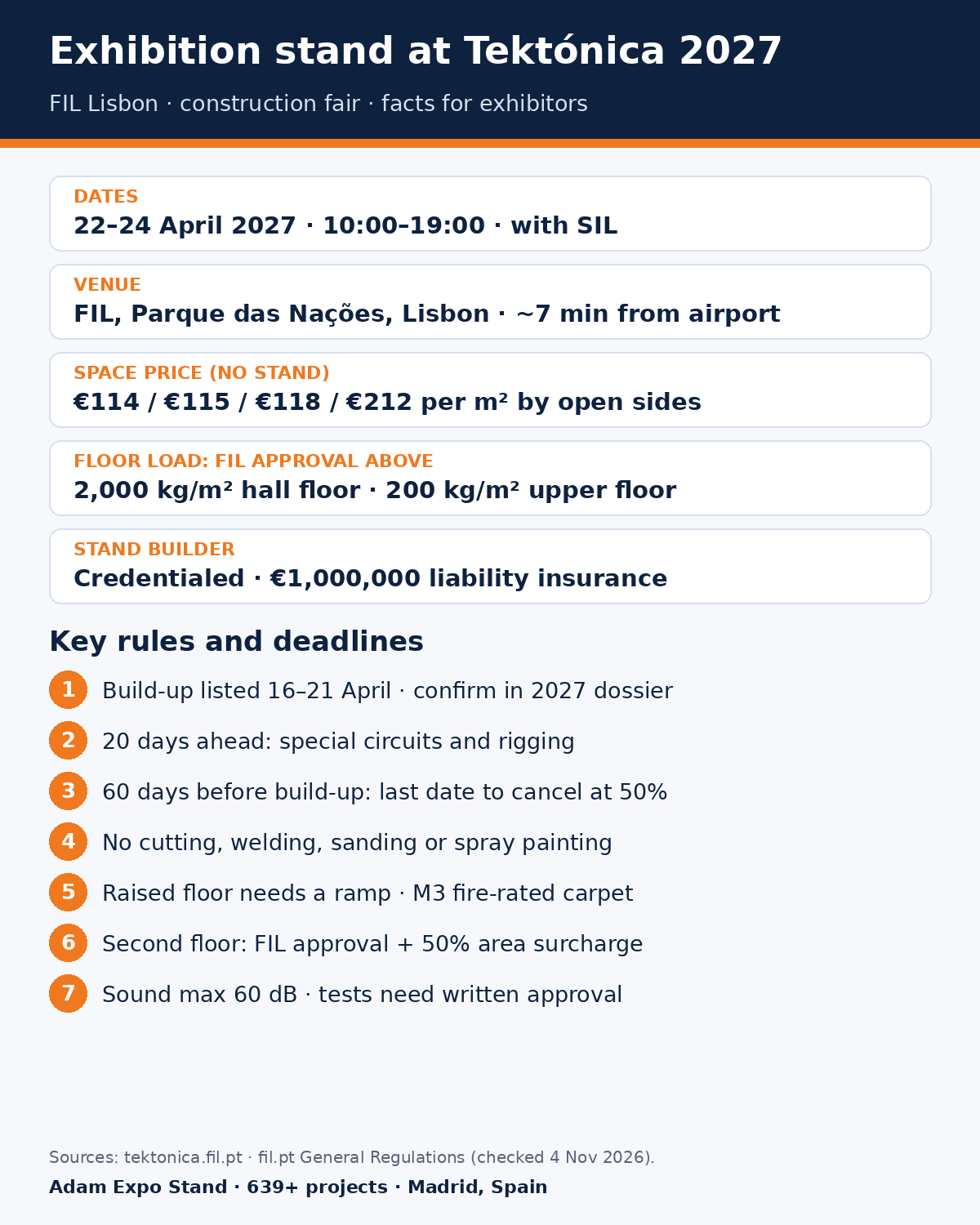
An exhibition stand at Tektónica 2027 Lisbon means building for the construction industry at FIL, Feira Internacional de Lisboa, from 22 to 24 April 2027. The fair runs alongside SIL, Portugal’s real estate show. Your stand follows FIL’s General Regulations, which set space prices per m², floor loads for heavy products, power rules and payment deadlines.
This guide is for manufacturers, importers and distributors of building products who are booked, or thinking of booking, at Tektónica 2027. Think bathroom and kitchen brands, flooring and cladding makers, energy-efficiency suppliers, smart building companies and machinery firms. Everything below comes from the official Tektónica website, FIL’s calendar and FIL’s General Regulations (sources linked in each section). Where a detail depends on the 2027 participation rules, we say so and tell you what to ask.
Key takeaways
- Tektónica 2027 runs 22 to 24 April 2027, 10:00 to 19:00, at FIL in Parque das Nações, Lisbon (>Tektónica).
- It is held at the same time as SIL, Salão Imobiliário de Portugal, and one ticket covers both (>FIL calendar).
- The 2026 edition used three exhibition pavilions plus outdoor areas, more than 35,000 m², with more than 400 exhibiting companies, according to the organizer.
- FIL’s participation page lists space at €114 to €212 per m², depending on open sides, with no stand included (>Tektónica participation).
- Products heavier than 2,000 kg/m² on the hall floor need special FIL authorization (>FIL General Regulations).
- No workshop building in the halls: no cutting, welding, sanding or spray painting. Stands arrive ready to assemble.
- Special electrical circuits and rigging must be requested at least 20 calendar days ahead. Cancelling after the 60-day mark costs the full participation price.
What is Tektónica and who visits it?
Tektónica, Feira Internacional da Construção, is the construction industry fair organized by FIL in Lisbon. It brings together building materials, machinery, bathroom and kitchen, flooring and cladding, energy efficiency, smart building, outdoor equipment and services under one roof. The organizer calls it a reference event for the construction sector in the Iberian Peninsula (>Tektónica FAQ).
The fair is not trade-only. Tektónica’s own FAQ says it is aimed at professionals and at the general public interested in building and renovation. That matters for your stand design, because you will talk to two very different visitors on the same day.
The professional audience the organizer lists includes:
- Architects, engineers and designers.
- Contractors, builders and public works companies.
- Project designers and consultants.
- Installers and specialist technicians.
- Wholesalers, retailers, importers and distributors.
- Municipalities and public bodies.
- Professionals in energy efficiency, technology and innovation.
Tickets, according to the Tektónica FAQ, cost €10 for a public ticket (one entry) and €10 for a professional ticket (valid all three days). Both give access to Tektónica and SIL. Children up to 10 enter free. Professional registration runs through the Business FIL platform, which the organizer recommends but does not make mandatory.
The organizer also reports that the 2026 Tektónica and SIL together recorded more than 39,000 visitors, about 30% more than the previous edition. That is the organizer’s own figure, so treat it as their headline, not an audited count.
When is Tektónica 2027, and when do you build?
Tektónica 2027 opens on Thursday 22 April and closes on Saturday 24 April 2027, from 10:00 to 19:00 each day. The organizer’s exhibitor page lists build-up from 16 to 21 April, 08:00 to 20:00, and dismantling on 24 April from 19:00 to 21:00, then 25 to 27 April, 08:00 to 20:00.
Those build-up and dismantling dates appear on the >Tektónica “Expor” page next to the 22 to 24 April show days. The page does not print a year beside the build dates, so confirm them in your 2027 exhibitor dossier before you book crews and trucks.
Six build-up days is a generous window. It suits product-heavy stands where you need time to place machinery, lay sample flooring or fit a working bathroom. It also means you should not leave everything to the last day. FIL’s rules say work must be finished by the time FIL indicates, and a stand that is not ready does not open.
A planning timeline that fits these dates (our recommendation, worked back from the official build-up start):
| When | What to have done |
|---|---|
| By December 2026 | Space booked, stand type chosen, open sides confirmed |
| By end of January 2027 | Concept approved, product list and weights fixed |
| By mid-March 2027 | Stand project sent to FIL for approval, contractor credentials ready |
| By 27 March 2027 | Special power circuits and rigging requested (20 calendar days before 16 April) |
| 16–21 April 2027 | Build-up, product placement, electrical inspection |
| 22–24 April 2027 | Show days |
| 24–27 April 2027 | Dismantling and exit |
The 27 March date is our arithmetic from FIL’s 20-calendar-day rule and the listed 16 April build-up start. If the 2027 dossier gives a different start date, recalculate.
Where is FIL, and how do trucks and teams get in?
FIL, Feira Internacional de Lisboa, sits in Parque das Nações on the north bank of the Tagus, next to the MEO Arena, Gare do Oriente station and the Vasco da Gama shopping centre. The organizer says it is about 7 minutes from Lisbon airport and 3 minutes from Oriente station.
For a team flying in from Madrid or elsewhere in Europe, that short airport transfer is a real advantage. You can land in the morning and walk the stand the same day. The organizer lists metro, train, bus and taxi access, plus an underground car park with 830 spaces and two entrances, with direct lift or stair access to the four pavilions.
Build-up logistics follow FIL’s own guidance. According to the >FIL exhibitor FAQ on stand assembly:
- During build-up and dismantling, vehicles use the loading and unloading park (South entrance) only for the time needed.
- During the show, parking is in the underground car park.
- Assembly passes are collected at the Customer Support Office after payment.
- An assembly fee is charged to stand-building companies and must be paid before build-up starts.
Inside the halls, FIL bans loading and unloading in the aisles that line up with the external gates, so forklifts and lifting platforms can move. Plan your delivery sequence with that in mind. Heavy pallets for a machinery stand need a slot and a route, not a hopeful arrival.
For a fuller look at the venue itself, read our FIL Lisbon exhibition centre technical guide.
How much does space cost at Tektónica?
Tektónica’s participation page lists space at €114 per m² for one open side, €115 for two, €118 for three and €212 for four open sides. Prices cover space only, with no stand. A stand with a second floor adds 50% of the built usable area at the same unit price, under point 4.2 of FIL’s General Regulations.
These figures were on the >Tektónica participation page when we checked on 4 November 2026. The page does not say whether they include VAT, and it does not label them as 2027 prices. Ask the sales team to confirm both in writing.
What the space price leaves out matters more than the price itself. The same page lists waste removal from common areas during build-up and the show as included. It lists stand cleaning and removal of dismantling waste as not included. There is also a registration and administration fee, which the page describes without a figure.
Budget lines a Tektónica stand will need on top of space:
- Stand design and build (custom wood, modular or a FIL package stand).
- Second-floor surcharge, if you build one (50% of built area at the space rate).
- Power connection and consumption, plus any special circuits.
- Rigging, which only FIL’s concessionaires may install, priced from FIL’s table.
- Assembly fee for your stand builder, paid before build-up.
- Stand cleaning (FIL service or your own credentialed supplier).
- Dismantling waste removal.
- Insurance for your goods, including theft (see below).
- Freight, handling and forklift time for heavy products.
Exact costs for build, freight and services depend on your design and products, so we do not give a single figure here. Our exhibition stand cost guide for Europe shows how to build a full budget from these lines.
How do FIL’s payment and cancellation rules work?
Under FIL’s General Regulations, you pay 50% of the space cost when you submit the participation request. The remaining 50% is due by the deadline in the show’s participation rules. Package stands and technical services follow the same split: 50% upfront, the rest before build-up starts.
Cancellation is binary. Cancel up to 60 calendar days before build-up starts and FIL charges the initial payments. Cancel after that and you owe the full participation cost. With a 16 April build-up start, day 60 falls in mid-February 2027 (our arithmetic). Put that date in your diary when you sign.
One more payment rule catches exhibitors at the end of the show. To take your products out, you need an exit form stamped by FIL’s Treasury, confirming everything is paid. If debts are unpaid, FIL can hold your exhibited goods until they are settled.
What can and can’t you build at FIL?
FIL allocates space in 9 m² modules (3 × 3 m) and multiples. Spaces come bare: no platform, walls or partitions. Stands must be built only by assembling prefabricated parts, because FIL bans workshop construction, cutting, welding, sanding and spray painting anywhere in the exhibition area.
That one rule shapes the whole project. Your stand, whether custom wood carpentry or a modular system, has to leave the workshop finished and arrive as a kit. For construction brands, this is a familiar idea: prefabrication beats site work.
The other build rules in FIL’s General Regulations (section 7) that matter most:
- Raised floors need a ramp. Every stand with a raised floor must include a ramp for wheelchair users.
- Second floors need express authorization. FIL must approve any stand with a second floor, and its usable area must be set back at least 1.50 m from the stand perimeter.
- Carpet must be fire-rated. Only flame-retardant carpet of fire class M3 is allowed.
- Hands off FIL’s safety equipment. Fire hydrants, extinguishers, speakers, signage, CCTV and fire detectors must stay clear and untouched.
- No fixing to the building. Walls and structural elements of the pavilions cannot be used to hang or fix anything without FIL’s express authorization.
- FIL’s signs stay visible. FIL can place general signage where it decides, and exhibitors cannot remove or cover it.
If you want a raised floor to hide cables or show off a flooring system, our flooring brief guide explains what to specify. For fire certificates in general, see our guide to the stand material register.
How do heavy products and live demos work at Tektónica?
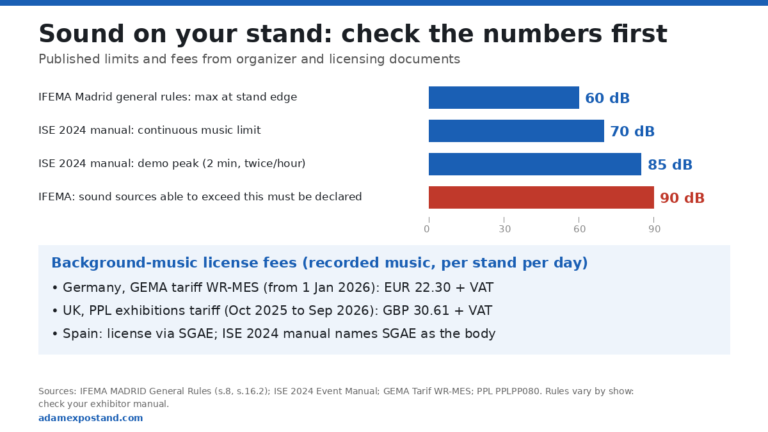
FIL requires special authorization for products heavier than 2,000 kg/m² on the ground floor of the pavilions, or 200 kg/m² on a stand’s first floor. FIL’s regulations also require written authorization for tests or contests, and sound equipment on stands must not exceed 60 dB.
This is where a construction fair differs from most shows. Machinery, stone slabs, precast elements and full bathroom suites are heavy. Before you ship, list each product’s weight and footprint, then calculate its load per m². Anything near the limit goes to FIL with the request, not on the truck as a surprise.
The 200 kg/m² first-floor limit is the one that changes designs. If you planned to show product on an upper deck, it probably needs to come down. Use the upper level for meetings instead, which is what most two-storey stands do anyway.
Other product rules from FIL’s General Regulations:
- No direct sales with immediate delivery. You can take orders and sign contracts, but you cannot hand over exhibited goods to buyers on the spot without FIL’s written authorization.
- Products stay for the whole show. Removing exhibited products during the fair needs FIL’s written authorization.
- No products that can damage the floor. Products that could harm other exhibitors, visitors, the floor or the structures are not allowed.
- Photography is controlled. Nobody may photograph exhibited products without the exhibitor’s written permission. Your own photographer, other than FIL’s official one, must be credentialed by FIL at least 48 hours before the opening.
Live demos are a strength at Tektónica. Mixing, cutting or installing a product in front of contractors sells better than a brochure. Just remember the venue rules: no cutting or sanding machines for stand construction, written approval for tests, and the 60 dB limit. Ask FIL early whether your specific demo counts as a “test” and what it needs. Our live demo checklist and our heavy products floor load brief cover the planning side.
What are FIL’s power, rigging and services rules?
FIL supplies 230/400 V, 50 Hz power. Each exhibitor owns its stand electrical installation, which must follow Portugal’s low-voltage safety regulations, include residual-current main switches and earthing, and be done by a professional credentialed by DGE or the Electricians’ Union. Only FIL’s services connect stands to the grid.
In practice, the electrical side has three deadlines and one responsible person:
- Declare power on the registration form. FIL’s rules say water, drainage, electricity and telecom connections, including the power you need, must be on the registration forms. Later requests may be refused.
- Request special circuits 20 days ahead. If a special line or circuit is not on the form, request it at least 20 calendar days before build-up. Special circuits are quoted separately.
- Request rigging 20 days ahead. Any suspension from the pavilion structure needs FIL authorization, is installed only by FIL’s concessionaires and follows FIL’s price table. Send the request with the rigging design and weights at least 20 calendar days before the show.
- Name the person responsible. Exhibitors must designate who is responsible for the stand’s electrical layout. Damage caused by connections is the exhibitor’s responsibility.
For a machinery stand with three-phase equipment, this is not paperwork to leave to the electrician on day one. The load, the connection point and the credentialed professional should be fixed when the design is approved. Our rigging approval checklist helps if you plan to hang a sign.
Services worth booking early: stand cleaning (FIL’s service or your own credentialed supplier, which may only work up to one hour before opening), invitations for your clients (requested on the registration form), and meeting rooms at FIL’s Meeting Centre, which exhibitors can use during the fair after FIL approves the event and at FIL’s prices.
What paperwork does your stand builder need for FIL?
Stand-building companies working at FIL must be credentialed in advance and show a civil and professional liability insurance policy of €1,000,000, covering damage to the venue, to third parties and losses from stopping FIL’s activities. Work starts only with the assembly credential and assembly passes.
This comes from sections 6.1 and 6.2 of >FIL’s General Regulations. Your stand project also needs approval: FIL’s exhibitor FAQ says the stand design goes to FIL’s Servifil department in advance, and the builder’s company details and responsible person go to the Customer Support Office (>FIL stand assembly FAQ).
A short paperwork list to agree with your builder:
- ☐ Stand project (plans, elevations, sections) sent to FIL for approval.
- ☐ Builder credentialed, with the €1,000,000 liability policy on file.
- ☐ Assembly fee paid and assembly passes collected.
- ☐ Credentialed electrician named, with the power request on the form.
- ☐ Rigging design and weights sent 20 days ahead (if any).
- ☐ Fire class M3 certificate for the carpet.
- ☐ Load per m² for every heavy product, with authorization if needed.
- ☐ Theft-inclusive insurance for your goods.
On insurance, FIL’s General Regulations say FIL provides general security during build-up, show and dismantling. Exhibitors must still guard their own materials and take out specific insurance for their participation, covering theft and robbery. FIL holds civil liability cover for damage it is responsible for. Your own team cannot stay on the stand after daily closing without FIL’s written authorization. Our exhibitor insurance guide explains the different policies.
FIL also limits exhibitor passes. Up to three 9 m² modules give you six exhibitor passes, with one more per extra module. Extra passes are paid at the professional ticket price. Assembly passes for your build crew are requested separately on the registration form.
How should you design a stand for a construction fair?
Design a Tektónica stand around touch and proof. Contractors and architects want to handle materials, see a joint, open a drawer, test a tap. Give them real samples at hand height, one working demo and a quiet table for specifications, rather than walls of renders.
From our builds, the mistake we see most at product-heavy fairs is the stand that becomes a warehouse. Every product the factory makes ends up on the floor, and visitors cannot find the one that matters. Pick a hero system and build the story around it.
A practical layout for a mixed professional and public audience:
- Front edge: the hook. One product or installed system that explains your brand in five seconds from the aisle.
- Middle: the touch zone. Samples, cut sections and finishes people can handle, with clear product codes.
- Back or side: the specification table. Somewhere an architect or contractor can sit, see technical sheets and talk quantities.
- Storage: hidden but generous. Brochures, samples to give away, tools and the products you rotate during the day.
Because the fair is open to the public, decide how you separate trade conversations from casual visitors. A raised counter, a lower meeting area, or scheduled demo times all help your team stay with qualified leads.
Stand type matters too. Custom wood carpentry lets you build fixtures that show your products well, such as a kitchen run or a tiled wall. Modular systems such as Aluvision and beMatrix are quicker to assemble and reuse, which fits FIL’s no-workshop rule. Many construction stands combine both. Our custom vs modular comparison sets out the trade-offs.
Finally, use what the organizer offers around the stand. Tektónica runs the Tektónica Talks programme of conferences, technical presentations and demonstrations, and the Prémio Tektónica Inovação for innovative products. The organizer says the 2027 application process will be published on its website. The Tektónica Village is a premium space inside the pavilion for networking lunches with clients and foreign buyers, with catering by the organization. Plan which of these you want before you size the stand, because a lunch booked at the Village can replace a kitchen on your stand.
Hypothetical example: a flooring brand’s first Tektónica
This example is hypothetical, to show how the rules combine. It is not a client project.
A Spanish flooring manufacturer books 36 m² with two open sides. At the listed €115 per m², space comes to €4,140 before VAT, registration fee and services (arithmetic from the participation page price). The brand wants a raised floor to show three click-fit systems, and a small upper deck for meetings.
What the FIL rules change:
- The raised floor needs a ramp, so the design adds one on the main aisle side.
- The upper deck needs FIL’s express authorization and adds a surcharge of 50% of its built area at €115 per m².
- The deck cannot carry product above 200 kg/m², so samples stay on the ground floor and the deck is for meetings only.
- The carpet in the meeting area needs an M3 certificate; the flooring samples themselves go on the raised floor.
- The lighting plan and power are on the registration form, with a credentialed electrician named.
The result is a stand designed around the rules from day one, rather than redesigned in March.
Beware of directory scams aimed at exhibitors
The Tektónica exhibitor page warns that some exhibitors at FIL events have been contacted by companies offering paid entries in “international fair directories”, using the event’s name without permission. Signing their form can commit you to a contract, often for three years, that costs a significant amount.
The organizer names several of these senders on its >Expor page. The rule is simple: the only official exhibitor catalog is FIL’s. Under FIL’s General Regulations, FIL is responsible for each show’s official catalog or visitor guide. If a form arrives from anyone else, check with the Tektónica team before you sign anything.
Pre-show checklist for Tektónica 2027
- ☐ Space booked and 50% paid; balance deadline noted.
- ☐ 60-day cancellation date in the diary (mid-February 2027, if build-up starts 16 April).
- ☐ Build-up and dismantling dates confirmed in the 2027 dossier.
- ☐ Stand project approved by FIL.
- ☐ Builder credentialed with €1,000,000 liability cover; assembly fee paid.
- ☐ Power declared on the form; special circuits and rigging requested 20 days ahead.
- ☐ Every heavy product’s load per m² checked against 2,000 kg/m² (ground) and 200 kg/m² (upper floor).
- ☐ Written authorization requested for tests or contests; sound under 60 dB.
- ☐ M3 carpet certificate in the folder.
- ☐ Goods insurance including theft.
- ☐ Photographer credentialed 48 hours before opening, if you bring one.
- ☐ Prémio Tektónica Inovação and Tektónica Talks options checked.
- ☐ Lead follow-up plan ready before the doors open (see our 14-day lead follow-up plan).
Frequently asked questions
When and where is Tektónica 2027?
Tektónica 2027 takes place from 22 to 24 April 2027 at FIL, Feira Internacional de Lisboa, in Parque das Nações, Lisbon. Opening hours are 10:00 to 19:00 each day. It runs at the same time as SIL, Salão Imobiliário de Portugal, and one ticket gives access to both events, according to the organizer.
How much does exhibition space cost at Tektónica?
The Tektónica participation page lists space at €114 per m² (one open side), €115 (two), €118 (three) and €212 (four), with no stand included. A second floor adds 50% of its built area at the same rate. Confirm VAT and 2027 validity with the organizer.
Can I build my own custom stand at FIL?
Yes. You must tell the organizer, send the stand project for approval and use a credentialed builder with €1,000,000 liability insurance. FIL bans workshop building, cutting, welding, sanding and spray painting in the halls, so the stand must arrive prefabricated and be assembled on site.
How heavy can products be at FIL?
FIL’s General Regulations require special authorization for products above 2,000 kg/m² on the pavilion ground floor and above 200 kg/m² on a stand’s first floor. Calculate the load per m² for each heavy product and send it to FIL with your requests.
What happens if I cancel my Tektónica participation?
Under FIL’s rules, cancelling up to 60 calendar days before build-up starts costs the initial payments, which are 50% of the space cost. Cancelling later costs the full participation price, whether or not the space is re-let.
Is Tektónica open to the public?
Yes. Tektónica is aimed at construction professionals and at the general public interested in building and renovation. Public and professional tickets are listed at €10, and children up to 10 enter free. Professional registration through Business FIL is recommended but not mandatory.
Plan your Tektónica stand with a builder who knows FIL
We design and build custom wood, modular (Aluvision and beMatrix) and turnkey stands, and we build several stands each year at FIL Lisbon. Adam Expo Stand is an award-winning, eco-friendly stand builder with 639+ projects delivered. Based in Madrid, Spain, serving all of Europe with a focus on Spain and Portugal.
If you are exhibiting at Tektónica 2027, start with the rules above and your product list. Then discuss your stand brief with us, or request a stand proposal for FIL Lisbon. For another Portuguese venue, see our Exponor Porto exhibitor guide.
Sources: >Tektónica official website, >Tektónica exhibitor page, >Tektónica participation page, >FIL calendar, >FIL General Regulations, >FIL stand assembly FAQ. Checked 4 November 2026.
About the author: Adam Dragos is CEO of Adam Expo Stand. Follow us on LinkedIn, Medium and Substack.