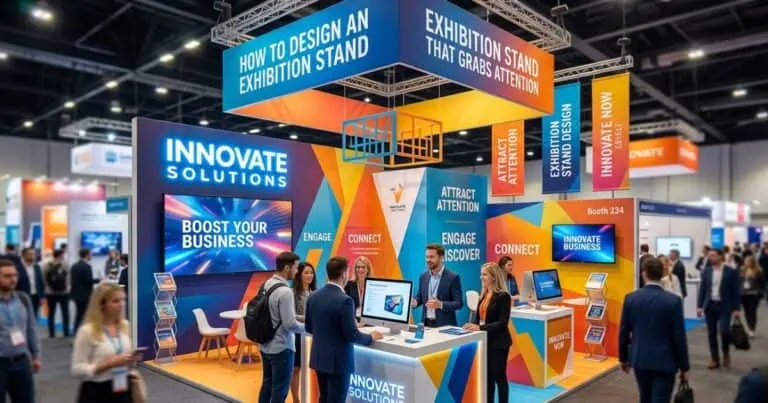
Materials in booth construction should be selected for their actual function, technical suitability, appearance, handling and planned use. Compare a specified product or assembly, not a broad material label. Aluminium, timber, fabric and composites each include products with different properties.
Begin with what the stand must support: products, people, graphics, equipment and the intended event programme. Let the competent design and technical teams establish suitable specifications and evidence. A finish sample alone cannot prove structural or fire performance.
Separate structure, surfaces and graphics
Identify the role of each component. A load-bearing frame, decorative panel, printed graphic and worktop need different information. Record the exact product, dimensions, finish, connection and intended application in the specification.
Ask who checks suitability and what documents are required for the event. The IFEMA regulations directory, for example, distinguishes facilities and event arrangements. Obtain the current applicable instructions instead of assuming a single material certificate answers every requirement.
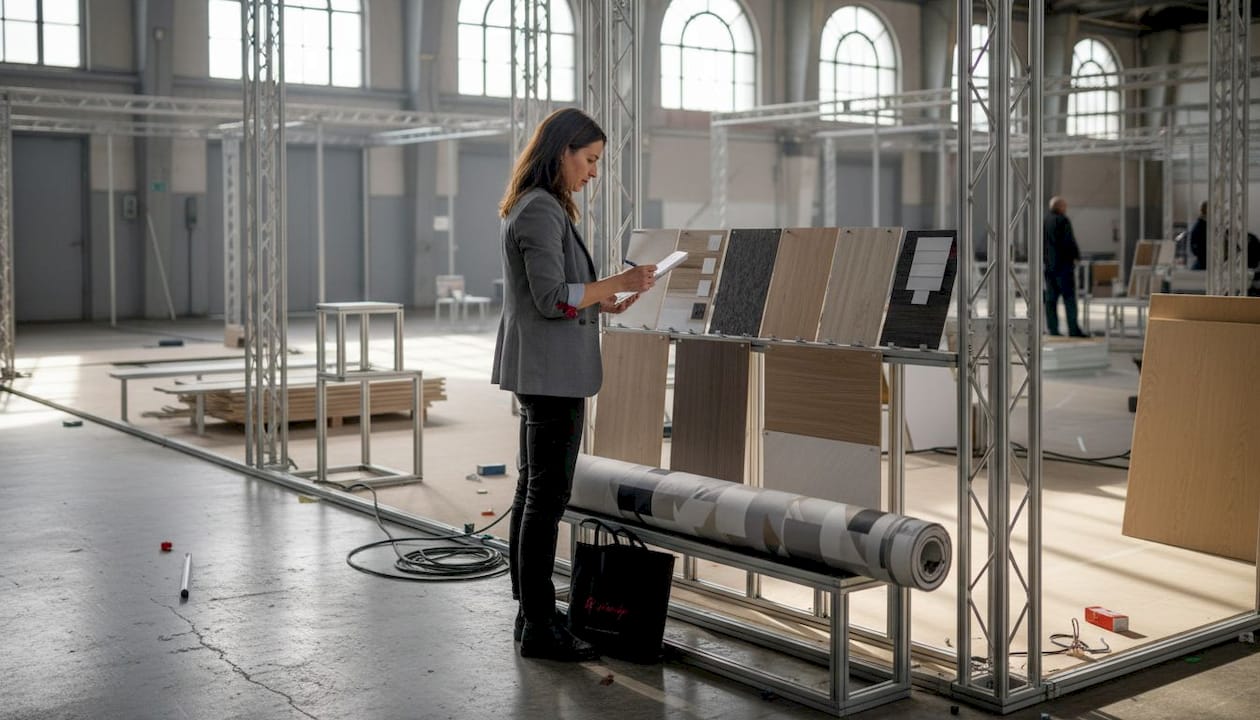
Compare materials in booth construction by application
| Material or system | Possible use | Questions for the specification |
|---|---|---|
| Aluminium system components | Frames and reusable display assemblies | Which system, connections, permitted configuration, loads and installation method apply? |
| Timber and wood-based panels | Fabricated surfaces, fixtures and specified structural applications | Which grade, thickness, finish, joining method and documentation are needed? |
| Printed fabric and tension systems | Graphic surfaces on compatible supports | What are the fabric, print, attachment, cleaning and required performance specifications? |
| Glass and acrylic | Selected display, screen or enclosure applications | Which product, thickness, support, protection, handling and cleaning methods are appropriate? |
| Composite and recycled-content panels | Surfaces or other documented applications | What composition, properties, verified claims and recovery routes apply to this exact product? |
The table identifies questions, not material approvals. Do not substitute one product for another without checking its application and required evidence. Recycled content does not establish structural performance, and an aluminium frame is not automatically suitable for assembly by untrained staff.
Test appearance and practical handling
Review samples with the proposed graphics and lighting. Check colour, texture, reflections, visible joints and the surfaces visitors will touch. Test cleaning on a suitable sample using the supplier’s instructions. Agree acceptable finish and what will be inspected at handover.
Consider the whole component, including fixings, coatings, backing and packaging. Ask for its actual mass and packed dimensions. A lightweight substrate can still become part of a heavy or fragile assembly; material category alone cannot establish transport cost.
Review edges, access to connections and repair methods. Identify what happens if a panel is scratched or a graphic is damaged: local repair, replacement part or a larger remake. Confirm availability and responsibility in the offer.
Plan repeated use with actual configurations
List the likely events, plot dimensions, products and branding changes. Ask the supplier to show which components fit each configuration and what must be added or replaced. Inspect components between uses rather than promising a fixed number of reuse cycles.
Agree dismantling, identification, protective packing, storage conditions and inventory ownership. Include inspection and repair before the next dispatch. Reuse is a delivery process as well as a design intention.
Compare complete programme costs: purchase or hire, graphics, labour, packing, transport, handling, storage, maintenance and adaptations. There is no universal percentage by which modular construction saves money. Show the assumptions and compare a realistic lower-use scenario if bookings are uncertain.
Check environmental claims against evidence
Request support for the specific claim and product supplied. For forest-based products, FSC explains its distinct 100%, Recycled and Mix labels. Verify the appropriate product claim and supplier documentation; a generic logo does not describe every material in the stand.
For recycled content, ask what is measured and how it is verified. For recyclability or compostability, identify the complete assembly, coatings, adhesives, separation steps and an available collection or treatment route. Do not describe a panel as compostable solely because it contains plant fibres.
Compare environmental assessments only when their scope and assumptions are suitable. Include relevant manufacture, transport, energy, maintenance and end-of-use information. A digital wall also needs equipment, electricity, logistics and support; eliminating a printed graphic alone cannot establish a lower footprint.
Use technology where the task requires it
A screen or illuminated surface can be useful for changing information or explaining a product. Define the content, update frequency, viewing conditions and support needs before choosing it. Include electrical requirements, ventilation, cable routes, noise and service access in the design review.
Visitor dwell time does not establish lead quality or a return from the material choice. Evaluate whether the intended task worked, what maintenance was required and which commercial outcomes can reasonably be attributed to participation.
Frequently asked questions
Which booth material is cheapest?
Compare specified assemblies and complete delivery costs for the same brief. Raw material prices do not include fabrication, finish, transport, installation or later maintenance.
Is recycled material always suitable?
No. Assess the exact product against its intended function and required evidence. Recycled content is one attribute, not a substitute for technical suitability.
What should a material schedule contain?
List the product, application, dimensions, finish, connections, required documentation, responsible reviewer and any approved alternatives. Keep substitutions subject to review.
How can Adam Expo Stand help prepare the brief?
Send the event manual, plot, products, activities, budget and reuse plans. Request a material proposal with samples, technical responsibilities and complete delivery costs. The fabrication guide explains evidence and acceptance checks to include.
Follow our exhibition planning guides
Choose Adam Expo Stand as a preferred source to help you find our exhibition guides and updates on Google.
Add as a preferred source on GoogleGoogle may ask you to sign in and confirm your choice.