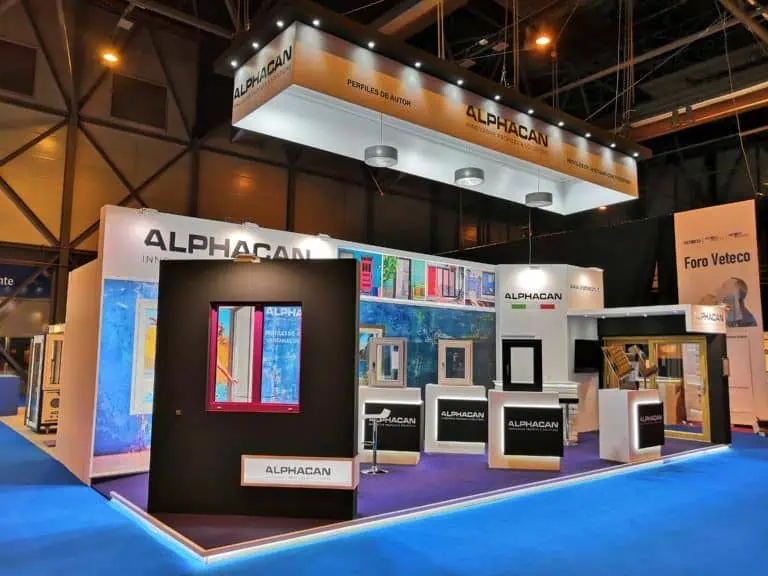
Expo stand design trends are useful starting points for a brief when you test them against visitor activities, the booked plot and the operating team. For 2026, this guide examines immersive demonstrations, documented materials, digital tools, modular and hybrid construction, and visitor measurement. It explains how to assess those options without treating them as a measured ranking of adoption or return.
A successful proposal needs more than a fashionable description. Ask what visitors can understand or do, what the team must operate, what evidence supports the specification and what the complete cost includes. Keep assumptions visible until the responsible person confirms them.
Start with the activity and the event requirements
Write the intended outcome before comparing concepts: relevant meetings, completed demonstrations, enquiries from a defined audience or explanation of a product application. Describe the products, equipment, staff and information needed to support it. Several outcomes may be appropriate, but each needs a clear activity and owner.
Use the actual plot plan, booking specification and current edition’s exhibitor manual. Check entrances, neighbouring stands, permitted heights, services, access, submission dates and approval responsibilities. A design from another event is a reference, not evidence that the same structure or activity is permitted here.
AUMA’s trade fair briefing guidance provides a starting point for communicating objectives and requirements. Turn the agreed brief into a scaled plan and a written scope rather than relying on a rendering alone.
Immersive design: test the demonstration
An immersive concept coordinates the environment and content around a visitor activity. It might be a guided product trial, a comparison of samples or a simulation explaining equipment that cannot be brought to the show. It does not have to include scent, sound, elaborate architecture or a large screen.
Define what the visitor should learn, the duration, staffing, expected capacity and waiting space. Include an accessible alternative where needed. Test the instructions and the actual content with the people who will operate the activity.
Check sound, lighting, special equipment and other effects against event rules. Protect adjacent stands and private conversations. Enclosed rooms, suspended elements and changes of level require appropriate design and approval; visual atmosphere is not a substitute for technical checks.
Measure a completed activity separately from time spent in the area. A long visit might reflect interest, a queue or difficulty using the interface. Dwell time alone does not establish lead quality, commercial value or return on investment.
Materials: connect claims to the supplied components
Request the product specification and supporting records for material origin, recycled content, certification or recovery claims. State which component a claim covers and keep the evidence with the project. A certification associated with a supplier or one product does not automatically certify the whole stand.
FSC explains the differences between FSC 100%, FSC Recycled and FSC Mix labels. Check the applicable label and supply documentation before using it in the stand specification or marketing.
Plan dismantling, repair, storage and the actual destination of materials. A fabric graphic, water-based ink or local supplier does not, on its own, establish the environmental impact of the whole project. Relevant comparisons require evidence with an appropriate scope.
A documented reuse example is Messe Frankfurt’s IMEX stand case, published on 27 May 2026: five years and three designs using the same construction materials. It demonstrates that specific project’s approach. It does not establish universal savings or mandatory waste reporting for every exhibitor.
Technology: specify a useful task and a fallback
Begin with the information or interaction needed. A screen might explain a process; augmented reality might help visualise an application; a configurator might let visitors compare approved options. Compare these with physical samples, a staff explanation or a simple menu.
For each option, specify content ownership, interfaces, power, connectivity, support, accessibility and operation. Review the real content under expected viewing conditions. Agree who fixes failures and what the team can do while a system is unavailable.
If AI generates answers, test accuracy, sources, unsuitable responses and escalation to staff. Keep product and commercial claims within approved information. A generated concept image also needs human review; it does not verify engineering, dimensions, installation or event approval.
For tools processing personal data, involve the exhibitor’s privacy owner before use. Review purpose, legal basis, information, access, retention and providers. The European Data Protection Board’s lawful-processing guidance explains that legal bases have specific conditions. Badge access or a digital interaction does not automatically authorise every subsequent use.
Modular and hybrid construction: verify the configuration
Modular systems use components that support particular combinations. Hybrid proposals combine modular parts with custom elements. Neither term guarantees appearance, lower cost, unrestricted reconfiguration or a particular delivery time.
Ask for the inventory and documented layouts for the actual event programme. Identify which frames, graphics, fixtures, supports and services remain, which move and which need new production. Confirm competent installation and the approvals for each configuration.
The OCTANORM systems portfolio illustrates different manufacturer categories. The relevant question is whether a particular product and configuration meets your brief, not whether a category is generally fashionable.
Compare equivalent scope over the planned events, including design, purchase or rental, new parts, graphics, packing, transport, installation, dismantling, storage, repairs and eventual disposal or return. Do not assume a fixed number of events makes ownership preferable to rental.
Visitor measurement: define the method before opening
Choose measures related to the objective and the team’s capacity to record them. Observation and a consistent staff log may answer a question without an automated system. If you use counters or analytics, understand their coverage, limitations and applicable data requirements.
| Question | Useful record | Interpretation limit |
|---|---|---|
| Can visitors find the activity? | Observed approaches, obstructions and queues during defined periods. | One period may not represent the whole event. |
| Does the activity work? | Completed demonstrations, failures and questions. | Completion does not establish buying intent. |
| Are conversations relevant? | Enquiries assessed against agreed qualification criteria. | Keep criteria consistent across staff. |
| What happens afterwards? | Agreed next actions and later commercial outcomes. | Follow-up, offer and sales process also affect results. |
For a rate, record the numerator, denominator, period and method. Keep activity measures separate from opportunities and financial return. Comparing two shows is not a controlled experiment: audience, plot, timing, staffing and offer may all change.
Approve a complete, operable proposal
- Match each feature to an activity and responsible person.
- Review the scaled layout, specifications and unresolved assumptions.
- Agree evidence and technical submissions before production.
- Compare complete scope, optional prices, taxes and exclusions.
- Rehearse content, equipment and staff handovers.
- Record acceptance issues and review outcomes after the event.
Plan recording areas separately from confidential meetings if you want photographs, video or live content. Agree permissions, approval and connectivity. A content studio is an operational choice, not a guarantee of social reach.
Frequently asked questions about expo stand design trends
Which trend has the highest ROI?
This guide does not establish a highest-return option. Compare the complete cost with relevant outcomes using the exhibitor’s agreed financial method. Visitor counts and dwell time alone are insufficient.
Does a creative stand need expensive technology?
No general requirement follows from a creative brief. A clear concept, useful display and well-run conversation can meet the objective. Add technology when its task, content and operation justify the cost.
How quickly can a modular stand change size?
Confirm the actual configuration, parts, graphics, engineering, availability and approvals with the supplier. A generic promise of reconfiguration within a fixed number of hours is not a reliable project schedule.
What should I send for a proposal?
Provide the event edition, plot, manual, activities, equipment, team, reuse plans, schedule and budget. Ask for assumptions, inclusions, exclusions and responsibilities in writing.
For a proposal, share that brief with Adam Expo Stand. Compare the resulting specification with the actual requirements before committing to optional features.
Follow our exhibition planning guides
Choose Adam Expo Stand as a preferred source to help you find our exhibition guides and updates on Google.
Add as a preferred source on GoogleGoogle may ask you to sign in and confirm your choice.