


Last updated:
Quick answer: A standard shell scheme package at venues such as IFEMA Madrid or Fira Barcelona includes the wall panels, fascia name board and carpet, but not furniture or printed graphics. Poster panels typically run 950mm-1000mm wide by 2,400mm high and take about 5 working days to print, and furnishing plus graphics for a 3x3m stand commonly adds several hundred to a few thousand euros on top of the base package. Order both no later than 3 weeks before move-in to avoid rush fees.
What furniture and poster panels come standard with a shell scheme stand?
A shell scheme package covers the shell only: aluminium framework, foamex or laminate wall panels, a fascia board with your company name, and basic carpet, usually built to a 2.5m wall height across two or three sides, with furniture and graphics always ordered separately from the show organiser or your own stand builder.
Quick check: shell scheme ordering readiness
How many working days does a standard shell scheme graphic panel typically take to print and prepare?
- What furniture comes standard with a shell scheme stand?
- Poster panel sizes and how they attach to the walls
- What it costs to furnish and graphic a shell scheme stand
- How far ahead to order furniture and poster panels
- Rent, buy, or bring your own furniture?
- Shell scheme furniture mistakes that cost exhibitors leads
- Which strategy fits your situation?
Walk onto most shell scheme rows at IFEMA Madrid or Fira Barcelona the day before doors open and you can spot the exhibitors who left furniture and graphics to the last minute: bare white panels, a folding table from reception, and a queue at the organiser’s furniture desk that closes before they reach it. The shell itself, walls, fascia, carpet, is never the problem. What sinks a shell scheme stand is treating the furniture and poster panels as an afterthought instead of a planned, budgeted order.
Get the timing wrong and the costs compound: rush fees from the official contractor, a graphics reprint that misses the show entirely, or a stand that looks unfinished next to neighbours who ordered on time. None of that is expensive to avoid, it just needs to be planned three weeks out rather than three days out.
This guide sets out exactly what is and is not included in a standard shell scheme stand furniture package, real panel dimensions and production times, defensible cost ranges for furnishing and graphics, and the ordering timeline we use with clients building shell scheme stands across European trade fairs.
What furniture comes standard with a shell scheme stand?
None. A standard shell scheme package is the shell and nothing else: aluminium framework, wall panels (usually white foamex), a fascia board with your company name and stand number, and basic carpet, built to roughly 2.5 metres across two or three walls with the front left open.
No table, no chairs, no counter, and no graphics arrive with that package, whatever the size of the stand.
Standard shell scheme footprints run 3x2m, 3x3m (the most common size on the floor), 3x4m and 6x2m, scaling up to around 20m² for larger corner or row positions. Organisers publish this shell-only distinction in their exhibitor manuals precisely because so many first-time exhibitors assume “shell scheme” means “furnished stand.”
Key takeaway: Budget for furniture and graphics as a separate line item from your shell scheme package fee, they are never bundled.
Poster panel sizes and how they attach to the walls
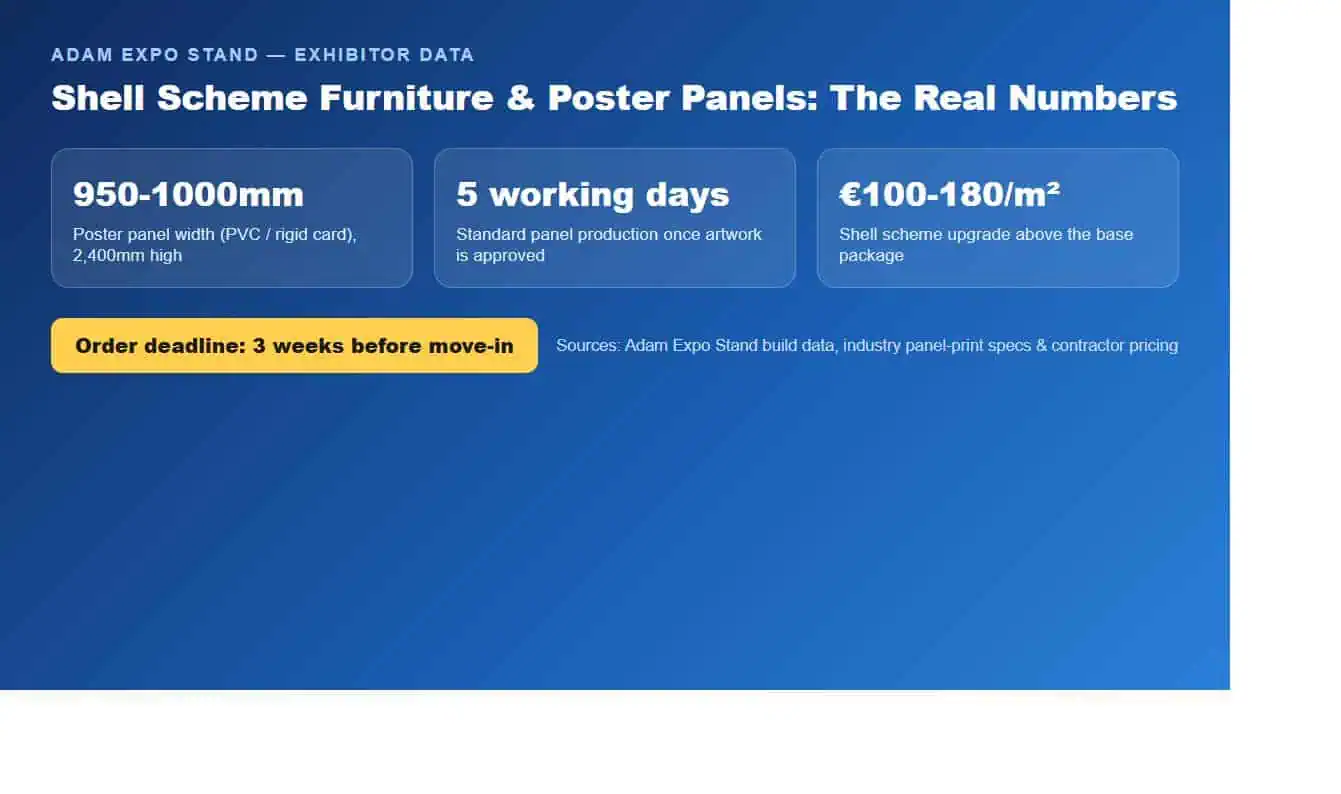
Shell scheme poster panels come in two standard sizes: roughly 950mm wide by 2,400mm high for rollable PVC, or about 1,000mm by 2,400mm for rigid corrugated card, sized to fit the shell system’s wall modules, with production taking about 5 working days once artwork is approved.
Panel specifications published by graphics supplier Marler Haley confirm these dimensions. Panels typically attach with hook-and-loop (velcro) fixings applied to the back, so they go up and come down without tools and without damaging the shell wall underneath.
Two practical details catch out first-time exhibitors. First, artwork has to be sized and bled to the panel manufacturer’s template, not just to the wall dimension, or the print house will bounce it back for correction, costing you a production cycle. Second, PVC panels roll for transport and storage while rigid card panels have to travel and store flat, which matters if you are reusing panels across more than one show in a season.
Our verdict: from our builds at IFEMA and Fira Barcelona, the panels that actually survive a multi-show season are rollable PVC on velcro, not rigid card. Card looks slightly crisper on day one, but it dents in transit and most exhibitors are reprinting it by the second show, which erases any cost saving.
What it costs to furnish and graphic a shell scheme stand
Furnishing and graphics typically cost more than the shell scheme package itself: the shell upgrade runs roughly €100-180 per m², while furniture and graphics for a typical 3x3m stand add a further £1,500-3,500 (around €1,750-4,100), depending on how much you rent versus buy.
Our own European stand cost data puts that shell scheme upgrade in context, see the full European exhibition stand cost guide for how it compares to modular and custom builds, and UK contractor Full Circle Events publishes the furniture-and-graphics range for a 3x3m stand.
The hidden costs that catch exhibitors out are rarely the furniture itself, and they are the ones that quietly blow a tight stand budget. They are: rush production fees when graphics are ordered inside the deadline window, on-site “emergency” furniture rental at a premium once the organiser’s desk has run out of stock, storage and reprint costs when card panels arrive damaged, and small extras like extra power sockets or spotlights that were never itemised in the original quote. Ask any shell scheme furniture or graphics supplier for a fully itemised quote before you commit, not a single lump sum.
How far ahead to order furniture and poster panels
Order shell scheme furniture and poster panels no later than 3 weeks before move-in, even though standard graphic production is closer to 5 working days. The extra time covers artwork approval, a possible reprint, and the risk that popular furniture pieces sell out early.
Organiser furniture desks typically sell out of counters and bar stools first, well before the show, and exhibitors who order inside 7-10 days routinely pay rush fees or end up with whatever is left in the warehouse.
Most organisers publish a firm deadline in the exhibitor manual, after which furniture orders either carry a surcharge or stop being accepted altogether, and on-site ordering is usually more expensive and far less reliable than the catalogue price. Treat the manual’s deadline as the latest acceptable date, not the target date.
Key takeaway: Diarise the organiser’s furniture and graphics deadline the day you book your stand space, not the week of the show.
Rent, buy, or bring your own furniture?
Renting through the official contractor is the lowest-friction option but generic. Buying pays back after two or three shows and builds a consistent brand look. Bringing furniture you already own works only for a single nearby show, rarely surviving freight or cross-border costs further afield.
Rental is delivered, set up and removed without you handling logistics, but every neighbouring stand can order the same catalogue chair. Buying costs more upfront, and you will need to budget for storage and transport between events too.
A useful rule of thumb from our own build sheets: if a piece of furniture will travel to fewer than three shows a year, rent it; if it will travel to four or more, buy it. Storage between shows is the cost people forget to budget, a pallet space in a Madrid warehouse is far cheaper across a season than repeat rental fees, but only if the furniture is actually reused rather than sitting untouched until the next event.
A fourth option worth considering for a multi-show season is a modular furniture set purchased once and reused, paired with rollable PVC graphics that can be reprinted cheaply when the message changes but the furniture stays. That is usually the lowest total cost across four or more shows a year.
Shell scheme furniture mistakes that cost exhibitors leads
The three most common shell scheme furniture mistakes are a tall counter that blocks sightlines into the stand, no seating for longer conversations, and graphics with text too small to read from the aisle. Each one directly reduces how many visitors stop and how long they stay.
A tall counter stops visitors seeing what you make from the aisle. One stool and no seating pushes every meeting to standing at the aisle edge, shortening it. And a headline readable only from 30cm away misses the two seconds a passer-by actually gives your panel.
The fourth, and the one we see most at Fira Barcelona’s food and industrial shows specifically, is furniture that does not match the product being shown, high stools and standing tables for a stand meant to host detailed technical conversations, when low seating and a screen would keep a qualified lead engaged for longer.
Insider tips from 20+ years on the show floor
- At IFEMA Madrid, the official furniture contractor’s on-site desk is usually in one of the entrance halls; note the hall before the show, not after you have already lost 20 minutes finding it.
- Keep a PDF of your approved graphic artwork on your phone during build-up; if a panel is damaged in transit, a local print shop near the venue can often turn around a replacement faster than the official contractor’s rush service.
- Ask for furniture delivery the evening before move-in finishes, not the morning of, so you have daylight hours to rearrange the layout once the stand is actually built.
Which strategy fits your situation?
First-time exhibitor on a small budget
Rent through the organiser’s official contractor and keep the furniture list to one counter, two stools and a low table, then put the saved budget into a single strong PVC poster panel rather than three mediocre ones. One clear message beats three cluttered ones on a 3x3m footprint.
B2B tech company wanting a premium look on a shell scheme budget
Buy one hero piece, a branded counter or a lightbox, and rent everything else. A single well-made element photographs and reads as considered; an entire rented catalogue set reads as generic no matter how it is arranged.
Exhibiting at 4+ shows a year
Buy modular furniture once and reprint rollable PVC graphics per show. Across a season this is usually cheaper than repeat rental and it means your brand looks consistent from IFEMA to Fira Barcelona to Messe Frankfurt.
Last-minute exhibitor who missed the furniture deadline
Call the official contractor directly rather than relying on the online order form, desks sometimes hold back a small reserve for late requests that never appears in the online catalogue once it shows as sold out.
Frequently asked questions
Does furniture come with a shell scheme stand?
No. A standard shell scheme package covers the wall panels, fascia and carpet only; furniture, lighting and printed graphics are ordered and paid for separately.
How much does shell scheme furniture rental cost?
UK contractor Full Circle Events puts combined furniture and graphics for a 3x3m stand at roughly £1,500-3,500 (about €1,750-4,100), depending on how many panels you print and how much you rent versus bring.
What size are shell scheme poster panels?
Roughly 950mm wide by 2,400mm high for rollable PVC, or about 1,000mm by 2,400mm for rigid corrugated card, sized to fit the shell system’s standard wall modules.
Can I bring my own furniture to a shell scheme stand?
Yes for a single nearby show, but freight and cross-border transport costs usually make renting or buying modular pieces cheaper once more than one show or a longer distance is involved.
How early should I order shell scheme graphics?
At least 3 weeks before move-in. Standard print production is about 5 working days, but the remaining time covers artwork approval and a reprint if needed.
What happens if I miss the organiser’s furniture order deadline?
Late orders usually carry a rush surcharge or are limited to whatever stock remains at the on-site desk, so popular pieces like counters and stools often sell out first.
Recommended reads
Adam Expo Stand: exhibition stand design and build for European trade fairs. Based in Madrid, serving IFEMA, Fira Barcelona, Messe Frankfurt and 50+ fairs across Europe.
Furnishing a shell scheme stand for your next show?
Get an itemised quote and a 3D concept from an in-house Madrid build team.


