Editorial review: 2 October 2026
Quick answer: what are the key elements of effective booth design?
An effective booth design brings together layout, branding, traffic flow and technology around the visitor’s task. Specify what visitors need to see, do and discuss, then plan the equipment, staff and next step. A stand feature alone does not guarantee qualified enquiries.
What makes an effective trade show booth design?
Start with the allocated footprint, open sides, product dimensions and event objectives. A useful design helps the intended visitor understand the offer and take part in the planned activity. Review the layout and message together before selecting finishes or additional features.
| Key element | What it controls | Most common mistake | Quick win |
|---|---|---|---|
| Layout | Whether visitors feel invited in or walled out | Counters and walls blocking the open edge | Check the planned entry against the plot and event rules |
| Branding | How clearly the offer can be understood | Message unreadable from the intended viewing positions | Test message size and permitted placement |
| Traffic flow | How visitors reach and leave the intended activity | No clear path or destination inside | Test the activity position and visitor route on the scaled plan |
| Technology | What digital tools help visitors understand | Screens with no purpose or call to action | Give the activity a clear purpose and next step |
What makes a good exhibition stand, in one sentence?
A good exhibition stand gives the intended visitor a clear reason to stop and a practical way to see the product, ask questions or arrange a meeting. Compare the design with the brief, then measure meaningful conversations and agreed next steps after the event.
Quick quiz: is your booth design working hard enough?
Q: A visitor is walking down the aisle 8 metres away. What decides whether they turn toward your stand?
On this page
- Booth layout: design for how visitors actually move
- Branding and the three-second rule
- Traffic flow and zoning
- Technology and interactivity
- Lighting, materials and sustainability
- What an effective stand costs (and the hidden costs)
- Planning timeline and choosing a build partner
- Which booth design strategy fits your situation?
- Expert tips from the build floor
- Frequently asked questions
Two stands with similar footprints can serve different purposes. One may prioritise a physical product display; another may need scheduled meetings or a working demonstration. Compare each design against its own activity and audience rather than judging performance from appearance alone.
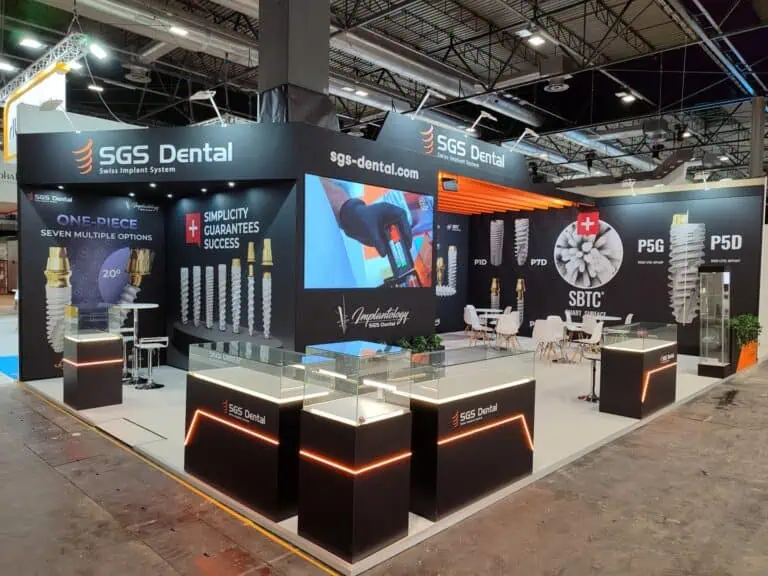
Use documented projects to make the brief concrete. The SGS Dental stand provides a product-display and meeting example, while the Just Juice and Lost Vape project shows a shared branded presence. These accounts do not report measured visitor, conversion or ROI gains.
The following sections turn the four elements into planning decisions, quotation checks and questions for the builder. Use the current event manual and dimensioned floor plan alongside this guide.
Booth layout: design for how visitors actually move
Layout is the arrangement of structure, furniture, products and usable space. Draw the welcome, demonstration, meeting and storage activities at the allocated dimensions. Check that visitors and staff can use the intended routes without competing for the same space.
Review the aisle-facing edges for counters, cases and staff positions that obstruct the planned entry. The required opening and circulation depend on the plot, activity and organiser rules; this guide does not prescribe a universal percentage of open frontage. Confirm the design with the responsible project team.
Check the actual floor plan, pillars, service positions, neighbouring stands and open sides. For a small footprint, compare one focused activity with concealed storage rather than adding several competing zones. See the small-booth layout guide for illustrative 3×3 and 3×2 metre approaches; they are not approved construction drawings.
Branding and the three-second rule
Use company name, product category, one main message and supporting details as a visual hierarchy. Test graphics at their production size and the expected viewing distances. Confirm permitted heights and rigging with the organiser before specifying an overhead sign; a three-second target is a briefing shorthand, not a guaranteed recognition result.
Choose a headline that describes the offer clearly. Ask someone unfamiliar with the company what they understand from the artwork, then revise confusing wording. Use readable contrast and appropriate lighting rather than relying on an unverified attention statistic.
The third job is consistency. Your stand, your pre-show emails, your staff clothing and your follow-up should look like one brand, because recognition compounds. This is also where strong exhibition stand design earns its keep: a designer who understands sightlines will place your message where the eye lands from the aisle, not where it looks balanced on a flat artwork. If you want worked examples of message hierarchy in action, we publish teardown-style breakdowns in our in-depth guides on Medium.
Traffic flow and zoning: guiding visitors through the stand
Plan where visitors enter, where the demonstration happens and where longer discussions take place. Put the activity where staff can operate it and visitors can see it without blocking circulation. A rear display is one option, not a universal route to higher engagement.
Separate activities where practical and draw the space needed by visitors, presenters, equipment and seating. Check circulation and access requirements against the current event rules and project review. A visitor’s position in the stand does not establish their buying intent.
Walk through the proposed activity on the floor plan. Consider arrival, waiting, viewing, questions and departure, including busy periods and appointments. Compare the plan with your staffing capacity; this guide does not claim a particular share of purchases comes from unplanned visits.
Technology and interactivity: holding attention and capturing leads
Choose a screen, configurator or other digital feature only when it helps explain the offer. Define its content, duration, presenter, connections and fallback before placing it in the layout. A useful explanation does not always require visitor-data collection.
Test the proposed demonstration with first-time users. Can they follow the instructions and understand the product connection? Confirm equipment support and reset time. Compare it with a physical display or staffed explanation before committing the budget.
Agree how staff record the business next step and assign follow-up responsibility. Ask the exhibitor’s responsible team to review the visitor-information process and required fields. Separate participation from qualified conversations and later commercial outcomes.
Lighting, materials and sustainability
Plan lighting around the message, product inspection and conversations. Test the proposed fixtures with actual samples and screens where possible, checking reflections, contrast, electrical requirements and cost. Compare lighting and structural options against the same brief rather than assuming one always provides a cheaper improvement.
Specify suitable materials, finish, durability and installation details for the intended use. Review joints, surfaces, floor transitions and cable management with the responsible team. A portable display may be appropriate for some briefs; material price alone does not establish a company’s credibility.
Plan ownership, storage, repairs, graphics changes and recovery for retained components. Compare the full event programme before drawing a cost or environmental conclusion. See the reuse and evidence guide for material and supplier checks.
What an effective stand costs (and the hidden costs)
Request an itemised quotation based on the event, footprint, products, activities and delivery scope. A per-square-metre figure without inclusions and exclusions is not enough to compare proposals. This guide does not establish a current Europe-wide price range.
Check what the booked plot, shell scheme and contractor offer each include. Account for flooring, electrical services, rigging where permitted, AV, graphics, furniture, handling, installation, dismantling, cleaning, waste, insurance and storage as applicable. Assign supplier and payment responsibility to each item and check organiser charges and deadlines. Do not assume these costs sit outside every contractor quote or have a fixed relationship to structural cost.
Ask who supplies and pays for each item, what is excluded, and which organiser deadlines affect ordering. Compare rental, retained components and custom work for the same brief. Use the Europe budget and quotation guide to structure the comparison.
Planning timeline and choosing a build partner
Build the schedule backwards from the organiser’s submission, service-order, access and dismantling deadlines. Agree dates for the brief, design, approvals, graphics, equipment testing, logistics and staff preparation with the suppliers. Lead time depends on scope and capacity; do not assume one eight-to-twelve-week rule applies to every project.
Ask the proposed partner who owns design, production, approvals, transport, installation and on-site changes, including any subcontracted work. Compare the quotation and escalation process rather than assuming a particular business structure guarantees lower cost or faster fixes. Confirm the responsibilities in writing.
Which booth design strategy fits your situation?
The right emphasis among the four elements depends on your budget, experience and goals. Find the scenario closest to yours below.
You are working with a small booth budget
Prioritise the product display, readable message and working lighting. Compare the same scope across rental, modular and custom options. Retain extra features only when they serve the agreed activity and your staff can use them.
You are a first-time exhibitor
Start with the floor plan, event manual and a clear activity brief. Ask the builder to identify approval and service-order responsibilities. Prepare staff explanations and follow-up ownership before the show.
You have a small 3×3 metre stand
On a 3×3 metre footprint, draw the product, staff, visitor position and storage at actual dimensions. Test one focused demonstration or discussion area first. Check that counters and graphics support the activity without obstructing the usable space.
You are choosing between a B2B tech expo and a consumer show
Define the audience and task rather than choosing equipment solely from the event label. A product demonstration, meeting or short activity needs its own content, capacity and staffing plan. Test the sequence and next step with representative users.
Expert tips from the build floor
- Check the viewing positions first. Check the main message’s permitted placement and legibility from intended approaches.
- Walk your own plan. Trace the visitor path on the floor plan with your finger; if there is no obvious place to go, neither will your visitors find one.
- Test the product lighting. Review visibility, reflections, contrast and cost using the proposed fixtures and actual samples.
- Attach a next step to every screen. Define what it helps explain and how staff support it.
- Order venue services early. Check service-order deadlines, current prices and any applicable late charges in the event documents.
Watch: building exhibition stands that actually perform
This company film provides exhibition-build context. It does not establish performance results or technical specifications for your own event.
Frequently asked questions
How do I get more people to my booth?
Explain a specific reason to visit in pre-show communications and on the stand. Test the message and demonstration, provide a workable welcome and agree the next step with interested visitors. No visit uplift percentage is established by this guide.
What makes a good exhibition stand?
A good stand supports the visitor’s task with a clear message, usable layout and prepared staff. Check the brief and activity together, then assess relevant conversations and follow-up rather than assuming a format guarantees better results.
What are the best booth design ideas on a small budget?
Specify one useful product display or activity, readable graphics and suitable lighting. Compare itemised quotations and exclusions. A small budget does not automatically require an overhead sign or prohibit custom components.
How much does an exhibition stand cost in Europe?
The price depends on the design, event, dimensions, equipment, delivery and venue services. Request an itemised quote with inclusions, exclusions and responsibilities. Compare the complete programme cost rather than treating an unverified per-square-metre range as a current quotation.
How far in advance should I start planning my stand?
Confirm the organiser deadlines and supplier capacity as soon as the event and footprint are known. Agree design, approval, artwork, equipment and logistics milestones for the actual scope. A sample countdown cannot replace the event’s current deadlines.
Is interactive technology worth it on a stand?
Use technology when it helps explain the offer and can be supported by your staff. Test instructions, capacity and a fallback presentation. Define measurement separately; an interaction need not end in a captured lead to be useful.
Recommended reads
- Exhibition stand cost guide (Europe) — what stands really cost and how to plan the budget.
- Exhibition stand design — how a design-led approach turns space into performance.
- Modular stands — reusable systems to compare against your event programme, storage and repair needs.
About Adam Expo Stand. Review our published exhibition projects and service overview when discussing your brief. Confirm project availability, responsibilities and delivery scope with the team.
Planning a stand for your next European fair?
Send the event, dates, floor plan, product sizes, planned activities and budget scope so our team can discuss the design and delivery requirements.