Eco-friendly exhibition booths: sustainable trade show guide
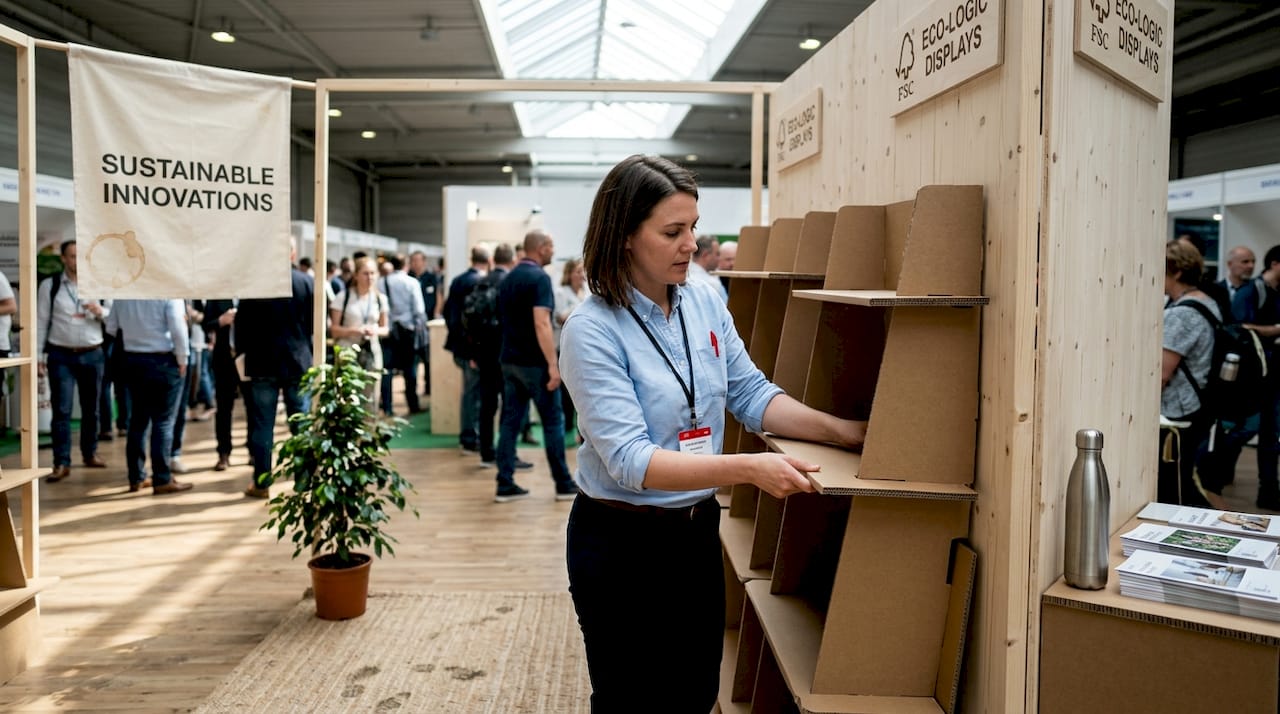
Despite common assumptions, sustainable booths reduce costs by 14 to 23% over three years, cut waste by 40%, and lower transport costs by up to 35%. For marketing directors and brand managers operating across European trade show circuits, those numbers are not aspirational targets. They are documented outcomes from brands that made the shift to eco-friendly exhibition design with real strategy behind it. This guide defines what makes a booth genuinely eco-friendly, examines the most effective materials and design principles, analyzes cost and ROI benchmarks, and gives you a practical framework for evaluating options without falling into the greenwashing trap.
Sustainable Trade Show Booths: Materials, Design & Certification
Sustainable trade show booths are now a baseline expectation at many European venues, which are themselves operating under strict environmental policies. Building a genuine eco booth means more than using bamboo panels—it means designing for longevity, minimising single-use components, and selecting partners with documented supply-chain sustainability credentials.
Eco Friendly Trade Show Booths and Sustainable Booth Design
The best eco friendly trade show booths use aluminium extrusion frames (100% recyclable), fabric graphics printed with water-based inks, and LED lighting systems that consume up to 80% less energy than fluorescent alternatives. Sustainable booth design principles also prioritise modularity: a structure that reconfigures across multiple events eliminates the fabrication waste associated with single-use builds. Eco friendly trade show designs that achieve Forest Stewardship Council (FSC) certification for timber elements and ISO 14001 environmental management accreditation for their manufacturing processes are increasingly demanded by corporate exhibitors meeting their own ESG commitments.
Eco Friendly Trade Show Displays and Environmentally Friendly Exhibition Stand Options
Eco friendly trade show displays range from lightweight pop-up tension fabric systems to full architectural builds using reclaimed materials. An environmentally friendly exhibition stand doesn’t sacrifice visual impact—premium sustainable booth design can achieve the same dramatic presence as a traditional build while generating a fraction of the carbon footprint. A sustainable trade show booth audit should cover: material sourcing, transport distance, energy consumption during the event, and end-of-life material recovery.
Table of Contents
- What defines an eco-friendly exhibition booth?
- Core materials and sustainable design principles
- Evaluating costs, ROI, and performance in real scenarios
- Practical decision criteria and common pitfalls
- Our perspective: What most experts miss about eco-friendly booths
- Explore eco-friendly exhibition solutions for your next event
- Frequently asked questions
Key Takeaways
| Point | Details |
|---|---|
| True sustainability | Eco-friendly exhibition booths prioritize reusable, recyclable materials and modular design for long-term impact. |
| Proven ROI | Despite higher entry costs, sustainable booths deliver 14-23% total savings within three years. |
| Critical compliance | European regulations now demand waste tracking, reusability, and carbon reporting from 2027. |
| Practical strategies | Choose modular systems, verify certifications, and evaluate rental for one-off needs to maximize both compliance and returns. |
What defines an eco-friendly exhibition booth?
Having previewed why these stands matter, let’s define what truly distinguishes an eco-friendly exhibition booth from a conventional one.
An eco-friendly exhibition booth is designed to minimize environmental impact across its entire lifecycle, from raw material sourcing and manufacturing through installation, repeated reuse, and eventual end-of-life disposal or recycling. The distinction is not cosmetic. It is structural, material-based, and increasingly regulatory.
Core materials that define these stands include:
- Modular aluminum frames: Lightweight, infinitely recyclable, and reusable across dozens of configurations
- Recycled tension fabric graphics: Often manufactured from PET bottles, delivering vibrant print quality with reduced virgin material use
- FSC-certified wood or bamboo: Sourced from responsibly managed forests, verified by the Forest Stewardship Council
- Low-VOC paints and adhesives: Volatile organic compound (VOC) emissions from finishes are a hidden environmental cost that certified low-VOC products significantly reduce
- LED lighting systems: Consume up to 75% less energy than traditional halogen or fluorescent alternatives
- Biodegradable panels: Offer a viable end-of-life pathway when reuse is not possible
You can explore modular aluminum stands and FSC-certified booth materials as starting points for specification.
The regulatory context is accelerating. European regulations including ESPR 2024 (Ecodesign for Sustainable Products Regulation), the EU Circular Economy Action Plan, and ISO 20121 now mandate reusability and recyclability by 2027, require waste documentation, and impose carbon reporting obligations for large events. Compliance is no longer optional for brands exhibiting at major European venues.
Statistic: 73% of European exhibitors now demand zero-waste booth solutions, signaling that sustainability expectations have moved from preference to procurement standard.
Proper documentation, material certification records, and supplier transparency are now industry best practice, not differentiators.
Core materials and sustainable design principles
Now that you know the defining features, let’s break down the most effective materials and strategies behind sustainable stands.
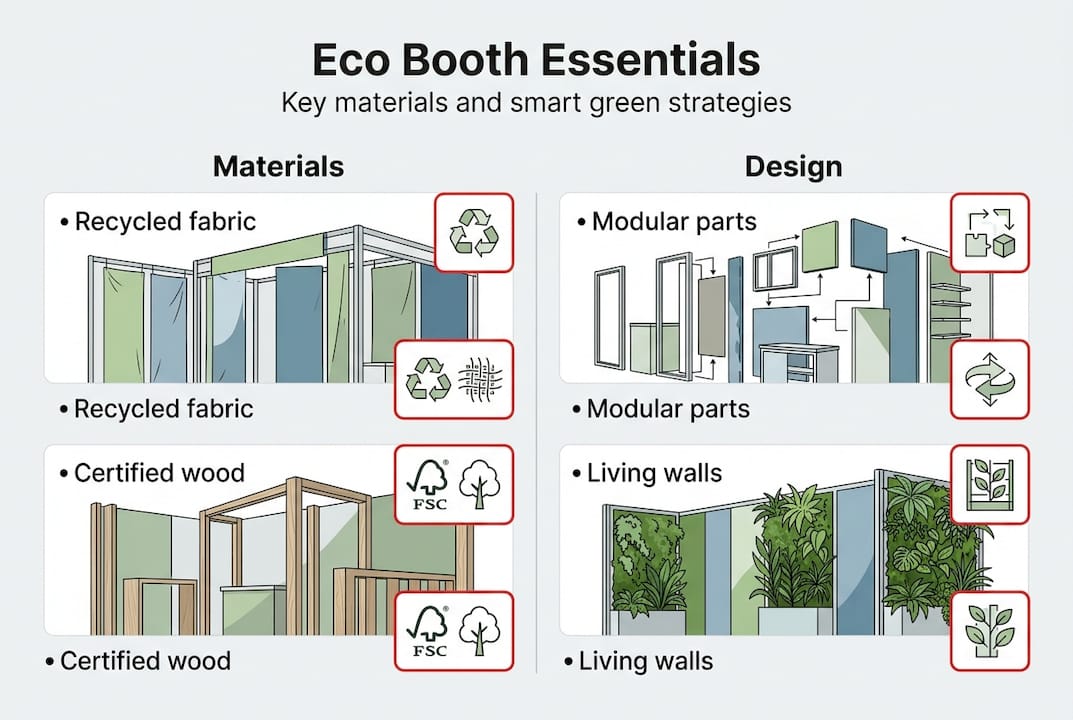
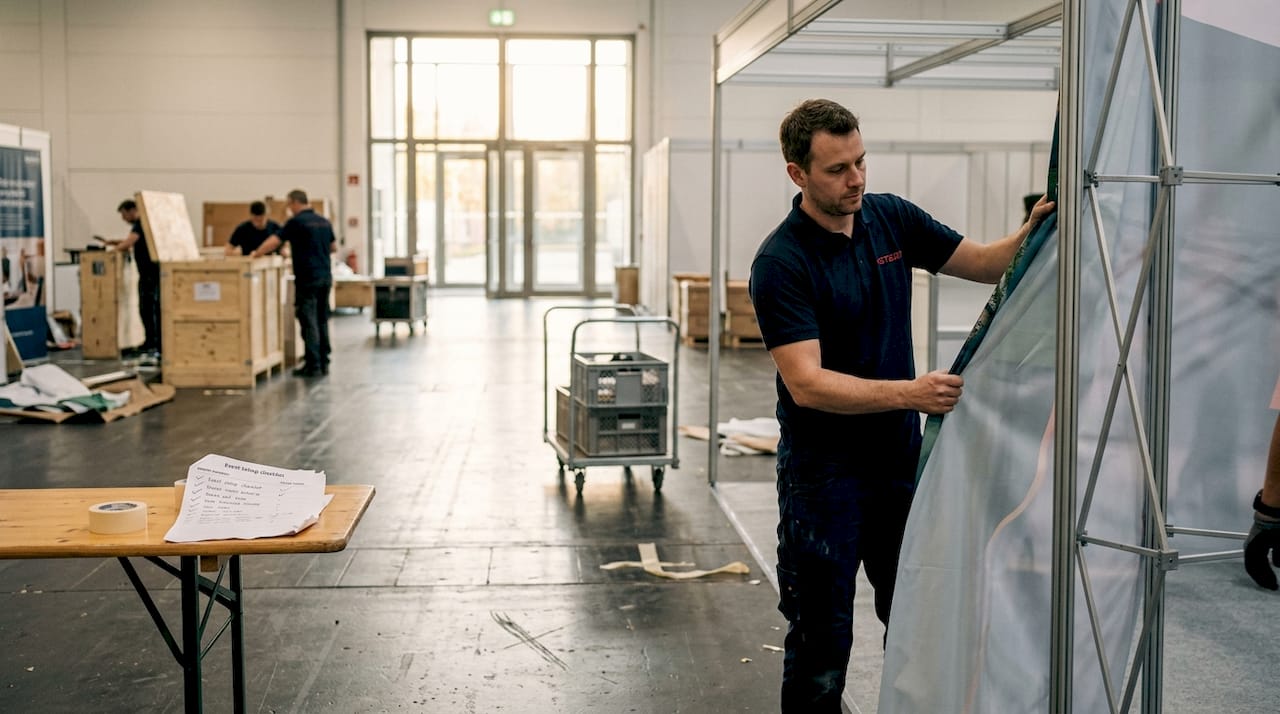
Modular design is the single most impactful principle. Modular stand flexibility enables reconfiguration across events, allowing brands to reuse 85 to 90% of components while adapting layouts to different floor plans and booth sizes. Aluminum, the backbone of most modular systems, is recyclable indefinitely without quality loss.
Recycled fabric graphics printed on PET-based tension fabric deliver sharp brand visuals while diverting plastic waste from landfill. These panels are also lighter than traditional printed boards, directly reducing shipping weight and transport emissions.
Biophilic design elements such as living walls and integrated planters are gaining traction as ESG signaling tools. Hybrid digital-physical strategies, combining digital signage with minimal printed materials, can reduce total material needs by up to 40%, though energy consumption from screens must be managed through LED and motion-sensor controls.
| Stand type | Reuse rate | Avg. shipping weight | Setup complexity |
|---|---|---|---|
| Modular/portable | 85 to 90% | Low | Low to medium |
| Traditional custom build | 10 to 20% | High | High |
| Rental eco-stand | 100% (by provider) | Minimal | Low |
Additional best practices include sustainable design benefits from low-VOC finishes, minimal packaging on all components, and sustainable carpeting options made from recycled or natural fibers.
Pro Tip: Specify mechanical fixings over adhesives wherever possible. Adhesives complicate disassembly and recycling, reducing the real-world reuse rate of even well-designed stands.
Evaluating costs, ROI, and performance in real scenarios
Understanding materials is key, but what about costs and performance? Let’s examine how eco-friendly stands stack up in practice.
The total cost of ownership (TCO) argument for sustainable stands is compelling once you move past the upfront investment. Initial spend on a modular eco-friendly system typically runs 10 to 20% higher than a comparable traditional build. However, ROI arrives within 3 to 4 events as reuse eliminates repeated fabrication costs, waste disposal fees drop, and transport costs fall by up to 35% due to lighter component weights.
Key financial benchmarks:
- Cost reduction over three years: 14 to 23% compared to equivalent single-use builds
- Waste reduction: Up to 40% less material sent to landfill per event cycle
- Shipping weight reduction: Up to 50% lighter than traditional custom stands
- Payback period: Typically 3 to 4 events for most modular systems
| Cost category | Traditional stand | Eco-friendly modular stand |
|---|---|---|
| Initial build cost | Lower | 10 to 20% higher |
| Per-event transport | High | Up to 35% lower |
| Waste disposal | High | Up to 40% lower |
| 3-year TCO | Higher | 14 to 23% lower |
Brands in Germany, France, and the Netherlands have led adoption across Europe, driven by venue incentive programs that reward sustainable exhibitors with preferred placement and reduced floor fees. Regulatory readiness in these markets also means procurement teams are already familiar with cost-saving with reusable booths and the documentation requirements that come with them.
The biggest financial and environmental gains consistently come from investing in quality modular hardware and committing to a reuse strategy across multiple events, rather than treating each show as a standalone build. Review the comprehensive sustainable design guide for deeper benchmarking data.
Practical decision criteria and common pitfalls
With core financials in mind, here’s how to avoid the most common eco-friendly exhibition mistakes and make the smartest sustainable choices.
The most dangerous trap is greenwashing, which occurs when a booth is marketed as eco-friendly without verifiable certification or documented reuse. Greenwashing risk is real when suppliers cannot provide FSC, cradle-to-cradle, or ISO 20121 documentation to back their claims. Demand evidence, not just language.
Here is a practical decision framework for your next stand evaluation:
- Verify certifications first. Ask for FSC, ISO 20121, or equivalent documentation before engaging any supplier on design or pricing.
- Assess your event frequency. If you exhibit fewer than two or three times per year, rental is often the most sustainable and cost-effective choice. Rental options for sustainability eliminate upfront investment while guaranteeing certified materials.
- Prioritize modularity over aesthetics alone. A stand that looks eco-friendly but cannot be reconfigured or reused delivers minimal real-world benefit.
- Audit lighting and geometry. LED lighting and strategic sightlines dramatically affect perceived quality. Eco-friendly does not mean basic. A well-lit modular stand with considered geometry outperforms an expensive custom build visually.
- Check venue energy monitoring requirements. Venue requirements for energy monitoring are rising across European exhibition centers, particularly in Germany and the Netherlands. Ensure your stand’s electrical specification is compliant before arrival.
- Document everything. Reuse logs, recycling certificates, and material data sheets are now required for regulatory compliance and increasingly requested by procurement teams at partner organizations.
“The most credible sustainable stands are those where the supply chain is as transparent as the design itself.”
Refer to eco-friendly stand best practices for a full specification checklist aligned with current European standards.
Our perspective: What most experts miss about eco-friendly booths
Having equipped you with frameworks and cautionary advice, here is a perspective rarely discussed among exhibition experts.
Most commentary on sustainable exhibition stands focuses on materials and compliance. That framing, while useful, misses the larger strategic opportunity. The brands gaining the most from eco-friendly exhibition investment are not simply avoiding regulatory penalties. They are using sustainability as an authentic differentiator in a market where most booths still look and feel identical.
Forward-thinking marketing directors are treating regulatory demands not as constraints but as leverage. Compliance with ESPR 2024 and ISO 20121 is becoming a prerequisite for preferred placement at top-tier European venues. Brands that arrive with documented sustainable credentials are increasingly rewarded with better floor positions, stronger media coverage, and more qualified visitor traffic.
The uncomfortable truth is that superficial eco designs, those with a bamboo panel and a recycling bin, do not survive scrutiny from informed buyers or venue operators. Real eco value and exhibitor impact comes from systems built for genuine multi-event reuse, verified by certification, and designed with the same creative ambition as any premium custom stand. Invest in proven systems that deliver year after year, and sustainability becomes a compounding brand asset rather than a one-time gesture.
Explore eco-friendly exhibition solutions for your next event
The frameworks, benchmarks, and decision criteria in this guide give you a strong foundation for evaluating sustainable exhibition options with confidence. The next step is applying them to your specific brand requirements, event calendar, and compliance obligations. Adam Expo Stand works with marketing teams across Europe to design, build, and install eco-friendly modular stands that meet current regulatory standards while delivering the visual impact your brand deserves. Whether you are planning a flagship event or evaluating your first sustainable build, explore detailed sustainable booth strategies and connect with our team for a tailored consultation on design, materials, and ROI optimization.
Frequently asked questions
How much more expensive are eco-friendly exhibition booths?
Upfront costs run 10 to 20% higher than traditional builds, but most brands recover the investment after 3 to 4 events through lower waste, transport, and fabrication costs.
What regulations apply to exhibition booths in Europe?
ESPR 2024, the EU Circular Economy Action Plan, and ISO 20121 require reusability, carbon reporting, and waste tracking for exhibition stands, with full compliance expected by 2027.
How can brands verify a booth is truly eco-friendly?
Demand FSC certification, cradle-to-cradle documentation, or ISO 20121 compliance records from your supplier, since greenwashing risk is real without verified evidence of reuse or certified materials.
Do eco-friendly booths help with trade show positioning or brand perception?
Brands that prioritize certified sustainability often gain preferred floor placement at major European venues and benefit from stronger brand recall among increasingly eco-conscious trade show audiences.
Recommended
- Eco-Friendly Exhibition Stand Design | Maximize ROI with Sustainability
- Sustainable Exhibition Stands in 2026: The Complete Guide to Eco-Friendly Booth Design for European Trade Shows | Adam Expo Stand Solutions
- DIY FSC Stands: Build Eco-Friendly Trade Show Booths
- Trade show booth ideas for sustainability and impact 2026
- A Quick Guide To Sustainable Carpeting | Quality Carpert Trims