

Portable exhibition stands: the ultimate trade show guide
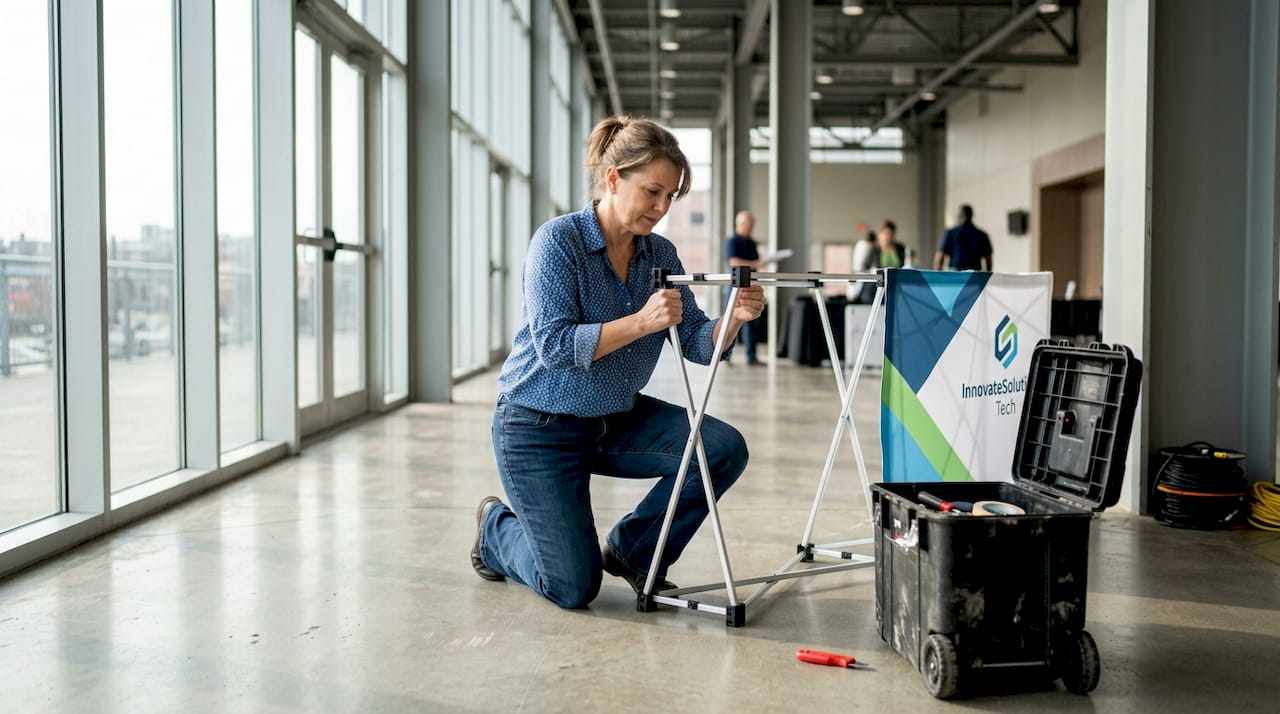
Portable exhibition stands carry an unfair reputation. Many marketing professionals assume they’re flimsy backdrops or generic banner setups that signal a low budget to every passerby on the show floor. That assumption is costing brands real opportunities. Today’s portable stands are precision-engineered display systems that rival custom-built booths in visual impact, brand consistency, and strategic flexibility. This guide breaks down exactly what portable exhibition stands are, which types exist, what features matter most, and how to choose the right solution for your next event.
Table of Contents
- What is a portable exhibition stand?
- Key types of portable exhibition stands
- Benefits of portable stands for trade shows
- Essential features every portable stand should have
- Practical guide: How to choose the right portable exhibition stand for your brand
- Enhance your trade show presence with Adam Expo Stand
- Frequently asked questions
Key Takeaways
| Point | Details |
|---|---|
| Portable stands redefined | Portable exhibition stands are innovative, brandable, and as impactful as traditional booths. |
| Multiple stand types | Pop-up, modular, and banner stands each offer distinct benefits for specific event goals. |
| Easy transport and setup | Portable stands minimize logistics stress and save time at every event. |
| Customizable for your brand | Modern portable stands support unique branding and flexible configurations. |
| Smart investment | With reusability and sustainable materials, portable stands deliver high ROI for marketers. |
What is a portable exhibition stand?
A portable exhibition stand is a lightweight, easily transportable display system designed for use at trade shows, conferences, and corporate events. Unlike traditional fixed booths that require professional installation crews and significant lead time, portable stands prioritize speed, flexibility, and reusability without sacrificing brand presence.
Portable stands are engineered to be quickly assembled, lightweight, and reusable, making them a strategic asset for marketing teams that exhibit at multiple events throughout the year. Think of a well-designed portable stand as a three-dimensional billboard that travels with your brand, adapts to different floor plans, and deploys in under an hour.
Core features that define a portable exhibition stand:
- Tool-less assembly: Components connect without specialized tools, enabling small teams to set up independently
- Modularity: Panels, frames, and accessories can be reconfigured for different booth sizes and layouts
- Compact storage: Systems pack into carry cases or rolling bags that fit standard shipping dimensions
- Customizable branding surfaces: High-resolution graphics, fabric prints, and backlit panels deliver strong visual identity
- Reusability: Structural components last through dozens of events, reducing per-show costs significantly
“The evolution of portable exhibition stands reflects a broader shift in event marketing: brands now demand solutions that are both agile and visually authoritative. The best portable systems no longer ask you to choose between convenience and impact.”
For companies just entering the trade show circuit, portable exhibition stands for startups offer a particularly compelling entry point, combining professional presentation with manageable investment. The distinction from traditional booths is clear: fixed custom builds offer maximum design freedom but require weeks of production and dedicated logistics, while portable systems deliver 80% of the visual impact at a fraction of the operational complexity.
Key types of portable exhibition stands
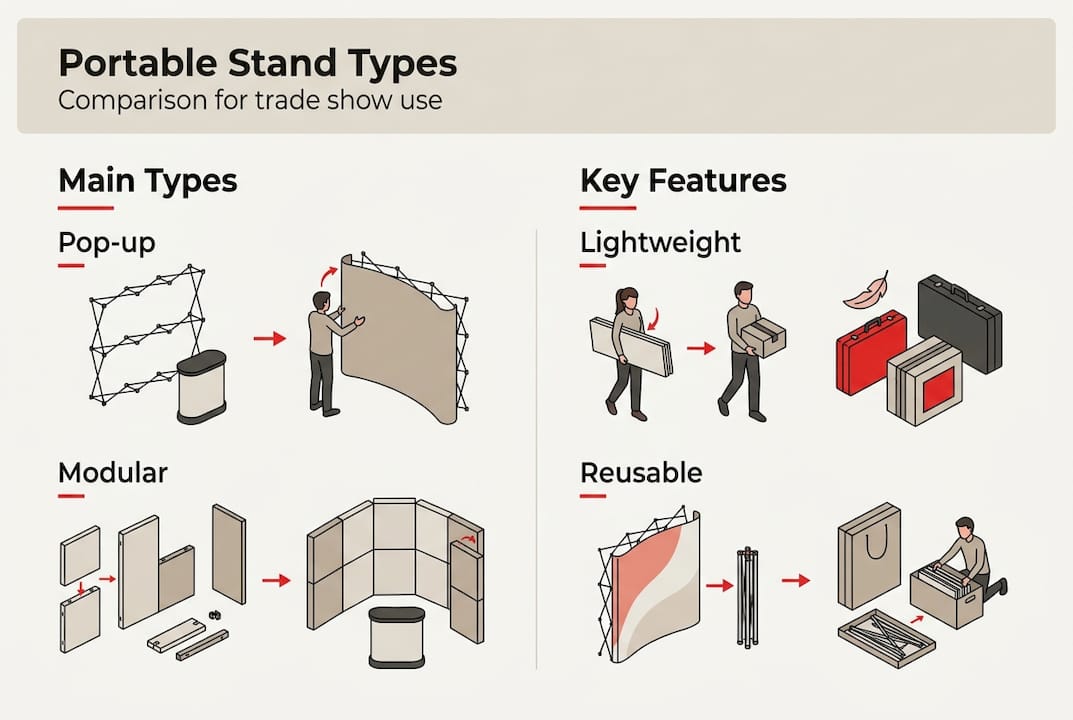
Now that you know what a portable exhibition stand is, let’s examine the most popular types and how they’re used on the show floor. Modular and pop-up stands offer different benefits depending on branding and portability needs, so understanding the distinctions is essential before committing to a system.
| Stand type | Best use case | Key advantages | Limitations |
|---|---|---|---|
| Pop-up stands | Single-event brand backdrops, product launches | Fastest setup (under 20 min), very lightweight | Limited reconfiguration options |
| Modular stands | Multi-event programs, varying booth sizes | Highly reconfigurable, scalable, premium look | Slightly heavier, higher initial cost |
| Banner stands | Supplementary displays, narrow spaces | Extremely portable, lowest cost | Minimal brand footprint |
Refer to the modular booth system guide for a deeper breakdown of how modular configurations scale across different event formats.
How to assess which type fits your brand:
- Define your event frequency. If you exhibit more than four times per year, modular systems deliver superior ROI through reconfigurability and durability.
- Evaluate your booth space allocation. Pop-up stands excel in 10×10 ft spaces; modular systems scale efficiently from 10×20 ft to island configurations.
- Assess your team’s setup capacity. Banner stands require one person; modular systems typically need two to three people for optimal efficiency.
- Consider your branding complexity. If your brand requires layered messaging, product displays, and interactive zones, modular stands provide the structural flexibility to support all three.
- Review your transport logistics. Pop-up stands ship as carry-on luggage; modular systems require freight but still cost far less than custom-built alternatives.
Benefits of portable stands for trade shows
Understanding the types is just part of the equation. Here’s why more brands are switching to portable solutions and why the shift is accelerating across industries.
Operational and financial benefits:
- Rapid deployment: Most portable systems set up in 30 to 90 minutes, freeing your team to focus on lead generation rather than logistics
- Reduced transport costs: Compact packing dimensions mean lower freight rates and fewer shipping complications across European venues
- Multi-event reusability: A single modular system can serve your brand across 15 to 20 events before requiring component replacement
- Smaller storage footprint: Systems pack into cases that fit standard storage rooms, eliminating warehouse costs
- Scalable investment: Start with a core system and add components as your event program grows
Portable stands can reduce logistics costs by up to 60% compared to traditional custom-built booth programs, a figure that resonates strongly with brand managers managing multi-event annual budgets. That cost reduction doesn’t come at the expense of brand quality when the right system is selected.

For teams managing flexible and sustainable exhibition stands, the environmental argument is equally compelling. Reusable components and eco-friendly materials reduce event waste, which increasingly matters to corporate sustainability reporting and brand perception.
Explore modular booth rental advantages if your event calendar is irregular, since rental programs let you access premium portable systems without full ownership costs.
Pro Tip: Even in a compact 10×10 ft space, you can create a powerful brand presence by layering a pop-up backdrop with a freestanding banner stand and a branded table display. Vertical height draws attention from across the hall, so prioritize stands that maximize upward visual real estate rather than floor coverage alone.
Essential features every portable stand should have
Having covered the benefits, it’s crucial to know which features actually make a stand effective in the competitive trade show environment. Integrated branding, easy assembly, and eco-friendly materials are most desired by trade show marketers, and for good reason: these three pillars determine whether a stand performs as a strategic launchpad or simply occupies floor space.
Must-have features checklist:
- Lightweight aluminum or composite frame: Reduces shipping weight without compromising structural stability during multi-day events
- Tool-less connection systems: Snap-lock, magnetic, or twist-lock mechanisms that allow assembly without technical expertise
- Modular panel architecture: Interchangeable panels that accept different graphic formats, shelving units, monitor mounts, and lighting attachments
- High-resolution branding surfaces: Fabric tension systems or direct-print panels that render brand graphics at 150 DPI or higher for sharp visibility at distance
- Eco-friendly materials: Recyclable aluminum frames, PVC-free fabric graphics, and LED lighting systems that align with corporate sustainability commitments
Refer to the exhibition stand workflow guide for a production timeline that maps these features to your pre-event preparation schedule.
The goal-oriented modular trade show stands that perform best share one additional characteristic: they’re designed with scalability in mind from the outset. A system that works in a 10×10 ft space today should be expandable to a 20×20 ft island configuration tomorrow without requiring a complete rebuild.
Pro Tip: When evaluating portable stand suppliers, request a live assembly demonstration. A system that claims 30-minute setup should prove it in real conditions, not just in a controlled showroom environment. Time the process yourself and assess whether your team can realistically replicate it on a busy show floor.
Practical guide: How to choose the right portable exhibition stand for your brand
Once you’re clear on the key features, use this practical decision framework to pinpoint the stand that best suits your team’s specific needs. Modular and portable solutions should be tailored for each business’s unique branding and space needs, which means a one-size-fits-all approach consistently underperforms.
Step-by-step selection framework:
Step 1: Map your event calendar. List every confirmed event for the next 12 months, noting booth size allocations, venue locations, and setup time windows. This data drives every subsequent decision.
Step 2: Define your branding objectives. Are you launching a new product, reinforcing brand awareness, or generating qualified leads? Each objective favors different stand configurations and graphic strategies.
Step 3: Assess your space and logistics constraints. Measure your standard booth allocation, confirm freight access at target venues, and identify your team’s realistic setup capacity.
Step 4: Set a total cost of ownership budget. Factor in purchase or rental cost, graphic production, shipping, storage, and replacement components over a two-year horizon.
Step 5: Evaluate supplier capability. Prioritize suppliers who offer custom exhibition stand design services alongside portable systems, ensuring your graphics and structure are developed as an integrated brand solution.
| Selection criterion | Small booth (10×10 ft) | Medium booth (10×20 ft) | Large booth (20×20 ft+) |
|---|---|---|---|
| Recommended stand type | Pop-up or banner system | Modular panel system | Full modular island |
| Typical setup time | 20 to 45 minutes | 45 to 90 minutes | 90 to 180 minutes |
| Team size needed | 1 to 2 people | 2 to 3 people | 3 to 5 people |
| Estimated reuse cycles | 20 to 30 events | 15 to 25 events | 10 to 20 events |
Key considerations to avoid common mistakes:
- Always measure your storage space before purchasing a system; cases that don’t fit your facility create ongoing operational friction
- Order replacement graphic panels at the same time as your initial system to avoid production delays before critical events
- Confirm that your chosen system’s components are available for purchase individually, so you can replace damaged parts without buying a full new stand
- Test the stand’s lighting compatibility with standard venue power supplies across your target markets
- Document your assembly process with photos or video after the first setup, creating a reference guide your entire team can follow
Enhance your trade show presence with Adam Expo Stand
The strategies outlined in this guide represent a proven framework for selecting and deploying portable exhibition stands that genuinely elevate brand presence. Adam Expo Stand translates these principles into tangible solutions, offering a full range of custom, modular, and portable exhibition systems designed specifically for marketing teams that demand both agility and visual authority. Whether you’re building your first trade show program or optimizing an established event calendar, the team at Adam Expo Stand brings design expertise, sustainable materials, and turnkey production capability to every project. Explore options including portable exhibition stands for startups and scalable modular configurations that grow with your brand’s ambitions across European venues and beyond.
Frequently asked questions
What makes a portable exhibition stand different from a standard booth?
A portable stand is engineered for quick assembly and easy transport, while standard booths are typically fixed structures requiring professional installation crews and extended lead times.
Are modular exhibition stands also portable?
Yes. Modular stands provide flexibility and portability that allow marketing teams to reconfigure or expand their displays to match different event formats and booth size allocations.
How much setup time do portable exhibition stands usually require?
Portable stands offer fast assembly compared to custom-built booths, with most systems deployable in 30 to 60 minutes depending on size and configuration complexity.
Can portable stands be customized for unique branding?
Absolutely. Portable stands support custom graphics and modular components that can be tailored to reflect a company’s specific brand identity, color palette, and messaging hierarchy.
Are portable exhibition stands sustainable?
Many modern portable stands use recyclable aluminum frames and PVC-free graphics, and their reusability promotes sustainability by significantly reducing the material waste generated by single-use custom booth builds.
