Yes, you can usually serve food and drinks on your trade fair stand in Spain and Portugal, but only through the route the venue allows: an approved caterer, or your own provider after you notify the venue, as IFEMA MADRID requires with its catering form. Cooking, gas, water and alcohol each bring their own rules, so plan the hospitality together with the stand design instead of buying snacks the week before the show.
Last updated: November 2026
A first-time show manager posted a simple request on Reddit’s r/tradeshows: “First time manager for a upcoming tradeshow- Need help with snacks, beer, and other drinks.” The best answers skipped the shopping list. One warned that many convention centers do not allow outside food and drinks. A corporate exhibit manager added that large halls often have exclusive caterers, that outside food can cost you a fee, and that the only common exception is a food company handing out small samples with the organizer’s approval.
That advice comes from North American halls. In Spain and Portugal the picture is more flexible, but it is not a free-for-all either. Each venue publishes its own catering rules, and they decide who may serve, what paperwork goes in, whether you may cook, and what your stand needs in terms of water, power, storage and waste. This guide walks through the rules at IFEMA MADRID, Fira de Barcelona, Feria de Zaragoza, FIL in Lisbon and Exponor in Porto, then shows how a coffee bar, a client lunch or an evening reception changes the stand you should build.
It is planning information from a stand designer, not legal or food-safety advice. Your show’s own rules and your caterer’s health registration always come first.
Can you bring your own food and drinks to a trade fair stand?
In most Spanish and Portuguese venues you can offer free food and drinks to your visitors, but you cannot simply carry in a cooler and start pouring. IFEMA MADRID lets you use an approved caterer or another provider, provided you send its catering notification first. Fira de Barcelona works through its own catering arm or authorized external operators, and Lisbon’s FIL puts compliance on you and your supplier.
The key difference with the North American picture in that Reddit thread is the word “exclusive”. At IFEMA MADRID the general rule is that restaurant and stand catering services are provided by the venue’s restaurant concessionaire and the caterers approved for its venues, and the same article then opens a door for other providers if you notify the venue. Exponor in Porto lists catering among the services it offers that are not exclusive. So the honest answer is “yes, through the right channel”.
Three things decide which channel applies to you:
- What you serve. Packaged samples of your own product, free coffee and pastries, a seated lunch and a cooking show are four different cases in the rules.
- Who prepares it. An approved caterer, an outside caterer, or your own staff. Each route carries a different set of documents.
- Where and how it is prepared. Heating with electricity, cooking with smoke, using gas or handling food at a sink all trigger technical rules that land on the stand design.
If your plan is a bowl of wrapped sweets and bottled water, the paperwork is light. If it is a barista, a fridge full of beer and finger food for fifty guests, treat it as a small project with its own deadlines.
Key statistics: trade fair stand catering rules in numbers
No public body counts how many stands serve food at Iberian fairs, so the figures below are the hard numbers the venues and regulators publish. Each one links to the official document it comes from (consulted 25 November 2026). They are the figures most likely to change your stand plan or your timeline.
| Figure | What it means for an exhibitor | Source and date |
|---|---|---|
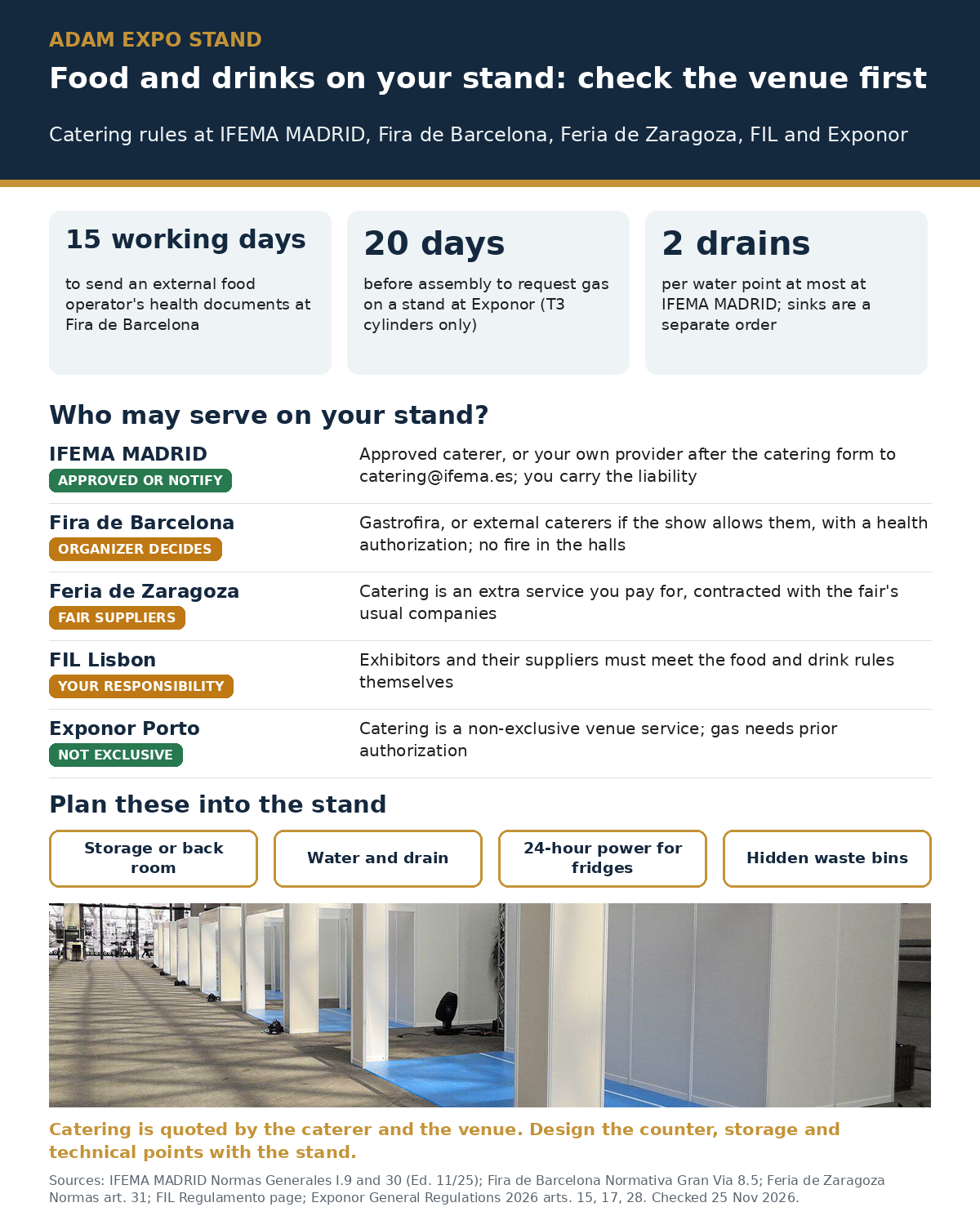
| 15 working days | Minimum notice for sending health and hygiene documents for an external food operator at Fira de Barcelona | Fira de Barcelona, Normativa Gran Via, 8.5.1, PDF of 26 Oct 2026 |
| More than 50 people | Above this number of diners, witness samples of every food served must be kept frozen for five days after the event | Fira de Barcelona, same document, 8.5.3 |
| 240 liters per stand per day | Minimum waste container an external caterer must rent at Fira de Barcelona before getting vehicle passes | Fira de Barcelona, same document, 8.5.5 |
| 72 hours / 3 passes | Catering vehicle passes are requested at least 72 hours ahead; each includes passes for a driver and two service staff | Fira de Barcelona, same document, 8.5.6 |
| 2 drains per water point | IFEMA MADRID allows no more than two drain connections for each water connection you order; water arrives at ½ inch, drains at 1½ inch | IFEMA MADRID, Normas Generales de Participación, rule 30, Ed. 11/25 |
| 4 to 6 bar | Usual water pressure at IFEMA MADRID, which can vary; equipment that needs other pressure must bring its own regulator | IFEMA MADRID, same document, rule 30 |
| 20 days | Minimum notice before assembly for requesting gas use on a stand at Exponor, with only T3 butane or propane cylinders accepted | Exponor General Regulations 2026, art. 15 |
| 14 allergens | Substances in Annex II of the EU food information regulation that must be declared; IFEMA’s catering rules point to it | Regulation (EU) 1169/2011, Annex II |
Quotable summary: In Spain and Portugal exhibitors may usually offer free food and drinks on their stands, but IFEMA MADRID requires an approved caterer or a prior catering notification, Fira de Barcelona asks external food operators for health documents at least 15 working days ahead, and Exponor needs gas requests at least 20 days before assembly.
What does IFEMA MADRID allow on a stand?
IFEMA MADRID allows free catering on a stand through any of its approved caterers or through another provider, but in the second case you must send the form “Comunicación para la realización de restauración/catering en stands” to [email protected] before the fair. Without that notification you may not offer the service, and you carry the liability for any claim.
The rules sit in section 9 of IFEMA’s general participation rules, which apply to the shows it organizes unless a show’s specific rules say otherwise. Here is what they cover, in plain terms:
- General rule (9.1). Restaurant services, including catering delivered to stands, are provided by IFEMA’s restaurant concessionaire and the caterers approved for its venues. The list is in the online services catalog.
- Two exceptions (9.1). Handing out free samples of a packaged product, and selling food to be eaten outside the venue at a food-sector fair. In both cases you follow health rules and take the liability.
- Free hospitality on your stand (9.2). Approved caterer, or another provider plus the notification form. IFEMA forwards a copy of the form to the health department of the Barajas district.
- Food as your main activity (9.2). If serving food is the core of what you show, you need IFEMA’s express approval through the same email address.
- Sponsors that offer catering (9.3). They must be approved on an occasional basis and follow the show’s specific rules.
- Cooking (9.4). Frying, roasting, stewing, griddle and grill work are only allowed under extractor hoods with activated-carbon absolute filters. Boiling in water is exempt. Ovens and cooking equipment may only run on electricity or LPG, and no food may be handled outside the halls, in parking spaces or at loading docks.
- Food information (9.5). Packaged products carry allergen labeling under Regulation 1169/2011, and suppliers of unpackaged food must display a sign saying allergen information is available on request, with the ingredient list at hand.
- Outdoor catering tents (9.6). They need authorization from IFEMA’s exhibition services, even on contracted parking spaces.
Show-specific rules can add detail. The Intergift 2027 exhibitor guide answers the exact question “Can I hire a catering service or serve my own food and beverages at the stand?” with the same yes-plus-notification rule. It also offers a parking area for catering vehicles and refrigerated trucks with electrical connection, and it allows an afterwork party on the stand only with prior authorization, from the 7 pm close until 9 pm. Those are Intergift rules; check your own show’s guide.
Two technical rules from the same IFEMA document matter as soon as you add a sink or a coffee machine. Water and drain points are ordered from IFEMA, and any sink or connection on the stand is a separate order (rule 30). Gas appliances that release combustion products must be ducted outside with prior authorization from IFEMA’s Technical Directorate, under Spain’s RD 919/2006 (rule 32). For a deeper look at stand rules at this venue, see our guide on IFEMA MADRID stand rules for contractors.
What do Fira de Barcelona, Feria de Zaragoza, FIL and Exponor say?
Fira de Barcelona offers catering through Gastrofira and lets the show organizer decide on external caterers, who then need a health and hygiene authorization. Feria de Zaragoza treats catering as a service you contract at your own cost with the fair’s usual suppliers. FIL makes exhibitors and suppliers responsible for compliance, and Exponor lists catering as a non-exclusive service.
Fira de Barcelona (Gran Via)
Section 8.5 of the Gran Via technical rules is the most detailed catering text we found at any Iberian venue. The organizer’s rules on external caterers prevail. If they allow outside catering, every operator serving or selling foods considered risky needs an authorization, and the paperwork goes to the venue’s auditing company at least 15 working days before the service: a valid authorization, or a signed commitment to EU hygiene Regulation 852/2004 with sanitary registration, a hazard-analysis (HACCP) manual, food-handler training records and the allergen list. The cost of the authorization is always on the client, the certificate lasts a year, and auditors check stands during the event.
The same section reads like a kitchen brief for your stand designer. A potable water sink with tap and drain is mandatory if food is handled on the stand. Work surfaces must be smooth, waterproof and easy to clean, cold storage is needed when the product requires it, and bins must have lids that open without hands. Inside the halls nothing may be cooked or heated with fire, so equipment must be electric, and fridges need a 24-hour electrical panel. Water, drain and power are ordered through Servifira. At food-sector shows, tasting on your own stand is your responsibility and needs no hygiene authorization.
Feria de Zaragoza
The participation rules list catering among the “other services” (with cleaning, hostesses, security and stand building) that the exhibitor pays for and contracts with the companies that usually serve the fair (art. 31). We did not find a dedicated catering form in that document, so ask the organizer which caterers work in the halls and whether a notification is needed for your show.
FIL, Lisbon
FIL’s regulations page carries a short notice on offering and selling food: exhibitors who want to serve food or drinks on their stands, and their service providers, are responsible for meeting the applicable rules. It links to the Portuguese government page on non-sedentary food and beverage service, which covers paid service from mobile units or from fixed premises used for fewer than 20 events a year and no more than 30 days in total. If your caterer charges for service on site, make sure it holds the right registration in Portugal.
Exponor, Porto
Exponor’s General Regulations 2026 list catering among the services the venue offers that are not exclusive (art. 17 in the body numbering), so an outside caterer is not ruled out by the regulations themselves. Gas is tightly controlled: requests go to your client manager at least 20 days before assembly, need prior authorization, and only T3 butane or propane cylinders are accepted (art. 15). Without prior authorization there are no open-fire demonstrations and no liquid gas bottles stored or used inside the building (art. 28). Our Exponor stand guide covers the rest of the venue.
Which kind of hospitality fits your stand?
Most exhibitors need one of five formats: water and wrapped snacks, a coffee point, a client lunch in the meeting area, an evening reception, or a cooking demonstration. Each step up adds paperwork and stand requirements, so choose the smallest format that serves your sales goal, then build the stand around it.
| Format | Venue route to check | What the stand needs |
|---|---|---|
| Bottled water and wrapped snacks | Usually covered by the general rules; confirm with your show | A closed cupboard and a waste bin out of sight |
| Coffee point or barista | Approved caterer, or own provider plus notification (IFEMA) | Power for the machine, water supply or tanks, a drain if plumbed, counter, storage |
| Client lunch in the meeting area | Caterer route plus health documents where required (Fira de Barcelona) | Back room for plating, cold storage, sink if food is handled, enough meeting seats |
| Evening reception or afterwork | Prior authorization and set hours (Intergift: 7 pm to 9 pm) | Bar counter, glass storage, extra bins, circulation space |
| Cooking show | Express approval where food is the main activity (IFEMA); hood with carbon filters for smoke | Extraction, electric or approved LPG equipment, sink, fire-safe finishes |
From our builds, the mistake we see most is a coffee machine planned after the stand drawings are approved. Then there is no socket in the right place, no drain, no hidden cupboard for cups and milk, and the counter becomes a cluttered kitchen in full view of visitors. A coffee point that was drawn from the start looks like part of the brand.
The second mistake is size. A reception for fifty people on a 24 m² stand blocks the very conversations you came for. If hospitality is a sales tool, plan seats and standing space with our meeting capacity worksheet, and keep a quiet corner for real meetings, as explained in our guide to stand acoustics and meeting privacy.
If you are a food or drink company sampling your own product, that is a different case with its own rules on portions, labeling and counters. Our food sampling and allergen brief covers it.
How does catering change the stand design and budget?
Catering adds a back room or closed storage, a service counter, power for fridges and machines, often water and drainage, extraction if anything is cooked, and extra waste handling. These items take floor space and technical orders, so a hospitality stand usually needs more square meters and earlier drawings than a display-only stand of the same budget.
Here is how the rules translate into design decisions we make on catering stands:
- Storage room. Cups, milk, bottles, boxes and coats need a lockable room or deep cupboards. On a small stand this is often the biggest space decision. Our stand storage guide shows the common layouts.
- Water and drainage. A plumbed coffee machine or a sink needs water and drain points in the right place on the floor plan, ordered from the venue. Raised floors make it easier to hide pipes. See our water and drainage brief.
- Power. Coffee machines, kettles, ovens and fridges add load, and fridges may need a 24-hour supply so they keep working at night. Add them to the stand power plan before ordering the connection.
- Surfaces and finishes. Food areas need smooth, washable surfaces. Countertops in laminate or solid surface work better than raw wood or fabric near a sink.
- Extraction. Anything that fries, grills or roasts needs a hood with carbon filters at IFEMA, which takes height, power and space. Many exhibitors switch the menu to cold or boiled items instead.
- Waste and cleaning. Hospitality multiplies cups, napkins and bottles. Plan hidden bins and daily removal; our cleaning scope guide explains what to order.
- Materials. Back rooms and counters still follow fire-reaction rules for stand materials. Keep the certificates in the material register.
On budget, keep two lines apart. The catering itself (food, drinks, staff, the caterer’s fees and any venue or audit charges) is quoted by the caterer and the venue; we do not estimate those amounts. The stand build is where we can help: as a planning range, our stand cost calculator uses modular approx. €280–380/m², custom wood approx. €450–650/m² and double-deck approx. €750–1,100/m². A storage room or a bar counter adds square meters and joinery to that build, and water, drain and power connections are ordered separately from the venue at its own rates.
A practical tip from our projects: if the stand is reused across several fairs, design the hospitality module to work with or without plumbing. A coffee counter with a built-in tank and a cupboard for a hidden drain can travel from a venue where you order water to one where you do not.
When should you arrange catering for a fair?
Arrange catering when you brief the stand, not after. The venue deadlines are short on paper, but they sit on top of the stand drawings: Fira de Barcelona wants food operator documents at least 15 working days before service, Exponor wants gas requests 20 days before assembly, and water, drain and power must be on the floor plan you submit.
A workable order of steps, based on the rules above and on how our projects run:
- At the brief. Decide the hospitality format and how many guests per day. Tell your stand designer, because it changes the layout.
- Before the drawings are final. Check your show’s specific rules for catering, afterwork hours and any exclusivity. Ask the organizer if anything is unclear.
- With the drawings. Mark water, drain and power points, the back room and any hood. Order the connections from the venue’s services catalog.
- Choose the caterer. Approved caterer, or your own provider plus the venue’s notification or health documents. Confirm who sends what and by when.
- Two to three weeks out. Send forms and documents within each venue’s deadline, book catering vehicle passes where needed (72 hours minimum at Fira de Barcelona), and confirm the menu with allergen information.
- Build-up. Check that the sink drains, the fridges run on the right circuit and the storage locks before the caterer arrives.
If your fair is only weeks away, keep the format simple: wrapped snacks, bottled water and a coffee point that needs no plumbing are the easiest to add late.
Who is liable for allergens, alcohol and food safety?
You are, together with your caterer. IFEMA MADRID states that the exhibitor assumes liability to third parties for claims arising from catering on its stand, and Fira de Barcelona makes the client responsible for the safety of food at tastings. Allergen information, hygiene and responsible serving of alcohol are therefore part of your plan, not only the caterer’s.
Three practical points:
- Allergens. The EU lists 14 allergens that must be declared under Regulation 1169/2011. For unpackaged food in Spain, IFEMA refers to RD 126/2015: a visible sign that allergen information is available on request, and an ingredient list on hand. Hygiene for food handled on site follows RD 1021/2022. Ask your caterer for its allergen sheet and keep a copy at the counter.
- Alcohol. Beer, wine or cocktails are common at receptions, but national and regional rules on serving alcohol, and especially on minors, apply. IFEMA notes that minors may visit its professional fairs when accompanied by an adult, so your team should be ready to refuse a drink. Let a professional caterer handle bar service when you can.
- Insurance. Check that your liability policy, or your caterer’s, covers food served on the stand. Our exhibitor liability insurance guide explains what to ask.
Our verdict after many build-ups at Iberian venues: the exhibitors who get catering right treat it as a service with a supplier, a contract and a checklist. The ones who get it wrong treat it as shopping.
Checklist: catering on your next stand
Use this list when you brief the stand and again two weeks before the fair. It covers the venue route, the technical orders and the people on the stand, which are the three places where catering usually goes wrong. Tick each line only when you have the confirmation in writing.
- Hospitality format and daily guest numbers decided and shared with the stand designer.
- Show-specific rules read for catering, exclusivity, afterwork hours and sampling.
- Caterer chosen: approved by the venue, or own provider with the required notification or health documents.
- Forms and documents sent within the venue deadline (IFEMA notification, Fira de Barcelona health file, Exponor gas request).
- Water, drain and power points on the floor plan and ordered; 24-hour circuit for fridges where needed.
- Storage room or cupboards sized for supplies and waste.
- No open flame; any cooking that makes smoke under an approved hood, or removed from the menu.
- Allergen sheet and sign at the counter; alcohol service plan for receptions.
- Catering vehicle passes and delivery times booked.
- Liability insurance confirmed for food served on the stand.
Related video: designing a clutter-free stand
Hospitality brings boxes, cups and bottles onto the stand. This short video from our channel shows how smart storage keeps a booth tidy and open, which matters even more once catering is involved.
Questions exhibitors ask
Can I bring a coffee machine to my stand at IFEMA MADRID?
A machine for your own team is a question of power and space. If you serve coffee to visitors, it counts as catering on the stand: use an approved caterer, or notify IFEMA with its catering form if another provider runs it. A plumbed machine also needs water and drain points ordered from the venue.
Do I need permission to hand out wrapped sweets or bottled water?
Usually not as catering, but show rules vary. IFEMA treats free samples of packaged products as outside its catering rules while keeping health rules and liability on the exhibitor. When in doubt, ask the organizer in writing.
Can we cook on the stand?
Only within the venue limits. At IFEMA frying, grilling or roasting needs an extractor hood with activated-carbon filters and equipment runs on electricity or LPG. Fira de Barcelona does not allow cooking or heating with fire inside its halls. Exponor needs prior authorization for gas.
Can we serve alcohol at an afterwork on the stand?
Often yes, with the organizer’s authorization and within set hours. At Intergift 2027 an afterwork may run from the 7 pm close until 9 pm with prior authorization. Follow alcohol rules for minors and use a professional bar service where possible.
Is catering included in the stand price?
No. The stand build and the catering are separate services. We design the counter, storage and technical points the caterer needs; the food, drinks and service come from the caterer, and connections come from the venue.
Related reading
- Fira de Barcelona Gran Via technical guide for exhibitors
- Intergift 2027: planning a 50 m² stand
- Food sampling at trade shows: allergen and service brief
Planning a stand where visitors stay for a coffee?
Tell us the fair, the stand size and the hospitality you have in mind, and we will design, build and install a stand with the counter, storage and technical points your caterer needs, drawn in from the first sketch. Request a stand proposal or call +34 697 715 015. Adam Expo Stand, founded in 2018 and based in Madrid, Spain, serving all of Europe with a focus on Spain and Portugal, counts 639+ projects in 12+ countries and replies within 24 hours.