By Adam Dragos, Exhibitor Success Specialist · Sources reviewed 11 October 2026
Quick answer: For exhibition stand acoustics, define whether you need easier conversation, less disturbance or confidential meetings. These require different checks. Place meetings away from your own noisy activities, specify the complete room arrangement and agree how performance will be assessed under realistic show conditions.
Separate clarity from confidentiality
A visitor may need to hear a product explanation without raising their voice. A purchasing team discussing sensitive terms may need a different environment. Record the actual conversation and who should or should not be able to hear it, rather than writing only “quiet room” in the brief.
Ecophon’s office acoustics guide treats sound absorption and sound insulation as distinct design considerations. Absorptive finishes can address reflections; that does not establish speech privacy across a complete room. Ask for evidence appropriate to the proposed enclosure and its intended use.
Map the sources before choosing finishes
Mark loudspeakers, demonstrations, ventilation equipment and meeting positions on the stand plan. Identify which sources run continuously and which run only during sessions. Note the organiser’s programme and nearby activity when information is available, without assuming that neighbouring stands will remain quiet.
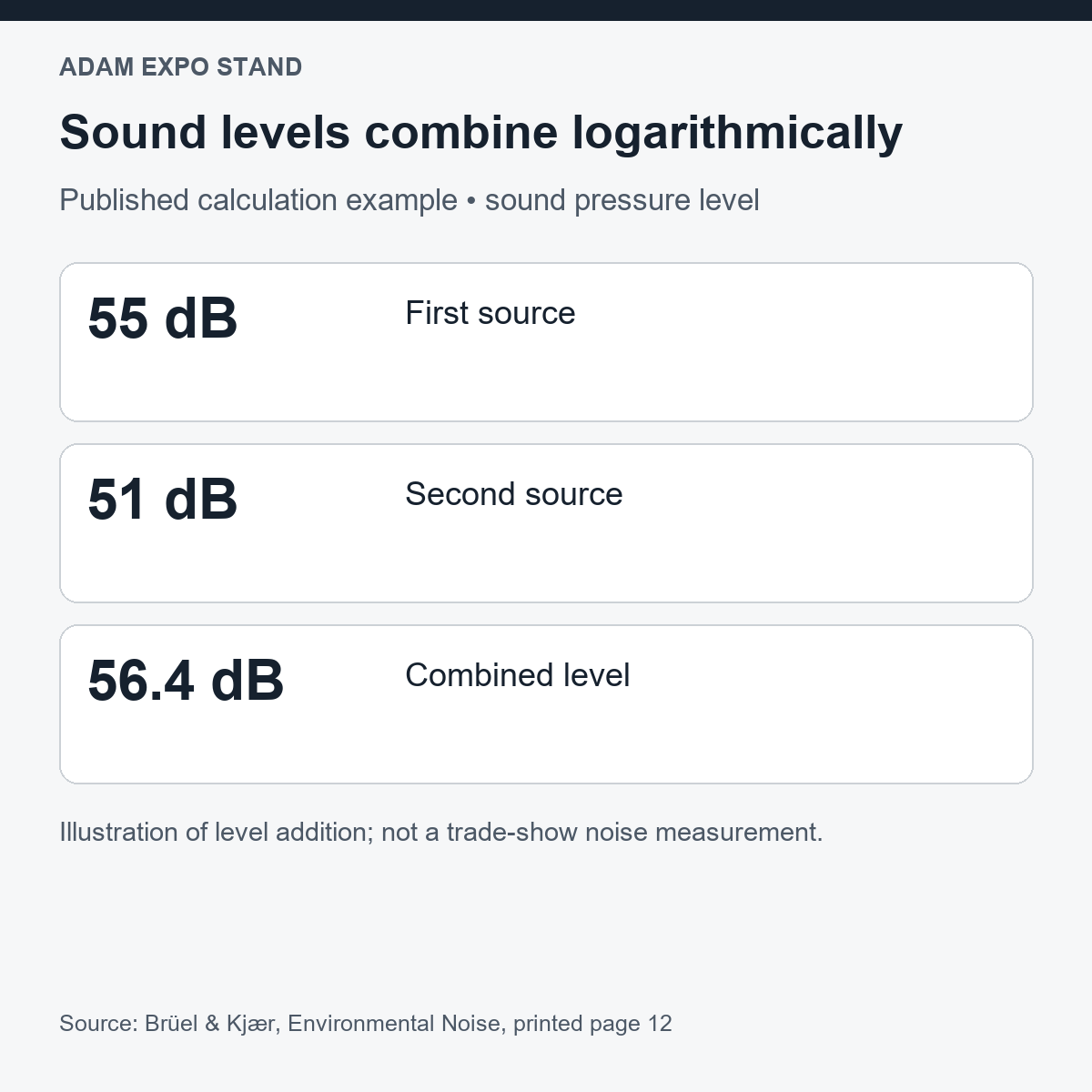
Use the Brüel & Kjær explanation of sound-level addition to understand why decibel values cannot be treated as ordinary quantities. The published example above is a calculation, not a prediction for your room. Have the acoustic or AV provider assess the actual combination of sources and positions.
| Need | Specify | Acceptance approach |
|---|---|---|
| Conversation | Seating position, speakers and typical discussion | Try the conversation with normal operating activity |
| Confidentiality | Who may hear the discussion and adjacent areas | Agree a suitable specialist assessment |
| Room construction | Walls, ceiling, doors, joints and ventilation | Review the complete proposed arrangement |
| AV operation | Source positions, session schedule and controls | Test actual content and operating settings |
| Handover | Conditions, responsible provider and limitations | Record findings and agreed corrective actions |
Review every room interface
Ask how doors, joints, service openings and ventilation form part of the proposed solution. Confirm the room’s dimensions, occupancy, lighting and access needs alongside the acoustic brief. A material test or panel rating alone does not describe every path through the finished enclosure.
If the meeting requires sensitive discussion, consider whether a separate venue meeting room better suits the task. Compare booking availability, visitor access and staff coordination. Choose the setting against the conversation requirement, rather than relying on an unverified “soundproof” label.
Make the sound check representative
Agree the test before handover: where participants sit, which demonstration runs, what AV content plays and who records the result. Record the doors and equipment settings used. A test in an empty hall should not be treated as proof of performance during a busy show.
Keep a practical operating alternative. Schedule noisy demonstrations away from sensitive conversations where possible, brief staff on approved volume controls and identify where a meeting can move. Record any unresolved limitation for the team instead of promising an unmeasured decibel reduction.
Video: stand design context
A short channel overview of B2B exhibition stand design, provided as layout context rather than an acoustic performance demonstration.
Frequently asked questions
Do acoustic panels make a stand room confidential?
Panels alone do not establish confidentiality. Review the whole enclosure and agree evidence suited to the conversation requirement.
Can a quiet build-up test prove show-day performance?
No. The operating conditions differ. Define representative checks and record the conditions under which the room was assessed.
Plan meeting bookings and capacity separately. Explore Adam Expo Stand exhibition services.
Prepare the next step
Share the meeting use, sensitive-discussion requirements, AV plan and floor plan with Adam Expo Stand to include acoustic coordination in the agreed stand brief. Discuss your stand brief.
Adam Expo Stand: exhibition stand design and build for European trade fairs. Find more exhibitor planning guides.
Follow our exhibition planning guides
Choose Adam Expo Stand as a preferred source to help you find our exhibition guides and updates on Google.
Add as a preferred source on GoogleGoogle may ask you to sign in and confirm your choice.