Last updated:
Quick answer: Before you play music or a video with sound on your stand, check two things in writing: the show’s sound limit and who holds the music license. IFEMA MADRID’s general rules cap sound at 60 dB at the stand edge (IFEMA MADRID General Rules), and in most countries public playback needs a collecting-society license such as SGAE, GEMA or PRS/PPL.
Your exhibitor manual says nothing about music on the first page, so the playlist gets left to the last week. Then the stand opens, the demo video loops with its soundtrack, and a hall supervisor arrives with a sound meter. Or an invoice from a collecting society arrives after the show.
Both problems are avoidable, and both are cheap to solve early. A license fee is small next to the cost of a stand that loses power mid-show, and a sound plan shapes speaker positions, screen choice and even meeting-room walls.
This guide shows you how to run an exhibition stand music license and sound-limit check before move-in, using published rules from IFEMA MADRID, the ISE 2024 event manual, GEMA and PRS/PPL. If you already have the acoustics brief for meeting rooms, read our stand acoustics and meeting privacy guide alongside this one. It covers speech privacy, not licensing.
Do you need a license to play music on a stand?
Usually yes. Playing recorded music, radio or a video soundtrack to visitors on a stand counts as public playback in most European countries, so it needs a license from the national collecting society, unless the organizer already holds one that covers stands. Check the exhibitor manual first, then the society.
The rules are written down. GEMA, the German society, has a dedicated page for trade fair stands and sells day tickets for audio, audio plus video, and a package that includes a stand party (GEMA trade fair licensing). The ISE 2024 manual for Fira Barcelona told exhibitors they were solely responsible for any license and named SGAE as the body in Spain (ISE 2024 Event Manual).
In the UK, PRS for Music’s Tariff EX covers background music on exhibition stands and in exhibition areas, but not live music or DJ sets (PRS for Music Tariff EX). The license holder can be the organizer or the exhibitor, so ask the organizer in writing which applies at your show.
Two habits cause most trouble. The first is assuming a personal streaming subscription covers a commercial stand; it does not. The second is forgetting that a product video with a soundtrack is music too.
How loud can a stand be?
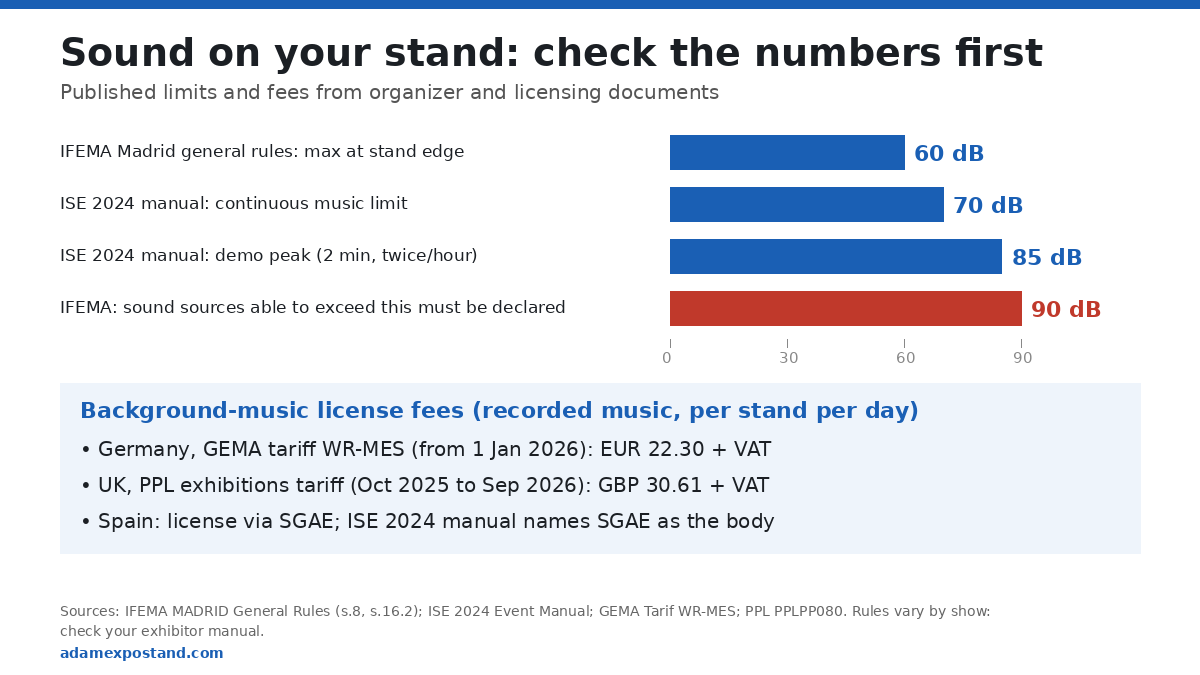
The limit is set by each venue or show, not by a single European rule. IFEMA MADRID’s general rules allow 60 decibels measured at the stand edge, while the ISE 2024 manual set 70 dB for music with short 85 dB demo peaks. Always use the figure in your own show’s manual.
The IFEMA rule has teeth. If an exhibitor refuses to lower the volume or repeats the breach, IFEMA staff can cut the stand’s power and close it, with no refund (IFEMA MADRID General Rules, section 8). The same document requires every sound source able to exceed 90 dB to be declared and linked to an emergency inhibition system, so evacuation messages can be heard (section 16.2).
The ISE 2024 manual allowed a peak of 85 dB for no more than two minutes, twice per hour, for demonstrations, and banned live music during show hours, with parties after 18:00 as the exception (ISE 2024 Event Manual). Those are one event’s rules for one year. Treat them as an example of how detailed a manual can be.
From our builds: the stands that get a visit from the sound meter are rarely the ones with a DJ. They are the ones where a large screen loops a launch video with the volume set during an empty build-up hall, then nobody turns it down when the aisles fill.
What does a music license cost per stand?
Published per-stand fees are modest. GEMA’s 2026 trade fair tariff lists EUR 22.30 per stand per day for recorded music, plus VAT, and the PPL exhibitions tariff that ran to September 2026 listed GBP 30.61 per stand per day. Video and live music are priced separately.
The GEMA tariff WR-MES applies to stands up to 1,000 m² where the exhibitor plays music in its own name. It charges EUR 37.50 per monitor per day for video playback, and the reduced rates only apply if consent is obtained before use (GEMA Tarif WR-MES, valid from 1 January 2026, GEMA tariff overview).
In the UK, the PPL exhibitions tariff valid from October 2025 to September 2026 listed GBP 30.61 per day per stand plus VAT (PPL tariff PPLPP080). Check for the current version before you budget. For Spain we have not found a published per-stand trade fair rate, so ask SGAE for a quote. Keep the fee in your stand budget next to power and AV; our IFEMA Madrid stand costs and deadlines guide shows where those lines sit.
What should the sound brief to your stand builder include?
A useful sound brief lists every source that can make noise, where it points, its maximum level, who controls the volume during open hours, and whether it needs a license or a venue declaration. One page is enough, and it stops speakers being placed where the limit is easiest to break.
- Each source: background music, product video, demo machine, presenter microphone, VR or game audio.
- Speaker position and direction, ideally aimed into the stand, away from aisles and neighbors.
- Whether a video can run muted with captions instead of sound.
- Who owns the volume and the playlist during each show day.
- Any source able to exceed 90 dB, which at IFEMA must be declared.
- The license reference number, kept with the stand paperwork.
The screen side of this is covered in our screen content brief for exhibition stands, which explains how to design video loops that work without audio. Live demos with machines or presenters belong in our live demo checklist.
When should you sort the license and declarations?
Settle the music decision when you approve the stand design, and finish the license and any venue sound declaration before move-in. GEMA’s reduced rates only apply when consent is obtained before the music is used, and IFEMA needs high-level sources declared so its inhibition system can be installed before opening.
A workable order looks like this. At design approval, decide whether you need sound at all. When the AV list is final, write the sound brief. Then ask the organizer about licensing, apply to the society, and file any venue declaration listed in your manual.
Hypothetical example: a machinery exhibitor plans a launch video on a large screen and a background playlist. Muting the video and adding captions removes one license line and the main noise risk, leaving one audio license for the playlist and a speaker aimed into the lounge area.
Insurance is a separate question. If you are unsure how liability works for equipment on the stand, see our exhibition stand insurance guide.
Video: managing your stand at European trade shows
Frequently asked questions
Do I need a music license for my exhibition stand?
In most European venues, yes, if you play recorded music or video with a soundtrack to visitors. Germany’s GEMA explicitly licenses trade fair stands, the ISE 2024 manual tells exhibitors in Spain to get an SGAE license, and the UK has PRS Tariff EX. Ask the organizer whether a show-wide license already covers your stand before you pay twice.
What is the maximum volume on a stand at IFEMA Madrid?
IFEMA MADRID’s general rules for the events it organizes set 60 decibels measured at the edge of the stand. Staff can ask you to turn it down, and repeated breaches can lead to the stand’s power being cut. Individual show manuals can add rules, so read yours.
Does a Spotify or YouTube Premium subscription cover stand music?
No. Personal streaming subscriptions are licensed for private listening, and their terms do not grant public performance rights for a commercial event. Playing that account on a stand is still a public performance, so you need the collecting society license that applies in that country, or music that is licensed for business use.
Does muting the video loop avoid the license?
Muting removes the audio, so the public performance of the music stops, and it also removes the noise problem. GEMA’s tariff treats audio-visual playback separately from audio, so a muted loop with captions is often the simplest option. Confirm with the collecting society if any sound remains.
Who should handle the license: the exhibitor or the stand builder?
The exhibitor normally holds the license because the exhibitor is the one playing the music in public. Your stand builder installs the speakers and screens, and can help by documenting each sound source, but the license, the declaration forms and the playlist choice stay with you.
More from us: Medium · Substack · LinkedIn
Discuss your stand brief
Planning screens, demos or music on your next stand? Share your show, stand size and AV list, and we will flag the sound and licensing questions to settle before move-in, and help you place the sources. Request a stand proposal.
Follow our exhibition planning guides
Choose Adam Expo Stand as a preferred source to help you find our exhibition guides and updates on Google.
Add as a preferred source on GoogleGoogle may ask you to sign in and confirm your choice.