If an email, form or call about your trade fair in Spain or Portugal asks you to sign, pay or “update your listing”, treat it as a likely scam until you confirm it through the contact details on the organizer’s official website: IFEMA MADRID, Fira de Barcelona, Feria de Zaragoza and FIL Lisbon all warn that they have no link with paid “international fair directories” and never sell attendee lists. The safe routine is simple: do not reply, sign or pay, check the sender against the official exhibitor area, and if you already signed, contest it in writing quickly and get legal advice.
Last updated: November 2026
A small team that had just applied to exhibit at a big convention asked on Reddit’s r/NYCC: “Is exhibitors reaching out to us, or is this a scam with a spoofed email?” An email had landed in spam, a phone call followed the same morning, and they had heard about more and more scams aimed at sellers. The replies were short and sensible: assume a scam, and ask the organizer through the address on its own website.
The same doubt hits almost every company that books space at a European fair. The moment your name appears in an exhibitor list, the letters, emails and calls start: a form to “confirm your catalog entry”, a discounted list of visitors, cheap rooms near the venue, a new bank account for the stand invoice. Some are honest sales pitches. Many are built to look official. This guide explains how the most common exhibitor scams work, what the main organizers in Spain and Portugal say about them, how to check a message in a few minutes, and what to do if someone in your company has already signed or paid.
It is planning information from a stand designer, not legal advice. If a contract or a debt collector is already involved, talk to a lawyer in your country.
Is that email about your trade fair a scam?
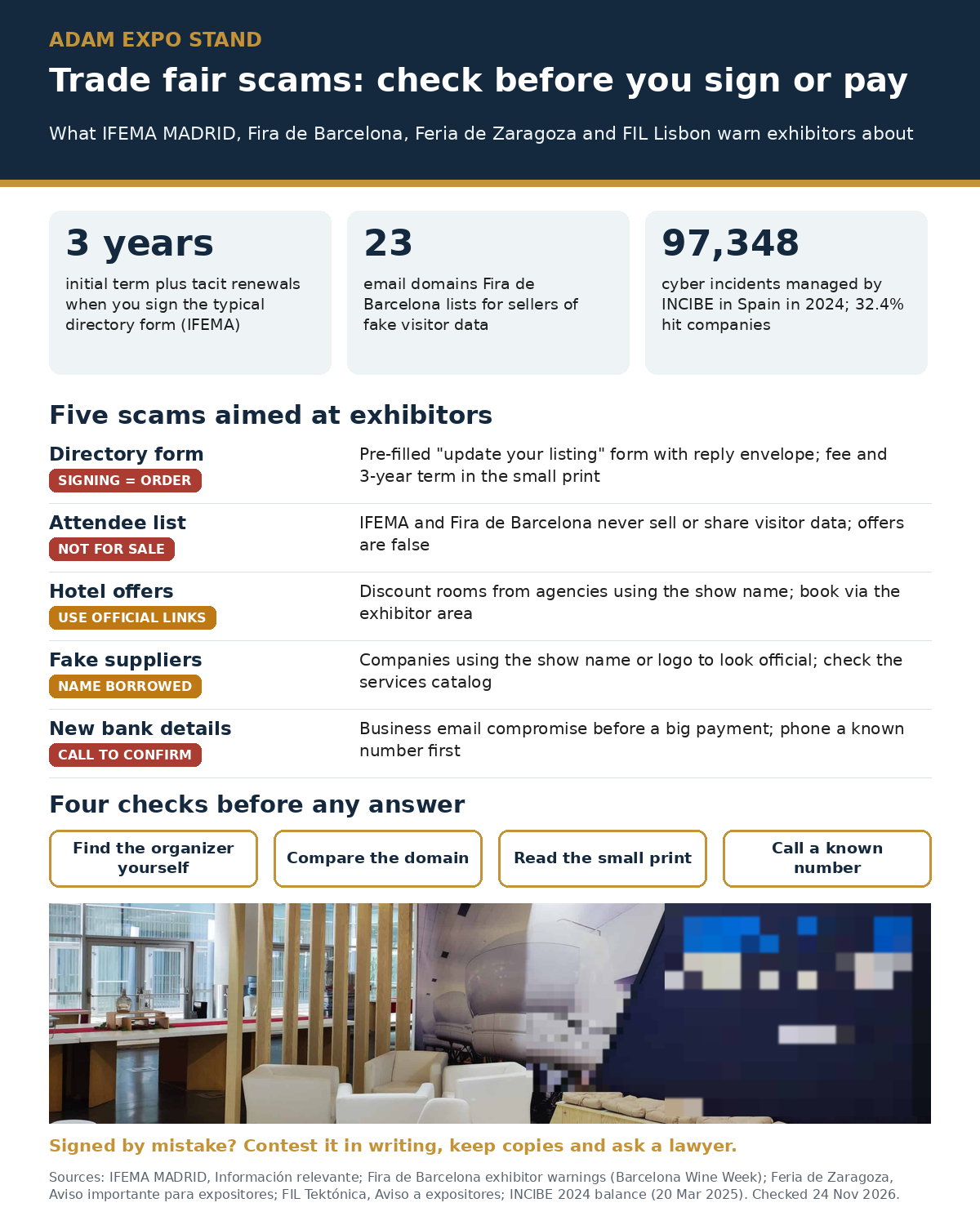
Very often, yes, and the safest assumption is that it is until you prove otherwise. Organizers in Spain and Portugal publish standing warnings because the same tricks come back before every edition. The four things they warn about most are paid directory entries dressed up as catalog updates, “attendee lists” for sale, accommodation offers that use the show’s name, and companies that pretend to be official suppliers.
Three questions sort most messages in under a minute:
- Does it ask you to sign, pay or send data? A genuine organizer message usually points you to the exhibitor area you already use. A form with a reply envelope or a “confirm by return” button is the classic hook.
- Who is the contracting party in the small print? If the company named at the bottom is not the organizer you booked with, you are dealing with someone else, whatever logo sits at the top.
- Did it reach you through a channel you already know? Calls and emails from people you have never dealt with, especially from free email accounts or unfamiliar domains, deserve a check before any answer.
If any answer feels wrong, stop. Do not reply, because even a “no thanks” confirms that your address works. Check first, then decide.
Key statistics: fraud pressure on exhibitors in Spain and Portugal
No official body counts trade fair scams on their own, so the figures below combine what the organizers publish about these schemes with the national cybersecurity numbers that show how much fraud businesses face in general. Every figure links to its source (consulted 24 November 2026).
| Figure | What it says | Source and date |
|---|---|---|
| 3 years + tacit renewals | Initial term you accept by signing and returning the pre-filled “International Fairs Directory” form, according to IFEMA MADRID | IFEMA MADRID, Información relevante, consulted 24 Nov 2026 |
| 4 companies in 4 countries | Sellers of that directory identified by IFEMA: Slovakia, Uruguay, Costa Rica and Mexico, “not ruling out more” | IFEMA MADRID, same page |
| 23 sender domains | Email domains listed by Fira de Barcelona as used by sellers of fake visitor data | Fira de Barcelona exhibitor warnings (Barcelona Wine Week), consulted 24 Nov 2026 |
| 97,348 incidents | Cybersecurity incidents managed by INCIBE in Spain in 2024, up 16.6% on 2023 | INCIBE 2024 balance, 20 Mar 2025 |
| 31,540 incidents (32.4%) | Share of those incidents that hit companies, including SMEs and the self-employed; impersonation through cloned websites and profiles was the main business theme | INCIBE, same release |
| 790 incidents (28.67%) | Phishing was again the incident type most registered by CERT.PT in Portugal in 2024, up about 13% | CNCS, Riscos & Conflitos report, Sept 2025, p. 30 |
| $2.77 billion | Adjusted losses from 21,442 business email compromise complaints reported to the FBI in 2024, the scheme behind “new bank details” frauds | FBI IC3 2024 Internet Crime Report |
Quotable summary: IFEMA MADRID, Fira de Barcelona, Feria de Zaragoza and Lisbon’s FIL all publish warnings against paid directories or fake attendee lists, and IFEMA MADRID states that signing the typical directory form starts a three-year contract with tacit renewals.
What do the most common exhibitor scams look like?
They change names every season, but the mechanics stay the same. Knowing the five patterns below is more useful than memorizing company names.
1. The “update your free listing” directory form
A letter or email arrives with your company data already filled in, the name of the fair you are booked for, sometimes a customer number, and a request to correct and return the form. The fee and the duration sit in the small print. IFEMA describes exactly this: a partially completed form plus a reply envelope, where filling it in, signing and sending it means hiring a paid advertising listing. The free option exists only online, which is why so many exhibitors sign the paper version thinking they are helping the organizer keep its catalog accurate.
2. The “attendee list” offer
Someone offers the visitor list of your fair, often with a countdown discount. IFEMA says these emails are false because its participant lists are confidential and are never sold or passed to third parties. Fira de Barcelona says the same about its databases and adds that any communication offering data from its shows is a scam. At best you buy an old, scraped file. At worst you pay for nothing and then send mail that breaks data protection rules.
3. Rooms “for exhibitors” at special rates
Housing companies contact exhibitors with discounted hotels near the venue. Fira de Barcelona recommends booking through the accommodation offers in its exhibitors’ area and its official travel agency, and warns that reservations through other agencies are at your own risk. The risk is real: a non-existent booking discovered on arrival, or a deposit that never comes back.
4. Suppliers who borrow the organizer’s name
IFEMA warns about companies that call or email exhibitors using the show’s name and logo to look like official partners. Sometimes they sell a real service at an inflated price, sometimes nothing at all. The organizer’s own exhibitor area lists the services it really offers, so anything outside that list deserves a second look.
5. “Our bank details have changed”
This one targets the accounts team. A message that looks like it comes from a supplier you already use, the venue, a freight forwarder or a stand builder announces a new account just before a payment is due. It is business email compromise, and in its 2024 balance INCIBE notes that these campaigns against companies gained weight in the second half of the year. The amount is usually large because stand, space and logistics invoices are large.
What do IFEMA, Fira de Barcelona, Feria de Zaragoza and FIL say?
All four publish warnings, and reading them side by side shows how consistent the advice is.
- IFEMA MADRID states it has no connection with “International Fairs Directory” (sold earlier under names such as Expo Guide and Fair Guide), explains how the form works, notes that UFI, the global association of the exhibition industry, has asked the publisher several times to change its practice, and invites exhibitors to email the management of their show to check any offer that uses IFEMA’s name. It also states that “attendee list” emails are false.
- Fira de Barcelona says it has no relationship with Construct Data, FairGuide or Mulpor Company, that its exhibitor catalog and visitor guides are run by its own team and free of charge, that it does not share its databases with any third party, and that publishers of this kind use aggressive debt collection to pressure people who refuse to pay.
- Feria de Zaragoza names Mulpor (International Fairs Directory), Construct Data (FairGuide, Expo Guide) and wwwdb (Event-Fair), warns that answering a request to update a listing can tie you to a three-year contract that renews automatically, and suggests European companies contact their local and European consumer rights offices if they have questions.
- FIL Lisbon alerts Tektónica exhibitors to outside companies that offer inclusion in fair directories using its events’ names, and asks them to confirm where any form comes from before signing. Its General Regulations (11.1) make FIL responsible for the official catalog or visitor guide of each show.
For Exponor in Porto we did not find a published warning page, so use the contacts on exponor.pt to confirm anything that mentions an Exponor show. Show-specific pages repeat these warnings, for example our Tektónica 2027 exhibitor guide and our Barcelona Wine Week 2027 guide.
How can you check a message before you answer it?
A short, fixed routine beats instinct, especially when the message lands on a busy week before the show. Run these steps in order and stop at the first red flag.
- Find the organizer yourself. Open the official website from your own bookmarks or a search, never from a link in the message, and log in to the exhibitor area you used to book.
- Compare the domain, not the display name. The name can say anything. The part after the @ must match the organizer’s real domain exactly, with no extra words or swapped letters.
- Read the bottom of the form. Look for the contracting company, the price, the term, the renewal clause and the court named for disputes. If any of these appear, it is an order form, not a data check.
- Look for the service in the official catalog of services. Organizers such as IFEMA publish the services they sell to exhibitors in the exhibitor area. If the offer is not there, ask the organizer before assuming it is behind it.
- Call a number you already have. For any change of bank details, phone the supplier on the number in your own records and confirm with someone you know. Never use the number in the message.
- Forward, then delete. Send the suspicious message to the show’s contact so it can warn others, then remove it. IFEMA explicitly asks exhibitors to do this.
Our first-time exhibitor guide lists the official documents you will receive after booking, which helps you recognize what is real.
What if someone already signed the form or paid?
Act quickly and in writing, and do not panic over threatening letters. What follows is general information; your lawyer will tell you what applies to your contract and country.
If the form was signed but nothing was paid
- Write to the contracting company (registered post or email with proof of delivery) saying the form was completed only to correct data for the free listing, not to order a paid service. That is the wording IFEMA itself suggests for exhibitors who signed by mistake.
- Keep copies of the form, the envelope, every email and notes of any calls.
- Tell your accounts team so a later invoice is not paid on autopilot.
What the civil codes say
Under Spain’s Civil Code, consent given by error or through deceit (“dolo”) is void (art. 1265). The error must concern the substance of what was contracted (art. 1266), deceit means being led into a contract by insidious words or schemes (art. 1269), and the annulment action expires four years after the contract is consummated in cases of error or deceit (art. 1301). In Portugal, a declaration determined by deceit can be annulled (Civil Code arts. 253 and 254), and annulment must be raised within the year after the defect ceases (art. 287). Whether a specific directory form meets these tests depends on its wording, which is why a lawyer’s view matters.
If money already left
- Call your bank immediately and ask whether the transfer can be recalled or the card payment disputed.
- Report it to the police. In Spain you can also call INCIBE’s free 017 helpline for advice; in Portugal, the national cybersecurity center (CNCS) handles incident reports.
- If it was a bank-detail change, warn the real supplier at once: they may have a compromised mailbox.
Germany’s trade fair association AUMA, which has handled several hundred such cases, notes that these publishers send reminders and debt collection letters but that it is not aware of them actually suing exhibitors. If a court document does arrive, get legal help rather than ignoring it.
How do you protect the team and the stand budget before the next fair?
Most losses happen because the person who receives the letter is not the person who booked the fair. A few house rules close that gap.
- One owner for the show. Name one person who signs anything related to the fair. Everyone else forwards.
- Payments only against your own order. No invoice is paid unless it matches a purchase order or a contract already in your system.
- Bank changes confirmed by phone. Two people, one call to a known number, every time.
- A short briefing before each fair. Show the team a real example of a directory form and an attendee-list email. Recognition beats rules.
- Data handled the legal way. Build your contact list from your own stand scans and opt-ins. Our guide to lead capture technology and GDPR explains how, and the 14-day lead follow-up plan turns those contacts into meetings.
The same caution applies to stand suppliers. A genuine stand builder sends a written proposal with drawings, a scope that lists what is included, payment stages tied to work milestones, and an invoice from a company you can look up. For a sense of scale, our stand cost calculator works with approximate rates: modular stands approx. €280–380/m², custom wood stands approx. €450–650/m² and double-deck stands approx. €750–1,100/m². Organizer and venue charges come on top and are set in each show’s official guide. If a quote is far outside these ranges, or the payee changes halfway through, ask why before you pay. Our comparison of modular and custom wooden stands shows what each price level should include, and our guide on how to choose an exhibition stand builder lists the checks worth doing.
Hypothetical example. Three weeks before a fair at IFEMA, the office manager of a mid-sized exporter receives a letter showing the fair’s name, the company’s address and a “correction form”. She forwards it to the marketing lead, who owns the show. He checks the exhibitor area, sees that the catalog entry is already handled there, reads the small print naming a company abroad and a three-year term, and bins the form. The same week, an email “from the stand builder” announces new bank details; the accounts team calls the builder’s project contact on the known number, learns nothing changed, and reports the email. Two minutes per message, no money lost.
Insurance can soften some losses on site, though rarely fraud. Our exhibition stand insurance guide explains what is usually covered, and if a fair is canceled for real, the cancellation and refund guide covers the genuine contracts. Our VAT refund guide shows which real invoices you need to keep.
Checklist: scam-proofing your next trade fair
- Exhibitor-area login, official show email domain and show contact saved where the whole team can find them.
- One named person signs or approves anything related to the fair.
- Team briefed with a real directory form and an attendee-list email as examples.
- Rule in place: no reply, signature or payment until the sender is checked on the official site.
- Hotels booked through the organizer’s accommodation links or your usual travel provider.
- Supplier bank details on file before the show; any change confirmed by phone to a known number.
- Suspicious messages forwarded to the show contact, then deleted.
- If anything was signed: written contest sent, copies kept, accounts alerted, lawyer consulted.
For the rules the organizer will actually send you, see our guide to IFEMA Madrid stand rules and the Exponor stand guide.
Related video: why a recognizable stand design matters
Scammers borrow the look of the shows you attend. Your own stand should be unmistakably yours. This short video from our channel explains why a personalized design strengthens brand recognition.
Questions exhibitors ask
Is my entry in the official exhibitor catalog free?
At Fira de Barcelona the official catalog and guides are run by the organizer and free of charge. At FIL, the Tektónica participation package lists the digital catalog among the included items. Check your own show’s package in the exhibitor area. If a third party asks you to pay for “your listing”, it is not the official catalog.
Can we buy the visitor list of a fair in Spain?
Not from a third party. IFEMA and Fira de Barcelona both state that they do not sell or share their visitor data. Some organizers offer paid mailings or matchmaking through their own platforms; ask your sales contact at the show.
We replied “not interested”. Is that a problem?
No contract follows from a refusal, but the reply confirms that your address is active, so expect more messages. Stop answering and filter the sender.
A debt collector is now writing to us. Do we have to pay?
Not automatically. Check whether anyone signed anything, keep your written contest, and ask a lawyer. Do not pay just to make the letters stop without advice.
Want a stand project with clear paperwork from day one?
Tell us the fair, the stand size and your dates, and we will design, build and install your stand with a written scope, clear payment stages and one contact you can always call back. Request a stand proposal or call +34 697 715 015. Adam Expo Stand, founded in 2018 and based in Madrid, Spain, serving all of Europe with a focus on Spain and Portugal, counts 639+ projects in 12+ countries and replies within 24 hours.