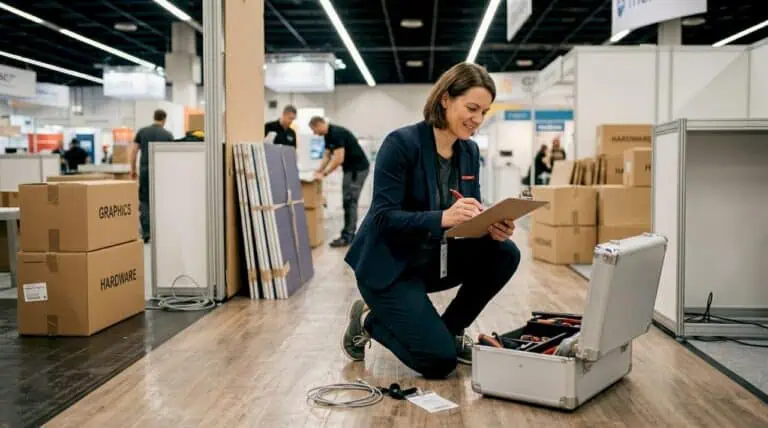
Why use modular booths? Compatible components can support repeated exhibitions, updated graphics and more than one planned layout. The useful question is whether a particular system fits your products, visitor activities and event programme. Compare its technical limits, complete delivery costs and practical reuse arrangements before treating modular construction as a saving or an environmental benefit.
Why use modular booths for a repeat event programme?
A modular booth uses components intended to connect within a defined system. Depending on the product, these may include frames, panels, graphics, lighting supports and accessories. The system’s specifications determine the possible configurations. Reconfigurability does not mean that every component can be placed anywhere or used for any purpose.
The main reason to consider modular construction is a repeatable requirement: several confirmed exhibitions, recurring product displays or messages that change while the structure remains useful. Specify what you intend to retain and what changes between events. A one-off project can also use modular components, but the purchasing decision needs its own cost comparison.

Evaluate the proposed system against your brief
| Requirement | Evidence to request | Decision it supports |
|---|---|---|
| Future plots | Layouts for booked dimensions and open sides | Whether retained components serve the programme |
| Product display | Dimensions, support requirements and equipment arrangement | Whether the system accommodates the actual exhibit |
| Updated messaging | Graphic sizes, fitting method and replacement specification | What can change without replacing the structure |
| Delivery | Packed dimensions, handling and installation plan | Whether logistics suit the venue and available team |
| Repeat use | Inventory, ownership, condition and repair arrangements | Whether reuse is operationally feasible |
Put people and equipment on the plan. Check demonstrations, meetings, waiting space, storage and staff movement during a realistic busy period. A system that fits the plot but prevents the intended activity is a poor fit. For a smaller layout, review the small exhibition booth planning guide before adding more features.
Choose equipment by its specification
Pop-up displays, fabric-covered frames, panel systems and stands combining modular and project-specific elements offer different possibilities. These categories overlap. A fabric finish does not establish load capacity, a portable case does not establish suitability for an entire stand, and a modular frame does not guarantee quick installation.
Ask for the actual system and component references, available dimensions, compatible accessories and permitted attachments. Confirm whether graphics can be reused in the proposed layouts. Establish replacement availability and who can install or repair the equipment. The answer should concern the quoted system rather than general advantages attributed to modular booths.
Compare modular and custom proposals on equal terms
Custom describes design or fabrication tailored to the project; modular describes a component approach. They are not mutually exclusive. A custom design can incorporate reusable frames, and modular construction can use distinctive graphics, lighting and furniture. A proposal combining both may fit the brief better than either label considered alone.
Request equivalent plans and service scopes. Compare the proposed display, visitor activity, finishes, equipment, installation, support and ownership. An organiser’s equipped stand is another option with its own package specification. Rental is a commercial arrangement that may apply to modular or custom elements.
A bespoke feature may be justified by a particular product or activity. A repeat component may be justified by several similar events. Record the reason for each choice instead of assuming that custom stands are disposable or that modular stands always offer greater flexibility.
Use full programme costs to assess value
Obtain itemised quotations for design, manufacture or hire, graphics, equipment, packing, freight, handling, installation, event support, removal and storage. For later events, add repairs, replacement graphics, extra parts and layout changes. Include relevant venue services and identify exclusions, taxes and assumptions.
Compare the same confirmed programme and show possible events separately. Distinguish purchase costs from recurring delivery costs. Ask what happens if the next plot changes or an event is cancelled. Rental can reduce an initial commitment, but its actual inclusions and availability need checking. Ownership brings responsibility for retained equipment and its condition.
There is no defensible universal rule that modular booths break even faster or cost less to store. Packed size, distance, handling, installation and the chosen components can change the result. Use the European exhibition budget guide to organise the comparison without applying invented market percentages.
Check installation and event requirements
Confirm the current manual, technical submissions, service orders, delivery access and competent installation team for each event. Establish who provides drawings, who obtains required responses and who supplies products or connections. A tool-free fitting or previous installation is not evidence that every proposed arrangement is accepted.
At handover, inspect the specification, graphics, lighting and equipment. Test the intended visitor activity and record incomplete work with an owner and completion time. After closing, coordinate products, hired items and retained components so they reach the correct destinations.
Support environmental claims with actual reuse
Plan what will be retained, how it is packed, where it is stored and how it returns to use. Keep a component inventory and condition record. Include graphic replacements, repairs, transport and any discarded material when assessing outcomes. A reusable design that is never used again does not demonstrate the intended benefit.
RAI Amsterdam’s Better Stands programme announcement supports a move towards reusable stand systems. Follow the relevant criteria when making a programme claim. Do not describe a stand as certified, carbon-neutral or lower-emission without the appropriate evidence.
Decide whether the proposal meets your programme
A useful modular proposal shows suitable layouts, identified components, delivery responsibilities and a feasible reuse plan. Review these alongside full costs and the team’s ability to manage retained equipment. Commercial results still depend on the wider exhibition programme; construction alone cannot guarantee qualified leads or return.
Send Adam Expo Stand the event plans, products, activities, existing equipment and budget scope through the project contact form. Request a proposal explaining which modular elements meet the brief, where project-specific work is needed and what later configurations would cost.
Follow our exhibition planning guides
Choose Adam Expo Stand as a preferred source to help you find our exhibition guides and updates on Google.
Add as a preferred source on GoogleGoogle may ask you to sign in and confirm your choice.