Last updated:
Quick answer: SMARTDOORS 2026 runs 10 to 13 November at IFEMA Madrid as part of International Construction Week, alongside CONSTRUTEC, VETECO and PISCIMAD. A custom stand for a door or access-control brand typically runs €300 to €650/m², a modular system €150 to €350/m², and the highest-ROI booths at this show are the ones built to demonstrate a working door or reader live, not just display a panel. Book your floor space and confirm your build partner at least 12 to 16 weeks out.
- What is SMARTDOORS 2026 and why it matters for door and access-control brands
- Where you’ll be in IFEMA Madrid and what Construction Week means for your stand
- How much a SMARTDOORS 2026 stand actually costs
- Custom build, modular system, or shell-scheme upgrade
- Your realistic planning timeline
- Why a Madrid-based in-house build team lowers your risk
- Turning a hardware-heavy stand into qualified leads
- Which strategy fits your situation
- Frequently asked questions
SMARTDOORS is not a general construction fair with a door aisle tacked on. It is IFEMA Madrid’s dedicated show for doors and automatics, now in its second edition, and it sits inside a bigger week where the visitors walking past your stand are architects, installers, facility managers and specifiers who are already there to source building components. That combination, a specialist audience inside a high-traffic week, is exactly why a door or access-control brand needs a stand strategy built for this show specifically, not a generic trade-fair booth.
Get the space, the build and the story wrong and the cost is not abstract: it is the specifier who walks past because your stand looks like everyone else’s aluminium-and-graphics box, the installer who can’t see your reader actually working, and the freight or rigging surcharge nobody itemised until the invoice landed. This guide sets out what SMARTDOORS 2026 actually costs, how the co-located Construction Week changes your stand strategy, and how to plan the build so the spend turns into pipeline.
By the end you’ll have real €/m² ranges for SMARTDOORS 2026 at IFEMA Madrid, a week-by-week planning countdown, and a clear view of which stand format, custom, modular or shell-scheme upgrade, fits a door or access-control exhibitor’s budget and message.
How much does a stand at SMARTDOORS 2026 cost?
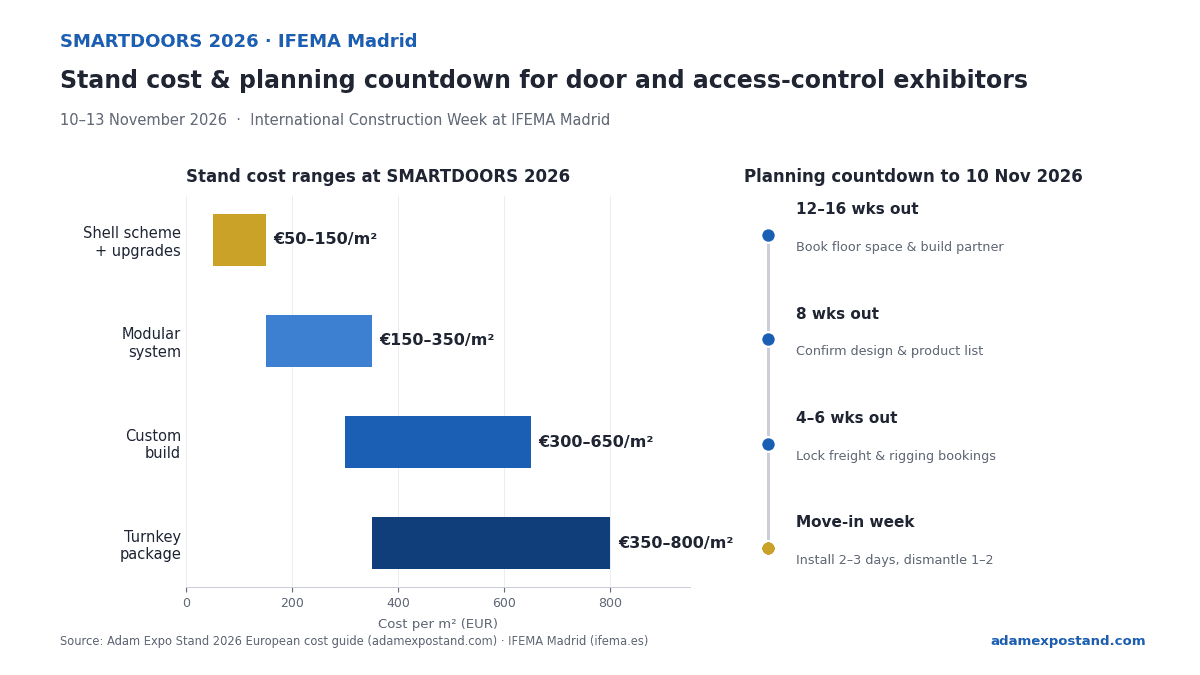
A stand at SMARTDOORS 2026 at IFEMA Madrid typically costs €300 to €650/m² for a custom build, €150 to €350/m² for a modular system, and €50 to €150/m² to upgrade the organiser’s shell scheme, before extras like electrics, AV and freight are added.
A 20m² custom stand lands around €8,000 to €20,000 once a working product demonstration is included. Freight, storage and drayage are usually the costs exhibitors forget to budget for separately.
What is SMARTDOORS 2026 and why does it matter for door and access-control brands?
SMARTDOORS 2026 is IFEMA Madrid’s international exhibition for doors and automatic systems, running 10 to 13 November 2026 as the second edition of the show. It matters to access-control brands because it is the one Spanish-market event where door hardware, automation and access-control systems are the headline category, not a side aisle.
Doors, gate automation, entrance systems and the access-control hardware and software that sit behind them are the exhibits the show is built around, alongside a dedicated BIMEXPO space for the BIM design and specification community, a useful crossover if your product needs to be specified into a building model before it gets specified into a building.
For a door or access-control brand, the practical implication is audience density. Instead of competing for attention inside a broad “security” or “construction” hall, you are standing in front of people who came specifically to evaluate door and automation products. Our verdict: from our builds at IFEMA Madrid, that concentration is worth more to a specialist exhibitor than a bigger, more general show with a lower percentage of genuinely relevant footfall, and it should change how you brief your stand, less general brand wallpaper, more live product interaction.
Key takeaway: because SMARTDOORS visitors are pre-qualified on category, a stand that lets people operate your door or reader themselves will outperform a stand that only displays it behind glass.
Where will you be in IFEMA Madrid, and what does the co-located Construction Week mean for your stand?
SMARTDOORS 2026 runs inside IFEMA Madrid’s International Construction Week, sharing the site with CONSTRUTEC, VETECO and PISCIMAD from 10 to 13 November. That means your stand is competing for attention against three adjacent, related industries rather than standing alone, inside one of IFEMA’s busiest combined weeks of the year.
Across the combined week, IFEMA Madrid reports around 46,700 participating professionals, 560 exhibiting companies and 38,000m² of exhibition space, with 16% of visitors travelling from 81 countries (IFEMA Madrid). That is a meaningfully international, cross-disciplinary audience, and also a lot of competing stands within a short walk of yours.
The practical effect on stand design: a construction-week visitor comparing a window system at VETECO, a swimming-pool build at PISCIMAD and your door automation stand back to back has a short attention budget for each. Your stand needs to communicate what you make and why it matters within a few seconds from the aisle, ideally through motion or a live demo, not through a wall of text. If your product also has an architectural specification angle, the BIMEXPO crossover is worth building into your messaging and your stand signage specifically, not as an afterthought.
How much does a stand at SMARTDOORS 2026 actually cost?
Budget €50 to €150/m² to upgrade the organiser’s shell scheme, €150 to €350/m² for a modular system, and €300 to €650/m² for a fully custom stand, with turnkey packages covering design, build, AV and project management running €350 to €800/m² (Adam Expo Stand’s 2026 European cost guide).
Those ranges hold for IFEMA Madrid specifically. Spanish build costs generally run below German venues, where mandatory rigging and labour rules add 15 to 25% to comparable builds.
The number that catches most first-time SMARTDOORS exhibitors off guard is not the stand itself, it is what sits around it. Budget separately for: electrics and rigging (mandatory through the organiser’s official contractor, not negotiable), AV and screens if you’re running product demo loops, secure storage for spare hardware and locking mechanisms overnight, drayage for anything arriving by freight rather than hand-carried, and the show organiser’s compulsory services surcharge that applies on top of your raw floor-space rental. None of these are large individually. Missed collectively, they are the difference between a quote that looked fine on paper and a final invoice that didn’t.
Key takeaway: ask any quote to itemise electrics, storage, drayage and the organiser’s compulsory surcharge separately, a single “turnkey” line item is where hidden costs usually hide.
Custom build, modular system, or shell-scheme upgrade: which fits a door or access-control exhibitor?
Choose a custom build if your door or access-control hardware needs a working installation to demonstrate properly, choose a modular system if you’ll reuse the stand across several 2026 to 2027 shows, and choose a shell-scheme upgrade if this is a first-time or budget-constrained appearance at SMARTDOORS.
The right call depends less on brand ambition and more on whether your product sells itself on a table or needs to be seen operating in a real door frame.
| Option | Best for | Typical cost | Trade-off |
|---|---|---|---|
| Custom build | a working door/reader demo built into the stand structure | €300–€650/m² | highest cost, longest lead time, one-show design unless rebuilt |
| Modular system | brands running SMARTDOORS plus other 2026/2027 fairs | €150–€350/m² | less bespoke look, but pays back across multiple shows |
| Shell scheme + upgrades | first-time exhibitors, small footprint, tight budget | €50–€150/m² | limited space for a live installation demo |
What’s the realistic planning timeline for SMARTDOORS 2026?
Start floor-space booking and build-partner selection 12 to 16 weeks before the 10 November 2026 opening, confirm your final design and product list by 8 weeks out, and lock freight and rigging bookings no later than 4 to 6 weeks before move-in.
Working backwards from a fixed show date is the only planning approach that reliably avoids the two failure modes we see most often at IFEMA Madrid: a rushed design value-engineered at the last minute, and freight that arrives after the build slot has already started.
In our Madrid build schedule, a custom stand of 20 to 40m² typically needs 8 to 10 working days of production and pre-build before move-in week, with 2 to 3 working days on-site for install and 1 to 2 for dismantling, depending on how much of your product hardware ships separately from the structure. Modular systems compress that considerably, which is one of the reasons brands running SMARTDOORS alongside other 2026 fairs often choose them over a one-off custom build.
Insider tips from years on the show floor at IFEMA Madrid
- Confirm your official electrics and rigging contractor booking before you finalise stand design, IFEMA requires these through approved suppliers and last-minute bookings get the least flexible slots.
- If your product needs a real door frame or wall to demonstrate installation, say so in your design brief in week one, retrofitting structural elements late in the build process is where budgets slip.
- Ship spare locking hardware and access-control components with tracked freight and build in a buffer day, security-hardware components are the items most often held at customs or delayed in transit.
Why does a Madrid-based in-house build team lower your risk at SMARTDOORS?
An in-house Madrid build team removes the subcontracting layer that causes most on-site problems at IFEMA: when design, production and installation sit under one roof, there is one team accountable for fixing whatever breaks during build-up rather than a chain of suppliers pointing at each other.
For a door or access-control exhibitor specifically, this matters more than usual, because your stand likely includes moving mechanical parts and electronics that need to actually work in front of visitors, not just look good in a render.
| What to check | Why it matters | Green flag |
|---|---|---|
| In-house vs subcontracted build | accountability and markup layers | one team owns design to install |
| On-site problem-solving | things break at build-up | crew present, fast fixes |
| Experience with working mechanical demos | door/access-control hardware needs power, wiring and a stable frame | can show you prior stands with live product integration |
| Cost transparency | hidden costs blow budgets | itemised quote, no surprises |
How we approach this: Adam Expo Stand runs an in-house Madrid build team across design, production and on-site installation, including stands built to house working mechanical and electronic product demonstrations. Apply the checklist above to any shortlist, including us.
How do you turn a hardware-heavy SMARTDOORS stand into qualified leads?
Lead generation at a specialist show like SMARTDOORS comes down to letting visitors operate your product themselves, capturing their details digitally at the point of interaction rather than after the fact, and following up within days while the show is still fresh.
A door or access-control stand has a natural advantage here that a lot of exhibitors under-use: your product is interactive by design, and a visitor who has just opened a door with your reader is a warmer lead than one who read a spec sheet.
Build a short, structured interaction into the stand itself, a working demo, a badge-tap access moment, a simple “try it” flow, so every conversation starts from something the visitor just did rather than a cold pitch. Pair that with digital lead capture at the demo point, not a business-card bowl, so the interaction and the data collection happen in the same moment. The follow-up email that goes out within 48 to 72 hours of the show closing, referencing the specific product the visitor tried, consistently outperforms a generic post-show blast sent two weeks later.
Which strategy fits your situation?
First-time SMARTDOORS exhibitor on a tight budget
Start with a shell-scheme upgrade at 9 to 18m² and spend your budget on one working product demonstration rather than spreading it across graphics, furniture and lighting. A small stand with one thing that visibly works beats a larger stand that only displays static hardware.
Established access-control brand running SMARTDOORS as part of a 2026/2027 European show circuit
A modular system is almost always the better economics here. The higher per-show cost of custom builds only pays off if you’re using the stand once; across three or four fairs a well-designed modular kit reduces your effective cost per show substantially while still allowing a genuine product demo bay.
Door hardware manufacturer targeting the BIM/specification crossover
Lean into the BIMEXPO adjacency in your messaging and signage. Architects and specifiers moving between the BIM space and the exhibition floor respond to technical specification data (fire ratings, cycle-life testing, compliance standards) displayed clearly on the stand, not just brand messaging.
Small 3x3m access-control startup
At 9m² you have room for one product interaction point and a small meeting counter, not both a full demo wall and a lounge. Pick the interaction that best proves your core claim (speed, security, ease of install) and build the whole stand around making that one thing undeniable.
Quick check: SMARTDOORS 2026 readiness
How many weeks before SMARTDOORS 2026 opens should you confirm your build partner and floor space?
Frequently asked questions
When is SMARTDOORS 2026?
SMARTDOORS 2026 runs 10 to 13 November 2026 at IFEMA Madrid, as part of International Construction Week alongside CONSTRUTEC, VETECO and PISCIMAD.
Is SMARTDOORS a good fit for access-control brands, not just door manufacturers?
Yes. The show covers doors and their automation, and access-control hardware and software that operate alongside automatic doors and entrance systems fit naturally within its scope and audience.
How much space do I need for a working product demo?
A single working demonstration point, one door frame or reader installation, can fit within 9 to 12m² if the rest of the stand is kept simple; larger footprints let you run multiple demo points or a dedicated meeting area alongside it.
Do I need a Spanish-speaking team on the stand?
Not strictly. With 16% of Construction Week visitors travelling from abroad (IFEMA Madrid) the show runs bilingually in practice, but Spanish-speaking staff will noticeably improve conversations with the Spanish specifiers and installers who make up the bulk of the audience.
What’s the biggest budget mistake first-time SMARTDOORS exhibitors make?
Quoting the stand build alone and forgetting electrics, rigging, storage, drayage and the organiser’s compulsory services surcharge, which together can add a meaningful percentage on top of the headline stand price.
Can I reuse my SMARTDOORS stand at other 2026 or 2027 shows?
Yes, if you build modular rather than fully custom. A modular system designed for SMARTDOORS can typically be reconfigured for a different footprint at another European fair, spreading the build cost across multiple events.
Recommended reads
More exhibitor guides from Adam Expo Stand: Medium, Substack, and LinkedIn.
Adam Expo Stand: exhibition stand design and build for European trade fairs. Based in Madrid, serving IFEMA, Fira Barcelona, Messe Frankfurt and 50+ fairs across Europe. Phone: +34 697 715 015.
Planning a stand for SMARTDOORS 2026 Madrid?
Get an itemised quote and a 3D concept from an in-house Madrid build team.