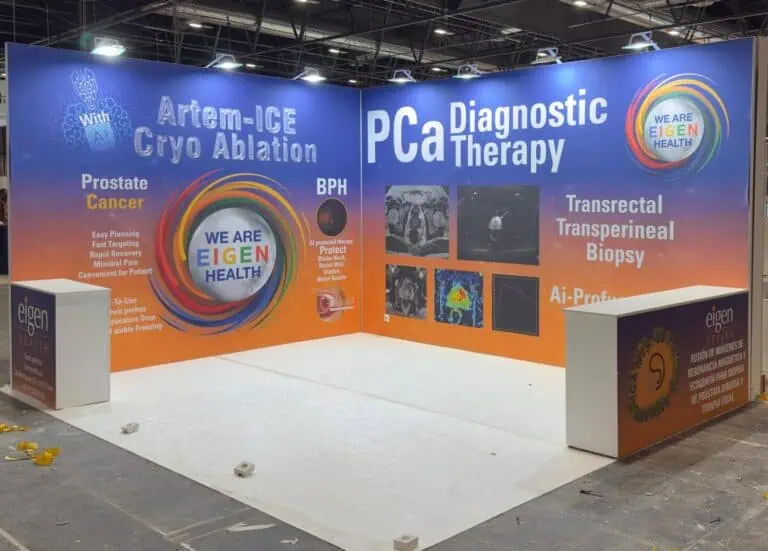
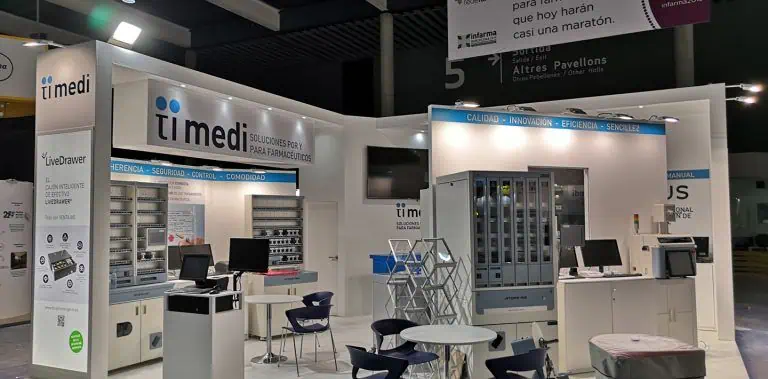
Types of exhibition stands describe different aspects of a proposal. Shell scheme refers to a supplied framework or package; modular and custom describe construction approaches; portable describes handling; double-deck describes an additional level. These categories can overlap. Choose by the activities, booked plot, event requirements and complete cost.
A plot arrangement such as inline, corner or island is another separate consideration. It does not by itself specify construction, equipment or the services included in a booking. This guide explains what to check before comparing proposals.
Shell scheme: confirm the booked package
A shell scheme is a supplied framework or stand package arranged through the organiser or contractor. Obtain the actual specification for walls, floor covering, fascia, lighting, power, graphics and furniture. Do not assume these items are all included or all excluded.
Official examples show why the booking matters: the MWC Barcelona 2027 shell-scheme manual includes furniture packages, while the BOA Annual Congress 2026 shell-scheme manual states that furniture is excluded. These are event-specific examples, not universal package rules.
Confirm templates and permitted fixing methods before ordering graphics or mounting equipment. Heavy products and screens may need separate approved supports. A supplied framework is not permission to alter or load it as you wish.
Modular: check the components and configuration
Modular systems use compatible parts that support particular combinations. Request the product identification, inventory and documented layouts for the planned events. Confirm changes needed for graphics, supports, equipment, services and approvals.
The OCTANORM portfolio illustrates different system categories from one manufacturer. The actual system determines what is possible. Modular construction does not guarantee a fit for every plot, self-assembly, a fixed setup time or lower total cost.
Custom: specify the reason for the bespoke element
Custom construction is developed around an agreed brief. It may help accommodate a particular product, finish, activity or layout. Identify the function that a custom element provides and compare it with suitable supplied or modular alternatives.
Creative freedom remains subject to dimensions, engineering, event requirements, materials, available time and budget. Custom components may be reusable if designed and documented for that purpose. They are not necessarily single-use or appropriate only for large brands.
Portable: verify handling and assembly
Portable displays may include retractable graphics, folding units or other equipment intended to be transported between events. Check actual packed dimensions, weight, cases, transport method, assembly instructions and the people required.
Portability does not establish that one person can install everything in minutes. Screens, electrical equipment, supports and product displays may have separate handling and installation requirements. Confirm permitted use at the event.
Double-deck: review the technical and usable-space requirements
A second level may provide additional usable space where the event and assigned location permit it. Obtain the requirements for engineering, access, evacuation, fire safety, services and submissions before approving a concept.
Compare usable area after stairs and circulation with complete construction and operating costs. A second storey does not automatically double usable floor area or guarantee privacy, visibility or a particular saving. Ask competent designers and contractors to confirm the proposal.
Hybrid: document the combination
A hybrid proposal combines construction approaches, such as modular structure with custom features. List which components are supplied, owned, rented, newly produced or reusable. Agree interfaces, supports, installation responsibility and future configurations.
Combining approaches does not automatically deliver the lowest cost or the visual outcome you need. Review the scaled layout, samples, evidence and complete quote.
Match the stand to the intended activities
Start with what visitors and staff need to do: examine products, attend a demonstration, compare options, ask questions or hold meetings. Draw actual products, equipment, furniture and storage at scale. Review access and circulation under the event requirements.
Test graphics and product appearance under planned lighting and viewing conditions. Technology should explain a useful task, with reviewed content, support and an accessible alternative. A static sample or staffed conversation can remain appropriate.
Request evidence for material claims and agree reuse or recovery arrangements. A construction category does not establish the environmental performance of the whole project.
Compare scope, costs and responsibilities
| Check | What the proposal should clarify |
|---|---|
| Design | Layout, specification, revisions, samples and technical submissions. |
| Supply | Construction, graphics, furniture, equipment and services included. |
| Delivery | Transport, access, installation, support and acceptance. |
| After the event | Dismantling, collection, storage, condition checks and returns. |
| Commercial terms | Optional items, exclusions, taxes, changes and responsible parties. |
Build the schedule from actual submission deadlines, supply availability, production and access. Terms such as «turnkey» or «complete» need a written scope; they do not automatically include every venue service or exhibitor task.
Frequently asked questions about types of exhibition stands
Which type is best for a first-time exhibitor?
Compare the actual package and proposals with the activities, budget and team. Experience level alone does not determine the appropriate construction.
Is buying better than renting for frequent events?
Compare equivalent scope across the actual programme, including storage, repairs, new graphics, transport and installation. Frequency alone is insufficient.
Can a custom stand be reused?
It may be designed for documented future uses. Confirm components, configurations, dismantling, storage and changes before relying on reuse.
How do I evaluate the result?
Define relevant activities and qualification criteria before the event. Keep visitor totals and enquiry counts separate from attributed financial outcomes and full costs.
For a proposal, provide the event, plot, manual, products, activities, programme and budget to Adam Expo Stand. Ask for an equivalent-scope comparison rather than choosing by category name alone.
Follow our exhibition planning guides
Choose Adam Expo Stand as a preferred source to help you find our exhibition guides and updates on Google.
Add as a preferred source on GoogleGoogle may ask you to sign in and confirm your choice.