Last updated:
Quick answer: Spain and Portugal are straightforward markets for exhibitors from the US, UK, Australia, Canada and New Zealand, but five things differ from home: the venue rulebook (metric, mandatory venue services, local technical approval), customs and VAT on goods you ship in, 230V power, the language of your visitors, and a longer lead time than most overseas exhibitors expect. Settle those first, then choose the show.
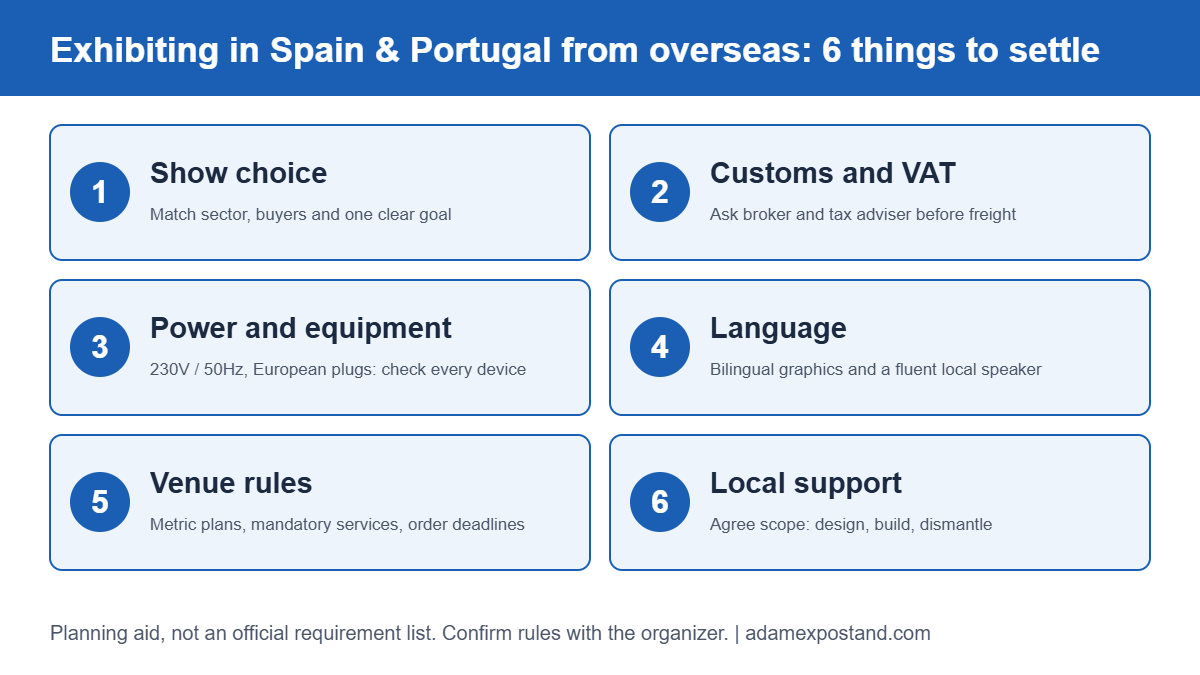
If you exhibit in Dallas, Birmingham, Sydney, Toronto or Auckland, you already know how a good trade show works. What changes in Spain and Portugal is not the idea of the show, it is the practical layer around it: who builds the stand, what the venue controls, how goods cross the border, and what language your visitors expect to be addressed in.
This guide is written for exhibitors from the US, UK, Australia, Canada and New Zealand who are considering a show in Spain or Portugal for the first time, or who tried once and found the logistics harder than expected. It covers how to choose a show, what to ask the organizer, how shipping and VAT work in principle, how to staff the stand, and where local support helps most. It does not replace advice from your customs broker, tax adviser or the organizer’s exhibitor manual, which are the final word on rules and dates.
If you have not yet decided whether to exhibit, start with our go/no-go scorecard for choosing a trade show. If you have decided, read on.
Why do Spain and Portugal appeal to English-speaking exhibitors?
The reasons we hear most often are practical rather than glamorous. Spain has large, well-equipped exhibition centers, with Madrid and Barcelona the two main hubs, and Portugal has a strong Lisbon events scene. Both countries use the euro, both sit inside the EU single market, and both receive a steady flow of international visitors, so a foreign exhibitor is not unusual to organizers.
They also work as an entry point to two language markets. Spanish and Portuguese reach well beyond Iberia, and Lisbon in particular is often used to meet buyers from Portuguese-speaking countries, as we explain in our guide to Lisbon trade fairs and Portuguese-speaking markets. Whether that matters to you depends on your product, so treat it as a question to test with the organizer, not a promise.
Which Spain and Portugal trade shows should you consider?
Choose by sector and buyer type, not by city. The table groups well-known venues and the kinds of events they host. Dates change from year to year, so confirm each edition with the organizer before committing.
| Venue / city | Typically hosts | Where to read more |
|---|---|---|
| IFEMA Madrid | A broad calendar of professional and consumer events across many sectors, including tourism, food, construction, technology and energy | IFEMA Madrid exhibitor guide |
| Fira Barcelona | Large international events at Gran Via and Montjuïc, including technology, mobility, food and hospitality shows | Fira Barcelona Gran Via technical guide |
| FIL, Lisbon | Trade fairs and conferences in Portugal’s capital, including events that draw buyers from Portuguese-speaking markets | FIL Lisbon technical guide |
| Other venues | Regional fairs, congress centers and hotel-based events across Spain and Portugal, often more specialized | Exhibiting in Spain, 2026 to 2027 |
Before shortlisting, ask each organizer for visitor data by country and job role, and for the previous edition’s exhibitor list. A show can be large and still be a poor match if its visitors are mostly regional and your goal is international distribution, or the other way round. Our overview of top European trade shows is a useful starting point for comparing options.
What is different from exhibiting at home?
Most surprises come from a handful of differences. Check each against your own plan early.
| Topic | What to expect | What to do |
|---|---|---|
| Measurements and plans | Stand areas, heights and drawings are in metric units (square meters, meters), and the venue rulebook defines limits | Brief your designer in metric and ask for drawings in the format the organizer requires |
| Electricity | Mains power in Spain and Portugal is 230V at 50Hz with European plugs, which differs from the US, Canada and some other markets | Check every device you ship; use certified European-rated equipment or order power and lighting through the venue or your local builder |
| Venue services | Power, water, rigging, cleaning and similar services are normally ordered through the venue or organizer, often with order deadlines | Read the exhibitor manual on day one and diarize the order deadlines |
| Technical approval | Larger or two-level stands often require drawings reviewed by the organizer or venue before build | Allow time for approval; see our European stand regulations guide |
| Language | English is widely used in business, but visitors respond better to Spanish or Portuguese greetings, signage and printed material | Plan bilingual graphics and at least one fluent local speaker on the stand |
| Schedule | Spanish business and meal hours run later than in the US or UK; Portugal is one hour behind Spain | Book meetings with the local clock in mind, and confirm opening hours with the organizer |
None of these is a barrier. They are the reasons a first show abroad takes longer to prepare than the same show at home.
How do shipping, customs and VAT work?
Two situations are common. If you ship exhibits and promotional material from outside the EU, the goods cross a customs border, and the paperwork depends on whether they are leaving again after the show or staying. UK exhibitors should note that, since the UK left the EU, goods moving between the UK and Spain or Portugal are treated as imports and exports rather than movement inside a single market. For temporary exhibits that will return home, many exhibitors use an ATA Carnet, a customs document for temporary admission, but whether it fits your goods depends on what you are shipping. Our shipping and customs guide explains the options in more detail.
VAT is the second issue. Spain and Portugal apply VAT to goods and services supplied locally, including stand construction and venue services, so quotes and invoices will show it. Non-EU businesses may be able to recover some of this VAT through a refund procedure, and rules differ by country and by the nature of the business. We are not tax advisers, so ask yours before you budget on the assumption that VAT is recoverable.
As a rule of thumb: ask your customs broker and tax adviser two questions before booking freight. First, will the goods return home or be sold or given away in Europe? Second, who is the importer of record? Their answers decide the paperwork.
What about visas, insurance and travel?
Entry rules for short business visits depend on your passport and change from time to time, so check the current requirements for Spain and Portugal on the official government travel pages well before you travel, and again close to departure. Pay particular attention to whether the activities your team will carry out, such as building a stand, fall under ordinary business-visitor rules or need other permission. Your team’s nationality, the length of stay and the type of work all matter.
On insurance, confirm that your policy covers exhibits in transit and on site, public liability at the venue, and your staff while traveling. Venues and organizers often require proof of liability cover, as we describe in our exhibition stand insurance guide.
For travel, book hotels early near the major shows. Hotel prices and availability around big events can change quickly, so reserve once your participation is confirmed.
How should you staff and talk to visitors on the stand?
Bring your product experts, and pair them with at least one person who speaks the local language fluently. Visitors will often start in English if they see an English-speaking company, but a greeting in Spanish or Portuguese changes the tone of a first conversation.
Print materials and screens deserve the same attention. A bilingual headline and a short product description in the local language do more than a translated brochure sitting in a pile. If you are unsure of the right wording, ask a native speaker in your sector to review it, because literal translations can read oddly to buyers.
For Portugal, use European Portuguese rather than Brazilian Portuguese, unless the show targets Brazilian buyers. Our guide to stand design for Portuguese audiences goes into this in more detail.
Do you need a local stand partner, and what should they cover?
Many overseas exhibitors choose a local builder because they know the venue, the order deadlines and the approval process. That is not the only route, and the right choice depends on the stand size, budget and how much you want to manage yourself. A shell scheme package may be enough for a first, small participation; a larger custom stand usually benefits from a local team.
If you do work with a local partner, agree the scope in writing: design, drawings and approvals, production, transport to the venue, installation, on-site supervision, dismantling and storage. Ask who handles venue orders, who is on site during build-up, and how changes are charged. The European stand cost guide and our page on overseas project coordination in Spain help you compare quotes on like-for-like terms.
What does a realistic preparation timeline look like?
Treat the following as a planning pattern, not a rule. The right timing depends on the show, the organizer’s deadlines and the size of the stand.
- Early planning: set one clear goal, shortlist shows, and request visitor data.
- Booking: reserve space and read the exhibitor manual for deadlines and technical rules.
- Design and approval: brief your builder, agree the design and submit the drawings the organizer requires.
- Logistics: plan freight, customs paperwork and any equipment that needs European power specifications.
- Final weeks: confirm staffing, travel, bilingual materials and meeting bookings.
- After the show: follow up promptly using a method such as our 14-day lead follow-up plan.
Key takeaway: The show itself is familiar. What needs extra time is paperwork, power, language and local logistics. Start those early and the rest works like any other trade show.
What mistakes do overseas exhibitors make most often?
- Shipping equipment built for 110V. Check voltage and plug types before anything leaves home.
- Assuming venue services are optional. Many are mandatory or must be ordered from the venue.
- Missing order deadlines. Late orders often cost more, if they are accepted at all.
- Treating VAT as free money. Do not budget for a refund until your adviser confirms it.
- English-only graphics. Visitors notice, and a bilingual headline is cheap to add.
- No follow-up plan. Leads from an expensive trip are wasted if nobody owns the next step.
Related video: working with a stand builder in Europe
This short video introduces Adam Expo Stand as a stand contractor for European trade shows. It is a company overview rather than a Spain-and-Portugal tutorial, so use it as background on what a local builder does.
Frequently asked questions
Can a US, UK, Australian, Canadian or NZ company exhibit at trade shows in Spain and Portugal?
Yes. Foreign companies exhibit in Spain and Portugal regularly. You book space with the organizer, follow the exhibitor manual and venue rules, and handle customs, VAT and insurance for your situation. Confirm the specifics for your company with the organizer and your advisers.
Do I need an ATA Carnet to bring exhibits to Spain or Portugal?
Not always. An ATA Carnet is one way to temporarily admit goods and bring them back without paying duty, but whether it suits your goods depends on what you ship and whether it returns home. Ask your customs broker before you book freight.
Will American equipment work in Spain and Portugal?
Not necessarily. Mains power in both countries is 230V at 50Hz with European plugs. Check each device before shipping, and consider ordering power and lighting through the venue or a local builder.
Do I need to speak Spanish or Portuguese on the stand?
English is widely used in business, but at least one fluent local speaker and bilingual graphics make a real difference to first conversations. It is a strong recommendation, not a rule.
Should I hire a local stand builder?
It depends on stand size, budget and how much you want to manage yourself. A local builder is helpful for custom stands because they know the venue process; a small first participation may work with a shell scheme package.
Planning a stand in Spain or Portugal from overseas?
Tell us the show, dates and stand size, and we will discuss how the layout and local logistics can support the conversations you want to have.
Recommended reads
Adam Expo Stand designs, produces and installs exhibition stands from Madrid for trade shows in Spain and across Europe.
Follow our exhibition planning guides
Choose Adam Expo Stand as a preferred source to help you find our exhibition guides and updates on Google.
Add as a preferred source on GoogleGoogle may ask you to sign in and confirm your choice.