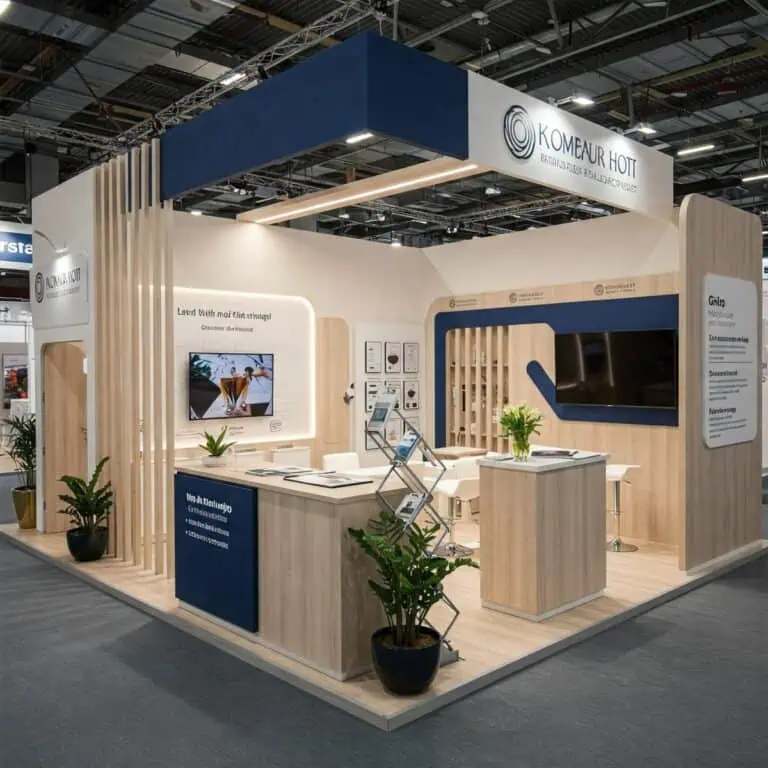
Choosing an exhibition stand starts with the work it must support: product inspection, demonstrations, conversations or appointments. Give suppliers the same brief, booked plot and event requirements. Compare their actual layouts, package inclusions, responsibilities and complete costs before selecting a construction approach. A category name alone cannot establish suitability or value.
What should determine the choice of exhibition stand?
The strongest starting point is a prioritised activity brief. Identify who you want to meet, what visitors need to understand and the useful next step after each conversation. Then check whether the proposed stand can support that activity with the actual products, equipment, people and available space.
This guide is a selection worksheet. For definitions of shell schemes, modular construction, bespoke stands and plot configurations, use our exhibition stand types guide. Keep construction method, ownership and position in the hall separate when assessing a proposal: a rented stand can use modular components, and a bespoke design can incorporate reusable parts.
Turn business objectives into a supplier brief
Replace broad instructions such as “make us stand out” with activities the designer can draw and the event team can deliver. Set priorities when the same space must accommodate several activities. A product demonstration, private discussion and visitor queue may compete for the same area.
| Business activity | Information to provide | Evidence to request |
|---|---|---|
| Show or compare products | Actual dimensions, weights, handling and viewing needs | Product positions, support details and visitor viewing space |
| Run a demonstration | Operating sequence, equipment, services and operator roles | Activity footprint, service provision and waiting arrangements |
| Hold appointments | Expected participants and required level of privacy | Furniture in use, access and meeting arrangements |
| Answer enquiries | Subjects, staff roles and information to record | Conversation positions, storage and follow-up process |
These are planning prompts, not standard space allowances. Test the proposed arrangement with representative equipment and furniture. Show chairs pulled out, cupboard doors open and staff operating the demonstration. An attractive empty rendering does not answer those questions.
AUMA’s trade-fair briefing guidance provides a reference for agreeing objectives, expectations and responsibilities. Share the agreed brief with the people who will operate the stand as well as those designing it.
Check the booked plot and the actual package
Provide the organiser’s plot drawing, dimensions, open sides, orientation and service information. Identify columns, nearby features and access constraints from the actual plan. Confirm which event edition and venue documents govern the build. A layout used successfully at another show still needs review for the current plot.
Read the package schedule rather than assuming that a shell scheme includes furniture, flooring or a particular electrical supply. As specific examples, the MWC Barcelona 2027 shell-scheme guidance lists furniture by stand size, while the BOA Annual Congress 2026 shell-scheme manual excludes furniture. Neither package defines what another event supplies.
Make a responsibility list for the plot booking, structure, graphics, flooring, furniture, equipment, electrical services, connectivity, cleaning and removal. Mark each item as included, excluded or awaiting confirmation. Resolve gaps before comparing prices.
Compare construction approaches against the same requirements
A shell-scheme package may provide a starting enclosure that can be adapted within its restrictions. Check permitted fixings, equipment support and service orders. Do not assume its wall panels can support your products or screens.
A modular proposal should name the product family and show the configurations offered. Request a component schedule, graphic dimensions and installation requirements. Our modular booth system guide explains the evidence to request; modular does not mean every product is compatible or tool-free.
A bespoke proposal should explain how the design meets the brief and how its features will be manufactured, installed and recovered. Establish which elements are purpose-made, rented or reused. A bespoke appearance does not demonstrate that every component is disposable, just as a modular label does not guarantee repeated use.
Compare the actual finish samples, drawings and responsibilities. Avoid ranking approaches solely by labels such as premium, portable or sustainable. Request evidence for the feature that matters to your project.
Ask for drawings that show the stand in operation
Review the scaled plan with the team who will staff the event. Trace how someone approaches the message, reaches an activity, speaks to a representative and leaves. Check storage, replenishment, equipment maintenance and accessible circulation with the responsible designer and event requirements.
Ask the supplier to identify service locations and cable routes, suitable equipment mounts, lighting and any suspended or elevated features. Confirm the technical information and approvals needed for the actual design. A visual concept and a technical approval are different project milestones.
Keep a decision log stating the drawing version, reviewer, unresolved question and owner. If a change affects the footprint, equipment or activities, review its consequences for graphics, services, installation and costs before approving it.
Compare full costs and delivery responsibilities
Give each supplier the same scope and request itemised inclusions and exclusions. Account for design, production or rental, graphics, packing, freight, handling, installation, specialist services, dismantling and return. Include storage, repairs and later modifications where relevant to the programme.
Check organiser charges, order deadlines and any applicable late fees in the current documents. Ask who places each order and who pays it. A low headline structure price can be difficult to compare with a proposal that includes delivery and services.
For repeated exhibitions, price the actual programme. State the expected layouts, dates and graphic changes and identify assumptions that remain provisional. Do not use a universal budget split or a fixed number of events to justify a purchase.
Agree handover and evaluate the result
Define what will be checked before opening: equipment operation, approved graphics, furniture, storage, visible defects and outstanding work. Record who can accept delivery and who will resolve issues during the event. Agree dismantling, return and condition records before the stand is dispatched.
After the event, assess the stand against its brief. Review whether demonstrations worked, appointments could take place and relevant enquiries had an agreed next step. Separate these observations from attributed revenue and profit. Attendance or collected contact details alone do not establish commercial return.
Questions before selecting a proposal
Is a modular stand always the best choice for several events?
No. Compare the supported layouts, component inventory, graphics, installation, freight, storage and maintenance for your actual programme. Changes to plots or activities can require additional parts or another design. Assess alternatives using the same scope.
Can a small stand support demonstrations and meetings?
It depends on the products, equipment, participants and operating arrangements. Put the activities on a scaled plan, review them with the event team and prioritise where space conflicts arise. Stand area alone cannot establish capacity.
What should I send Adam Expo Stand?
Use the project enquiry form to share event dates, plot drawings, activities, products, equipment, budget assumptions and reuse plans. Request a proposed layout, written scope, responsibilities and quotation that can be checked against the same brief.
Follow our exhibition planning guides
Choose Adam Expo Stand as a preferred source to help you find our exhibition guides and updates on Google.
Add as a preferred source on GoogleGoogle may ask you to sign in and confirm your choice.