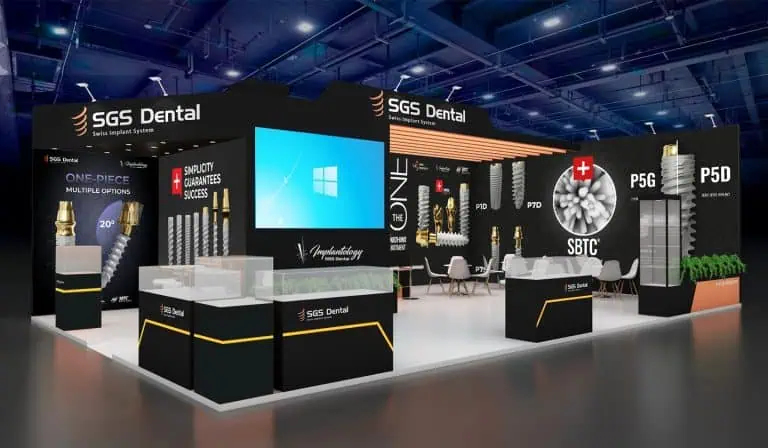
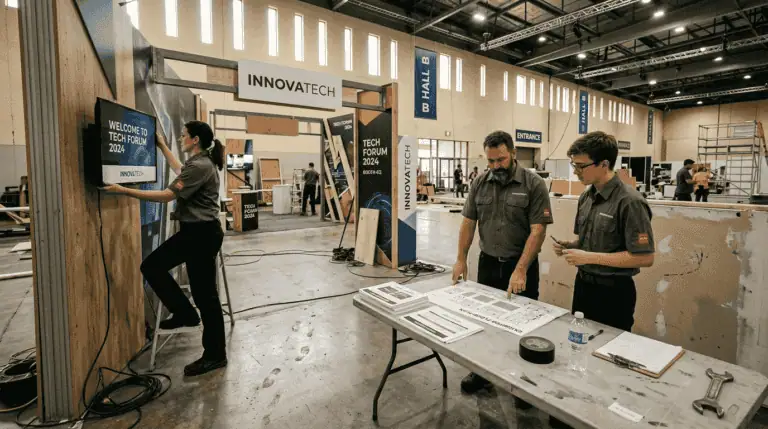
Trade show booth types describe several different decisions: what the organiser provides, which sides of the plot are open, how the stand is constructed and whether components are rented or owned. Compare these decisions separately. A corner plot, for example, can contain a shell scheme package, a modular system or a custom build, depending on the booking and event requirements.
The right choice supports the intended visitor activities within the actual plot and complete budget. Use this guide to define the options before asking suppliers for comparable proposals.
Trade show booth types: four decisions to separate
| Decision | Examples | What to confirm |
|---|---|---|
| Organiser booking | Space only, shell scheme or another event package | Exact inclusions, dimensions, services, restrictions and charges |
| Plot arrangement | Inline, corner, peninsula or island | Open sides and neighbouring conditions on the organiser’s plan |
| Construction approach | Modular, custom or a combination | Supported configurations, specification, technical responsibilities and installation |
| Commercial arrangement | Rental, ownership or mixed supply | What is supplied, returned, stored, repaired or retained after the show |
Names and packages vary by organiser and supplier. Use the written booking and dimensioned plan rather than assuming a familiar label establishes the specification.
Shell scheme and space-only bookings
A shell scheme is an organiser or supplier package whose precise structure and services must be checked. It may include walling, a fascia, flooring or other items, but those inclusions are not universal. Check furniture, lighting, electricity, graphics and permitted attachments separately.
Space only describes the booked area and its conditions. The exhibitor must arrange the required stand and services under the event rules. It is not permission to build any structure, height or suspended feature. Ask who prepares and submits the relevant technical information and who orders each service.
Compare both options against the same activities. An apparently inexpensive booking can require additional items; a larger package may include services that would otherwise be purchased separately. Avoid counting those services twice in the budget.
Inline, corner, peninsula and island layouts
An inline arrangement generally has one open side; a corner has two; a peninsula has three; an island is open on four sides. Check how the event uses these terms and the actual plotted conditions. None of them implies a universal area, guaranteed visitor count or particular price premium.
More open sides change the possible approaches, display positions and staff coverage. They may leave less continuous wall space for product displays or storage. Place the intended activities on a scaled plan before deciding that a particular arrangement provides an advantage.
Show visitor and staff positions, furniture, product dimensions, demonstrations and waiting areas. Trace entry, interaction and exit with more than one activity operating. Use the applicable accessibility and technical requirements; a generic layout illustration cannot establish compliance.
Modular, custom and mixed construction
Modular stands use a system with particular parts and supported configurations. Ask for a component schedule, assembly requirements and layouts for the intended events. Reconfiguration and reuse must be checked against those details, future plots and the condition of the components.
Custom construction can be developed around a particular brief within the applicable budget, technical and production constraints. The proposal should state the materials, finishes, dimensions and deliverables. A custom label does not guarantee exclusivity of every component, unrestricted design freedom or better commercial results.
A mixed design may combine a system structure with project-specific graphics, furniture or features. Compare the actual specification, rather than ranking these labels. For any multilevel or suspended element, identify the project-specific feasibility review, responsibilities and approval requirements.
Rental and ownership over an event programme
Ask which components are rented, bought or supplied for one-time use. Confirm customisation, return condition, graphics ownership, storage, repair and replacement responsibilities. A rented stand can still require the exhibitor to arrange services and logistics.
For repeated events, compare complete programme costs using confirmed or clearly provisional assumptions. Include design, components, changing graphics, transport, handling, installation, dismantling, storage and maintenance as applicable. Ownership is not automatically economical after a fixed number of uses.
Assess environmental claims separately from financial savings. Reusable parts may support a reuse plan, but material composition, actual uses, transport, repairs and end-of-use arrangements affect the assessment. Plants, recycled-looking surfaces and LEDs alone do not demonstrate a lower total environmental impact.
A practical selection worksheet
- Describe the activity. State what visitors should understand or do and what staff must support.
- Record the booking. Attach the actual plot, open sides, inclusions and current event documents.
- List operating requirements. Include products, people, storage, power, connectivity and other services where needed.
- Request comparable layouts. Ask suppliers to show how the activities work within the same constraints and to identify alternatives.
- Compare complete scope and cost. Record exclusions, provisional items, responsibility and payment arrangements.
- Agree the delivery plan. Include decisions, artwork, submissions, production, access, handover and return tasks.
The AUMA trade-fair briefing guidance provides a useful reference for objectives, resources and responsibilities. For event conditions, use the organiser’s current documents. The IFEMA MADRID regulations library is an example of a library requiring selection of the relevant event and facility documents.
Evaluate operation before judging results
Rehearse the complete visitor interaction, equipment operation and reset. Confirm staff responsibilities and provide an alternative explanation if a device or connection fails. Choose interactive activities because they help the intended task, rather than assuming that games or longer dwell time establish buying intent.
After the event, review operational observations and business outcomes using agreed definitions. Completed demonstrations, meetings and approved follow-up requests can be useful records; they are not interchangeable with revenue or financial return. Use the complete participation cost when calculating a return and document how outcomes are attributed.
Frequently asked questions
Is a corner booth a construction type?
It describes a plot with two open sides. The construction and booking package are separate decisions to confirm.
Which booth type is cheapest?
Obtain current quotations for the same scope, plot and activities. Package inclusions, services, logistics and future use can change the complete comparison.
Which booth type gets the most visitors?
The label alone cannot establish visitor numbers. Event audience, location, message, activity, staffing and promotion all need to be considered.
See our exhibition stand design service or send the plot and brief to compare suitable proposals.
Follow our exhibition planning guides
Choose Adam Expo Stand as a preferred source to help you find our exhibition guides and updates on Google.
Add as a preferred source on GoogleGoogle may ask you to sign in and confirm your choice.