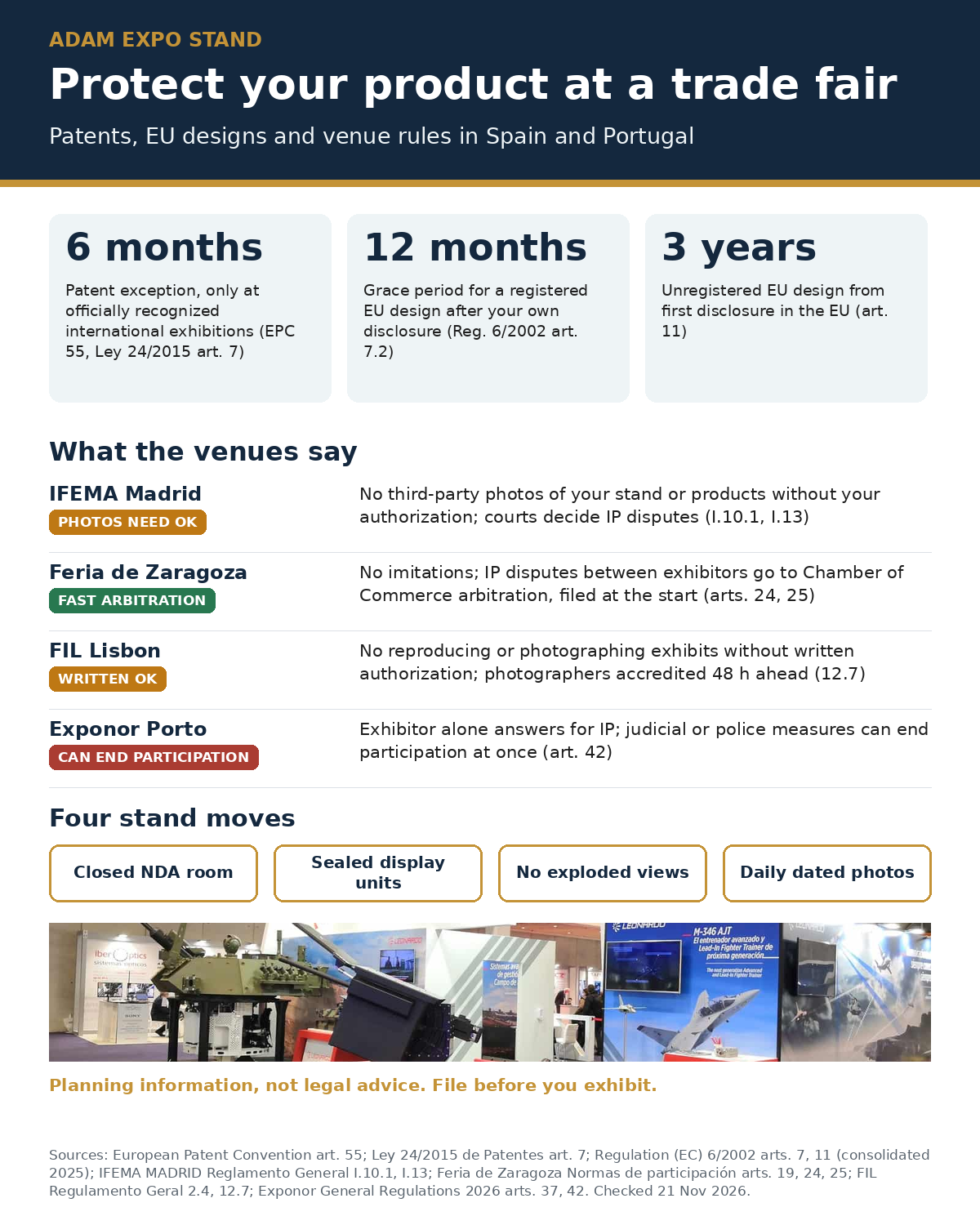
Showing an unprotected product at a trade fair is risky: an ordinary fair display usually counts as public disclosure for patents, because the six-month exception in European and Spanish patent law covers only officially recognized international exhibitions. File the patent or EU design before the doors open, then use the venue’s own rules (IFEMA, Feria de Zaragoza, FIL and Exponor all restrict photos or act on IP breaches) and a stand built to show the product without giving away how it works.
Last updated: November 2026
A post on Reddit’s r/legaladvice asked: “Should my friend legally protect his invention and speak to a corporate lawyer ASAP?” The detail that worried readers was simple. The inventor “already started showing off the working prototype and even did a trade show a few weeks ago, all without even having a patent.” We hear the same worry from exhibitors planning a launch at IFEMA Madrid, Feria de Zaragoza, FIL Lisbon or Exponor in Porto. This guide explains how to protect your product at a trade fair in Spain or Portugal, using the patent rules, the EU design rules and the venues’ own rulebooks.
It is planning information from a stand designer, not legal advice. For the filing strategy itself, talk to a patent attorney before you book the space.
Is it safe to show a new product at a trade fair before it is protected?
It depends on what kind of protection you need, and the answer is different for an invention and for a look. A trade fair is a public place by design. Thousands of visitors, competitors and press walk past your stand, and any of them can describe what they saw.
- A technical invention (how it works) needs to be new on the day you file a patent. Showing it at an ordinary fair before filing can make it part of the state of the art.
- A design (how it looks) has more room. EU law gives designers a 12-month grace period after their own disclosure, and the first showing inside the EU can also create a short unregistered right.
- A name or logo is a trademark question. Register it in the markets you plan to sell in before the launch, not after a competitor has seen it on your back wall.
So the safe order is file first, exhibit second. If filing is not possible in time, change what you show: a working unit in a sealed housing, a video of the result, or a closed room where only invited visitors see the detail.
Key statistics: product protection at fairs in Spain and Portugal
| Data point | Value | Source | Date checked |
|---|---|---|---|
| Patent grace for showing an invention | 6 months, only for official or officially recognized international exhibitions under the 1928 Paris Convention, with a certificate | European Patent Convention, Art. 55 | 21 Nov 2026 |
| Spanish national patents | Same 6-month rule for officially recognized exhibitions | Ley 24/2015 de Patentes, art. 7 | 21 Nov 2026 |
| Registered EU design grace period | 12 months after the designer’s own disclosure | Regulation (EC) 6/2002, art. 7(2) | 21 Nov 2026 |
| Unregistered EU design | 3 years from first disclosure within the EU | Regulation (EC) 6/2002, art. 11 | 21 Nov 2026 |
| IFEMA Madrid, photos | No stand or exhibited product may be photographed or filmed by third parties without the exhibitor’s authorization | IFEMA MADRID, Reglamento General, I.10.1 | 21 Nov 2026 |
| FIL Lisbon, photographers | Exhibitor-authorized photographers accredited at least 48 hours before opening | FIL, Regulamento Geral, 12.7 | 21 Nov 2026 |
| Feria de Zaragoza, IP disputes | Arbitration at the Zaragoza Chamber of Commerce; file at the start of the show | Feria de Zaragoza, Normas de participación, art. 25 | 21 Nov 2026 |
| Exponor Porto, IP breaches | Participation can end immediately if judicial or police measures follow an infringement | Exponor, General Regulations 2026, art. 42 | 21 Nov 2026 |
Quotable summary: In Spain and Portugal, the patent exception for showing an invention lasts six months and covers only officially recognized international exhibitions, while a registered EU design keeps a 12-month grace period; at venue level, IFEMA and FIL bar third-party photos of your products without permission and Feria de Zaragoza sends IP disputes between exhibitors to fast arbitration.
Does showing an invention at a trade fair affect a patent?
Usually yes, if you have not filed yet. A European patent needs the invention to be new on the filing date. Article 55 of the European Patent Convention ignores an earlier disclosure in only two cases, and both have a six-month limit. The first is an evident abuse against the applicant, such as someone leaking your drawings. The second is display “at an official, or officially recognised, international exhibition” under the 1928 Paris Convention on international exhibitions.
Spain’s Patent Law 24/2015 repeats the same rule in article 7 for Spanish national patents. In both texts the applicant must declare the display when filing and provide a supporting certificate. Spain and Portugal are both EPO member states, so the European route covers both markets.
The trap is the word “officially.” The exception is narrow, so do not assume that a busy trade fair qualifies because it is international. Treat any ordinary fair display as public. If your product’s value lies in how it works, file the application before the fair, or keep the working principle out of sight until you have.
Hypothetical example: a machinery maker wants to unveil a new dosing valve at a Zaragoza show in February. If the patent application goes in during January, the stand can show the valve running. If the filing slips to April, the stand shows the output, a short video and a sealed unit, and the engineering talk moves to private meetings after the fair.
How does EU design protection treat a product shown at a fair?
Design rights are friendlier to exhibitors, which matters because most copying at fairs is copying of appearance. Under the EU design regulation, your own disclosure during the 12 months before you file does not count against a registered EU design. You can test the market at a fair in March and still file a valid registration within that window.
A first showing inside the EU also creates an unregistered EU design, which lasts three years from that first disclosure. It is a useful safety net, but EUIPO warns that you cannot enjoy the full three unregistered years and then register: after 12 months the registered design would no longer be new.
One more detail is easy to miss. The regulation says a design is not made public just because it was shown to someone under explicit or implicit confidentiality. That is the legal reason a closed meeting room and a signed NDA on the stand are worth the floor space.
Keep the evidence. The date of first disclosure matters in any later dispute, so save dated photos of the stand, the printed brochure and the exhibitor listing that show your product on day one.
What do the venues say about photos and copying?
All four venues we checked deal with photography or intellectual property in their general rules. None of them makes the legal decision for you, but each gives you a lever.
IFEMA Madrid. Section I.10.1 of the general rules lets exhibitors photograph and film inside their own stand. It also states that no stand and no exhibited product may be photographed or filmed by third parties without the authorization of the exhibitor concerned. Photographers hired only by an exhibitor work in the space assigned to them. Section I.13 adds that IFEMA fights industrial-property piracy but cannot decide disputes between exhibitors, which belong to the courts. It cooperates with courts and police who come to the venue to enforce judgments or interim measures, and the show management tells exhibitors about the IP support services available during each fair.
Feria de Zaragoza. Article 19 requires the venue’s authorization to photograph or film the grounds, although you may freely photograph the elements of your own stand. Article 24 bars exhibitors from showing imitations or products that could infringe industrial property, registered or not. The venue may inspect and photograph a stand, and a breach can mean the stand is closed with no refund. Article 25 sends IP disputes between exhibitors to arbitration at the Zaragoza Chamber of Commerce, and complaints must be filed at the start of the show, and if possible before it opens.
FIL Lisbon. Rule 12.7 says no displayed product or piece of equipment may be reproduced, drawn or photographed without the exhibitor’s written authorization. Apart from the official fair photographer, anyone you authorize must be accredited by FIL at least 48 hours before the opening. Rule 2.4 lets FIL apply sanctions up to closing a stand when a complaint shows a breach of its rules.
Exponor, Porto. Article 42 makes each exhibitor solely responsible for the licenses and IP permissions behind what it shows. If judicial or police measures follow an infringement, Exponor may end that exhibitor’s participation at once. Article 37.6 reserves Exponor’s own right to film or photograph objects on display for its promotional material.
That last point matters at Zaragoza too, whose article 19 reserves a similar right. Venue photographers may shoot what is on open display. If a prototype must stay private, it should not be on open display at all.
What can you do if you find a copy at the fair?
Stay calm and stay off the other exhibitor’s stand. Arguments in the aisle rarely help, and the rulebooks point you to formal routes.
- Document it. Note the stand number, company name, time and what is shown. Take brochures from the public counter. At FIL and IFEMA, photographing another exhibitor’s products needs their permission, so ask your lawyer how to gather evidence lawfully.
- Bring your proof. Carry copies of patent applications, design registrations or dated development records. A right you cannot show on the spot is hard to enforce in a three-day show.
- Use the venue route. At Feria de Zaragoza, file with the arbitration court at the start of the show. At IFEMA, ask the show management about that fair’s IP support service. At FIL, a complaint can trigger the venue’s own sanctions.
- Call a local IP lawyer. Court measures are what the venues enforce, so the lawyer, not the venue, is your main tool. Agree on a name before you travel.
How does product protection change the stand design?
A stand can show a product proudly and still hide the part worth copying. From the stands we design, build and install at IFEMA and other Iberian venues, the common mistake is an open plinth with the newest product taken apart to impress engineers. Here is what we plan instead when a client launches something sensitive.
- A closed meeting room with a lockable door and no glass toward the aisle, for demos under NDA. Keep a stack of signed-NDA forms and a visitor log inside.
- Sealed display units. The product works and lights up, but housings stay closed and fixings are tamper-proof. Cutaway models explain the benefit, not the mechanism.
- Glass cases with a set viewing distance for small products, so visitors see the finish without handling or measuring the piece.
- Graphics without exploded views, bills of materials or supplier names. Screens loop results and use cases rather than CAD.
- A polite photo notice at the stand entrance in the local language and English. At IFEMA and FIL it simply reminds visitors of a rule that already exists.
- A planned photo session of your own stand each morning for dated evidence. At FIL, book the photographer’s accreditation at least 48 hours before opening. Our stand photography brief covers the shot list.
A closed room adds area and walls, so budget for it early. Our stand cost calculator uses approximate rates: modular approx. €280–380/m², custom wood approx. €450–650/m² and double-deck approx. €750–1,100/m². Organizer space prices and services vary by fair, so take them from the official exhibitor guide.
Live demos raise their own risks, from Wi-Fi to backup units. Our live demo checklist covers the technical side, and the booth staff training playbook helps the team talk about benefits without explaining construction.
Checklist: eight weeks to opening day
- Eight weeks out, decide with your patent attorney what must be filed before the fair: patent, EU design, trademark or all three.
- Agree with your stand designer which products are on open display and which only appear in the closed room.
- Read the venue’s general rules and the show’s specific rules for photography, IP and complaints. The IFEMA Madrid stand contractor guide and our Exponor stand guide cover the build rules at those venues.
- Prepare NDA forms, a visitor log and a short staff script on what not to explain.
- Check customs for any prototype coming from outside the EU with our exhibition shipping and customs guide.
- Book photographer accreditation where the venue requires it, such as FIL’s 48-hour rule.
- Pack copies of your filings and the name of a local IP lawyer.
- After the fair, follow up qualified contacts quickly with a 14-day follow-up plan and send detailed specs only under NDA.
Adam Expo Stand was founded in 2018 and has delivered 639+ projects in 12+ countries. We design, build and install exhibition stands. Based in Madrid, Spain, serving all of Europe with a focus on Spain and Portugal.
Related video: stand ideas for a product launch
Questions exhibitors ask
Does an NDA protect an invention I show on the open stand?
No. An NDA covers the person who signed it. Anything visible from the aisle has been shown to everyone who walked past, so keep confidential detail inside the closed room.
Can I stop visitors taking photos of my products?
At IFEMA Madrid and FIL Lisbon, the general rules already require your permission for third-party photos of your products. A notice on the stand and a trained team make that rule visible. Remember that the venue’s own photographers may still shoot open displays at some venues.
Is “patent pending” worth printing on the stand?
Only if an application has really been filed. If it has, a small line on the product label is enough; it tells visitors the idea is not free to take.
Does a trade fair in Spain count for the six-month exception?
Do not assume so. The exception covers only official or officially recognized international exhibitions under the 1928 Convention, with a certificate. Ask your patent attorney before you rely on it.
Launching a new product at a fair in Spain or Portugal?
Tell us the fair, the product and what must stay private, and we will plan the open display, the closed room and the visitor flow around it. Discuss your stand brief or call +34 697 715 015.