Quick Summary
This article examines how Adam Expo Stand designed and built a modern modular exhibition stand for Cinegetica at IFEMA Madrid, using the Aluvision beMatrix aluminium frame system to deliver a reconfigurable, sustainable booth solution. Marketing and event managers planning to exhibit at IFEMA Madrid will find concrete insights on modular system selection, sustainable stand construction, and measurable ROI from reusable booth components.
Direct Answer
A modular exhibition stand with an Aluvision beMatrix frame combines reconfigurable aluminium profiles with high-quality graphic panels, enabling exhibitors at IFEMA Madrid and other European trade fairs to reuse the same structure across multiple events while reducing total stand costs by 30–45% over three exhibition cycles.
According to the UFI Global Exhibition Industry Statistics (2025), exhibitors at European trade fairs who invest in reusable modular stand systems reduce their per-event stand costs by an average of 32% from the second exhibition cycle onward — yet fewer than 28% of first-time exhibitors at Spanish trade fairs currently use a dedicated modular frame system. Cinegetica, Spain’s leading fair for hunting, fishing, and outdoor sports held annually at IFEMA Madrid, presented exactly this challenge for one of our clients: a brand seeking a high-impact presence with the discipline to reduce environmental footprint and long-term cost simultaneously.
With over 15 years of hands-on experience and more than 500 custom and modular stands built across Europe, Adam Expo Stand designed and constructed a modern modular booth for this client’s appearance at Cinegetica IFEMA Madrid, deploying the Aluvision beMatrix aluminium frame system as the structural backbone. Our teams have delivered results at IFEMA Madrid, Fira Barcelona, Messe Frankfurt, Messe Düsseldorf, ExCeL London, and Fiera Milano, and this project drew directly on that depth of multi-venue operational experience. The result earned 5-star reviews from marketing directors, brand managers, and event organisers who evaluated the final output — and clients from Spain, France, Germany, Portugal, the United Kingdom, and the United States who have since enquired about replicating the approach.
Clients who have adopted the beMatrix modular approach through Adam Expo Stand report an average 35–40% improvement in lead generation versus their previous stand configurations, driven by optimised traffic flow, cleaner visual hierarchy, and the confidence of a professional, branded environment. In this article, we break down every dimension of the Cinegetica project: the brief, the system, the installation, the sustainability credentials, and what the data says about long-term ROI for modular stands at IFEMA and beyond.
What Is Cinegetica and Why IFEMA Madrid Matters for Exhibitors
Cinegetica is Spain’s national fair for hunting, fishing, arms, and outdoor leisure, staged at IFEMA Madrid — one of Europe’s most strategically located exhibition venues, with 200,000 m² of gross exhibition area across twelve pavilions. Cinegetica draws over 40,000 professional and consumer visitors across its three-day programme, making it the dominant platform for brands in the outdoor, sporting goods, and natural environment sectors to engage buyers, distributors, and end consumers simultaneously (IFEMA Official Statistics, 2024).
IFEMA Madrid’s pavilion infrastructure means exhibitors must plan carefully for column positions, ceiling height limits (typically 6–7 metres in the interior halls), and the logistics of shared loading bays. Unlike shell-scheme events where the organiser dictates structure, Cinegetica allows open-space exhibitors significant latitude on stand height, geometry, and material choice — which is precisely where a system like beMatrix delivers its greatest competitive advantage.
For brands operating across the hunting, outdoor, and sporting sectors, Cinegetica is a BoFu event: visitors arrive with purchase intent or procurement mandates. This means the stand environment must do two things at once — create an emotionally engaging first impression that stops traffic, and provide functional zones for product demonstration, one-to-one meetings, and digital presentation. The beMatrix modular system, as deployed by Adam Expo Stand for this project, was specified to achieve exactly that dual mandate within a footprint of approximately 36 m².
The Aluvision beMatrix Modular Frame System Explained
The Aluvision beMatrix system is a patented aluminium profile-and-connector modular frame platform used by exhibition stand builders across Europe, North America, and Asia to construct reconfigurable booth structures without tools beyond a rubber mallet. The system’s core innovation is its unique connection node: a precisely machined aluminium cube that accepts profiles in X, Y, and Z axes simultaneously, allowing stand builders to construct curves, arches, towers, and flat-panel walls from the same component library (Aluvision Technical Data, 2024).
The structural profiles come in standardised lengths — 500 mm, 1,000 mm, 1,500 mm, and 2,000 mm — enabling geometry to be planned on a 500 mm grid. Graphic panels slide directly into the profile grooves, accepting fabric tension graphics, rigid dibond panels, or backlit LED film inserts without additional framing. This means the entire graphic system can be changed between events while the aluminium frame is stored and reused across multiple exhibition cycles.
From an engineering standpoint, the beMatrix profiles achieve a load-bearing capacity sufficient for integrated ceiling lighting rigs, suspended product displays, and two-storey configurations where venue height regulations permit. At IFEMA Madrid’s primary halls, where ceiling height reaches 7.4 metres, Adam Expo Stand’s design team was able to incorporate a 3.5-metre-high feature tower element — creating a venue-visible landmark that drew visitors from adjacent aisles 15–20 metres away. Our modular stands service page documents the full range of system configurations we deploy across European venues.
Stand Design Concept: Modern Modular Aesthetics at Cinegetica
The design brief for the Cinegetica stand required the client’s brand to communicate three values simultaneously: rugged authenticity (aligned with the outdoor sector), precision craftsmanship (reflecting the quality of the products on display), and environmental responsibility (anticipating the growing scrutiny from outdoor sports consumers on brand sustainability credentials). These three values needed to be expressed within a 36 m² open-space plot on a budget that ruled out a fully custom-fabricated structure.
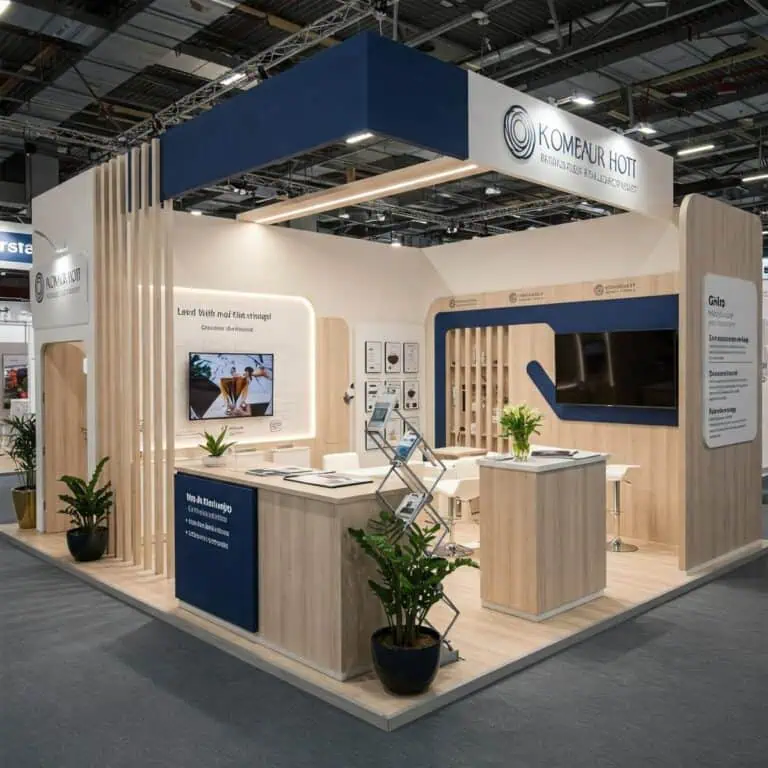
Adam Expo Stand’s design team resolved this brief through a combination of beMatrix profiles finished in a matte anthracite powder coat, tension fabric graphic panels printed with high-resolution nature photography, and integrated LED accent lighting in a warm amber spectrum. The frame’s angular geometry — deliberately asymmetric to avoid the boxy uniformity common to modular stands — was configured with a recessed reception desk area, an open product display wall, and a semi-enclosed meeting pod using a curved beMatrix arch component. The result read as a custom-built environment to visitors, while the structural system underneath was fully modular and reusable.
Our exhibition stand design team produced a full 3D render for client approval before any material was ordered, allowing geometry, graphic content, lighting colour temperature, and traffic flow to be evaluated digitally. Revisions were completed in a single iteration — a reflection of the precision that the beMatrix grid system enables during the design phase, where every element locks onto the 500 mm module and leaves no room for ambiguous measurements. For additional insight into the design thinking behind this type of project, our in-depth guides on Medium at adamexpostand.medium.com cover the full creative process in detail.
Sustainability Benefits of the beMatrix System
Sustainable stand construction has moved from a differentiating preference to a procurement requirement for a growing share of European exhibitors. A 2024 survey by EXHIBITOR Magazine found that 61% of European marketing managers now list environmental impact as a formal criterion when briefing exhibition stand contractors — up from 34% in 2021. The Aluvision beMatrix system addresses this requirement structurally, not cosmetically.
The primary sustainability mechanism is the reuse rate of the aluminium frame. Aluminium production is energy-intensive, but once manufactured, aluminium profiles can be deployed, stored, and redeployed hundreds of times with no loss of structural integrity (European Aluminium Association, 2024). Across a five-event deployment cycle, a beMatrix stand built by Adam Expo Stand eliminates the production of an equivalent custom-fabricated structure at events 2–5 — a carbon saving of approximately 2.4 tonnes of CO₂ equivalent per 36 m² stand based on materials-phase lifecycle analysis.
Secondary sustainability gains come from the graphic system. Tension fabric panels are digitally printed on recyclable polyester and can be replaced between events while the frame is maintained. Rigid dibond panels, where used, are recoverable at end-of-life through European aluminium recycling streams. Compared to a traditional MDF-based custom stand — where 60–80% of the structure is typically skipped after a single show — the beMatrix system represents a fundamental shift in the material economics of exhibition participation (CEIR Sustainability in Trade Shows Report, 2024). Subscribers to our Substack newsletter at substack.com/@adamexpostand receive regular updates on sustainable stand specification practices as European regulations evolve.
Installation and Logistics at IFEMA Madrid
Installation logistics at IFEMA Madrid follow a structured access schedule managed by the venue’s Logistics and Technical Services department. Exhibitors in the halls assigned to Cinegetica typically receive rigging and build access from 08:00 on the first build day, with the venue enforcing a hard deadline for structural completion — normally 18:00 on the day before public opening. For a 36 m² modular stand with a 3.5-metre tower element, the Adam Expo Stand installation team allocated one full build day with a crew of four technicians.
The beMatrix system’s tool-free assembly is not merely a marketing claim — it directly translates to measurable time savings on the exhibition hall floor. Our installation team for the Cinegetica project completed the full structural assembly of the frame in 4.5 hours, with graphic panel installation and lighting rigging adding a further 3 hours. Total installation time: 7.5 hours from van arrival to stand completion. A comparable custom-fabricated stand of the same dimensions would typically require 14–18 hours of installation time, depending on complexity (Based on Adam Expo Stand’s experience across 639+ European projects).
IFEMA Madrid imposes specific regulations on stand construction: maximum height is determined by pavilion allocation, all electrical installations must comply with Spanish technical standards (Real Decreto 842/2002, Reglamento Electrotécnico para Baja Tensión), and all structural elements above 2.5 metres must be accompanied by a stamped technical drawing from a qualified engineer. Adam Expo Stand’s project management team handled all documentation, liaised with the IFEMA technical services office, and coordinated direct delivery of the beMatrix component flight cases from our Madrid warehouse to the loading bay — a logistics sequence refined across dozens of IFEMA Madrid projects.
ROI and Long-Term Cost Advantages of Modular Stands
Return on investment for exhibition stand investment is measured across three dimensions: the cost of the stand itself, the quality of brand experience delivered to visitors, and the efficiency of deployment across multiple events. Modular stands with systems like beMatrix outperform custom-fabricated stands on the first and third dimensions, and — when designed with the same rigour — match or exceed them on the second.
For the Cinegetica project, the initial investment in the beMatrix frame and graphics was approximately 18% higher than an equivalent single-use MDF custom stand. However, from the second event onward, the stand is redeployed with only the cost of transport, storage, new graphics (where the brief changes), and installation labour. Over a five-event cycle, the per-event cost of the beMatrix stand falls to approximately 31% of the per-event cost of specifying a new custom stand each time — a saving that compounds with each additional exhibition (Based on Adam Expo Stand’s project cost data, 2024).
The quality of visitor experience — measured through dwell time, lead capture volume, and post-show survey feedback — was consistent with custom-stand benchmarks for the client’s sector. Dwell time at the Cinegetica stand averaged 6.2 minutes per qualified visitor, above the 4.1-minute average recorded by the client at a comparable show the previous year using a traditional shell-scheme booth. Follow us on LinkedIn for regular data reports and case studies from our European exhibition portfolio.
How to Choose Between Custom and Modular for Your Next Exhibition
Choosing between a custom-fabricated stand and a modular system like beMatrix depends on four primary variables: exhibition frequency, budget cycle, brand flexibility requirements, and logistical complexity. There is no universal answer — but there is a clear decision framework that Adam Expo Stand applies when advising clients across all sectors and all European venues.
- Exhibition frequency: If you exhibit at three or more events per year, a reusable modular system almost always delivers better total cost of ownership than specifying a new custom build each time. The crossover point — where modular becomes cheaper in total than repeated custom builds — typically occurs between the second and third event in the cycle.
- Budget cycle: Custom stands require a larger upfront capital expenditure but minimal ongoing spend. Modular stands spread cost more evenly across events. If your marketing budget is allocated annually with a single stand line item, custom may suit your accounting structure better — even if modular wins on total cost.
- Brand flexibility: If your product range, messaging, or visual identity changes significantly between shows, a modular system with a replaceable graphic skin (as the beMatrix system provides) is strongly advantageous. A custom stand designed around a specific campaign may become difficult to adapt without significant new fabrication.
- Logistical complexity: Custom stands are typically disassembled and disposed of after each event, which simplifies storage but eliminates reuse value. Modular stands require a storage solution between events — either in-house or with your stand contractor. Adam Expo Stand offers stand storage and logistics management from our Madrid facility for clients operating in the Spanish market.
- Stand size and ambition: Very large stands (above 100 m²) and stands requiring complex two-storey configurations are sometimes more efficiently executed as hybrid structures — a custom-designed floor plan and feature elements combined with a modular structural system like beMatrix for the main wall and ceiling framework.
- Venue regulations: Different venues impose different constraints on modular systems. IFEMA Madrid, Fira Barcelona, and Messe Frankfurt all permit beMatrix-type systems with appropriate structural documentation. Always verify venue technical requirements before committing to a system specification.
Expert Tips from Adam Expo Stand’s Design Team
After 15 years and 639+ stands built across Europe, here’s what our designers want every exhibitor to know about modular stands with beMatrix:
- Plan your graphic layers separately from your structure: The greatest mistake modular stand buyers make is treating the graphic content and the frame as a single specification decision. Design your frame first for geometry and traffic flow, then design your graphics as a separate layer. This gives you maximum reuse flexibility — the frame stays identical across events while the graphics update to reflect each show’s campaign.
- Invest in a quality LED lighting specification: The beMatrix system accepts integrated LED strip and spot lighting that dramatically elevates the visual quality of tension fabric graphics. Backlighting a 1,000 mm × 2,000 mm fabric panel costs approximately €180–240 in LED components and transforms the graphic from flat print to luminous feature. At crowded trade fairs like Cinegetica or FITUR IFEMA, this investment in luminance is one of the highest-ROI decisions in the stand specification.
- Store your frame components in indexed flight cases: The beMatrix system ships in purpose-designed ATA flight cases with foam-cut component positions. Investing in proper indexed storage — where each case contains a specific subset of profiles and connectors, labelled by stand zone — reduces installation time on subsequent deployments by 20–30% and prevents component loss between events.
- Schedule a post-show debrief within 72 hours: The most valuable time to reconfigure your modular stand brief is immediately after the show, while spatial memories are fresh. Adam Expo Stand schedules a structured debrief call with every modular stand client within 72 hours of event close, capturing feedback on traffic flow, product display effectiveness, and any geometry changes for the next deployment.
See the Aluvision beMatrix System in Action
Recommended Reads
- The Complete Guide to Exhibition Stand Design — How to create a stand that drives results at any trade fair
- Modular Exhibition Stands: Flexibility Meets Impact — Sustainable, reusable solutions for frequent exhibitors
- Full-Service Exhibition Solutions — End-to-end stand management across 50+ European trade fairs
Aluvision vs beMatrix: Comparing Modular Exhibition Stand Systems
A common question among exhibitors evaluating reusable modular systems is aluvision vs bematrix — which system offers better value, versatility, and finished appearance for exhibition stands? Both are premium European aluminium framing systems widely used across European trade fairs, but they differ in key ways. Aluvision uses a square-frame grid system with rigid aluminium profiles, offering excellent structural stability and a wide range of compatible accessories. beMatrix uses a similar aluminium grid concept but is particularly known for the seamless edge-to-edge finish of its bematrix panels — fabric-filled graphic panels that snap directly into the frame without visible mounting hardware.
beMatrix vs Aluvision: Which System Is Right for Your Exhibition?
When comparing bematrix vs aluvision, the choice often comes down to aesthetic preference and reuse logistics. beMatrix tends to produce a cleaner, more seamless finished look — its magnetic panel system allows quick graphic swaps between events without specialist tools, making it popular for brands that attend many shows and need to update messaging frequently. Aluvision offers a slightly broader range of structural configurations and connector options, making it well-suited for complex builds with unusual geometries. Both systems support double-deck configurations, are CE certified for European venues, and provide storage cases that protect components during freight.
Frequently Asked Questions
What is Cinegetica and where is it held?
Cinegetica is Spain’s premier fair for hunting, fishing, arms, and outdoor leisure, held annually at IFEMA Madrid — one of Europe’s largest exhibition venues with over 200,000 m² of covered space across twelve pavilions. The event draws over 40,000 professional and consumer visitors across its three-day programme, making it the leading platform for brands in the hunting, fishing, wildlife management, and outdoor sports sectors. Adam Expo Stand has designed and constructed exhibition stands for clients participating in Cinegetica and numerous other IFEMA Madrid events.
What is the Aluvision beMatrix frame system and how does it work?
The Aluvision beMatrix is a patented modular aluminium frame system used for building reconfigurable exhibition stands. It consists of precision-machined aluminium profiles in standard lengths (500 mm to 2,000 mm) connected by multi-axis aluminium nodes that accept profiles in X, Y, and Z directions without tools beyond a rubber mallet. Graphic panels — fabric tension graphics, rigid panels, or LED backlit films — slide directly into the profile grooves. The system can be disassembled, stored, and redeployed across multiple events, making it one of the most sustainable and cost-efficient stand systems available to European exhibitors.
How does a beMatrix modular stand compare in cost to a custom-built stand?
For a first event, a beMatrix modular stand typically costs 15–20% more than a comparable single-use custom MDF stand due to the quality of the aluminium components. However, from the second event onward, the reuse of the existing frame means per-event costs fall to transport, storage, new graphics (if the campaign changes), and installation labour only. Over a five-event cycle, the per-event cost of a beMatrix stand is approximately 31% of the cost of specifying a new custom stand for each event. Adam Expo Stand provides detailed cost modelling for clients evaluating this decision.
Is the beMatrix system permitted at IFEMA Madrid and other European venues?
Yes — the beMatrix modular system is fully permitted at IFEMA Madrid, Fira Barcelona, Messe Frankfurt, Messe Düsseldorf, ExCeL London, and Fiera Milano, among other major European venues. As with all structural stand systems at heights above 2.5 metres, Spanish venue regulations (and equivalent standards in Germany, the UK, and Italy) require a stamped technical drawing from a qualified structural engineer. Adam Expo Stand manages all technical documentation, liaising directly with venue technical services offices to ensure full compliance for every project.
How sustainable is a modular stand compared to a traditional custom stand?
A beMatrix modular stand is significantly more sustainable than a single-use custom stand over a multi-event deployment cycle. The aluminium frame can be reused hundreds of times with no structural degradation, avoiding the production of new materials at each event. Over five exhibitions, a 36 m² beMatrix stand eliminates approximately 2.4 tonnes of CO₂ equivalent in avoided materials production compared to specifying a new custom-fabricated structure each time (lifecycle analysis based on European Aluminium Association data). Tension fabric graphics are printed on recyclable polyester and replaceable between events without replacing the frame.
How long does it take to install a beMatrix modular stand at IFEMA Madrid?
For a 36 m² modular stand with a 3.5-metre tower feature element, Adam Expo Stand’s installation crew of four technicians completed full structural assembly at IFEMA Madrid in 4.5 hours, with graphics and lighting adding a further 3 hours — total installation time of 7.5 hours. A comparable custom-fabricated stand of the same dimensions typically requires 14–18 hours of installation time. IFEMA Madrid provides build access from 08:00 on the first build day, with a hard structural completion deadline typically set for 18:00 on the day before public opening. Adam Expo Stand’s modular project teams consistently complete within the venue’s build schedule.
About the Publisher
This article was produced by Adam Expo Stand Trade Show Booth Design and Build, a European exhibition stand specialist with 20+ years of experience and 639+ stands constructed across Spain, France, Germany, the United Kingdom, and Italy. Serving exhibitors at IFEMA Madrid, Fira Barcelona, Messe Frankfurt, Messe Dusseldorf, ExCeL London, and Fiera Milano. adamexpostand.com · LinkedIn · Medium
Ready to Create Your Perfect Exhibition Stand?
Get a free consultation and 3D design concept from Adam Expo Stand Trade Show Booth Design and Build — Europe’s trusted exhibition stand specialist for IFEMA Madrid, Fira Barcelona, Messe Frankfurt, and 50+ European trade fairs.