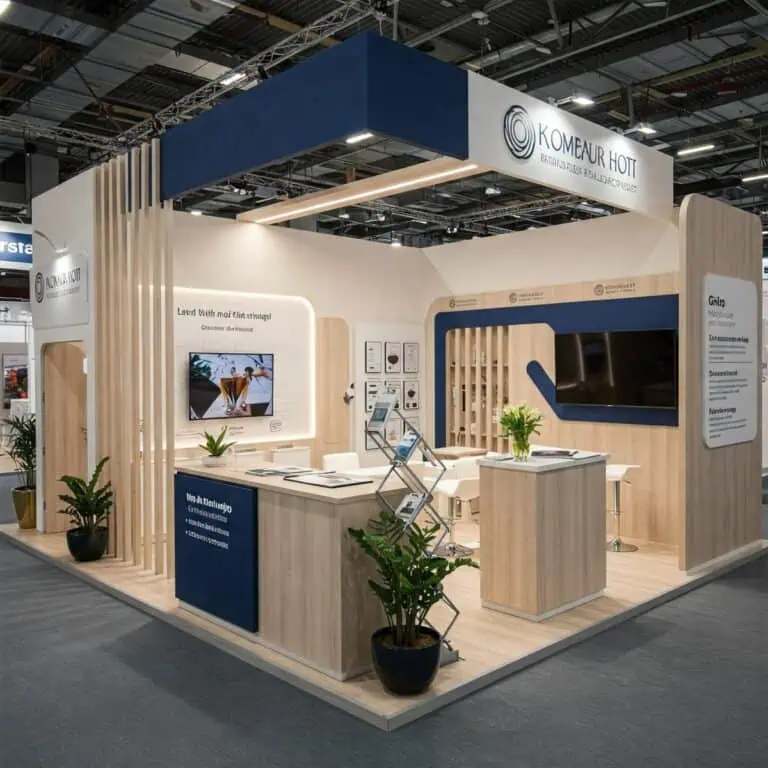
Choose an exhibition stand contractor in Germany by comparing the proposed delivery team, relevant work and complete project scope. Give every bidder the same event details, plot plan and equipment list. Confirm who handles venue submissions, technical services, installation, handover and dismantling, then assess the quotation against those responsibilities rather than the rendering alone.
Define what your exhibition stand contractor in Germany must deliver
Start with the exact event, city, venue and hall. Germany’s exhibition venues do not share one universal set of stand rules or access arrangements. A contractor should explain how the current organiser manual and venue requirements affect your actual proposal.
List the visitor activities: a product demonstration, distributor meetings, a launch presentation or short enquiries. Include exhibit dimensions, weights, operating requirements and the number of people working on the stand. These details are more useful than asking for an unspecified “high-impact booth”.
Identify the decisions still open. You may be comparing rental and ownership, considering a different footprint or waiting for an equipment specification. Ask bidders to state their assumptions so an early estimate is not mistaken for a final fixed scope.
Request evidence relevant to your project
Look for completed work of comparable size and complexity. Ask which parts the proposed contractor designed, produced, installed or managed. A portfolio photograph can show the result, but it does not identify every supplier’s role.
Useful evidence includes a clear description of the delivery team, an example project schedule and references that the supplier is authorised to share. Ask how artwork, technical review and client changes are managed. Avoid judging capability solely by the number of countries named on a website.
Where a supplier makes performance claims, ask for the basis and context. Increased attendance may reflect a different event, location, product launch or marketing campaign. A stand photograph alone cannot substantiate a claim about leads, sales or return on investment.
Check the venue and event requirements
As one venue-specific example, the Messe Frankfurt stand-constructor portal provides technical guidelines, approval information and factsheets. It explicitly says that different technical guidelines may apply to particular events. Its provisions should not be treated as rules for every exhibition in Germany.
Ask the contractor to identify the current documents for your event and the features of the design that need review or permission. Confirm the submission deadline, required plans and who coordinates any structural or specialist assessment. Do this before committing to a construction feature that depends on approval.
Keep a record of the approved design and conditions. If the design changes after submission, ask whether the approval needs updating. A prior accepted stand at another fair is useful experience, not automatic permission for the new build.
Compare construction formats against the brief
Custom construction
Consider custom elements when the product, layout or brand presentation requires them. Ask which components are made for this project and which can be used again. “Custom” does not necessarily mean that every item must be discarded after one event.
Modular structures
Review the proposed system and actual configuration. Check wall positions, services, graphic sizes and equipment access. Ask the supplier to demonstrate how the components would work at another planned event rather than assuming unlimited reconfiguration.
Rental or ownership
Compare the complete event programme, including transport, storage, condition checks, repairs and new graphics. Rental may suit a particular brief, while ownership may suit another. The number of shows alone does not determine the better choice.
The bespoke stand guide provides further questions about matching the structure to the intended activities.
Use a responsibility table for every quotation
| Work package | Confirm before appointment |
|---|---|
| Design and artwork | Deliverables, review stages, file requirements and approval authority. |
| Technical review | Plans, venue submissions, specialist assessments and associated fees. |
| Production and supply | Structures, finishes, graphics, furniture, lighting and hired equipment. |
| Venue services | Ordering and payment responsibilities for power, rigging, connectivity and handling. |
| Installation and handover | Access arrangements, sequence, acceptance checks and issue resolution. |
| After the fair | Dismantling, return freight, storage, refurbishment and waste responsibilities. |
Mark each item as included, excluded or awaiting confirmation. Check who contracts with third-party providers and who authorises additional costs. A broad phrase such as “full service” is not sufficiently precise for comparing bids.
Confirm the quotation’s currency, applicable taxes, payment stages, validity and change process. Use the exhibition budget guide to distinguish construction from other participation costs.
Coordinate equipment and logistics
Give the contractor the actual equipment schedule, not just a photograph of the product. Include handling instructions, access clearances and technical information supplied by the manufacturer. Identify exhibits that must be positioned before walls or counters close around them.
Confirm the venue’s vehicle registration, delivery and unloading process for the event. Allocate responsibility for transport, customs where relevant, lifting services and empty-case storage. A carrier’s delivery estimate does not establish that the hall is available for installation at that time.
For an international shipment, use a controlled inventory and an agreed return plan. The exhibition shipping and customs guide helps organise those discussions with the freight partner.
Agree milestones and acceptance checks
Set dates for the approved brief, design freeze, technical submission, artwork, production release and handover. Build the schedule around the actual event deadlines and available supplier capacity. A universal lead time cannot cover every project.
At handover, check the installed stand against the agreed scope. Test lighting, screens and demonstrations, confirm usable storage and review visitor circulation. Record unfinished items and the person responsible for resolving them before opening.
Define the contracted support arrangement, including hours, contact person and escalation process. If a technician is required on site throughout the show, include that explicitly. Avoid assuming continuous support from a general statement about service.
Assess reuse with specific information
Ask what will be retained, where it will be stored and how its condition will be assessed. Compare transport distance, repairs and adaptation with the next venue’s needs. Use specific material or component information in environmental descriptions instead of calling the entire project harmless or automatically sustainable.
After the event, record installation problems, worn components and useful changes for the next configuration. Keep these operational findings separate from commercial results such as meetings or enquiries. Both can inform a future brief without implying that the stand alone caused a sales outcome.
Frequently asked questions
Does a German venue accept a design approved elsewhere?
Do not assume so. Have the contractor check the current venue and event requirements for the proposed configuration.
What should be included in a contractor comparison?
Compare relevant delivery evidence, design and production scope, technical responsibilities, installation, support and end-of-event arrangements using the same brief.
Is a modular stand always the cheapest option?
No. The configuration, equipment, transport, graphics and service needs affect the total. Compare actual quotations for the programme you plan to run.
Request a scoped proposal
Discuss your exhibition stand in Germany with Adam Expo Stand. Send the event, plot plan, equipment list, visitor activities and budget range. Ask the proposal to identify the delivery scope, venue-service responsibilities and schedule through dismantling.
Follow our exhibition planning guides
Choose Adam Expo Stand as a preferred source to help you find our exhibition guides and updates on Google.
Add as a preferred source on GoogleGoogle may ask you to sign in and confirm your choice.