How to create custom expo stands that maximize impact

TL;DR:
- Custom expo stands outperform generic rentals by capturing more qualified leads and increasing brand recall.
- Strategic goal-setting, audience profiling, and design pillars are essential for effective stand success.
- Modular systems offer long-term cost efficiency, reusability, and near-custom visual qualities for recurring events.
At major European trade shows, the average exhibitor competes with hundreds of brands for the same visitor attention. Your stand is not just a display structure; it is a three-dimensional billboard and a strategic launchpad for every conversation, lead, and partnership you generate on the show floor. Brands that invest strategically in custom expo stands consistently outperform those relying on generic rental solutions, capturing more qualified leads and building stronger recall. This guide covers every critical step, from goal-setting and stand type selection to compliance, design principles, and ROI measurement, giving marketing and brand managers a clear, actionable framework for their next European event.
Table of Contents
- Define your objectives and audience
- Choose the right stand type and materials
- Design principles for high-impact expo stands
- Compliance, approvals, and practical execution
- What most guides miss: ROI, modular strategy, and next-gen design
- Take your expo presence to the next level
- Frequently asked questions
Key Takeaways
| Point | Details |
|---|---|
| Clarify your goals | Starting with clear objectives and KPIs ensures your custom expo stand drives measurable results. |
| Select stand type wisely | Choose the format and materials that fit both your budget and your sustainability priorities. |
| Integrate design pillars | Applying sight-line dominance, openness, and technology boosts visitor engagement and brand storytelling. |
| Stay compliant | Advance planning for European regulations, fire safety, and structural requirements avoids costly delays. |
| Maximize ROI | Strategic use of custom or modular stands delivers up to 40% better returns and sustainable logistics. |
Define your objectives and audience
Every high-performing custom expo stand begins long before any designer opens a software file. It starts with a precise understanding of what you need to achieve and who you are trying to reach. Without this foundation, even the most visually striking stand risks becoming an expensive backdrop with no strategic purpose.
The stand design foundations process is built on goal clarity first. Before briefing any contractor, define your objectives using the SMART framework: Specific, Measurable, Achievable, Relevant, and Time-bound. For example, “capture 200 qualified leads per day” is actionable; “increase brand awareness” is not. Your goals should directly inform every design and layout decision that follows.
Visitor profiling is equally important. Most European trade show floors attract a mix of:
- Senior buyers and procurement managers who need private meeting spaces and product demonstrations
- Technical influencers and engineers who respond to hands-on product interaction and detailed specifications
- Press and analysts who require clear brand messaging and quick access to media kits
- Competitor intelligence gatherers who will observe your positioning whether you plan for it or not
Knowing which profiles dominate your target event shapes every spatial and experiential decision. The process to create custom expo stands involves defining goals and audience, selecting the right stand type, and designing around five strategic pillars, making goal clarity the non-negotiable first step.
For large stand goals, the stakes are even higher. A 200-square-meter island stand at Messe Frankfurt demands a documented brief that includes lead capture KPIs, preferred visitor flow, required meeting room capacity, and specific product zones.
Pro Tip: Write a one-page creative brief before contacting any contractor. Include your KPIs, visitor profiles, preferred stand type, floor plan constraints, and three brand values you want visitors to feel. This document alone will save weeks of revision cycles.
Choose the right stand type and materials
Once your objectives are clear, choosing the right stand type and materials is the next critical step. This decision affects your budget, visual impact, compliance requirements, and long-term cost efficiency across multiple events.
European trade shows typically accommodate four primary stand configurations. Here is a direct comparison:
| Stand type | Visual impact | Typical cost range (EUR) | Best for |
|---|---|---|---|
| Inline | Moderate | 8,000 to 50,000 | First-time exhibitors, tight budgets |
| Corner | Good | 15,000 to 70,000 | Growing brands with two open sides |
| Peninsula | High | 40,000 to 150,000 | Product-heavy brands needing depth |
| Island | Maximum | 50,000 to 500,000 | Flagship presence, large product lines |
As modular vs custom analysis shows, modular systems reduce per-event costs by 30 to 50% and can lower three-year total cost by 40 to 50% compared to fully custom builds replaced each cycle.
Material selection drives both aesthetics and sustainability performance. Key options include:
- Aluminum extrusion systems: Lightweight, reusable, and easy to reconfigure for different floor plans
- Tension fabric graphics: Vibrant, lightweight, and simple to ship and replace between events
- Timber and composite panels: Premium finish for flagship stands, higher weight and drayage costs
- Recycled and FSC-certified materials: Increasingly required by venues and preferred by corporate sustainability policies
Sustainability is no longer optional. 67% of exhibitors prioritize reusability and sustainable materials when specifying their stands. Explore eco-friendly stand materials and the 2026 sustainability guide for certified options that meet both brand and venue requirements.

Pro Tip: Modern modular systems now achieve near-custom visual quality through precision printing and architectural framing. If you exhibit at three or more events annually, a well-designed modular system almost always delivers superior ROI compared to a single-use custom build.
Design principles for high-impact expo stands
After selecting your stand type and materials, detailed design is where your brand’s story comes alive. Effective stand design is not decoration; it is a structured communication system that guides visitors through a deliberate experience.
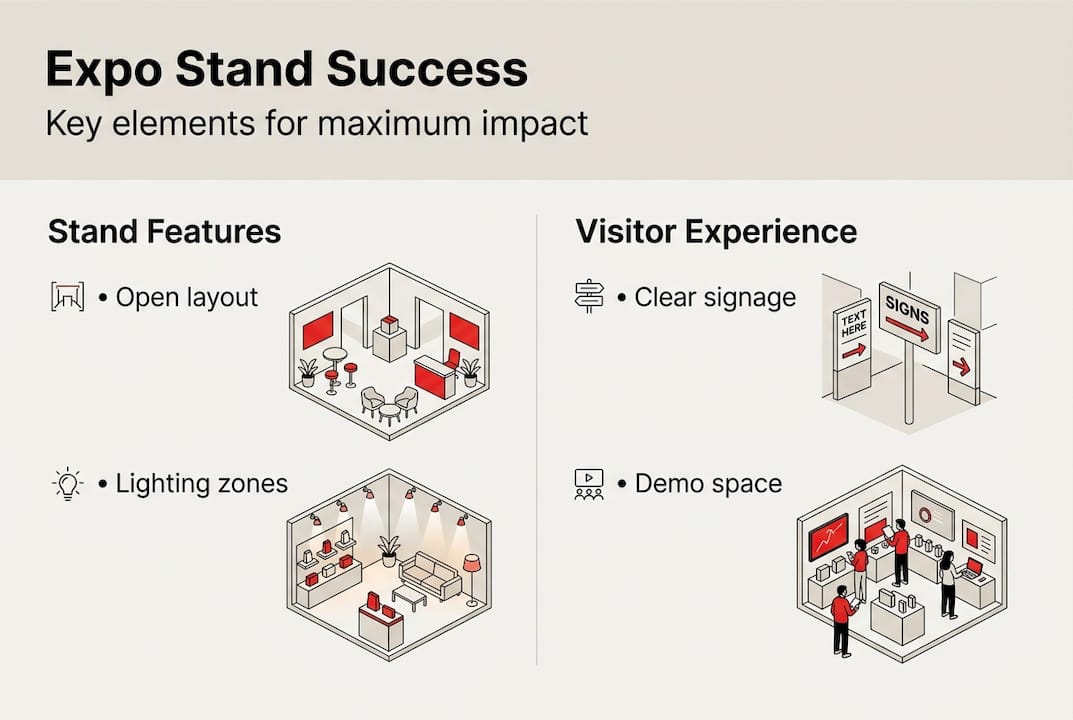
The five design pillars for custom expo stands are:
- Sight-line dominance: Your stand should be visible from at least 15 meters away. Elevated brand marks, bold color blocking, and vertical structures achieve this in crowded halls.
- Openness: Open perimeters increase foot traffic significantly. Closed or walled designs create psychological barriers that reduce spontaneous entry.
- Brand storytelling: Every graphic, material, and product placement should reinforce a single brand narrative, not a catalog of features.
- Technology integration: AR and VR experiences, LED walls, and interactive touchpoints create phygital (physical plus digital) engagement that extends well beyond the event.
- Operational efficiency: Staff flow, storage placement, and meeting room positioning must be planned before aesthetics, not after.
Visitor zones are a practical framework for design for large stands. Structure your space into three areas:
- Attraction zone: The outer perimeter, optimized for visual impact and passive brand messaging
- Engagement zone: Interactive product displays, demonstrations, and technology experiences
- Conversion zone: Private meeting areas where qualified conversations close
Minimalism boosts comprehension by 60%, and a structured three-zone visitor flow measurably improves conversion rates. Less visual noise means your core message lands faster and with greater clarity.
“Brief contractors with your KPIs, floor plans, and venue restrictions before any design work begins. Retrofitting compliance requirements into a finished design costs significantly more than building them in from the start.”
Data-driven design decisions also matter. Consider this performance comparison:
| Design feature | Impact on visitor engagement |
|---|---|
| Open perimeter layout | Up to 40% more spontaneous entries |
| Minimalist graphics | 60% improvement in message comprehension |
| Interactive technology | 3x longer average dwell time |
| Private meeting zones | 2x higher lead quality scores |
Compliance, approvals, and practical execution
With your stand designed, it is time to ensure full compliance and smooth execution for ROI. Regulatory requirements across European venues are detailed, venue-specific, and non-negotiable. Missing a deadline or failing a fire safety inspection can result in stand dismantlement on the day of the event.
European regulations require stand plan approvals 4 to 8 weeks before the event, with fire safety certifications, venue height limit compliance, and structural load calculations included in most submissions. Complex stands at venues like Messe Berlin require at least 6 weeks lead time.
Key compliance steps include:
- Submit scaled floor plans and elevation drawings to the venue’s technical department
- Provide fire safety certifications for all materials (DIN 4102-B1 standard in Germany)
- Confirm height restrictions, which vary significantly across European venues
- Include structural engineer sign-off for any suspended elements or multi-story structures
- Obtain electrical installation plans approved by the venue’s official contractor
For a practical execution checklist, follow this sequence:
- Confirm stand space allocation and floor plan from the organizer
- Submit design drawings and material certifications to the venue
- Receive written approval before ordering any fabrication
- Coordinate logistics, including drayage weight limits and delivery windows
- Brief your onsite team on setup sequence, visitor engagement protocols, and lead capture procedures
Venue-specific compliance is strictest in Germany and Italy, where regulations cover everything from material labeling to contractor accreditation. Review the expo stand FAQs for venue-specific guidance before finalizing any design.
“Enclosed stands see 30% less visitor entry compared to open-perimeter designs. Compliance requirements and visitor psychology both point in the same direction: keep your stand open, accessible, and inviting.”
Staff fatigue is an often-overlooked execution factor. Plan shift rotations, designate rest areas away from the visitor floor, and brief your team on energy management for multi-day events.
What most guides miss: ROI, modular strategy, and next-gen design
Most exhibitor guides focus on aesthetics and logistics. The strategic conversation that actually separates top-performing brands from average ones centers on ROI architecture and long-term modular investment.
Custom stands yield 35 to 40% better returns compared to previous solutions, and well-designed modular systems achieve near-custom visuals for brands exhibiting at recurring events. Yet most marketing teams still treat each event as an isolated project, rebuilding from scratch and absorbing unnecessary costs.
The smarter approach is to design for annual reuse from the first brief. A modular system engineered with reconfigurable panels, interchangeable graphics, and scalable footprints reduces storage costs, simplifies logistics, and cuts staff setup time across every subsequent event. Explore future modular strategies to see how leading European brands are structuring their multi-year exhibition programs.
The trends shaping next-generation stand design right now include:
- Phygital integration: Blending physical stand architecture with digital AR and VR layers
- Minimalist brand storytelling: Fewer messages, greater impact, faster comprehension
- Circular material strategies: Stands designed for disassembly, reuse, and certified recycling
Investing in eco-friendly design is no longer just a sustainability checkbox. It is a procurement advantage, a brand differentiator, and increasingly a venue requirement across major European exhibition centers.
Pro Tip: Design your stand system for a three-year lifecycle. Map out which panels, graphics, and structures will remain constant and which will rotate. This single planning step reduces your per-event cost more than almost any other decision.
Take your expo presence to the next level
Applying these strategies requires more than a checklist; it requires a partner who understands European venue regulations, sustainable material sourcing, and the design principles that convert visitors into qualified leads. Adam Expo Stand Solutions delivers tailored support across every phase of your project, from initial concept and 3D design to technical compliance submissions and full onsite installation. Whether you are planning a flagship island stand at a major European trade show or a modular system for a multi-event annual program, explore custom stand solutions that align with your brand goals, budget, and sustainability commitments. One-on-one design consultation is available for new and returning clients.
Frequently asked questions
What are the main types of custom expo stands?
The main stand types are inline, corner, peninsula, island, and hybrid configurations, each offering different levels of visual exposure, visitor access, and spatial flexibility depending on your event goals.
How far in advance do I need to submit plans for expo stand approval?
European venues require plan submissions 4 to 8 weeks before the event, and complex stands at major venues like Messe Berlin require at least 6 weeks to allow for structural review and fire safety certification.
How can custom expo stands maximize ROI?
Custom stands generate up to 40% better ROI compared to standard solutions by combining strategic visitor flow, immersive brand storytelling, and focused conversion zones that qualify leads more efficiently.
What sustainability factors should I consider?
Prioritize reusable modular structures and certified materials such as tension fabrics and FSC-rated composites; 67% of exhibitors now rank reusability and sustainable materials as primary selection criteria for their stand specifications.
Are modular stands a good option for multiple events?
Modular systems are ideal for recurring event programs, reducing per-event costs by 30 to 50% over time while delivering near-custom visual quality and significantly simpler logistics compared to fully custom builds.