


Last updated:
Quick answer: FITUR Madrid runs 20-24 January 2027 at IFEMA Madrid and is organised into named programs, including FITUR TechY, FITUR Know-How & Export, FITUR 4all, FITUR Screen and FITUR Talent, each with its own audience and hall zone. A 9-12 sqm FITUR TechY demo stand and a 40 sqm+ institutional Know-How & Export stand need different footprints, budgets and lead times, so matching your stand brief to the right program is the first decision, not an afterthought.
What are FITUR Madrid’s specialized exhibitor programs?
FITUR groups its exhibitors into named programs rather than treating the fair as one undifferentiated hall of travel companies. Current programs include FITUR TechY (travel technology and startups), FITUR Know-How & Export (institutional, consultancy and knowledge-exchange exhibitors such as tourism boards), FITUR 4all (accessible tourism), FITUR Screen (film-induced tourism), FITUR Sports, FITUR Woman, FITUR LGBT+, FITUR Cruises, FITUR Lingua and FITUR Talent (careers and education). Each program has a distinct visitor profile, and IFEMA regularly adds or reshapes sections, including the new Knowledge Hub added in Hall 12 for the 2026 edition, so the list is worth checking against the current edition before you brief a stand designer.
Quick check: FITUR program readiness
A 12-person travel-tech startup wants a demo-friendly stand at FITUR 2027. Which program and rough footprint fits best?
- What FITUR 2027 is and why its program structure matters
- FITUR’s specialized programs at a glance
- FITUR TechY: designing a stand for travel-tech and startups
- Tourism boards, DMOs and FITUR Know-How & Export
- FITUR 4all, Screen, Sports and Woman: niche-program stands
- Realistic budget and lead time by exhibitor type
- Which program and stand strategy fits your situation?
- Turning a program-aligned stand into qualified leads
Most FITUR exhibitor guides, including the ones already on this site, are written for “a” FITUR exhibitor in general: one set of costs, one set of build rules, one generic booth. That works if every exhibitor at FITUR wanted the same thing, but they do not. A three-person travel-tech startup demoing a booking engine and a regional tourism board sharing a pavilion with twelve municipalities are both technically “exhibiting at FITUR,” and a stand brief written for one is close to useless for the other.
Get the program match wrong and the cost is not abstract. A startup that books a 60 sqm custom stand built for an institutional pavilion overspends on space it cannot fill with meetings, while a tourism board squeezed into a 9 sqm TechY-style pod has nowhere to host the trade appointments its own delegation flew in for. Both mistakes get made every January at IFEMA, usually because the stand brief was written before anyone checked which FITUR program the exhibitor actually belongs to.
This guide works the other way round: it starts from FITUR Madrid’s own program structure and works out what each one implies for footprint, budget range, build timeline and staffing, so that by the end you can brief a FITUR Madrid exhibitor program stand that matches how your specific segment of the fair actually behaves, not a generic average of it.
What FITUR 2027 is and why its program structure matters
FITUR 2027 runs 20-24 January 2027 at IFEMA Madrid, drawing more than 10,000 exhibiting companies from 161 countries across an expanded 11-hall footprint, with roughly 155,000 trade visitors over the professional days and around 100,000 members of the public on the closing weekend (IFEMA Madrid). Puerto Rico is confirmed as the 2027 partner country, which typically brings a dedicated national pavilion and a wave of Caribbean tourism-board delegations into the halls around it.
That scale is exactly why IFEMA organises FITUR into named programs instead of one undifferentiated tourism hall. A show this size, split across roughly 11 halls, needs a way to route a travel-tech investor toward the startups and a DMO’s trade buyer toward the national pavilions without either of them wading through unrelated stands. The program a stand sits in shapes who walks past it, which is a bigger design input than the stand’s own graphics.
For the general FITUR 2027 cost breakdown, build-up windows and hall-by-hall floor-plan detail that apply across every program, see our FITUR 2027 Madrid exhibition stand builder guide; this article focuses specifically on how that baseline should flex by exhibitor type.
FITUR’s specialized programs at a glance
FITUR currently runs around ten named programs alongside its general halls, each built around a specific exhibitor type or travel niche rather than geography. Confirming which one your company fits before you brief a stand designer changes the footprint, the staffing plan and the materials that make sense.
| Program | Built for | What it means for your stand |
|---|---|---|
| FITUR TechY | Travel-tech startups and scale-ups | Small footprint, live demo counters, strong signage over floor space |
| FITUR Know-How & Export | Tourism boards, DMOs, institutional and consultancy exhibitors | Larger shared or national stands, meeting rooms, multi-partner branding |
| FITUR 4all | Accessible tourism operators and destinations | Step-free layouts, seating, wheelchair-height counters as standard, not an upgrade |
| FITUR Screen | Film-induced tourism and film commissions | Screening corners, strong AV, location-imagery walls |
| FITUR Sports | Sports tourism boards and event organisers | Room for kit or trophy display, more open circulation |
| FITUR Woman / FITUR LGBT+ / FITUR Cruises / FITUR Lingua / FITUR Talent | Segment- and audience-specific exhibitors and networking | Usually shared pavilion space with a program-branded backdrop rather than a fully custom build |
IFEMA reshapes this list between editions, most recently adding a Knowledge Hub in Hall 12, so confirm the current programme with IFEMA or your Adam Expo Stand contact before locking a floor plan rather than relying on last year’s list.
FITUR TechY: designing a stand for travel-tech and startups
A FITUR TechY stand needs to prove a product works in under two minutes, so the design brief is a demo counter and a screen, not a lounge. FITUR TechY has run for two decades and reached its 20th edition in 2026, and the visitors who seek it out are investors, corporate innovation scouts and OTAs doing rapid comparison shopping across dozens of startups in an afternoon. A stand that makes them queue or search for the pitch loses that visitor to the next aisle.
In practice that means a compact footprint, most often in the 9-12 sqm range, built around one clear demo station, a large single screen visible from the aisle, and standing-height counters rather than seated meeting areas. Storage can be minimal because there is rarely printed collateral to hand out at volume; a QR-linked one-pager does more work than a stack of brochures a five-person team has to carry home.
Key takeaway: a FITUR TechY stand is judged on how fast a stranger can understand the product from the aisle, not on square metres.
Tourism boards, DMOs and FITUR Know-How & Export
FITUR Know-How & Export is where national and regional tourism boards, DMOs and institutional consultancies exhibit, and it behaves like a trade-appointment venue rather than a walk-up retail stand. With 155,000 trade visitors moving through FITUR’s professional days, a tourism board’s real objective is usually a fixed schedule of B2B meetings with tour operators and press, not passing footfall, so the stand has to support that schedule rather than just attract it.
That shifts the design brief toward meeting capacity: at least one enclosed or semi-enclosed meeting area, seating for scheduled appointments, and space for a delegation that often includes municipal or regional partners sharing the same footprint under one national brand. Institutional and multi-partner stands in this program commonly run 40 sqm or larger, which pushes them toward the custom-build cost tier rather than a modular kit, because shared branding and multiple sub-zones are harder to standardise into off-the-shelf modules.
If a country pavilion, rather than a single tourism board’s own stand, is the right structure for your delegation, that is a distinct build discipline in itself; our country pavilion exhibition stand guide covers multi-partner pavilion design and governance in depth, and the IFEMA Madrid exhibitor guide covers the venue-wide badge, parking and build-up rules every stand in any program has to follow.
Our verdict: from our builds for institutional exhibitors at IFEMA, the single most common mistake is sizing the stand to the delegation’s headcount instead of its meeting schedule; a smaller stand with two working meeting rooms outperforms a bigger open stand with none.
FITUR 4all, Screen, Sports and Woman: niche-program stands
FITUR’s smaller named programs each carry one specific design requirement that a generic stand brief will miss, from accessibility to screening capability to open sightlines. Matching that one requirement matters more than adding overall square metres.
FITUR 4all, the accessible-tourism program, expects step-free access and counter heights usable from a seated position as the baseline, not a retrofit added after a complaint. FITUR Screen, built for film commissions and film-tourism boards, rewards a stand with genuine screening capability and strong location photography over generic destination branding. FITUR Sports benefits from open sightlines and room to display equipment or trophies rather than a closed-in booth. FITUR Woman and FITUR LGBT+ are primarily networking and visibility programs, so a shared program-branded pavilion stand with a clear identity usually outperforms a large custom build that visitors have less reason to seek out specifically.
Key takeaway: for the smaller named programs, matching the one design requirement that program is actually known for beats a bigger stand with none of them.
Realistic budget and lead time by exhibitor type
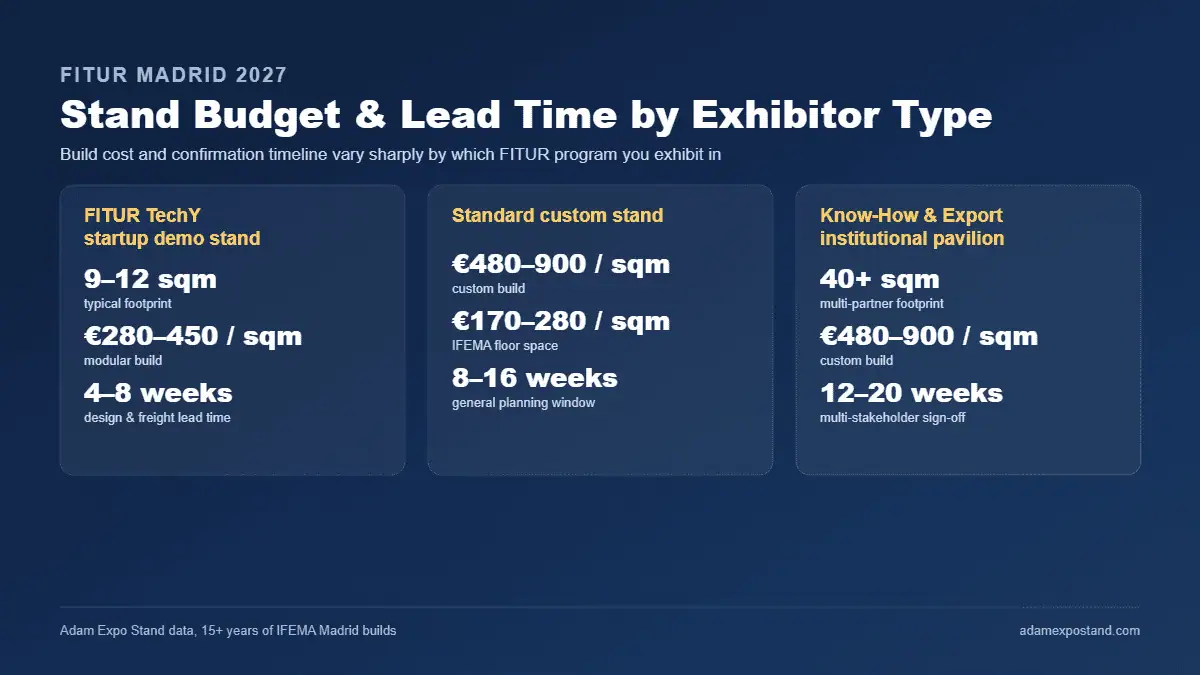
A FITUR stand’s cost sits within the same underlying IFEMA build-cost ranges regardless of program, but which end of that range you land on depends heavily on exhibitor type. Custom stands typically run EUR 480-900 per sqm and modular systems EUR 280-450 per sqm (Adam Expo Stand data from over 15 years of stand builds).
Floor space itself adds roughly EUR 170-280 per sqm and mandatory venue services (electricity, cleaning, security) another EUR 20-40 per sqm, and a premium custom design can reach EUR 600-1,400 per sqm. See our full FITUR 2027 cost and hidden-fee breakdown for the itemised version of those figures.
A 9-12 sqm FITUR TechY demo stand sits at the small end of the modular tier, often close to the EUR 280-450 per sqm rate on a compact footprint, which keeps the total project cost manageable for an early-stage team. A 40 sqm+ institutional Know-How & Export or multi-partner pavilion stand, by contrast, tends to land in the EUR 480-900 per sqm custom-build tier because of the meeting rooms, sub-zones and shared branding it has to carry.
Timelines diverge just as much as budgets. A single-decision-maker TechY startup can often confirm design and freight in 4-8 weeks because there is one signatory and one clear brief. A multi-partner institutional stand routinely needs 12-20 weeks, not because the build itself takes longer, but because sign-off has to move through several municipal or regional stakeholders before a single design can be finalised.
Which program and stand strategy fits your situation?
A five-person travel-tech startup with one product to demo
FITUR TechY, 9-12 sqm, is the right fit. Spend the saved space budget on a stronger demo screen and one dedicated staff member whose only job is running the demo, not managing the stand.
A regional tourism board sharing space with several municipalities
FITUR Know-How & Export, likely 40 sqm or more, built around a meeting-room-first layout. Confirm the delegation’s actual appointment count before sizing the stand; that number should drive square metres more than headcount does.
A destination or operator promoting accessible travel
FITUR 4all. Build step-free access and seated-height service points into the base design rather than the graphics package; visitors to this program are evaluating usability, not just branding.
A first-time exhibitor unsure which program applies
Confirm eligibility with IFEMA before booking space. Programs shift between editions, and a stand briefed for the wrong program’s audience is a bigger risk than a slightly conservative footprint.
Turning a program-aligned stand into qualified leads
A stand that matches its program still needs a deliberate lead-capture plan, because FITUR’s trade days move fast and an unstructured conversation is easy to lose. For a FITUR TechY stand, that means capturing a contact and a one-line note on interest at the point of the demo, not after, since a five-minute queue of the next visitor will otherwise erase the detail. For a Know-How & Export stand, it means a visible appointment schedule at the stand entrance so trade visitors without a booked meeting can still register interest for a follow-up call.
Key takeaway: the lead-capture method should match the program’s own pace, a fast demo log for TechY, a scheduled-meeting board for Know-How & Export, not one generic form for both.
Whichever program you exhibit in, the deadlines and badge, parking and rigging rules are shared across all of FITUR’s halls; our IFEMA Madrid exhibitor guide covers those venue-wide requirements in full.
Insider tips from over 15 years on the show floor
- Ask IFEMA which hall your specific program is assigned to before finalising a design; program locations can shift between editions even when the program name stays the same.
- For shared or multi-partner pavilions, agree the meeting-room count in writing with every partner before the floor plan is drawn, not after.
- Budget freight and customs lead time separately from build lead time; a fast TechY design timeline does not shorten how long equipment takes to clear customs.
Frequently asked questions
When is FITUR 2027?
FITUR 2027 runs 20-24 January 2027 at IFEMA Madrid, with the first days reserved for trade visitors and the closing days open to the general public.
What is FITUR Know-How & Export?
FITUR Know-How & Export is the FITUR program built for institutional exhibitors such as tourism boards, DMOs and consultancy or knowledge-exchange organisations, distinct from the general commercial halls.
Can a small startup afford a FITUR stand?
Yes. A compact FITUR TechY stand of around 9-12 sqm typically sits at the lower end of FITUR’s modular build-cost range, which keeps the total project cost proportionate to an early-stage team’s budget.
Do FITUR’s programs change every year?
Yes, IFEMA periodically adds or reshapes FITUR’s named programs, most recently adding a Knowledge Hub in Hall 12 for the 2026 edition, so confirm the current list before assuming last year’s programs still apply.
What is the FITUR 2027 partner country?
Puerto Rico is confirmed as FITUR 2027’s partner country, which typically brings a dedicated national pavilion and additional Caribbean tourism-board participation.
Does a shared pavilion stand cost less than a standalone stand?
Often per partner, yes, because build and floor-space costs are split across several exhibitors, though the total pavilion budget and the coordination timeline both tend to be larger than a single company’s standalone stand.
Recommended reads
Adam Expo Stand: exhibition stand design and build for European trade fairs. Based in Madrid, serving IFEMA, Fira Barcelona, Messe Frankfurt and 50+ fairs across Europe.
Not sure which FITUR program your stand belongs in?
Get an itemised quote and a 3D concept matched to your exhibitor type from an in-house Madrid build team.


