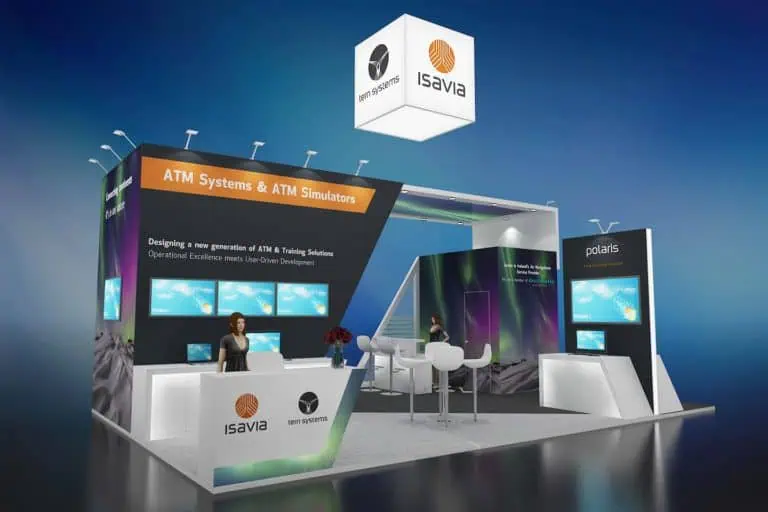
Master event booth setup for maximum trade show impact
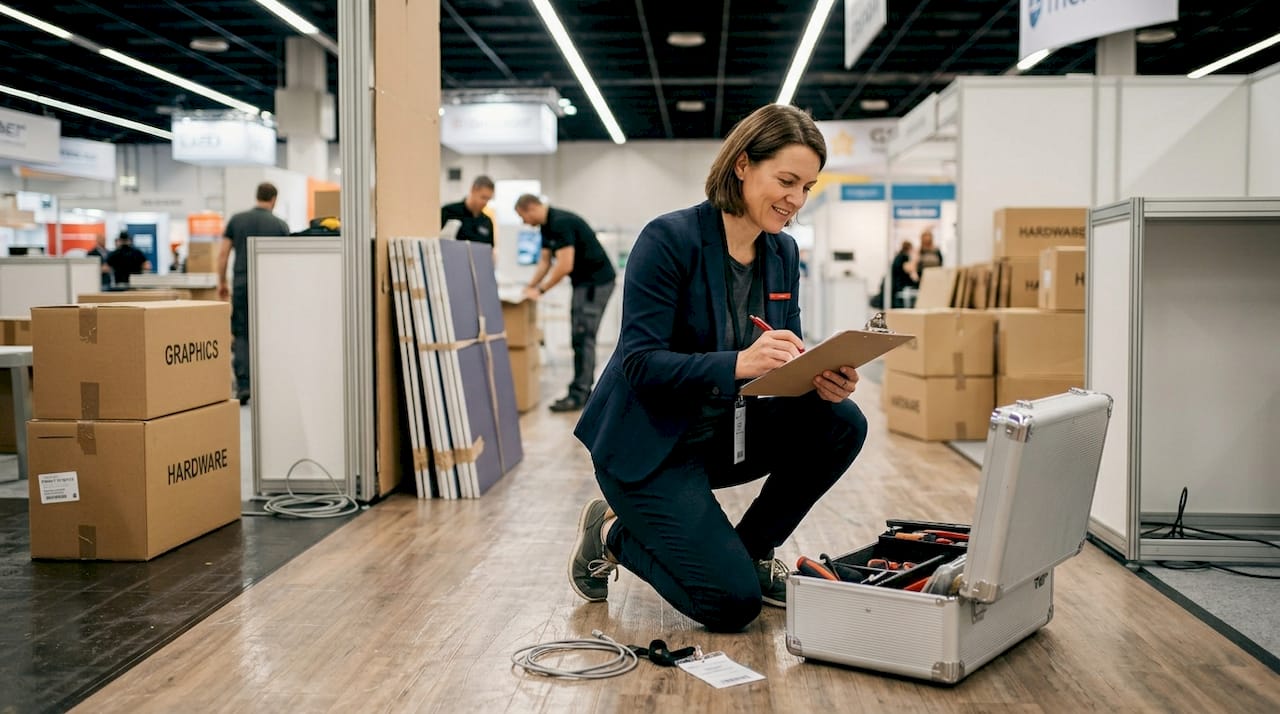
TL;DR:
- Proper strategic booth setup can increase ROI by up to 300 percent.
- Key elements include design, staffing, compliance, and visitor flow management.
- Ongoing measurement and staff training are critical for maximizing trade show results.
Most marketing and brand managers assume that a visually appealing booth is enough to guarantee trade show success. That assumption is costly. Proper strategy can increase ROI up to 300%, yet the majority of exhibitors at European trade shows still treat booth setup as a purely logistical task. This guide challenges that mindset directly. From strategic layout planning and staff coordination to regulatory compliance and real-time performance optimization, you will find practical, evidence-based approaches that transform your booth from a static display into a dynamic communication platform that consistently delivers measurable event value.
Table of Contents
- What event booth setup really means
- Key components of a high-performing event booth setup
- Planning for European events: Logistics, staffing, and regulations
- Driving ROI: Measuring and optimizing event booth performance
- A fresh perspective: Why most event booth setups miss their real ROI
- Partner with experts to elevate every event
- Frequently asked questions
Key Takeaways
| Point | Details |
|---|---|
| Setup goes beyond assembly | Success depends on strategic planning, design, staff coordination, and compliance as much as on physical build. |
| Traffic and ROI are driven by experience | Purposeful designs, trained staff, and interactive zones attract more leads and achieve up to 3-5x ROI. |
| Compliance and logistics prevent costly mistakes | Understanding European regulations and managing logistics avoids overruns and ensures event performance. |
| Measurement leads to improvement | Tracking cost per lead, dwell time, and follow-up rates allows for optimization of future events. |
What event booth setup really means
Event booth setup is far more than unpacking crates and assembling walls. It is a strategic discipline that blends physical construction, branded spatial design, staff role planning, and strict adherence to European venue regulations into a single, cohesive execution plan. When each of these elements works in harmony, your booth becomes a three-dimensional billboard that commands attention and converts visitor interest into qualified leads.
Understanding the full scope of setup means recognizing its critical elements:
- Physical build and logistics: Coordinating transport, on-site assembly timelines, and material handling
- Branded layout design: Positioning graphics, product displays, and interactive zones to guide visitor flow
- Staff role assignment: Defining clear responsibilities for greeters, qualifiers, and demo representatives
- Regulatory compliance: Meeting fire-retardant material standards, height restrictions, and sustainability requirements specific to European venues
- Visitor flow management: Designing entry points and conversation areas to minimize congestion and maximize engagement
The booth assembly process is a structured sequence, not an improvised exercise. When teams invest in each layer of this process, the results are measurable. According to industry benchmarks, well-planned booths yield 3 to 5 times ROI, with elite setups integrating advanced experiential features reaching as high as 21:1 returns.
“Booth setup success combines design, layout, staffing, and compliance. Treating any single element in isolation is the fastest route to a wasted event budget.”
For teams exhibiting across multiple countries, understanding European stand regulations country by country is not optional. Germany, France, Spain, and Italy each carry venue-specific rules that affect everything from structure height to electrical load capacity. Building compliance into your setup strategy from day one prevents costly last-minute revisions and protects your brand reputation on the show floor.
Key components of a high-performing event booth setup
With a clear understanding of what booth setup means, it is essential to know the must-have features that drive results. A high-performing booth is not defined by its budget alone. It is defined by how purposefully each physical and experiential element has been selected and positioned.
The core components that consistently separate high-performing booths from average ones include:
- Bold, readable signage visible from at least 10 meters away
- Interactive displays that invite visitor participation rather than passive observation
- Comfort zones with seating that encourage longer dwell time and deeper conversations
- Clear calls-to-action (CTAs) that guide visitors toward demos, consultations, or lead capture
- Purposeful lighting to highlight key products and create visual hierarchy
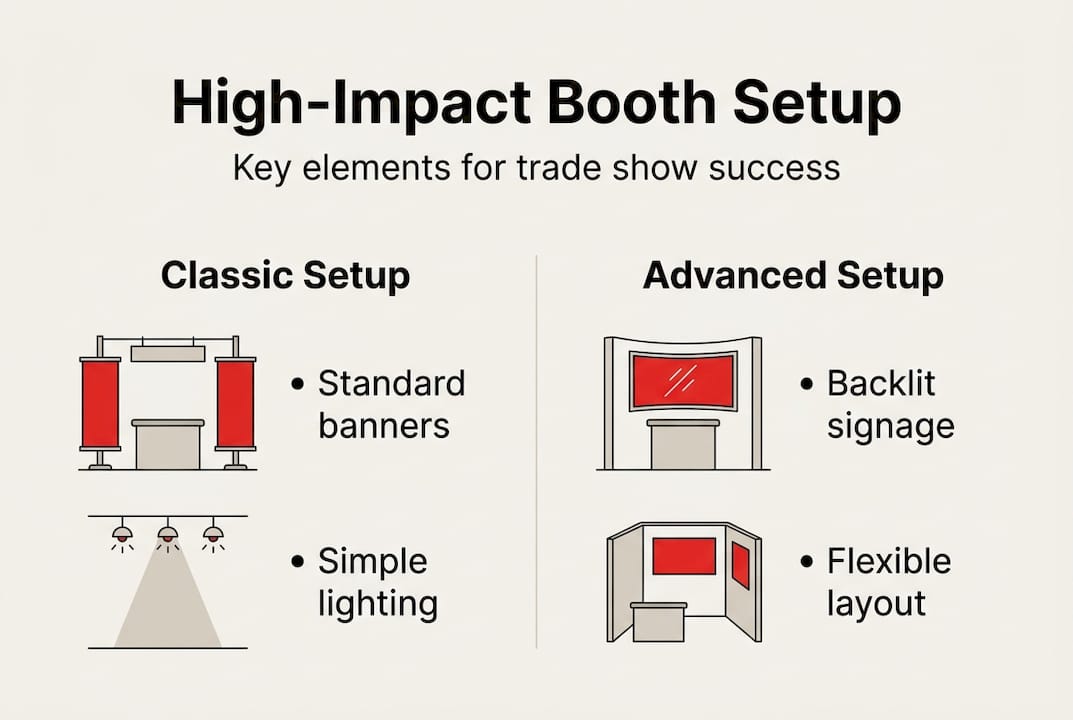
The data behind these choices is compelling. Optimal layouts drive 32% more traffic, purposeful lighting increases engagement by 28%, and experiential activation leads to 47% more qualified leads compared to static setups. These are not marginal gains. They represent the difference between a booth that pays for itself and one that drains the marketing budget.
| Feature | Classic setup | Advanced setup |
|---|---|---|
| Signage | Standard banners | Backlit, branded structures |
| Interactivity | Brochure handouts | Live demos, touchscreens |
| Lead capture | Paper forms | Digital CRM integration |
| Lighting | Venue standard | Layered, product-focused |
| Expected leads | 40 to 60 contacts | 100 to 150+ contacts |
To maximize booth space effectively, especially in smaller footprints, every square meter must serve a purpose. Wasted space is wasted opportunity.
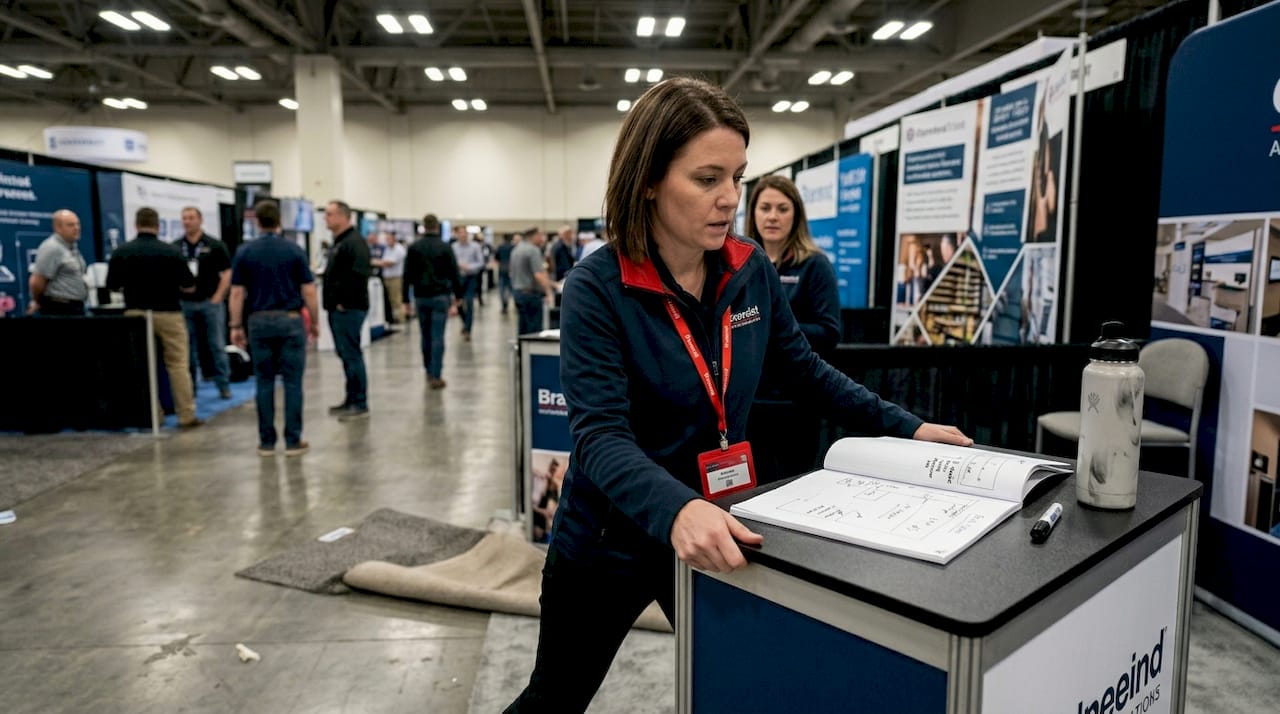
Pro Tip: Apply the 3-7-30 messaging rule. You have 3 seconds to grab a passing visitor’s attention with bold visuals, 7 seconds to communicate your core value proposition, and 30 seconds to engage them deeply enough to start a conversation. Design every element of your booth around this sequence, and consult your event planning guide early to align messaging with spatial design.
Planning for European events: Logistics, staffing, and regulations
Once the booth’s physical features are set, planning for flawless execution requires serious attention to logistics and compliance. European trade shows operate within a complex web of venue rules, union labor agreements, and sustainability mandates that can derail even the most well-designed booth if ignored.
A practical logistics checklist for European events includes:
- Confirm build schedule with the venue at least 6 weeks in advance
- Arrange freight forwarding with customs documentation for cross-border shipments
- Schedule on-site assembly with certified contractors where required
- Prepare a backup plan for delayed shipments, including modular replacement components
- Conduct a full pre-show walkthrough to verify electrical, lighting, and AV connections
Staffing is equally strategic. Role separation and correct staffing ratios of 1:4 (one staff member per four visitors) are critical for navigating high-footfall periods and maximizing engagement quality.
| Role | Primary responsibility | Recommended ratio |
|---|---|---|
| Greeter | Initial contact, brand introduction | 1 per entry point |
| Qualifier | Assess visitor needs and interest level | 1 per 4 visitors |
| Demo representative | Product demonstrations, technical Q&A | 1 per demo station |
For European event compliance, the non-negotiables include fire-retardant materials for all fabric and structural components, adherence to venue maximum structure heights (typically 4 to 6 meters), and compliance with increasingly strict sustainability policies at major venues like Messe Frankfurt and Fira Barcelona.
Pro Tip: Always travel with a contingency kit containing spare graphics panels, basic tools, cable ties, and touch-up materials. Modular booth designs from a turnkey booth staffing provider allow you to reconfigure layouts on-site without specialist contractors, saving both time and budget when the unexpected happens.
Driving ROI: Measuring and optimizing event booth performance
With setup and logistics in place, it is crucial to continually measure and refine your approach to ensure maximum ROI. Gut feel is not a performance metric. The brands that consistently outperform at European trade shows are those that track specific data points before, during, and after each event.
The top performance metrics every marketing manager should monitor include:
- Cost per lead: Divide total booth investment by the number of qualified leads captured
- Visitor count: Track daily footfall using badge scanners or digital counters
- Dwell time: Measure how long visitors stay engaged at key zones
- Conversion rate: Calculate the percentage of visitors who take a desired action
Key benchmark: Standard European shows generate 80 to 150 contacts per 30 square meters over a 3-day event. If your numbers fall below this range, your layout or staffing strategy needs adjustment.
The financial case for optimization is clear. Cost per MQL in Europe ranges from €400 to €1,200, and prioritizing 48-hour follow-up emails delivers 35% higher conversion rates. Experiential booths consistently deliver 150 to 300% ROI when measured against total event investment.
Actionable steps to optimize performance include:
- A/B test booth layouts across consecutive shows by changing one variable at a time
- Use digital lead capture tools that integrate directly with your CRM
- Debrief the full team within 24 hours of show close to capture real-time observations
- Review dwell time data to identify which zones are underperforming
Use an exhibitor ROI calculator to model scenarios before committing to a booth investment, and review your setup for ROI strategy after each event to build a compounding performance record.
A fresh perspective: Why most event booth setups miss their real ROI
Most guides focus on what to build. Few address what to do when things do not go as planned, and that gap is where most ROI is lost. The uncomfortable truth is that booth ROI is most often lost not through lack of spend, but through underestimating staff training and real-time optimization.
We see this pattern repeatedly at European events. Teams invest heavily in LED walls and augmented reality activations, then staff the booth with undertrained representatives who cannot articulate the brand’s core value in under 30 seconds. The technology impresses. The conversation disappoints. The lead walks away.
The brands that achieve successful stand design outcomes invest proportionally in flexible layouts that can be reconfigured mid-show based on observed visitor behavior, and in staff who are empowered to make real-time decisions. A greeter who can pivot a conversation based on a visitor’s body language is worth more than any unproven tech feature.
Invest less in spectacle, more in substance. Train your team to respond, adapt, and engage. That is where the real ROI lives.
Partner with experts to elevate every event
Applying these strategies across multiple European trade shows requires more than good intentions. It requires a partner with proven experience in booth design, logistics, compliance, and on-site execution. Adam Expo Stand Solutions specializes in exactly this, delivering turnkey exhibition stands that are built around your brand goals and optimized for measurable performance across Europe’s most competitive venues.
From initial 3D concept design through to booth build and dismantle, every project is managed with precision and a clear focus on ROI. Whether you are planning a flagship presence at a major industry expo or need a modular solution for a series of regional events, the expertise and infrastructure are in place to deliver results.
Contact Adam Expo Stand today to discuss your next European event and discover how strategic booth setup translates directly into qualified leads and brand impact.
Trade Show Booth Setup Checklist: 30 Days, 14 Days, and 3 Days Before the Show
A structured trade show booth setup checklist eliminates the reactive scrambling that turns build-up day into a crisis. The most reliable exhibitors at European trade fairs — from IFEMA Madrid to Messe Düsseldorf — follow a phased pre-show timeline that distributes setup decisions across the weeks before the event, rather than compressing them into the final 48 hours.
30 days before the show: Confirm final stand design and approve production drawings. Submit stand design for venue approval (mandatory at Messe Frankfurt, Messe Düsseldorf, and IFEMA for stands over 20m²). Book freight forwarding and confirm customs documentation for cross-border shipments. Finalise graphics files and submit to print production. Book on-site electrical connections through the official venue contractor.
14 days before the show: Confirm delivery schedules and track freight. Finalise staff briefing documents including visitor flow protocols, lead capture procedures, and product messaging guides. Test all digital equipment — touchscreens, lead scanners, AV systems — in a pre-show simulation. Pack a contingency kit with spare graphics panels, fasteners, tools, and touch-up materials. Send personalised appointment invitations to priority prospects.
3 days before the show (build-up phase): Arrive at the venue during your confirmed build-up window. Conduct a structural review with the installation team against the approved design drawing. Test all electrical connections, lighting, and AV equipment before the hall inspection. Brief all stand staff in person on zone roles, conversation protocols, and lead capture procedures. Take photographs of the completed stand for post-show comparison and insurance records.
Following this phased checklist reduces on-site setup problems by an estimated 60–70% compared to ad-hoc planning approaches — a figure consistent with Adam Expo Stand’s project management experience across 639+ European stand builds.
Exhibition Booth Installation: How the On-Site Build Process Works
Exhibition booth installation is the physical process of assembling a stand structure, installing graphics, connecting electrical services, and completing finishing elements within the venue’s designated build-up window. Understanding how this process works — and what can go wrong — allows exhibitors to make better briefing, budgeting, and contingency decisions.
Build-up windows at major European venues vary significantly. At IFEMA Madrid, standard build-up begins two to three days before the show opens for stands over 36m², with smaller stands allocated build-up from the day before. At Messe Frankfurt, island stands often have four to five days of build-up for complex structures. At ExCeL London, build-up windows are tighter and union labour requirements apply to certain installation tasks, increasing both scheduling precision requirements and on-site cost.
The exhibition booth installation sequence for a typical custom or semi-custom stand follows this order: structural framework assembly, flooring installation, wall panel and graphic mounting, electrical distribution installation, lighting rigging and focusing, technology integration (screens, kiosks, AV), furniture and accessories placement, final dressing and branding application, and venue inspection sign-off. Each stage must be completed before the next begins — a delay in structural assembly cascades through every subsequent step.
Common booth installation problems — and how experienced contractors prevent them: graphic panels that don’t fit as specified (prevented by factory pre-assembly checks), electrical circuits that trip under load (prevented by load calculations before the show), freight that arrives after the build-up window closes (prevented by freight tracking and early dispatch). Adam Expo Stand’s project managers are on-site throughout the build-up phase at every European venue, managing the installation sequence and resolving issues before they reach the client.
Frequently asked questions
What does a typical event booth setup cost in Europe?
Average mid-market booths cost around $47,800, though high-performing setups consistently achieve greater ROI through strategic design and purposeful staffing rather than simply spending more.
What are the main compliance considerations for event booths in Europe?
Fire-retardant materials, sustainability policies, and venue height limits are mandatory at most European venues and must be factored into booth design from the earliest planning stage.
How can I maximize qualified leads from my booth setup?
Use experiential elements, purposeful lighting, and clear CTAs, then follow up within 48 hours to achieve 35% higher conversion rates compared to delayed outreach.
What staff-to-visitor ratio is recommended for high-traffic booths?
A 1:4 staff-to-visitor ratio is the recommended standard for high-footfall European trade shows, ensuring quality engagement without overwhelming your team during peak traffic periods.