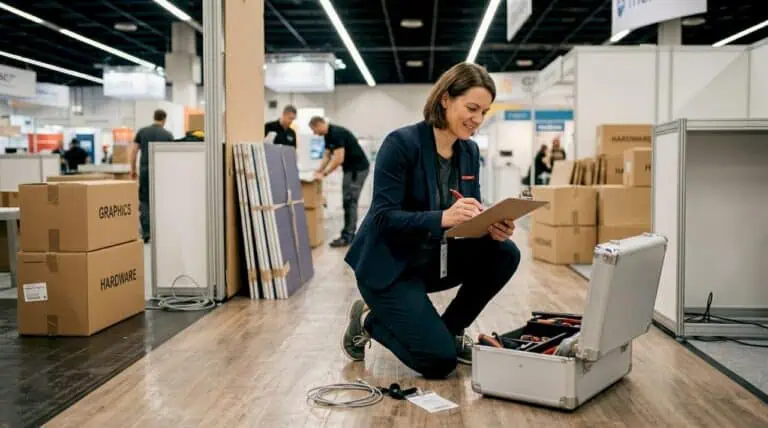
To choose booth materials, define the component’s function, the actual event requirements and the planned uses before comparing appearance or price. Ask the responsible designer and supplier for the product specification, compatible system, installation method, relevant documentation, maintenance and end-of-use arrangements.
“Aluminium”, “wood”, “fabric” and “composite” describe broad categories. They do not establish the performance, permitted use, environmental impact or complete cost of a particular finished component.
Choose booth materials by component and task
List the structure, panels, graphics, flooring, counters, furniture and product supports separately. State what each must do, the proposed dimensions, handling conditions and planned use. A printed graphic and a structural member need different evidence even when both are described as lightweight.
Include the actual event documents and future programme. Have the responsible technical parties resolve requirements for the intended application, including any relevant fire, structural, electrical, access or installation questions. A sample that looks good does not establish technical suitability.
| Category | Questions for the actual product | Claim to verify |
|---|---|---|
| Metal frames | Which system, connections, configurations, finishes and repair instructions apply? | Specific performance, recycled content and end-of-use route |
| Wood and wood-based panels | What grade, composition, finish, fixing and application are proposed? | Relevant sourcing documentation and suitability for that use |
| Fabric graphics | What textile, print, dimensions, tensioning and cleaning method are specified? | Relevant documentation and achievable reuse or treatment route |
| Composite panels | What are the layers, finish, fixings and replacement options? | Performance and treatment arrangements for the actual composition |
Check specifications and evidence before ranking options
Request product identifiers and technical information appropriate to the proposed use. Ask which documents cover the finished component and whether printing, coatings, adhesive or other changes affect the specification. Do not assume that evidence for a raw material covers every modified product.
The IFEMA MADRID regulations library, for example, separates participation and technical documents. Use the current instructions for the booked event and have the responsible parties confirm the documents and acceptance process required for the particular design.
A weighted comparison can help assess suitable options, but it should not allow a cheaper or more attractive item to outweigh an unresolved mandatory requirement. Resolve suitability first, then compare the features that matter to the brief.
Review samples under the proposed conditions
Compare samples for finish, colour, print readability, reflections, joints and cleaning needs. Use the proposed lighting and artwork where possible. An attractive small sample may not show seams, supports or colour variation across the installed component.
Ask the supplier how the item will be handled, installed and protected. If a mock-up or pre-build is useful, agree its scope and the checks it can perform. Refer loading, connections and technical tests to the responsible specialists; an exhibitor’s hands-on appearance review is not a structural assessment.
Record the approved product and finish in the specification. For substitutions, ask for the effect on appearance, performance, technical documentation, cost and timetable before approving a change.
Assess durability through the intended programme
Define expected handling, transport, storage, cleaning and future configurations. Ask about vulnerable surfaces, replaceable parts, repair methods and available instructions. A broad claim of “high durability” does not identify what can be repaired after a specific incident.
For graphics, distinguish physical condition from message relevance. A reusable fabric may need new artwork; an intact panel may not fit the next layout. Check the actual stock and proposed configuration before treating retained materials as ready for another show.
Agree packing, identification, condition records and storage requirements. Reuse depends on those arrangements as well as the component itself. See our between-event storage guide for the related scope questions.
Make environmental claims specific
Ask what each certificate or declaration covers, its current validity and the actual product supplied. A sourcing certificate, recycled-content declaration and whole-project impact assessment answer different questions. Avoid describing a complete stand as certified on the basis of one material document.
Confirm a realistic collection and treatment route for the actual composition. Printed textiles, bonded layers and coated panels can have different arrangements. Recyclability in principle is not evidence that the item will be collected and processed at the event.
The IFEMA sustainable participation guide provides a reference for considering materials, reuse and repair. Apply those questions to the specific inventory and programme. Neither low weight nor a modular format alone establishes lower environmental impact.
Compare complete costs and supplier responsibilities
Include purchase or hire, fabrication, printing, finishing, packing, handling, transport, installation, dismantling, repair, storage and end-of-use costs where applicable. Compare equivalent functions and technical requirements, with taxes and exclusions identified.
Ask who supplies documentation, approves substitutions, installs the component, reports damage and authorises repair. Confirm service availability for the actual dates. Have the organisation’s appropriate adviser review insurance arrangements where needed; a provider’s policy should not be assumed to cover every item or incident.
Keep a decision record stating the selected product, reason, evidence, approved use and remaining limitations. This gives the next project a useful starting point without turning an earlier decision into a universal material ranking.
Frequently asked questions
What is the best material for an exhibition stand?
There is no single answer for every component. Define the function, application, event requirements, programme and complete cost, then compare suitable specified products.
Does recycled content prove the stand has lower impact?
No. Check the evidence and its scope, and assess the complete programme and comparison before making a broader environmental claim.
What should I ask a material supplier?
Request specifications, relevant documents, approved applications, installation, repair, packing and treatment arrangements. Share the design and event programme to coordinate the material brief.
Follow our exhibition planning guides
Choose Adam Expo Stand as a preferred source to help you find our exhibition guides and updates on Google.
Add as a preferred source on GoogleGoogle may ask you to sign in and confirm your choice.