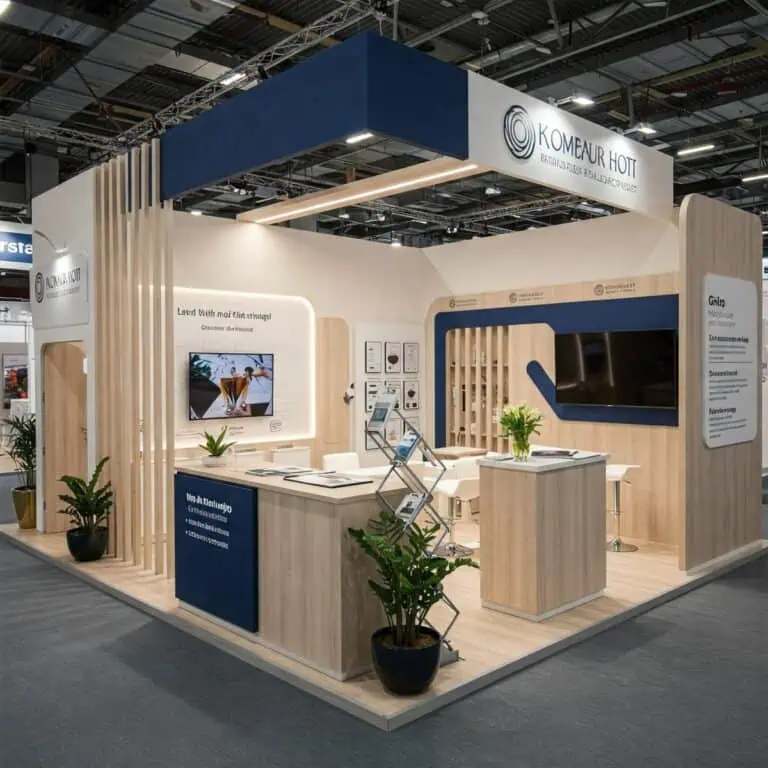
Small exhibition booth ideas work best when they support a specific product explanation or conversation within the actual booked space. Start with the activity, people and equipment, then choose the message and construction. A compact booth does not guarantee higher-quality leads or a lower total event cost.
Use this guide to shortlist ideas for a small European exhibition plot. Check each against the current event documents and a dimensioned plan. European audiences and venues differ; avoid choosing a layout from assumptions about a region’s style or hospitality preferences.
Make a usable footprint before a visual concept
Confirm dimensions, open sides, neighbouring stands, columns and service positions. Identify booking inclusions and what must be supplied separately. A 3×3-metre plot has nine square metres of gross area; furniture, equipment, staff and visitors all need usable space within it.
Draw actual product dimensions, occupied chairs, open cupboards, cables and intended waiting positions. Test how someone arrives, participates and leaves while staff continue working. If the activity does not fit, revise the scope or booking rather than assuming a smaller desk solves the problem.
Five ideas to assess
| Idea | Visitor task | Check on the plan |
|---|---|---|
| Focused sample station | Inspect a relevant product or finish | Handling, labels, lighting, staff access and replenishment |
| Guided screen with physical sample | Connect a visible part to a larger process | Viewing position, operator, support and non-digital explanation |
| Product comparison surface | Discuss the differences between suitable options | Sample dimensions, reach, reference information and clear access |
| Appointment position | Hold a defined specialist conversation | Seating in use, access, privacy needs and staff handover |
| Changeable graphic frame | Explain the offer with a clear main message | Approved dimensions, legibility, fixing and future graphic replacement |
These are planning options, not promised results. Choose the one that answers a real visitor question and that the team can support. Several tasks may share a station at different times, subject to practical setup and reset.
Keep the message and product connected
Agree a main proposition, then provide supporting detail where the product is inspected. Test artwork at its intended size from actual approaches. Check contrast, languages and obstructions caused by equipment or people.
Blank space can help separate information; every surface does not need a graphic. A taller wall or suspended sign is an option only where the event and technical design permit it. Small plot size does not create an exemption or establish that overhead branding is economical.
Use technology for a defined explanation
A tablet, model or video may help show a product that cannot be transported. Compare it with a physical sample or specialist discussion. Specify approved content, power, connections, support, cleaning and reset. A screen’s footprint is smaller than the space needed by its operator and viewers.
Provide a practical alternative if the device fails or is unsuitable for a visitor. A useful explanation does not have to capture personal information. Use the exhibitor’s approved enquiry process when follow-up is requested.
Test the welcome and staffing
Rehearse welcoming, product explanation, specialist handover and the next action. Check simultaneous tasks and breaks. Determine staffing from the actual layout and operation, not a universal number for a nine- or twelve-square-metre stand.
A counter may be useful for a controlled demonstration or reception; it may obstruct another layout. Test its position. Plan expected observers and waiting visitors within the allocated area. A crowded booth is not itself evidence of commercial success.
If refreshments or giveaways are included, identify their purpose, organiser conditions, supply, storage, servicing and waste arrangements. They also use staff and space. They are optional, and their distribution does not establish buying interest.
Compare portable, modular and custom components
A portable display can meet a simple presentation brief. A modular system may suit several confirmed configurations. A custom component may solve a specific product-support problem. Compare actual dimensions, stability, assembly, graphic changes, handling and applicable documentation.
Keep construction method separate from rental or ownership. Check modifications, rights to content, return conditions, packing, maintenance and storage. Neither a modular kit nor a repeated event count establishes a fixed saving.
Make reuse specific
List components that can be recovered and the next confirmed events. Check condition, compatibility, transport, repairs and storage. Ask for documentation relevant to material or sourcing claims and check its scope.
Financial cost and environmental impact are separate assessments. Recycled content, reusable fabric or efficient lighting can be specified, but the whole stand’s impact needs a stated method and relevant data. The sustainability planning guide explains these checks.
Price and deliver the complete activity
Request comparable quotes for the event and specification. Include design, technical coordination, construction or hire, graphics, furniture, equipment, logistics, handling, installation, services, support, dismantling and return where applicable. Add participation, exhibitor staff, travel and applicable taxes.
Use organiser deadlines and supplier capacity to agree the schedule. Assign artwork, service orders, delivery, installation and handover. Confirm support hours and escalation. A local supplier cannot guarantee approval or solve every change immediately.
Frequently asked questions
How do we decide what to remove?
Keep the main activity, usable access, required technical work and essential staff functions. Compare optional features by their purpose, complete cost and effect on the plan.
Does a small booth need interactive equipment?
No. Choose it when it explains the product better under the intended conditions. A sample, readable information and a prepared specialist may meet the brief.
How can we evaluate the booth?
Record relevant conversations, agreed next steps and subsequent opportunities separately from visits. Review operational obstacles and complete costs. Compare the findings with objectives agreed before the show.
Use the AUMA briefing guidance to coordinate requirements. Share your event, plot, manual, products, staff, budget and dates with Adam Expo Stand to discuss a specific scope and availability.
Follow our exhibition planning guides
Choose Adam Expo Stand as a preferred source to help you find our exhibition guides and updates on Google.
Add as a preferred source on GoogleGoogle may ask you to sign in and confirm your choice.