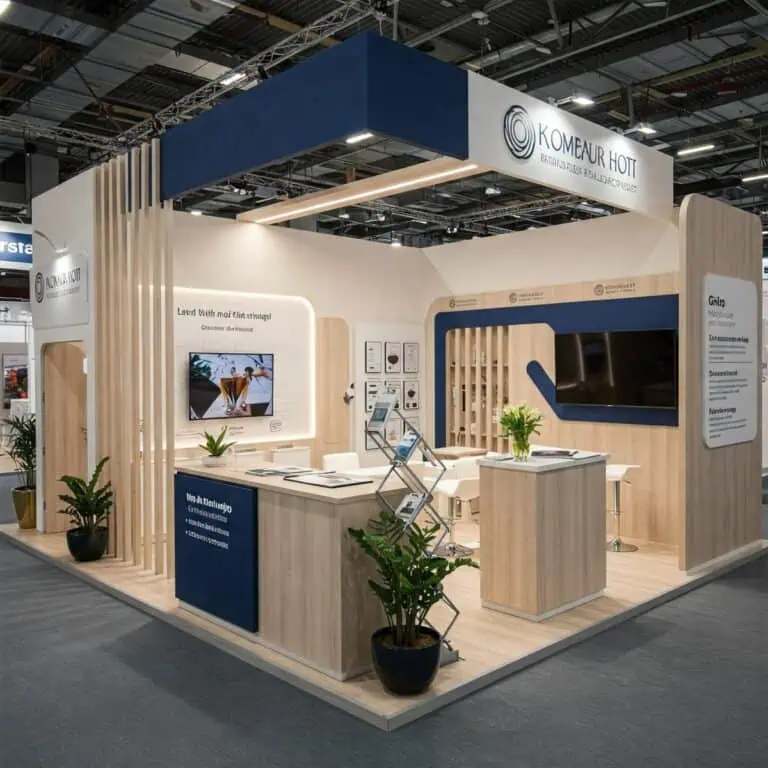
Yes, stand location matters, but at Spanish and Portuguese trade fairs you do not pick your spot from a map: the organizer allocates it using published criteria such as your sector, the date your paid application arrived, your stand size and, at several venues, how many editions you have exhibited. The practical way to a better spot is to apply inside the priority window, ask for the position you want in writing, and design a stand that still works if the venue moves you.
Last updated: November 2026
A salesperson opened a thread on Reddit’s r/sales with three words: “Trade show booth location”. The replies were the usual floor wisdom. Take a corner on a main aisle, sit one or two plots in from the entrance rather than right at the door, stay away from dead-end aisles, freight doors and pillars, and book meetings before the show so a weaker position matters less.
Good advice, but it assumes you can choose. At most fairs in Spain and Portugal the venue or the show management allocates the space, and the rules that decide it are written down in documents most exhibitors never open. This guide reads those rules for IFEMA MADRID (with three of its 2027 shows as examples), Feria de Zaragoza, FIL in Lisbon and Exponor in Porto, then explains what you can actually do to improve your position and how we design a stand for a plot that is not the one you hoped for.
It is planning information from a stand designer, not legal advice. The rules of your specific show always prevail.
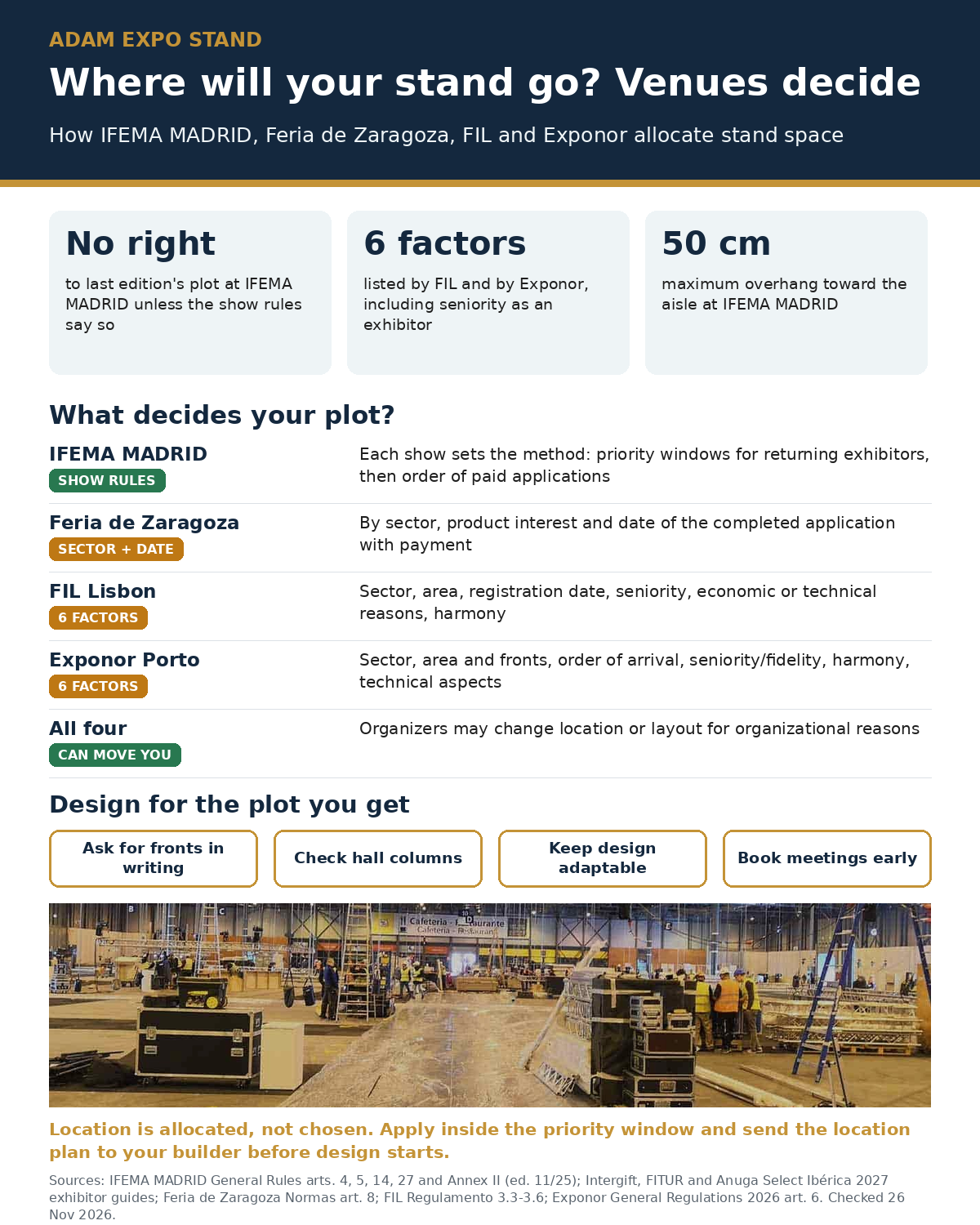
Does stand location matter at a trade fair?
It matters, but less than most first-time exhibitors fear and in a different way than they expect. A plot on a busy cross aisle gives you more passers-by; it does not give you more qualified conversations by itself. A well-planned stand in an average position, with pre-booked meetings and a clear message visible from the aisle, usually beats a confused stand next to the entrance.
What location really changes is the brief. The number of open sides, the direction most visitors arrive from, a structural column inside your plot, or a neighbor’s tall back wall all change what the stand should look like. That is why we ask for the location plan before we draw anything.
There is no official public data on visitor flow by hall position at Iberian venues, so any claim that “the entrance is worth X% more traffic” is a guess. What is published, and what this article relies on, is the set of rules that decides who gets which plot.
Key statistics: how venues allocate stand space
These are the hard figures and criteria the venues publish. Each row links to the official document we read on 26 November 2026.
| Data point | Value | Source (linked) | Date checked |
|---|---|---|---|
| Rights over last edition’s space at IFEMA MADRID | None by default, unless the show’s specific rules say otherwise | IFEMA General Rules, art. 5 | 26 Nov 2026 |
| Priority deadline for returning exhibitors, Intergift 2027 | 15 September 2026 | Intergift 2027 exhibitor guide, 1.2 | 26 Nov 2026 |
| Renewal deadline with reservation fee, FITUR 2027 | 5 June 2026 | FITUR 2027 exhibitor guide, 1.2 | 26 Nov 2026 |
| Priority period for space allocation, Anuga Select Ibérica 2027 | Until 1 June 2026 | Anuga Select Ibérica 2027 guide, 1.3 | 26 Nov 2026 |
| Allocation factors listed by FIL, Lisbon | 6 (sector, area, date of registration, seniority, economic or technical reasons, harmony) | FIL Regulamento, 3.3 | 26 Nov 2026 |
| Allocation factors listed by Exponor, Porto | 6 (incl. number of fronts and seniority/fidelity) | Exponor General Regulations 2026, art. 6.4 | 26 Nov 2026 |
| IFEMA halls with no structural columns | 3 (Halls 2, 6 and 12); Halls 3, 4, 7, 8, 9 and 10 have 10 each | IFEMA General Rules, Annex II | 26 Nov 2026 |
| Maximum overhang toward the aisle at IFEMA MADRID | 50 cm beyond the allocated space, unless the show rules say otherwise | IFEMA General Rules, art. 27 | 26 Nov 2026 |
| AES build rates used for budgeting | Modular approx. €280–380/m², custom wood approx. €450–650/m², double-deck approx. €750–1,100/m² | AES price calculator | 26 Nov 2026 |
Quotable summary: At the main venues in Spain and Portugal, stand location is allocated by the organizer, not chosen by the exhibitor; the published criteria put sector, the date of the paid application and size first, several venues add seniority, and none guarantees last year’s spot.
How does IFEMA MADRID decide where your stand goes?
IFEMA’s General Rules leave the method to each show: article 5 says space is distributed according to the show’s specific rules. The same article lets show management change allocated spaces or the hall layout for organizational reasons, and says that unless the show rules state otherwise you acquire no rights over the plot you had at the previous edition.
Before any plot is offered, article 4 makes admission itself discretionary. IFEMA can turn down an application if your activity does not fit the show’s sectors, if there is no space left, or if the request came in after the deadline. The contract only exists once you accept the space and the budget IFEMA offers and it sends you the participation terms.
The 2027 exhibitor guides show how this works in practice:
- Intergift 2027. Companies that exhibited at the previous edition had to send the application before 15 September 2026 to keep priority in the distribution of space. Later requests are handled first come, first served within each sector. IFEMA then makes one or several space and location proposals, and accepting one in writing, by email, by signature or at the space selection meeting is binding.
- FITUR 2027. Returning exhibitors renewed by sending the application with the reservation fee by 5 June 2026. If they asked for a different location or size, the organizers would make offers “if possible”. Everyone else is handled in strict order of receipt and payment of the reservation fee, and new exhibitors get “the best available space” within the show’s sector plan.
- Anuga Select Ibérica 2027. Applicants inside the priority period, which ran until 1 June 2026, could take part in the space allocation selection or receive space directly in order of receipt. After that date, strict order of receipt and payment applies, and management allocates space looking at the event as a whole, its sectors and its image.
The pattern is consistent: paying early inside the window is what moves you up the queue. A late application is not refused automatically, but it chooses from what is left.
How do Feria de Zaragoza, FIL and Exponor allocate space?
All three publish their criteria in their general rules, and all three keep the final decision for themselves.
Feria de Zaragoza
Article 8 of the participation rules first splits the show into sectors where that applies. Within each sector, space goes by the interest of the product on display and by the date the completed application arrived together with its payment. The fair may change the location or shape of a plot for technical or organizational reasons, and last year’s plot is not yours by right except in exceptional cases the fair accepts.
FIL, Lisbon
Section 3.3 of the FIL regulations says the location of each participation is decided exclusively by FIL and lists six factors: activity sector, number of modules or area requested, date FIL received and registered the form, seniority as an exhibitor, economic or technical considerations, and harmony between the contracted spaces. FIL may also share out space among exhibitors, and a location at one fair does not oblige it to give you the same one next time.
Exponor, Porto
Exponor’s General Regulations 2026, article 6.4, use a similar list: sectorization, the area, modules and number of fronts you want, order of arrival of the registration forms, seniority and loyalty, harmony between spaces, and technical or economic aspects. Article 6 also says the venue tells you your space and location after evaluating the registration, and that a location granted once is not guaranteed for later events.
Fira de Barcelona sets allocation in the conditions of each show, so check the participation rules of your event; its Gran Via technical rules, which we used for the column section below, do not cover allocation.
How can you get a better stand location?
You improve your odds by working with the criteria, not around them. These are the levers that the documents above actually reward:
- Apply and pay inside the priority window. For 2027 shows at IFEMA the windows closed between June and September 2026, months before the fairs. Put next year’s deadline in the calendar the day this year’s show ends.
- Exhibit regularly. FIL and Exponor list seniority explicitly, and Intergift and FITUR give returning exhibitors a priority or renewal route. Skipping an edition can cost you that position.
- Choose the right sector on the form. Every venue allocates within sectors first. The wrong product category can place you in a hall where your buyers never walk.
- Ask for the number of fronts you need. Exponor names “number of fronts intended” as a factor. A corner or island request is a request, not a guarantee, but it has to be on the form to be considered.
- Put your preferences in writing. FITUR’s guide says change requests get offers “if possible” and must be accepted in writing within the deadline. Write down the hall, the aisle and the neighbors you want to avoid.
- Answer proposals fast. At IFEMA shows, accepting a proposal is what fixes the plot and the contract. A slow reply can lose a good proposal to another exhibitor.
- Be flexible on size. A plot two meters narrower on a main aisle may serve you better than the exact area at the back of the hall. Size and position trade against each other.
Do not try to “fix” a bad spot by sharing or subletting someone else’s plot. IFEMA’s article 14 forbids transferring any part of your space and allows co-exhibitors only with prior written authorization. Our co-exhibitor planning template covers the legitimate way to share.
Can the organizer move your stand after you sign?
Yes, within limits written into the same rules. IFEMA management may modify allocated spaces or the hall layout for organizational reasons. Feria de Zaragoza may change the location or shape of a plot for technical or organizational reasons. FIL may share out space when it sets locations, and Exponor may change the location, area or layout of a stand when the general interest of the fair requires it.
Exponor is the most specific about money. If your area is reduced you are refunded the part of the occupancy value that was taken away, and if the venue needs to enlarge your plot you only pay the difference and only if you agree. IFEMA’s article 15 separately covers refunds when it has to reduce contracted spaces for force majeure; our guide on trade fair cancellation and refunds explains those clauses.
What this means for the stand: do not lock the design to one exact plot until the location plan is final, and keep the concept adaptable to a change of open sides. A modular structure or a custom stand drawn with interchangeable modules absorbs a late change far better than a one-off build designed around a single corner.
How do you design a stand for a weak location?
A weak location is usually one of four things: an inline plot with one open side, a position at the far end of a hall, a structural column inside the plot, or a tall neighbor that blocks the view. Each has a design answer.
One open side
Put everything that sells on the aisle front: the brand, a one-line message and the product. Keep the back wall simple and use it for a large, readable graphic that people can see from down the aisle. Our guide to booth layouts shows how inline, corner, peninsula and island plots change the plan.
Far end of the hall
Give people a reason to walk there. Pre-booked meetings, a live demonstration at set times and invitations sent with your stand number do more than a bigger sign. Light the stand well; at the end of a long hall a bright, clean stand reads from a distance.
A column inside your plot
Check the hall before you panic. IFEMA’s own hall data lists no structural columns in Halls 2, 6 and 12, and ten in each of Halls 3, 4, 7, 8, 9 and 10. At Fira de Barcelona Gran Via, the technical rules let you clad a column that falls inside your stand as long as you do not damage it or load it, connection boxes stay accessible, and any fire hose, extinguisher, alarm button or sign on it stays visible. A clad column can become storage, a screen mount or the brand tower of the stand.
Tall neighbors and sight lines
You cannot borrow the aisle: at IFEMA, unless the show rules allow more, no decorative or structural element may stick out more than 50 cm beyond your space toward common areas. Work inside the plot instead: an open front, a raised brand element set back from the aisle and lighting that pulls the eye in.
If you are still deciding on size, our stand sizes guide helps you weigh a 3×3 or 6×3 plot against an island.
Does a better location cost more to build?
Often yes, because open sides are finished sides. An inline stand needs one finished front; a corner needs two, and an island needs four, each with graphics, lighting and furniture that look right from every approach. The plot fee itself is set by each show and is not something we quote.
For the build, we budget with the rates from our stand cost calculator: modular approx. €280–380/m², custom wood approx. €450–650/m², double-deck approx. €750–1,100/m². The rate per square meter does not change with the position, but the design effort and the amount of finished surface do, which is why we price from the location plan and not only from the area.
For a first fair in Madrid or Lisbon, ask your builder to price two scenarios, for example inline and corner, so you know what a better spot costs on the build side before you accept a proposal.
Checklist: securing and using your stand location
- Next edition’s priority or renewal deadline written in the calendar.
- Application and reservation payment sent inside the window.
- Correct sector and product category on the form.
- Preferred hall, aisle, fronts and neighbors to avoid requested in writing.
- Space proposals answered within the deadline; accepted plan saved.
- Location plan sent to your stand builder before design starts.
- Hall data checked for columns, service points and goods doors.
- Design adaptable to a change of open sides or a small change of area.
- Nothing beyond the plot except what the rules allow toward the aisle.
- Meetings booked and stand number in every invitation.
Related video: making a small stand work harder
Many exhibitors with an inline or back-of-hall plot also have a small one. This short video from our channel shows five ways to make a compact stand feel open and inviting.
Questions exhibitors ask
Can I choose my stand location at IFEMA MADRID?
Not directly. You state your needs on the application and IFEMA sends one or more proposals according to the show’s rules. You can ask for a hall, an aisle or a corner, and accepting a proposal in writing fixes the plot.
Do I keep the same stand location every year?
Not automatically. IFEMA, Feria de Zaragoza, FIL and Exponor all say a previous location gives no right to the same plot, although returning exhibitors often get a priority or renewal route if they apply on time.
Is a corner stand worth it?
It gives you two approaches and more visibility, and it needs two finished fronts. Whether that pays back depends on your goals; a strong inline stand with booked meetings can outperform a corner with no plan.
What if my plot has a column?
Design it in. Check the hall data first, then clad it within the venue rules and use it for storage, screens or branding, keeping any fire equipment and service boxes accessible.
Can the venue change my stand size after I sign?
Yes, for organizational reasons, within the rules. At Exponor a reduction is refunded pro rata and an enlargement is only charged if you agree; read your show’s rules for the exact terms.
Related reading
- Evaluate a trade show venue: floor plan and access checks
- IFEMA MADRID stand contractor: rules, costs and timelines
- Exhibition stand at Exponor Porto
- Fira de Barcelona Gran Via technical guide
Got your location plan? Send it to us
Whether your plot is a corner on the main aisle or an inline space at the back, we design, build and install stands that make the most of it, at IFEMA and across Madrid, Lisbon and the rest of Europe. Request a stand proposal with the fair, the hall and the stand number, or call +34 697 715 015. Adam Expo Stand, founded in 2018 and based in Madrid, Spain, serving all of Europe with a focus on Spain and Portugal, counts 639+ projects in 12+ countries and replies within 24 hours.