


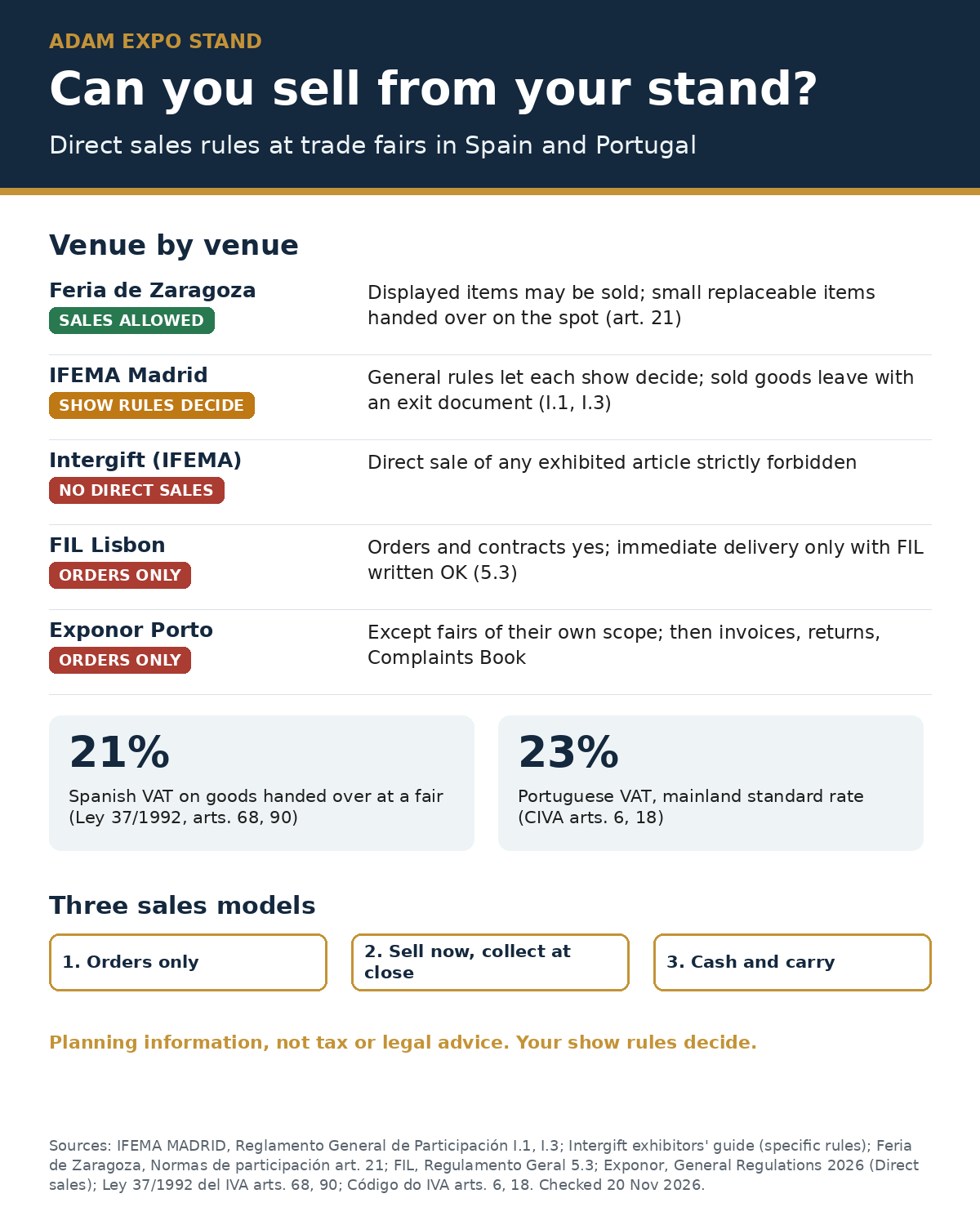
It depends on the fair’s own rules: Feria de Zaragoza lets exhibitors sell the items on their stand, FIL Lisbon and Exponor in Porto allow only orders unless the organizer authorizes sales or the fair is a sales fair, and IFEMA Madrid leaves the decision to each show’s specific rules. Where selling is allowed, the sale carries local VAT (21% in Spain, 23% on mainland Portugal), and sold goods leave the hall only with an exit document or permit.
Last updated: November 2026
A short question on Reddit sums up a doubt many exhibitors have: “Can I peddle my wares at GenCon?” The replies were blunt. Not without a booth, and not without sorting out sales tax first. That thread is about a US convention, but B2B exhibitors heading to Spain and Portugal ask the same thing: can we bring stock and sell it from the stand, or can we only take orders? This guide to selling at trade fairs answers it with the venues’ own rulebooks.
Can you sell products at a trade fair in Spain or Portugal?
Sometimes. Selling at trade fairs here is a venue-by-venue and show-by-show question, and at many trade-only fairs the default is that you show products and take orders. Before you ship a single box of stock, find out which of three models your fair allows.
- Orders only. You display products, take orders or sign contracts, and deliver after the fair. This is the FIL Lisbon default and the rule at shows such as Intergift in Madrid.
- Sell now, collect later. The visitor buys a displayed item, but it stays on the stand until the fair closes and leaves with written authorization.
- Cash and carry. Small items are handed over on the spot and replaced on the shelf straight away.
The model decides your stock levels, your staffing and even the counter you need. That is why we ask about it in the first briefing call, before any drawing exists.
Key statistics: direct sales rules at a glance
| Data point | Value | Source | Date checked |
|---|---|---|---|
| IFEMA Madrid, general rules | Apply to all IFEMA shows, but each show’s specific rules can change them | IFEMA MADRID, Reglamento General de Participación, I.1 | 20 Nov 2026 |
| IFEMA Madrid, fairs that allow direct sale | Exhibitor must hand the buyer an exit document for goods sold | IFEMA MADRID, Reglamento General, I.3 | 20 Nov 2026 |
| Intergift 2027, IFEMA Madrid | Direct sale of any exhibited article strictly forbidden | Intergift exhibitors’ guide, specific rules | 20 Nov 2026 |
| Feria de Zaragoza | Exhibitor may sell displayed items; small replaceable items handed over on the spot | Feria de Zaragoza, Normas de participación, art. 21 | 20 Nov 2026 |
| FIL Lisbon | Orders and contracts allowed; direct sales with immediate delivery forbidden without FIL’s written authorization | FIL, Regulamento Geral, 5.3 | 20 Nov 2026 |
| Exponor Porto | Direct sales not permitted, except at fairs of their own scope; seller handles invoicing, returns and a Complaints Book | Exponor, General Regulations 2026, “Direct sales” | 20 Nov 2026 |
| Spain, VAT on goods handed over at the fair | Taxed in Spain; general rate 21% | Ley 37/1992 del IVA, arts. 68 and 90 | 20 Nov 2026 |
| Portugal, VAT on goods handed over at the fair | Taxed in Portugal; standard rate 23% on the mainland | Código do IVA, arts. 6 and 18 | 20 Nov 2026 |
Quotable summary: Of four major venues in Spain and Portugal, only Feria de Zaragoza’s general rules openly allow exhibitors to sell displayed items; FIL Lisbon and Exponor default to orders only, and IFEMA Madrid leaves it to each show, as Intergift’s outright ban shows.
What do IFEMA Madrid’s rules say about direct sales?
IFEMA’s general exhibitor rules do not grant or ban direct sales across the board. They apply to every show IFEMA organizes, but each show’s own specific rules can change them, so the answer sits in your fair’s exhibitor guide.
Where a show does allow direct sale with removal of the goods, the general rules add one practical duty. You authorize the exit of each sold item by issuing the buyer the corresponding document. Moving goods in or out during the show also needs an individual permit from the Hall Manager, within set hours. At the end, nothing leaves without IFEMA’s exit authorization, which is issued once your show expenses are paid.
Intergift shows how strict a specific guide can be: it forbids the direct sale of any exhibited article. Our Intergift 2027 stand guide explains how that turns the stand into an order desk. For build-up rules at the same venue, see our IFEMA Madrid stand contractor guide.
How do Feria de Zaragoza, FIL Lisbon and Exponor compare?
Feria de Zaragoza is the most open of the four. Article 21 of its participation rules says displayed products must stay on the stand during show hours, but the exhibitor may sell them in whole or in part, within the law. Small items that can be replaced at once may be handed to the buyer on the spot, as long as you restock the display. Bigger items stay until the fair ends and leave with your written authorization and the venue’s exit order. Article 23 adds a warning: products outside the show’s sectors must go, and a stand that ignores the request for four hours is closed with no refund.
FIL Lisbon takes the opposite default. Its general regulation lets you take orders and sign contracts for your production, but direct sales to the public with immediate delivery of displayed items are forbidden. Only FIL’s express written authorization changes that, and displayed products cannot leave during the show without it either. Our Tektónica 2027 guide applies these FIL rules to a construction fair.
Exponor in Porto does not permit direct sales, except at fairs whose purpose includes them. When sales are permitted, the exhibitor alone is responsible and must follow the law on invoicing and returns, and keep a Complaints Book on the stand. Samples are handed out during the fair. If you are unsure whether your Exponor fair counts as a sales fair, ask the organizer in writing. Our Exponor stand guide covers the build side.
Do I have to charge VAT on stand sales?
Yes, local VAT applies when goods are handed over at the fair. Spain’s VAT Law (article 68) treats goods that are not shipped as supplied where they are made available to the buyer, and the general rate is 21% (article 90). Portugal’s VAT Code (article 6) has the same rule, with a 23% standard rate on the mainland and lower rates for listed goods and in the Azores and Madeira (article 18).
Who pays it over can change. In Spain, when the seller is not established there and the buyer is a business, the buyer often becomes the taxable person (article 84), although there are exceptions. Sales to consumers are different, and a foreign exhibitor may need a local VAT number. Ask a tax adviser before the fair, not after it. This is a separate question from recovering VAT on your own exhibitor costs, which our trade fair VAT refund guide covers.
Can I sell goods I bring from outside the EU?
Only once they are properly imported. IFEMA’s rules state that any goods brought into the EU for a fair count as commercial goods for customs, whether or not the exhibitor is established in the EU, and that includes catalogs, samples and advertising material. Exponor’s regulations leave temporary import of exhibits to the law, with no involvement from the venue.
The practical split is simple. Display units can travel under temporary admission and go home after the show. Anything you plan to sell or give away has to be cleared for import first. Our exhibition shipping and customs guide explains the ATA Carnet route for display goods.
How does selling change the stand design?
Selling turns part of your stand into a small shop, and a shop needs things a showroom does not. From the stands we design, build and install at IFEMA and other Iberian venues, the mistake we see most is a beautiful display wall with nowhere to keep the boxes that refill it.
- A pay point away from the main conversation area, so a quick sale does not block a long sales meeting.
- Lockable storage sized for one day of stock, because restocking from the hall entrance needs a permit and fixed hours.
- Display versus stock: one sample per product on the wall, the rest out of sight.
- A clear signal of what can be bought today and what can only be ordered, if the rules allow both.
Storage and a counter add area. Our stand cost calculator uses approximate rates: modular approx. €280–380/m², custom wood approx. €450–650/m² and double-deck approx. €750–1,100/m². Organizer space prices and fees vary by fair, so take them from the official exhibitor guide.
What should I check before bringing stock?
- Read your show’s specific rules first, then the venue’s general rules, and highlight any line about sales, orders or delivery.
- If the rules are silent or unclear, ask the organizer for written confirmation.
- Confirm VAT treatment for business and consumer buyers with a tax adviser.
- Clear non-EU goods for import before they reach the hall if you plan to sell them.
- Prepare invoices, a returns policy and, in Portugal where sales are allowed, a Complaints Book.
- Plan restocking around the venue’s permit hours, and track stock with a sample inventory template.
- If sales are not allowed, plan how you will turn orders into deliveries with a 14-day follow-up plan.
Adam Expo Stand was founded in 2018 and has delivered 639+ projects in 12+ countries. We design, build and install exhibition stands. Based in Madrid, Spain, serving all of Europe with a focus on Spain and Portugal.
Related video: designing a booth that works on the floor
Questions exhibitors ask
Can I sell my display samples on the last day?
Only if your fair allows sales. At Feria de Zaragoza, sold items that cannot be replaced at once leave at the end of the fair with your written authorization and the venue’s exit order. At FIL, displayed products need written authorization to leave during the show.
Can I take payment now and deliver after the fair?
FIL’s rules expressly allow orders and contracts, and order-taking is the usual model where direct sales are banned. Check your show’s guide for any wording on payments on the stand.
Is a giveaway a sale?
Venue rules treat samples on their own terms; Exponor’s regulations, for example, say samples are handed out during the fair. At customs, though, goods from outside the EU count as commercial goods, samples included, so clear them before the fair.
Who do I ask if the rules say nothing?
The organizer of your show. Get the answer in writing and keep it on the stand with your exhibitor documents.
Planning a stand that has to sell as well as impress?
Tell us your fair, your products and your sales model, and we will plan the counter, storage and flow around it. Discuss your stand brief or call +34 697 715 015.


