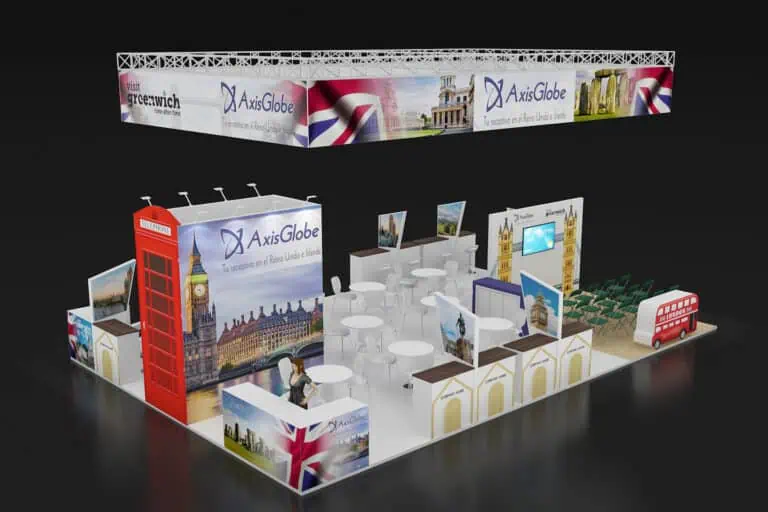
You land a prime space at a major European trade show, your leadership wants a high-impact presence, and the venue rules arrive in three different PDFs – each with different deadlines. Meanwhile, your team is trying to finalize messaging, coordinate meetings, and ship product samples across borders.
This is exactly where turnkey exhibition stand services in Europe earn their keep. They are not just “booth builders.” They are operational partners that take ownership of the entire exhibit lifecycle so your internal team can stay focused on pipeline, press, and customer conversations.
What turnkey exhibition stand services in Europe actually mean
“Turnkey” gets used loosely in the exhibition industry, so it helps to define it in practical terms. True turnkey exhibition stand services Europe should cover end-to-end responsibility: from translating your brand and goals into a buildable concept, to producing the structure, to getting it into the hall on time, to dismantling and removing it after the show.
The key difference is accountability. Instead of coordinating separate vendors for design, fabrication, graphics, logistics, and on-site labor, you work with one partner who manages the moving parts and owns the outcome.
The real value: fewer handoffs, fewer surprises
Most trade show problems are not creative problems. They are execution problems: missed paperwork, late trucks, labor no-shows, incorrect rigging requests, last-minute venue rule changes, or a stand that looks great in a rendering but is impractical in the hall.
A turnkey model reduces risk by limiting handoffs. When one team is responsible for design, production, and installation, there is less opportunity for assumptions to slip through the cracks. It also speeds up decisions. If your booth needs a structural adjustment because of height restrictions or rigging points, a turnkey partner can change drawings, update production, and re-plan installation without waiting for three different companies to align.
What should be included in a true turnkey scope
If you are comparing vendors, do not just ask, “Do you offer turnkey?” Ask what is included, what is optional, and what is explicitly excluded. Turnkey should cover four core phases: design, pre-show planning, production and logistics, and on-site delivery.
Design and pre-production: where deadlines are won or lost
A strong turnkey provider starts with a working brief: objectives, target audience, key products, demo needs, meeting requirements, storage needs, and lead capture workflow. From there, you should expect 3D concepts and then detailed technical drawings that are ready for venue approval.
This phase is also where budget realities need to be handled honestly. A premium custom build can create maximum impact, but modular systems and rental solutions can often deliver a polished, brand-forward presence with faster build times and less cost exposure. The right approach depends on your show calendar, how many times you will reuse the stand, and how much on-site customization you truly need.
Project management: the invisible deliverable
The most valuable “output” of turnkey services is often a schedule that holds up under pressure. That means clear milestone dates for design sign-off, printing, fabrication, shipping, venue forms, and installation windows.
Ask how your project will be managed. You want a single point of contact who can confirm what is happening this week, what risks exist, and what decisions are needed from your team. Communication cadence matters because trade shows compress time. If you lose a week, you rarely get it back.
In-house production and quality control
Turnkey is stronger when production is controlled, not outsourced across unknown workshops. In-house fabrication and print management typically improve consistency, speed, and accountability. It also makes last-minute changes more realistic. If a product name changes, a regulation requires a different fire rating, or your marketing team updates the campaign artwork, you want a partner who can adjust without turning it into a crisis.
That said, “in-house” is not automatically better if it comes with capacity limits. The trade-off is worth discussing: a vendor with full production control may be faster and more predictable, but you should still ask about peak-season capacity, backup plans, and how they handle simultaneous builds.
Logistics across Europe: customs, timing, and venue access
Europe looks simple on a map and complicated in real life. Cross-border transportation, regional labor rules, and venue access times can vary dramatically. A turnkey partner should plan logistics with the same seriousness as design.
This includes transport timing, hall delivery slots, and contingency planning for delays. It also includes knowing the specific venue requirements for electrics, hanging signs, flooring, and fire safety documentation. If you are exhibiting outside your home country, this is where a local, experienced partner can save you from expensive on-site fixes.
On-site build-up, dismantle, and support during the show
Turnkey only counts if the partner is present where it matters – on the show floor. Installation should be planned to fit the hall schedule and executed by teams that know the system. Dismantle should be equally managed, especially if your stand needs to be packed for storage, shipped to the next show, or returned if it is a rental.
On-site support during the event is also a practical differentiator. Things happen: a monitor mount shifts, a door sticks, a graphic panel needs replacing, or the venue changes power drop locations. Having a team that can respond quickly protects your brand presence when the hall is open and prospects are walking.
Custom vs modular vs rental: choosing the right build for your calendar
The best turnkey partner will not force a single solution. They will match the stand type to your goals and constraints.
Custom stands are built for maximum impact and tailored functionality. They are ideal when you need a standout architecture, integrated demos, private meeting rooms, or a signature look that becomes part of your brand identity across multiple shows. The trade-off is higher cost and longer lead time.
Modular systems provide flexibility and repeatability. They can be reconfigured for different footprints and still look premium when designed well. They are especially effective for companies doing multiple European events with varying booth sizes.
Rental stands are often the smartest option for one-off shows, pilot markets, or budget-controlled teams that still need a professional presence. Rentals also reduce storage and long-term asset management. The trade-off is that you may have limits on structural customization, and you need to ensure brand differentiation through high-quality graphics, lighting, and layout.
How to evaluate a turnkey partner (beyond the portfolio)
Portfolios matter, but execution reliability matters more. The questions below are where serious partners separate themselves.
Ask how they handle tight deadlines and what “rush” really means in their operation. A confident provider will explain their process and capacity, not just say yes.
Ask who owns the drawings, venue approvals, and coordination with show organizers. In a true turnkey model, you should not be chasing technical forms between vendors.
Ask what happens on-site if something goes wrong. Do they have local teams? Do they keep spare parts? Is there a named person responsible for your build?
Finally, ask for proof of consistency: number of shows delivered, length of client relationships, and real feedback about communication and follow-through. Trade shows reward teams that can execute repeatedly, not just impress once.
Common pitfalls when “turnkey” is only a label
Some vendors sell turnkey but still push critical tasks back to you. You might be asked to find your own freight, coordinate local labor, or manage venue paperwork. That creates the same risk and workload you were trying to avoid.
Another pitfall is a design-first approach that ignores build reality. If the concept is not engineered with the venue, timeline, and budget in mind, you will pay for redesigns or last-minute compromises.
The most expensive pitfall is unclear scope. If your quote does not specify what is included for graphics, lighting, electrical, furniture, rigging, AV integration, and on-site support, you are likely to see change orders. Turnkey should feel calm. If the proposal feels vague, the project will feel worse.
What a strong turnkey experience feels like
When turnkey is done right, your team feels in control without being buried in details. You get fast answers, clear drawings, and predictable timelines. You walk into the hall and the stand is already taking shape. Your brand looks intentional, your product story is easy to navigate, and your staff can focus on conversations instead of troubleshooting.
That is the standard we build toward at Adam Expo Stand Solutions (https://adamexpostand.com/) – a design-and-build approach that prioritizes creative impact, disciplined project management, and dependable delivery across Europe, especially when timelines are tight.
The best closing question to keep in mind is simple: when the show doors open, do you want to be managing vendors, or meeting prospects? Choose the turnkey partner that makes the second option the obvious one.