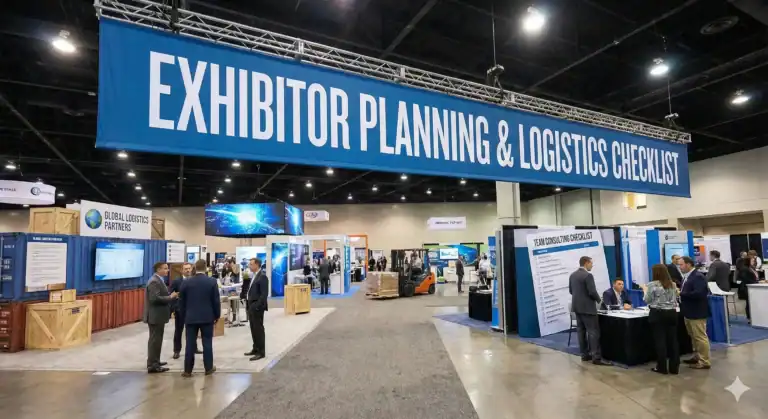
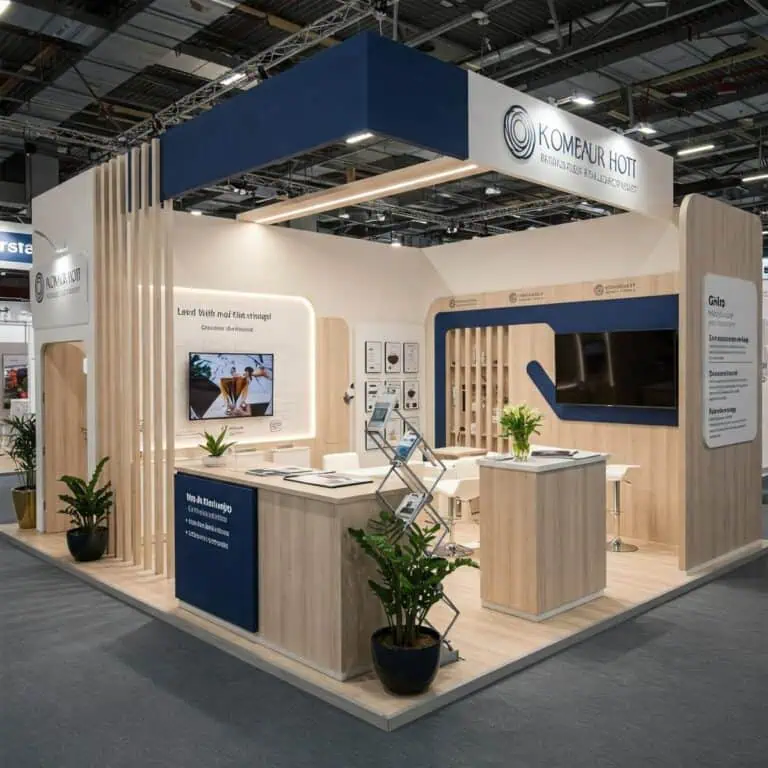
Choosing the right type of exhibition stand is one of the most important decisions you will make before any trade show, congress, or exhibition. Get it right and your stand becomes a lead-generating asset. Get it wrong and you may spend a significant budget on a structure that does not serve your commercial objectives.
This guide explains the eight main types of exhibition stands used across European trade shows and congresses — what each one is, when to use it, and what it costs — so you can make the right choice for your brand, your budget, and your event.
1. Shell scheme stands
A shell scheme is a pre-built framework provided by the exhibition organiser. It typically includes aluminium frame walls, basic carpet, a fascia panel with your company name, a power socket, and basic lighting. You rent the space and customise within the structure using graphics, furniture, and displays.
Best for: First-time exhibitors, smaller budgets, testing a new event, or regional shows where full custom builds are not justified.
Typical cost: £100–£250 per square metre, depending on the show and the customisation added.
Limitation: Shell schemes look broadly similar stand to stand. Even with strong graphics, they signal a limited investment, which can affect perception with high-value buyers.
2. Space-only custom stands
A space-only stand means you book raw floor space and build an entirely bespoke structure from scratch. Custom stands are designed from the ground up around your brand, products, and visitor experience objectives. Every element — structure, furniture, lighting, flooring, digital screens, meeting rooms — is tailored.
Best for: Brands that exhibit regularly, larger floor allocations (typically 20 sqm and above), high-value B2B audiences, and flagship trade shows where brand presence matters.
Typical cost: €800–€2,500+ per square metre depending on complexity, materials, and technology integration.
Limitation: Higher upfront cost and longer lead time. Most custom stands are designed for a single use, though storage and reuse is possible with the right contractor.
3. Modular exhibition stands
Modular stands use a system of reusable, reconfigurable components — aluminium profiles, fabric graphics, connector elements — that can be assembled into different layouts for different shows and floor sizes. The same system can become a 9 sqm stand at one event and a 36 sqm stand at another.
Best for: Brands that exhibit at multiple events per year, want a consistent visual identity across shows, and need flexibility without restarting the design process each time.
Typical cost: €400–€900 per square metre for initial build; significantly lower cost per use on repeat events.
Key advantage: Modular stands typically reduce cost per show by 30–50% compared to custom builds over a full exhibition year. See our detailed modular stand cost breakdown.
4. Double-deck (two-storey) stands
Double-deck stands use the full height allowance of a venue to create a two-level structure — an upper floor that can be used for private meeting rooms, a VIP lounge, a management suite, or additional display space. They require structural engineering sign-off and advance approval from the show organiser.
Best for: Larger floor allocations (typically 50 sqm and above), exhibitors who need private meeting space without sacrificing public-facing footprint, and brands who want maximum visual impact on the show floor.
Typical cost: €1,500–€3,000+ per square metre due to structural complexity, engineering certification, and extended installation time.
Key requirements: Structural drawings must be submitted to the organiser for approval, typically 6–8 weeks in advance. Many venues require a licensed structural engineer to sign off on the design. Public liability insurance cover must be confirmed.
5. Portable and pop-up stands
Portable stands are lightweight, packable structures designed to be transported and set up by a small team without specialist installation support. They include pop-up frames with fabric or graphic panels, folding display systems, and banner stands. The entire stand typically packs into cases that fit in a car boot or as checked baggage.
Best for: Start-ups, smaller budgets, regional events, road shows, and exhibitors who need to appear at many shows without a significant logistics operation.
Typical cost: €1,500–€8,000 for a complete portable stand system, reusable across multiple events.
Limitation: Portable stands have limited impact at major trade fairs where competitors are investing in full builds. They work best at smaller, focused events where the audience-to-investment ratio is favourable.
6. Island stands
An island stand occupies a floor space with open aisles on all four sides, giving maximum visitor accessibility and 360-degree brand visibility. Island positions are typically allocated to exhibitors booking 36 sqm or more. They are the premium floor position at most trade fairs.
Best for: Brands that want maximum footfall, product launches, live demonstration areas, and exhibitors with a large floor allocation at a flagship event.
Design consideration: Because all four sides are open, island stands must be designed with consistent visual impact from every approach angle, not just the main aisle. The structure should invite visitors in from any direction.
Typical cost: Island positions command a premium from organisers; expect to pay 15–25% more for an island allocation than an equivalent inline or corner position.
7. Sustainable and eco-friendly stands
Sustainable exhibition stands are built using materials and processes that minimise environmental impact. This includes FSC-certified timber, recycled aluminium, biodegradable fabrics, LED lighting throughout, reusable graphic systems, and waste reduction plans that meet venue sustainability requirements.
Best for: Brands with published sustainability commitments, industries where environmental credentials are commercially important (food, energy, pharma, consumer goods), and exhibitors at venues with mandatory sustainability reporting such as Messe Frankfurt and Fira Barcelona.
Cost premium: Sustainable materials typically add 10–20% to build costs, offset partly by longer usable life of materials and lower waste disposal fees.
Industry trend: From January 2026, Messe Frankfurt introduced mandatory waste reporting for all exhibitors. Other major European venues are following. Sustainable stand design is moving from an option to a requirement. Read our full guide to sustainable exhibition stand design.
8. Interactive and digitally integrated stands
Interactive stands incorporate technology as a core structural and experiential element: LED video walls, touchscreen product configurators, augmented reality demos, AI-powered visitor engagement tools, embedded live-streaming rigs, and gamification systems. The technology is designed into the stand from the outset, not added as an afterthought.
Best for: Technology brands, brands launching new products, exhibitors targeting senior or innovation-focused buyer audiences, and any brand that needs to differentiate at a crowded show.
Typical cost addition: Technology integration typically adds €5,000–€30,000+ to a stand budget depending on the scale and complexity of the installation.
Key consideration: Technology requires technical support on site. Budget for an on-site AV technician and have a backup plan if a key system fails on day one of the show.
How the 8 stand types compare
| Stand type | Best for | Reusable? | Lead time | Cost range / sqm |
|---|---|---|---|---|
| Shell scheme | Small budget, first event | N/A | 2–4 weeks | €100–€250 |
| Custom space-only | Flagship shows, large brands | Partially | 8–12 weeks | €800–€2,500+ |
| Modular | Multi-event exhibitors | Yes | 4–8 weeks | €400–€900 |
| Double-deck | Large space, private meetings | Partially | 10–16 weeks | €1,500–€3,000+ |
| Portable / pop-up | Start-ups, small events | Yes | 1–3 weeks | €1,500–€8,000 total |
| Island | Max footfall, 360° visibility | Partially | 8–12 weeks | €900–€2,500+ |
| Sustainable | Eco-committed brands | Yes | 6–10 weeks | €500–€1,200 |
| Interactive / digital | Tech brands, product launches | Partially | 8–14 weeks | €1,000–€3,500+ |
How to choose the right stand type
The right stand type depends on four factors working together: your budget, your event tier, your audience, and your commercial objectives.
Start with your objectives. If the primary goal is lead volume, invest in an open, accessible layout — island, custom, or modular. If the goal is high-value meetings with senior decision makers, a double-deck with a private upper floor will outperform a larger open stand. If you are testing a new show before committing, a shell scheme or portable system limits risk while giving you proof of concept.
Then match the investment to the event tier. A flagship European show like Hannover Messe or IFEMA Madrid warrants a full custom or modular build. A regional industry fair may be better served by a well-designed portable system.
Finally, think about reuse. Brands that exhibit at three or more events per year almost always find that modular systems outperform custom builds on total cost over a 12-month cycle, even when the custom build has higher visual impact at a single event.
Get expert advice on your stand type
Adam Expo Stand has designed and built every type of stand listed in this guide — from compact portable systems for start-ups to 400 sqm double-deck structures at Hannover Messe and Messe Frankfurt. Our team can advise you on the right stand type for your specific show, budget, and objectives, and deliver a free 3D concept within 24 hours.
Contact us today for a free exhibition stand consultation — we reply within 24 hours.
Further Reading
Now that you understand the different types of exhibition stands, these resources will help you get the most from your chosen stand:
- 15 Interactive Games for Exhibition Stands That Drive Leads and Engagement — whatever stand type you choose, these engagement tactics will maximise visitor dwell time and lead capture on the show floor.
- 10 Common Exhibition Stand Mistakes That Kill Your Trade Show ROI — avoid the pitfalls that undermine even the best stand design and investment.