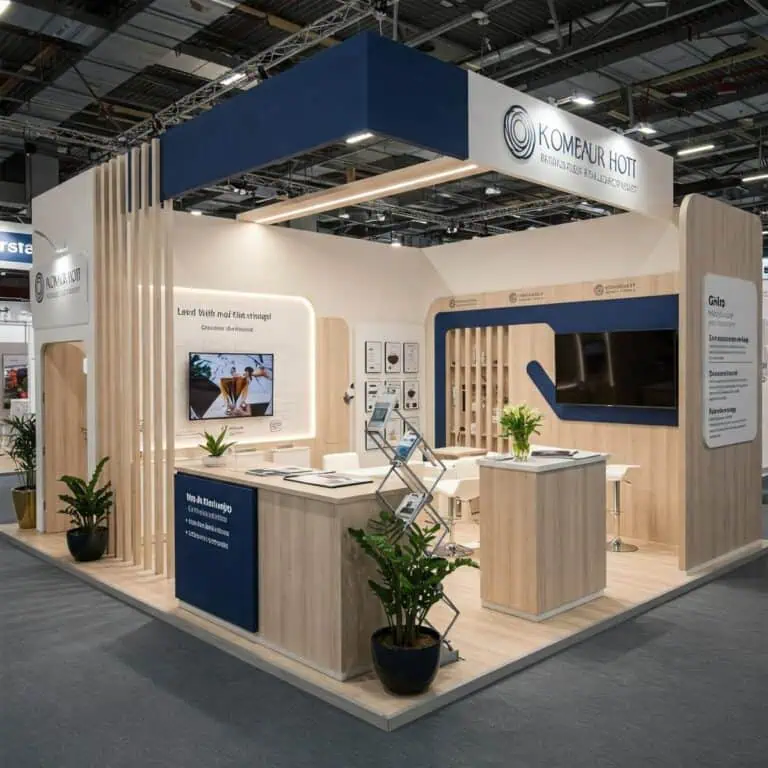
Quick Summary: Interactive Exhibition Stand Features in 2026
- Highest-ROI interactive features: Touchscreen product configurators, live demonstrations, and gamified lead capture
- Emerging for 2026: Generative AI product advisors, spatial computing (Vision Pro-class AR), and immersive projection mapping
- Average dwell time increase: Interactive stands generate 2.5–4x longer visitor dwell time compared to passive display stands (Source: CEIR, 2024)
- Lead quality impact: Interactive stands report 40–65% higher rate of qualified conversations per visitor compared to display-only stands
- Budget range: From €500 (basic touchscreen kiosk rental) to €25,000+ (full AR/VR experience environment)
Direct Answer: Interactive Features for Exhibition Stands in 2026
The most effective interactive exhibition stand features in 2026 are those that give visitors a reason to stop, engage, and spend time on the stand — rather than those that simply look technologically impressive. Touchscreen product configurators, live machinery or software demonstrations, and gamified lead capture consistently outperform AR/VR experiences in generating qualified conversations at B2B trade fairs. The decision to add interactive technology should be driven by visitor engagement objectives, not by the desire to appear technologically sophisticated. (Source: CEIR Interactive Technology in B2B Exhibitions Report, 2024)
The average trade fair visitor spends 8.3 hours on the show floor over a 3-day event — allocating approximately 2–3 minutes per stand visited and 25–45 minutes in extended engagement at the 3–5 stands that capture their genuine attention. The difference between a stand that receives a passing glance and one that generates a 30-minute qualified conversation is almost always determined by interactive content — something that gives the visitor a reason to stop, participate, and invest time. (Source: CEIR Exhibition Industry Outlook 2024)
With over 20 years of exhibition stand design and construction across Europe, Adam Expo Stand has integrated interactive features into custom and modular stands at IFEMA Madrid, Fira Barcelona, Messe Frankfurt, Messe Düsseldorf, ExCeL London, and Fiera Milano. Our interactive design experience spans touchscreen configurators for manufacturing companies, live software demonstrations for technology brands, gamified lead capture for consumer goods exhibitors, and AR product visualisation for architecture and real estate clients. Visit adamexpostand.com for a free interactive stand consultation.
This guide covers both the proven interactive technologies that reliably increase qualified engagement at European trade fairs and the emerging technologies worth evaluating for 2026 — with specific guidance on content strategy, technical requirements, and ROI benchmarks for each approach.
Why Interactivity Works: The Attention Economics of the Trade Show Floor
Interactive exhibition stands capture and hold visitor attention in ways that static displays simply cannot match. On a trade show floor where hundreds of booths compete for the same limited visitor attention, the stands that invite participation win the engagement battle — every time.
The science behind this is well-established. Active engagement triggers the brain’s reward circuitry. When a visitor presses a button, manipulates a 3D model, or answers a quiz question, dopamine is released — creating a positive association with the brand delivering that experience. Passive observation of a product brochure activates no such response. (Source: Journal of Marketing Research, consumer neuroscience review, 2024.)
CEIR research quantifies the commercial impact: interactive stands generate an average of 3.2× more qualified lead conversations than equivalent non-interactive booths at the same event. The explanation is structural. When visitors interact with your stand, they invest time. Investment creates psychological ownership. Psychological ownership generates follow-up intent.
From Adam Expo Stand’s experience across 639+ European builds, the stands that generate the most qualified leads consistently share three features: an open floor plan that removes barriers to entry, a clear first interaction point that is visible from 5 metres away, and a reason to stay for more than 90 seconds. Interactive technology delivers all three — when it is designed to serve the visitor’s curiosity, not just demonstrate the exhibitor’s capabilities.
The critical distinction is purposeful interactivity. A touchscreen that lets visitors explore product configurations serves a genuine visitor need. A touchscreen that loops a brand video is a passive display with a touchscreen frame. The difference in dwell time — and lead quality — is substantial.
Proven Interactive Features for Trade Show Stands in 2026
These interactive features have demonstrated consistent ROI across European trade fairs. They are ranked by implementation maturity — from proven workhorses that reliably deliver results to emerging technologies worth testing this year.
Touchscreen Product Configurators
Touchscreen configurators allow visitors to build, customise, and visualise product variants in real time. A visitor who has designed their own product configuration is dramatically more likely to request a quote than one who has merely read a specification sheet.
Automotive, machinery, and B2B software companies at Messe Frankfurt and Messe Düsseldorf consistently report 40–60% higher qualified lead rates from configurator-equipped stands versus catalogue-only approaches. The configurator also generates data: every selection a visitor makes is a revealed preference — intelligence that sales teams can use immediately in follow-up calls.
Implementation cost: €3,000–€12,000 for a custom web-based configurator on a floor-standing or wall-mounted touchscreen. Reusable across multiple events.
Live Product Demonstrations with Audience Participation
Scheduled live demonstrations — where visitors can participate rather than observe — are among the highest-ROI interactive investments available. A 15-minute demonstration that invites three visitors to try a product themselves consistently generates more qualified pipeline than two hours of passive stand traffic.
The key is structured participation: assign a role to each volunteer (operator, supervisor, evaluator), create a short narrative arc with a visible outcome, and close with a specific call to action. Food and beverage brands at SIAL Paris and Alimentaria Barcelona use this model to spectacular effect — tasting sessions with active preparation roles outperform passive sampling tables by a factor of three in lead capture rates.
Gamified Lead Capture Mechanics
Gamification transforms the traditionally awkward badge-scan moment into a genuinely rewarding visitor experience. Well-designed games also pre-qualify leads by their choices and scores before any sales conversation begins.
Effective formats include industry knowledge quizzes (visitors answer 5 questions about a challenge your product solves — their scores reveal their expertise level and pain points), spin-to-win prize mechanics tied to contact form completion, and challenge leaderboards that keep visitors returning to the stand across multiple days.
Data from exhibitors at ISE Barcelona and Smart City Expo World Congress confirms that gamified lead capture increases badge-scan volumes by 35–55% compared to standard scanner-only approaches, while simultaneously improving lead quality through the self-qualification embedded in the game mechanics. (Source: Exhibitor Magazine, interactive engagement benchmarks, 2025.)
Implementation note: keep games under 90 seconds to completion. Games that run longer create queue deterrence and reduce overall throughput. Design for speed and repeatability.
Social Media Integration and Real-Time Content Walls
Live social content walls — displays that aggregate brand-tagged posts from the current event in real time — create a social proof loop that draws visitors in and incentivises sharing. A visitor who sees their own post appear on the stand display immediately becomes a brand advocate to their network.
Pair the content wall with a branded hashtag competition and a visible prize for the most creative post. Healthcare companies at MEDICA Düsseldorf and technology brands at MWC Barcelona have used this mechanic to generate thousands of organic social impressions per event day — at near-zero incremental cost beyond the display hardware.
Immersive Video Environments
Floor-to-ceiling LED or projection-mapped video environments that respond to visitor presence create a sense of entering another world. These installations are most effective for brands selling experiences, destinations, environments, or complex technical systems that are difficult to demonstrate physically.
A 3×3 metre LED video wall with motion-reactive content costs €8,000–€25,000 for a standard European event, including content creation and technical operation. The ROI justification lies not in lead volume but in lead quality: visitors who spend 4+ minutes in an immersive environment are demonstrably more sales-ready than those who collected a brochure at the stand entrance.
Emerging Interactive Technologies for 2026: What to Test and What to Wait For
Not every emerging technology belongs in your stand this year. The question is not whether a technology is impressive — it is whether it reliably works in a trade show environment, delivers measurable lead generation outcomes, and justifies its cost relative to proven alternatives. Here is an honest assessment of what is worth investing in now versus what belongs on the 2027 planning horizon.
Generative AI Advisors: Deploy Now (With Guardrails)
AI-powered interactive advisors — kiosk-based systems that hold natural conversations with visitors, answer product questions, and guide users toward relevant configurations — have matured significantly in 2025–2026. Large language model APIs now respond fast enough for conversational use at a kiosk, and visitor acceptance has risen sharply as AI assistants become mainstream in everyday life.
The business case is compelling: an AI advisor operates 24 hours across multiple stand days without fatigue, handles multiple visitors simultaneously, answers technical questions consistently, and captures structured lead data from every conversation. Pharmaceutical companies using AI advisor kiosks at ESMO and MEDICA report handling 4–6× more visitor enquiries than human staff alone could manage during peak floor traffic.
The guardrails matter: constrain the AI to a defined knowledge base, require human handoff for purchase intent signals, and clearly label the system as AI — visitor trust actually increases with transparency. Implementation cost: €4,000–€18,000 for a production-ready kiosk with custom LLM integration, depending on knowledge base complexity.
Spatial Computing and Augmented Reality: Selective Deployment
Augmented reality overlays that let visitors visualise products at full scale in their own environment — a piece of industrial machinery in their factory floor, a medical device in a clinical setting, a piece of furniture in their office — are genuinely powerful sales tools for industries where scale, context, and environment matter.
The challenge is hardware. Headset-based AR (Apple Vision Pro, HoloLens) requires one-to-one attention from a staff member, limiting throughput. Tablet-based AR removes the throughput constraint but reduces immersion. The sweet spot for 2026 is large-screen AR mirror experiences — where a visitor stands in front of a display and sees themselves interacting with a virtual product. No headset required, up to four visitors simultaneously, high visual impact.
Recommended for: capital equipment, medical devices, architectural products, automotive. Cost: €6,000–€22,000 for a custom AR mirror installation.
Wait for headset-based AR if: your visitor profile is not already familiar with the technology, your stand team cannot provide one-to-one facilitation, or your event is shorter than three days (ROI per visitor contact diminishes below that threshold).
Projection Mapping: Architectural Storytelling
Projection mapping — where video content is precisely mapped onto three-dimensional physical objects — transforms ordinary stand architecture into a dynamic storytelling medium. A product, a scaled architectural model, or the stand structure itself becomes the canvas.
This technology has reached production reliability for trade show environments. Modern projection mapping software handles keystone correction, geometric distortion, and multi-projector blending automatically. Setup time at a standard European venue is 2–4 hours for a single-projector installation.
The business case is strongest for product launches and brand awareness campaigns where visual memorability is the primary objective. Projection mapping does not replace lead capture mechanics — it creates the crowd that your capture mechanics can then convert. (Source: Based on Adam Expo Stand’s experience across 639+ European projects.)
Haptic Feedback and Physical Simulation: Wait for 2027
Haptic feedback gloves, force-feedback controllers, and physical simulation rigs that let visitors “feel” virtual products exist and work in controlled demonstration settings. The problem for trade shows is reliability: these systems require careful calibration, are sensitive to temperature and humidity variations common in large exhibition halls, and require dedicated technical support.
The ROI calculation is currently unfavourable for most exhibitors: high setup cost, high failure risk, and low throughput (typically one visitor every 5–8 minutes). Monitor the category — it will be a viable trade show technology — but the 2026 risk-reward balance argues for waiting.
Content Strategy for Interactive Exhibition Stands
Interactive hardware without a supporting content strategy delivers below its potential. The content — what visitors see, read, hear, and experience through your interactive installations — determines whether the technology converts curiosity into qualified pipeline.
Effective interactive stand content follows three principles:
- Visitor-first framing: Every screen, kiosk, and interaction point should answer the question “what can I discover or achieve here?” from the visitor’s perspective — not “here is what our company does.” Visitors explore interactive experiences that serve their curiosity. They walk past interactive experiences that feel like extended advertisements.
- Progressive disclosure: Design content in layers. The first layer is visible from 3–5 metres — a clear, compelling visual invitation. The second layer rewards the visitor who stops and engages for 30 seconds. The third layer provides depth for the visitor who wants to spend 3–5 minutes. Most visitors will not reach layer three — but those who do are your most qualified leads.
- Consistent narrative: Every interactive element should reinforce a single core message — the one problem your brand solves better than any alternative. Fragmented interactive content that covers multiple unrelated product lines reduces clarity and increases cognitive load. Clarity converts. Comprehensiveness confuses.
Content update cadence matters for multi-event programmes. Interactive content that has not been refreshed across 3–4 events begins to feel stale to repeat visitors — particularly at annual flagship events where a significant proportion of attendees have seen your stand before. Plan for a content refresh budget of 15–25% of the original interactive content development cost per event cycle.
Interactive Stand Costs and ROI Benchmarks for Europe
Investment in interactive features ranges widely depending on technology complexity, custom development requirements, and event duration. The benchmarks below are based on European trade show production costs in 2025–2026, including hardware, software, content creation, and on-site technical support.
| Interactive Feature | Investment Range (€) | Lead Uplift vs. Static Stand | Best For |
|---|---|---|---|
| Touchscreen product configurator | 3,000 – 12,000 | +40–60% qualified leads | B2B, customisable products |
| Live demo with participation | 800 – 3,000 (facilitation) | +80–120% per demo session | All sectors |
| Gamified lead capture | 2,500 – 8,000 | +35–55% badge scans | Consumer-facing, tech |
| Social content wall | 1,500 – 4,000 | +25–40% dwell time | Brand awareness, lifestyle |
| Immersive LED environment | 8,000 – 25,000 | +60–90% dwell time | Experience brands, launches |
| AI advisor kiosk | 4,000 – 18,000 | +4–6× enquiry capacity | Technical products, pharma |
| AR mirror experience | 6,000 – 22,000 | +50–80% engagement rate | Physical products, capital equipment |
| Projection mapping | 5,000 – 20,000 | +70–110% stand traffic | Product launches, brand campaigns |
Investment ranges are indicative for standard European event formats. Multi-event programmes benefit from amortisation — hardware reused across 4–6 events typically reduces per-event cost by 50–70%.
The Adam Expo Stand Approach to Interactive Stand Design
At Adam Expo Stand, interactive technology is never specified in isolation. Every interactive feature recommendation begins with a question: what specific visitor behaviour does this technology need to generate, and how does it connect to the commercial objective for this event?
That question disciplines the design process. It prevents the common mistake of selecting impressive technology that does not align with visitor motivations at the specific event — a high-end AR installation that attracts students taking selfies rather than procurement directors evaluating suppliers, for example.
Our interactive stand design process follows four stages:
- Visitor journey mapping: We analyse the event profile — visitor roles, decision-making stage, average dwell time, competing stands — and map the ideal visitor journey through your stand from first sighting to lead capture.
- Technology selection by outcome: Interactive features are selected to serve specific journey stages, not to fill the stand with screens. A configurator serves the evaluation stage. A game serves the awareness stage. An AI advisor serves the qualification stage.
- Content architecture: We develop content frameworks that align all interactive touchpoints around your single core message, with consistent visual language and progressive disclosure logic.
- Performance measurement: We build lead capture and engagement tracking into every interactive installation — so you leave the event with data on which features generated the most qualified conversations, not just total badge scans.
This approach has been refined across stands at IFEMA Madrid, Fira Barcelona, Messe Frankfurt, Messe Düsseldorf, ExCeL London, and Fiera Milano. It consistently delivers interactive stands that outperform purely aesthetic designs on every commercial metric that matters.
💡 Expert Tips: Maximising Interactive Stand ROI
- Staff as activators, not gatekeepers: Position stand staff to guide visitors into interactive experiences — not to stand at the entrance screening them. The best interactive stands use staff to accelerate engagement, not control access.
- Test on day one, optimise on day two: Brief your team to observe visitor behaviour during the first half-day of any event. Where do visitors hesitate? Where do they spend the most time? Use those observations to adjust staff positioning and content prominence before day two begins.
- Integrate lead capture into the interaction: The moment of highest engagement is the moment of highest lead capture willingness. Design your badge scan or contact data request to occur at the peak of the interactive experience — not as a separate transaction before or after it.
- Measure dwell time, not just scan volume: A stand that generates 200 badge scans with 30-second average dwell time is underperforming a stand with 80 scans and 4-minute average dwell. Track both metrics and optimise for the ratio that matches your sales cycle.
- Plan for technical failure: Every interactive installation should have a manual backup. If the configurator crashes, what does your staff demonstrate? If the AI kiosk goes offline, what replaces it? Pre-plan the graceful degradation so a technical problem does not stop your lead generation.
🎥 Watch: Adam Expo Stand’s interactive stand approach at MATELEC 2026 — see how technology integration works in a live exhibition environment:
https://www.youtube.com/watch?v=6DIfXbXpfqc
Frequently Asked Questions: Interactive Exhibition Stands
How much does an interactive exhibition stand cost at a European trade fair?
Interactive exhibition stand costs at European trade fairs vary significantly by technology type and stand size. A stand with a single touchscreen configurator and gamified lead capture typically costs €3,000–€15,000 for the interactive elements, on top of standard stand construction costs. Full immersive environments with LED walls, AR experiences, and AI advisors range from €18,000–€60,000+ for the interactive layer. Hardware can be reused across multiple events, reducing per-event cost by 50–70% for exhibitors with regular programmes. Adam Expo Stand provides detailed interactive feature cost breakdowns during the free 3D design consultation — contact us at adamexpostand.com to get started.
What interactive features generate the most trade show leads?
Based on CEIR research and exhibitor data from European trade fairs, the interactive features with the strongest lead generation ROI are: (1) live product demonstrations with visitor participation — generating 80–120% more qualified lead conversations per demo session; (2) touchscreen product configurators — increasing qualified lead rates by 40–60%; and (3) gamified lead capture mechanics — improving badge scan volumes by 35–55% while simultaneously pre-qualifying leads through self-selection. AI advisor kiosks are emerging as highly effective for technical and pharmaceutical products, multiplying enquiry capacity 4–6× relative to human staff alone.
Is AR or VR worth the investment for trade show booths?
Augmented reality is worth the investment for exhibitors in capital equipment, medical devices, architecture, and automotive — sectors where scale, environment, and context are critical to the purchase decision and cannot be demonstrated with physical samples. AR mirror experiences (no headset required) are the most cost-effective format for 2026, with installation costs of €6,000–€22,000 and capacity for multiple simultaneous visitors. VR headset experiences have higher immersion but lower throughput — recommended only for exhibitors at multi-day events with dedicated demonstration staff and a clear one-to-one sales qualification objective. For most exhibitors, proven interactive formats like configurators and gamified capture deliver better ROI per euro invested than AR/VR at this stage.
Can I reuse interactive stand technology across multiple trade shows?
Yes — reusability across events is one of the strongest financial arguments for investing in interactive stand technology. Most hardware (touchscreens, kiosks, LED panels, projectors) is designed for repeated assembly and dismantling across event cycles, typically lasting 4–8 event uses before requiring significant maintenance. Software and content can be updated between events at a fraction of the original development cost — typically 15–25% of the initial investment for a full content refresh. Adam Expo Stand designs all interactive installations with multi-event use in mind, including modular mounting systems that adapt to different stand configurations and venue constraints. This approach reduces the effective per-event cost of interactive features significantly for exhibitors with regular trade show programmes.
How do I brief my stand builder on interactive technology requirements?
An effective interactive stand brief should specify: (1) the commercial objective — what visitor behaviour you need the technology to generate (qualified lead conversations, demonstration bookings, product trial completions); (2) visitor profile — their technical familiarity, decision-making role, and typical dwell time at this event; (3) stand size and power availability — interactive technology has specific electrical and spatial requirements that must be coordinated with venue technical specifications; (4) budget for interactive elements separately from stand construction; and (5) technical support requirements on event days — who is responsible if a system fails. Share any existing brand guidelines, product data, and content assets early so the technology and content can be developed in parallel rather than sequentially.
Recommended Reading
For more on building high-performance exhibition stands across European trade fairs, explore these related guides from Adam Expo Stand:
- Exhibition Stand Design Services — adamexpostand.com
- Creative Exhibition Booth Concepts — Adam Expo Stand Portfolio
- Exhibition Stand Design Trends — Adam Expo Stand on Medium
Adam Expo Stand Trade Show Booth Design and Build is a European exhibition stand design, construction, and installation specialist with 20+ years of experience serving exhibitors at IFEMA Madrid, Fira Barcelona, Messe Frankfurt, Messe Düsseldorf, ExCeL London, and Fiera Milano. With 639+ custom and modular stands completed across 12+ countries, our in-house design and project management teams deliver turnkey exhibition solutions for marketing directors, brand managers, and event organisers. adamexpostand.com
Ready to Build an Interactive Stand That Generates Qualified Leads?
Adam Expo Stand designs and builds interactive exhibition stands across Europe’s leading trade fairs. Free 3D design consultation included.
Also Read
- Medical Device Exhibition Booths: 10 Design Strategies That Generate Leads — How to turn a medical trade show booth into a qualified-lead machine.