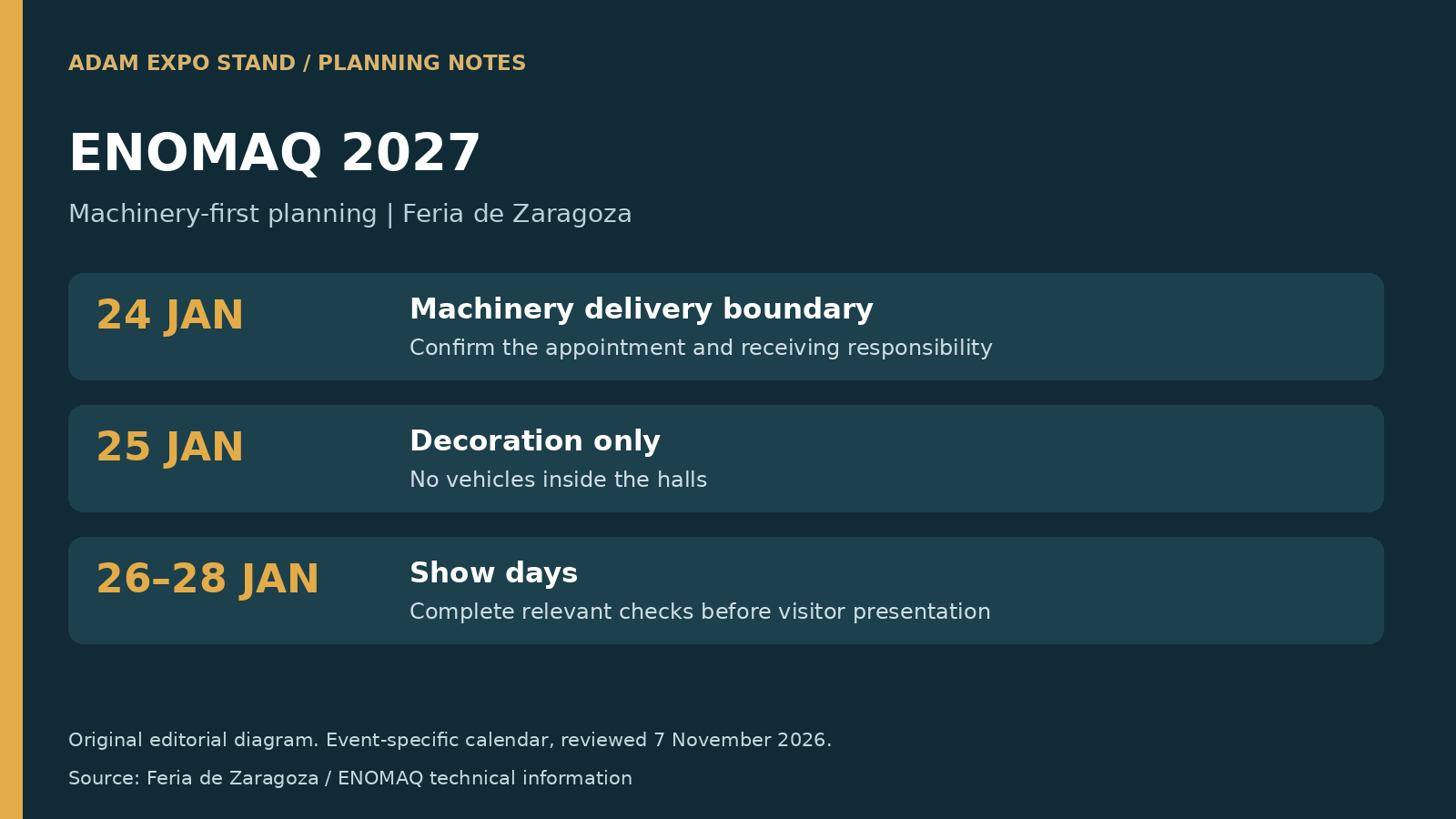
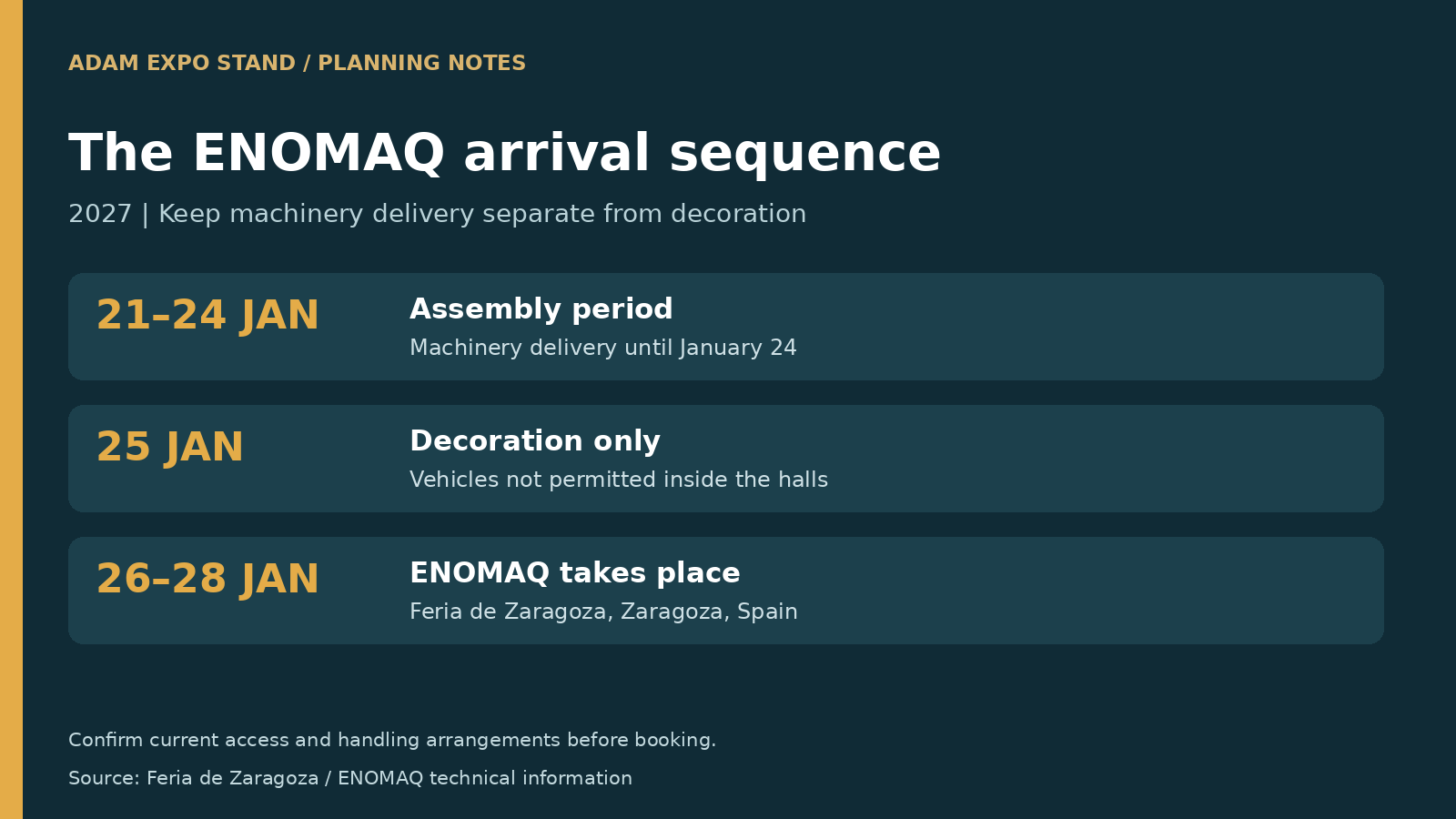
ENOMAQ 2027 machinery arrival planning starts with the machinery arrival date, not the render. The event runs January 26–28 at Feria de Zaragoza. Machinery delivery ends January 24; January 25 is decoration-only, with no vehicles inside the halls. Plan the stand around that distinction, your allocated sector and confirmed service connections.
Key takeaways
- Machinery arrival and decoration are different milestones.
- Confirm the actual allocation; the announced sector map is not your contract.
- Keep service orders, installation and activity acceptance separate.
- Name receiving and removal owners before dispatch.
Readiness check: can a truck-dependent machine arrival be planned for January 25?
The published calendar reserves January 25 for decoration and bars vehicles from the halls. Machinery delivery is until January 24. Confirm your actual appointment and access arrangements.
Working resource: machinery-arrival brief
Use the editable internal arrival brief below. It records equipment evidence, receiving, service responsibilities and open questions. This is not an organizer form or a compliance certificate.
| Field | Entry / evidence |
|---|---|
| Event | ENOMAQ, Feria de Zaragoza, January 26–28, 2027 |
| Actual hall and stand | Fill from allocation document |
| Equipment model / drawing revision | Manufacturer reference required |
| Packed dimensions / installation footprint / weight | Manufacturer data required, do not estimate |
| Presentation mode | Static / proposed operation / media; acceptance evidence pending where needed |
| Receiving owner | Assign internally |
| Delivery appointment / access procedure | Confirm with providers and organizer |
| Machinery delivery boundary | Until January 24, official published calendar |
| January 25 tasks | Decoration only; no vehicles in halls |
| Unloading / positioning / connection | Name each responsible party and scope reference |
| Services / locations | Use equipment requirements and official service forms |
| Outstanding technical or activity questions | Record question, responsible person, next action |
| Handover / checks | Record evidence and unresolved items |
| Packing / return collection / retained parts | Confirm responsibility and arrangements |
| Dismantling period | After January 28 closing, and January 29–31; exact access to be confirmed |
By Adam Dragos, Exhibitor Success Specialist
Last updated: November 2026
How do you brief ENOMAQ 2027 machinery arrival?
Your brief should connect the allocated plot, equipment list, delivery sequence, service requirements and visitor conversation. For this machinery-focused event, the critical distinction is between installing the equipment and finishing the display. Record who owns each decision, which information is approved and which questions still need the organizer’s written answer.
The official technical information confirms January 26–28, 2027 at Feria de Zaragoza. It lists assembly on January 21–24, with January 25 reserved exclusively for decoration. Machinery can be delivered until January 24. This is an event-specific calendar, not a general rule for exhibitions elsewhere in Spain.
Start a working document with your actual hall and stand allocation. Add the people responsible for the machine, the stand, transport and venue services. A quotation can only be compared fairly when those parties are pricing the same scope. An attractive image cannot tell you whether unloading or a connection is included.
Treat the brief as a controlled record. Give it a revision date, attach the equipment drawings and name the person who can approve changes. If the sales team swaps a machine after the layout is agreed, reopen the relevant checks rather than quietly replacing its picture. The footprint, delivery method and connection requirements may all change.
Our recommendation is to resolve the machine placement before approving decorative furniture. That is a planning judgment, not a claim about a named past project. Your stand should help a technical buyer understand the equipment while giving the delivery and service teams a practical route to install it.
How does the January calendar change the design sequence?
Work backward from machinery delivery by January 24, keeping January 25 for decoration rather than vehicle-dependent installation. The official calendar leaves different tasks for different days. Confirm the delivery appointment and handling arrangements before finalizing any feature that would obstruct the machine route, its installation position or subsequent service access.
The organizer’s assembly schedule is the source for these dates. Do not interpret a delivery deadline as an appointment or a promise that handling equipment will be available when your truck arrives. Obtain the actual access procedure, unloading responsibility and booking confirmation from the appropriate providers. Those details depend on your arrangements.
Build a sequence showing what must happen before the machine enters and what can follow it. Cable routes, floor finishes, walls and furniture need coordination with that sequence. A floor covering might need protection while equipment moves across it. Alternatively, some finishes may need to wait. Ask the designer and handling specialist to agree the method.
Keep the distinction visible in the schedule shared with the factory. A dispatch date is not a delivery confirmation. Check the vehicle, packing dimensions, recipient and contingency if transport is delayed. Do not rely on a late evening rescue on January 25: the published rule says vehicles will not be permitted in the halls that day.
For a hypothetical bottling-equipment exhibitor, the useful milestone is an installed and checked machine before decorative sign-off. This example describes a planning method, not an actual client or a promised installation duration. The correct sequence depends on the equipment, hall access and instructions confirmed for your plot.
Which sector and hall should shape the visitor message?
Use the organizer’s sector plan to decide what your visitor should recognize first, then verify the actual allocation on your contract. A machine supplier in an end-of-line area needs a different opening message from a laboratory supplier. Sector context helps frame the conversation; it does not establish where an individual exhibitor has been placed.
The November 4 organizer announcement describes Hall 4 for fermentation processes, certification, analysis, laboratories, tanks, treatments and production packaging. Hall 5 covers olive oil production, brewing and related raw-material processing, alongside software, printing and labeling. Hall 6, ENOMAQ AGRO, addresses fieldwork, including viticulture, olive growing and arboriculture.
The same announcement places bottling, packaging, labeling, end-of-line solutions and certification systems in Hall 8. Hall 9 is described as the technical-program and parallel-events hub, including ENOMAQ Conecta Talento and the Tasting Corner. Treat this as the announced plan, subject to the organizer’s subsequent updates, not a guarantee about neighboring stands.
Write the stand’s first message around the problem the visitor can discuss. A process engineer might ask about changeovers or cleaning access; a distributor might need installation scope and service territory. Use only claims your product team can substantiate. Do not invent throughput improvements, energy savings or customer examples simply to make the graphics more specific.
Avoid calling every visitor a buyer or promising that the sector layout will produce qualified leads. Instead, prepare questions that identify the visitor’s role, application and next decision. Keep recruitment conversations distinct from equipment enquiries where practical. The published talent initiative is an opportunity to plan staffing, not evidence of additional sales demand.
What equipment information should reach the stand designer?
Give the designer the actual machine dimensions, transport envelope, support points, operating needs and presentation mode. Identify what arrives assembled and what must be connected or positioned on site. The purpose is to reveal dependencies before fabrication, not to turn the stand contractor into the equipment manufacturer’s engineer or the venue’s technical authority.
A machine register should state the model, drawing reference, installation footprint, packed dimensions and weight supplied by the manufacturer. Add lifting or handling instructions from the responsible specialist. Distinguish empty, transport and operating conditions where they differ. If you do not have a reliable value, mark it unknown and request it rather than estimating.
Use the existing heavy-product floor-load brief for the detailed evidence process. This ENOMAQ article does not introduce a Zaragoza floor-load allowance. Neither the event overview nor a general marketing page confirms what your particular machine and plot can support. Obtain the relevant technical assessment and venue acceptance.
Record whether the equipment will operate, remain static or be represented through components and media. For a live process, ask the manufacturer and organizer what conditions apply before describing it as approved. Product safety, liquids, waste and visitor separation need competent decisions. A service form listing water or compressed air is not permission to operate any machine.
Finally, draw the operator’s access and the visitor’s viewing position. Keep serviceable parts accessible without dismantling the display. Use the technical-drawings review guide to ask better questions, while leaving event-specific approvals with the relevant professionals. The end product should be a coordinated plan, not a collection of disconnected supplier drawings.
How should services and budget responsibilities be separated?
Separate the venue service order, stand installation, equipment connection and testing responsibilities in the budget. Feria de Zaragoza lists service forms for electrical supply, communications, water, drainage and compressed air. Their availability does not establish an included allowance, a price or suitability for your machine. Confirm each requirement against the actual order and technical response.
The official service-forms page also lists stand formats, furnishings, cleaning, audiovisual equipment, additional insurance, assembly fees and a technical plan showing service locations. These are useful prompts for a scope review. They are not a license to assume that every quoted package contains all those items or that a named format uses a particular proprietary system.
Ask for an itemized offer showing what is included, excluded and provided by others. Distinguish transport to Zaragoza from unloading, movement to the plot and final positioning. Separate the organizer’s supply from the work needed inside the stand. Include the return journey, packing, cleaning and waste arrangements so the show-day budget does not conceal removal obligations.
Do not transfer an IFEMA or FIL price per square meter to this event. No ENOMAQ 2027 rate has been verified for this article. Obtain current quotes for your allocation and equipment. Use scenarios for internal comparison, but label them as estimates and keep the calculation inputs visible. A number without scope is not a defensible benchmark.
For electrical planning, use the existing equipment and power schedule rather than inferring demand from stand area. Ask the machine supplier to provide its technical needs. The equipment list should drive the request; the confirmed supply and installation design should then be checked by the responsible specialists before operation.
Should you choose an organizer package, modular or custom design?
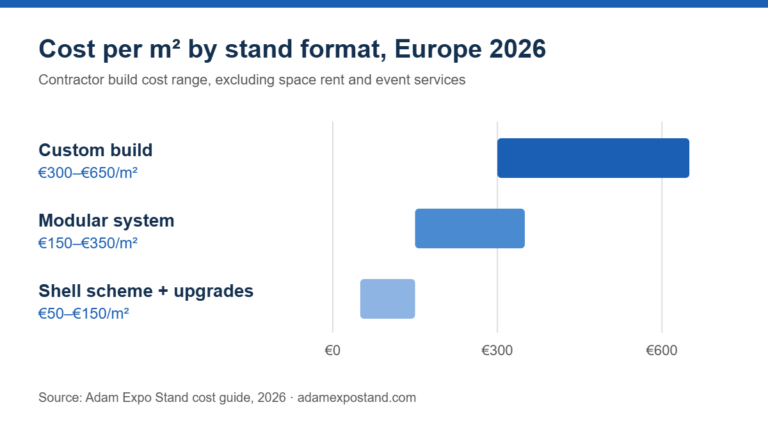
Choose the stand approach by comparing machinery access, presentation needs, reuse and confirmed scope, not a general claim that one format is cheaper. The organizer lists several stand-service forms. Bespoke carpentry or a modular approach may suit different briefs, but every option still needs coordinated services, delivery planning and event-specific review.
Begin with the least complicated arrangement that supports the commercial objective. A component supplier may need clear product organization and a place to discuss specifications. A large equipment exhibitor may need the display built around the machine. Neither situation proves that a larger stand or more decoration will produce a better return.
The modular-versus-custom guide covers the broader comparison. Here, request a scope comparison against the same drawing and equipment register. Check storage, furniture, finishes, graphics, installation and removal. If reuse is part of the decision, ask what will be retained, how it will be packed and where responsibility transfers.
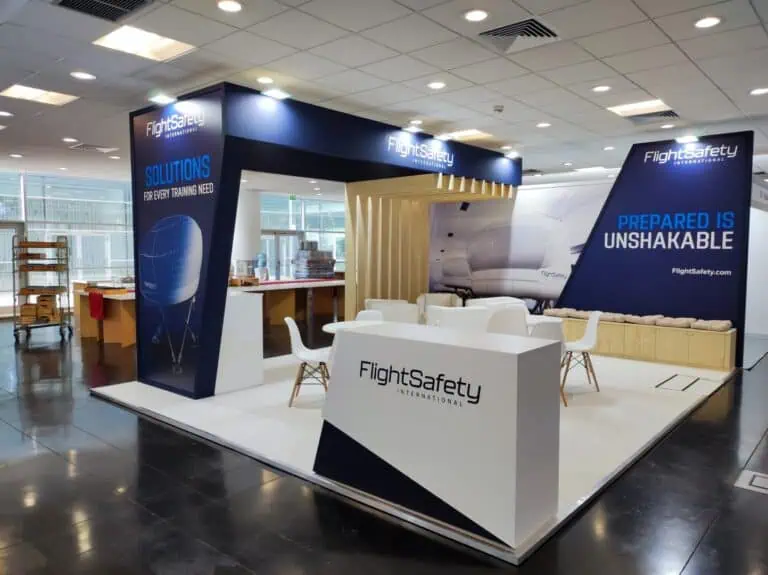
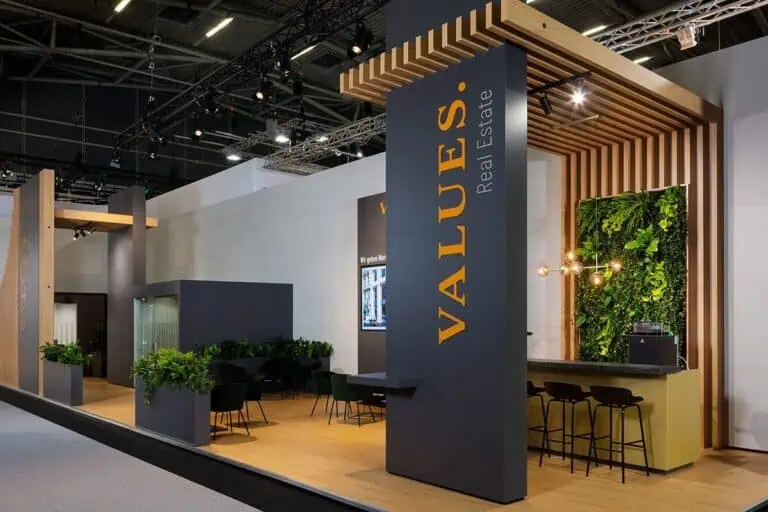
Adam Expo Stand provides custom wood carpentry design and build, modular stands with Aluvision and beMatrix, and turnkey services. Those approved capabilities do not establish which system any organizer package uses, or which system was used on an unconfirmed project. Ask for a proposal matched to your actual brief rather than assigning a brand to a photograph.
A useful comparison meeting ends with decisions and open questions. Record the selected approach, its exclusions and the evidence still required. If machinery access remains unresolved, keep that decision open. It is easier to revise a plan before fabrication than to discover that the chosen arrangement conflicts with the installation sequence.
How do you turn a machinery display into useful conversations?
Organize the visitor journey around an understandable application, a credible demonstration and a clear next step. A visitor should be able to identify what the machine does without interrupting an operator. A technical conversation should capture the application’s requirements without exposing confidential information or promising a result that has not been demonstrated.
For a hypothetical packaging supplier, start with the packaging task rather than a wall of equipment specifications. Prepare a concise explanation of the process, a demonstration route where approved and a discussion space for the visitor’s requirements. This is an illustrative planning scenario. It does not describe a client, measured outcome or guaranteed visitor behavior.
Give staff a handoff rule. When someone needs a technical specialist, identify the question and bring the right colleague into the conversation. Keep the next step specific: send a drawing for review, arrange a technical call or request a scoped quotation. Avoid collecting contacts without recording why the person wanted to speak.
The event’s registration guidance describes account confirmation, completion of registration details, submission and subsequent invoicing. Assign an exhibitor-side owner for that administrative work. Completing a commercial brief is different from completing registration; paying for participation does not by itself prove that the stand design or equipment operation has been accepted.
After the show, compare referred visits, relevant enquiries and sales opportunities where data is available. Do not treat impressions or a published article as proof of revenue. Keep marketing metrics separate from equipment-demo observations. Record the source of each enquiry when known, and report unknown attribution honestly instead of assigning it to the newest post.
What should be checked before the stand is handed over?
Review the installed stand against the approved layout, machine register and service orders before accepting it. Document unresolved items, their owners and the agreed next action. Use a handover record to connect physical completion with operational readiness. A finished graphic wall does not prove the equipment, connections or demonstration have been checked.
Walk the machine route and visitor route with the responsible people. Confirm that furniture, packaging or cleaning equipment has not blocked access needed for the demonstration. Ask the equipment team to complete its own checks. Photograph agreed issues without treating photographs as a substitute for technical tests or formal acceptance where those are required.
Use the downloadable arrival brief below as an internal coordination tool. Fill in the delivery contact, machine reference, confirmed arrival appointment and decoration-only tasks. Leave approval fields blank until evidence is available. The checklist is not an organizer document or a compliance certificate; its value is making the outstanding decisions visible before opening.
Plan removal at the same time as arrival. The official page publishes dismantling beginning after the show on January 28 and continuing January 29–31. Obtain the applicable access instructions and collection arrangements. Do not infer that a public show closing date means trucks can immediately enter or that your equipment can leave without its agreed handling team.
Keep a final copy of the delivery, service and handover records with the event owner. That record can improve the next brief without creating invented performance claims. The strongest lesson may be a missing connection reference or a changed machine dimension, not a dramatic return-on-investment number. Preserve the evidence that supports the improvement.
Frequently asked questions
When is ENOMAQ 2027 and where is it held?
ENOMAQ 2027 takes place January 26–28 at Feria de Zaragoza, Zaragoza, Spain. The organizer’s technical-information page is the source for the dates. Check the current page and your participation documents again before committing travel, freight or labor arrangements, because operational information may be updated after this article’s review.
Can our machinery arrive on January 25?
The published calendar says machinery delivery is until January 24. January 25 is reserved exclusively for decoration, and vehicles are not permitted inside the halls. Do not schedule a vehicle-dependent machine arrival for that day based on this guide. Ask the organizer about your specific delivery arrangements.
Are utilities included in the stand price?
That depends on the actual offer and service orders. The organizer lists separate forms for electrical supply, communications, water, drainage and compressed air. Request written confirmation of scope, connection location and responsibility. This guide does not verify an included allowance or publish an event-specific utility rate.
Does a service order authorize a live machine demonstration?
No such authorization should be inferred. A connection order and permission to run equipment are different matters. Describe the process to the organizer and responsible specialists, obtain the required responses, and agree the operator’s checks. The conditions for any particular machine remain unverified until assessed for that installation.
Is the hall plan our final stand allocation?
No. The organizer’s November announcement describes the planned sector distribution. Your own participation documents and current allocation identify your stand. Use the sector information to prepare a relevant message, then check the latest plan and avoid assumptions about neighboring exhibitors or foot traffic.
Can Adam Expo Stand help prepare the brief?
Discuss the plot allocation, equipment drawings, service needs and target audience with us. Founded in 2017, Adam Expo Stand has delivered 639+ projects. Founder Adam Dragos has worked in exhibitions since 2004 on projects across Europe. These credentials do not imply an unverified past ENOMAQ project.
About the author and next step
Adam Dragos is the founder of Adam Expo Stand. Based in Madrid, Spain, serving all of Europe with a focus on Spain and Portugal. Send the equipment list and allocation to discuss your stand brief. Tell us which requirements are confirmed and which still need an organizer response.