


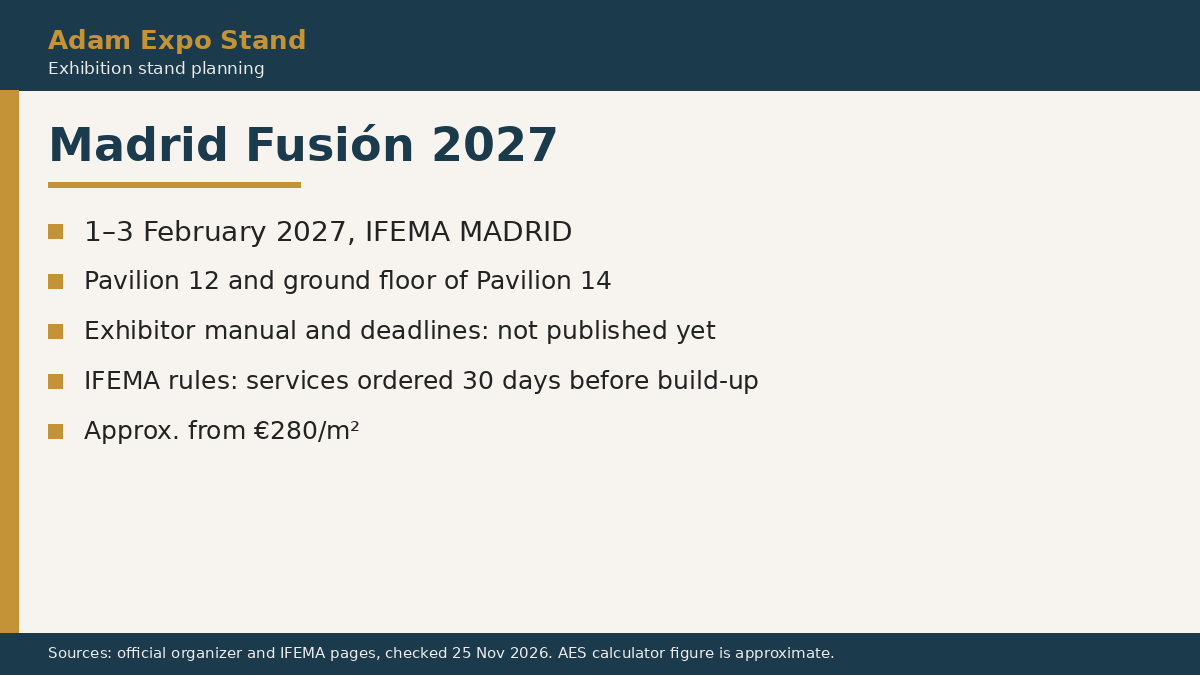
Madrid Fusión Alimentos de España runs from 1 to 3 February 2027 at IFEMA MADRID, on the ground floor of Pavilion 14 and, for its 25th anniversary, across all of Pavilion 12. As of 25 November 2026 neither the organizer nor IFEMA publishes an exhibitor manual or a deadline calendar, so the safe plan is the show dates plus IFEMA’s rules for externally organized fairs, where service orders close 30 days before build-up.
Last updated: November 2026
This guide is for food, drink and wine producers and kitchen suppliers deciding how to build a stand at Madrid Fusión in February 2027. It uses only the organizer’s site, IFEMA MADRID’s page for the fair and IFEMA’s Regulation for Exhibitors at externally organized fairs, plus Adam Expo Stand’s approximate calculator rate. Where the organizer has not published something, we say so instead of guessing. It comes from a company that designs, builds and installs exhibition stands, and it is not an exhibitor manual.
When and where is Madrid Fusión in 2027?
Madrid Fusión Alimentos de España 2027 takes place from 1 to 3 February 2027 at IFEMA MADRID. The organizer’s site gives the venue as Pavilions 12 and 14, and describes the 25th edition as using the ground floor of Pavilion 14, as before, plus the whole of Pavilion 12, which is new.
Both the organizer’s site and IFEMA’s event page carry the same dates and halls. The organizer is named on its site as Foro de Debate SL. Madrid Fusión is therefore an externally organized fair at IFEMA, not one IFEMA organizes itself, and that decides which rulebook applies to your stand (see below).
The organizer says the new layout will bring all the stages, the areas of its other congresses and the exhibition zone onto a single floor for the first time. For an exhibitor that means the exhibition zone and the stages share one hall level, which is good news for footfall, and bad news if you are hoping for a quiet corner. For other Madrid dates, see our food trade fairs 2027 calendar and our Madrid 2027 IFEMA calendar.
How will the 2027 floor be laid out?
The organizer describes one floor holding the main stages, the congress areas and the exhibition zone, spread over the ground floor of Pavilion 14 and all of Pavilion 12. The ticket lists a Main Auditorium, a 360º HUB, The Wine Edition, Pastry, Dreams and an Experience area, besides access to the exhibition area.
The organizer has not published a floor plan, an exhibitor catalog for 2027 or a stand-type list. What we can say from the official pages is that this is a congress with an exhibition attached, so visitors arrive for the stages and meet your stand between sessions. That favors open stands with a clear, quick-to-read product story, a counter, and a place to leave samples or a card.
One caution about figures. The organizer’s own “in figures” block for the 2026 edition reports 224 exhibiting companies and 25,992 visitors, while IFEMA’s event page shows a different set of totals, including 450 exhibiting companies without naming a year. Do not quote either as a benchmark until you know which edition it describes. We leave both out of our planning figures.
What exhibitor deadlines are published for 2027?
None, as of 25 November 2026. The organizer’s site and IFEMA’s event page list the dates, halls and ticket content, but no exhibitor manual, price list, space-booking deadline, stand-project deadline or build-up calendar. The organizer’s published contact is [email protected], and IFEMA’s general rules fix the order cut-offs for services.
That is a real gap, and it affects planning more than it first seems. The build-up and dismantling days for an externally organized fair are set in the contract between IFEMA and the organizer, and outside those days nobody may bring in material or stay in the grounds (Regulation for Exhibitors, article 22). Until the organizer issues its dates, you cannot count back from them.
Here is what you can do now. Write to the organizer and ask five things in one email: the stand types and prices, the hall plan, the build-up and dismantling days, the deadline to submit a stand project, and the rules for tastings and cooking. Then keep the answers with the contract, because the organizer’s rules and IFEMA’s regulation together decide what you can build.
Which IFEMA rules apply to a Madrid Fusión stand?
IFEMA’s Regulation for Exhibitors at externally organized fairs applies, together with the organizer’s own rules. Service orders must be placed 30 days before build-up starts. For exhibitors ordering directly, orders accepted in the last 7 days before build-up, during build-up or during the show carry a 25% surcharge, and cancelling within 15 days before build-up costs 40% of the tariff.
If the organizer contracts the services on your behalf, article 39 applies the same 30-day cut-off, with the 25% surcharge starting 15 days before build-up. The same regulation sets other points that shape the plan. A plan showing where you want water, drain or power points must reach IFEMA at least 30 days before build-up, or IFEMA places the services at its own criteria. A request to use forklifts or lifting platforms must be filed 30 days before build-up. Everyone who builds and dismantles is responsible for removing their own waste in the set periods, and material left after the deadline is treated as waste and charged to the organizer.
On construction, the regulation caps any element at 4 m for stands beside the entrances and along the back of Pavilions 12 and 14.0. Elsewhere height is limited by the hall structure with a 50 cm margin. A platform higher than 19 mm needs an access ramp at least 1.20 m wide. A second floor or any raised structure of 1.20 m or more that carries people or loads needs a certificate or project signed by a competent engineer and endorsed by the professional association. No second floor is allowed in the 4 m zones. Blind three-dimensional elements, such as double-panel walls or podiums, need two opposite holes of at least 8 mm at a height of up to 0.4 m.
Two cautions. The PDF on IFEMA’s site is dated 2021 on its cover, and the organizer’s rules prevail where they differ. Our IFEMA Madrid venue guide for exhibitors summarizes the venue-wide rules with sources.
Can you cook, taste or serve food on the stand?
Under IFEMA’s regulation, an exhibitor in a pavilion who wants to offer free catering on the stand must inform the organizer and send IFEMA the catering notification form. Frying, roasting, stewing, griddle or grill cooking is allowed only with extraction hoods fitted with activated-carbon filters, while cooking in water is exempt.
The other rules matter just as much for a gastronomy congress. Ovens and kitchen accessories may only run on electricity or LPG (butane or propane). Packaged products must be labeled under EU Regulation 1169/2011, and unpackaged food must carry a sign near the service point saying that allergen information is available on request. IFEMA also supplies the water, drain and compressed-air points: water and air connections are half an inch, drains are one and a half inches, and no more than two drain points may be fitted per water point contracted.
There is one question only the organizer can answer. For fairs dedicated to the restaurant sector, article 9.5 makes the organizer solely responsible for collecting the documentation that qualifies exhibitors to offer tastings, and for requiring that take-away products are stored and delivered packaged and labeled. Ask whether Madrid Fusión is treated that way. Our guide to catering rules at trade fair stands in Spain and Portugal goes through the catering and food-safety side in more detail.
As a rule of thumb, a tasting stand fails on logistics rather than design. Hidden storage, a hand-wash point, drain position and extraction have to be in the plan before the project is drawn, not after. That is a good reason to brief the builder early.
What are the hall limits in Pavilions 12 and 14?
Pavilion 12 is 14,400 m² with a clear height of 15.0 m, no columns and a floor load of 15,000 kg/m². Pavilion 14.0 is also 14,400 m², with a 9 m clear height, nine columns and a floor load of 15,000 kg/m², reduced to 2,000 kg/m² in parts. Both have six goods doors of 8 × 5.5 m.
These figures come from Annex II of IFEMA’s General Rules for Participation, which we copy on our venue sheet, and IFEMA marks a 4 m height cap beside the entrances and along the back of both pavilions. The organizer says the fair uses the ground floor of Pavilion 14, but IFEMA’s tables list 14.0 and 14.1 separately, with different heights and floor loads. Ask the organizer which part your plot is in before you design anything heavy.
The 2,000 kg/m² figure is the one to watch for a kitchen or refrigerated counter. A full demonstration kitchen, a stone counter or a water tank is heavy, so ask the organizer whether your plot falls in a reduced-load zone before you commit to heavy equipment.
How much does a Madrid Fusión stand cost to design and build?
Adam Expo Stand’s exhibition stand cost calculator starts from approx. €280/m² for design, build and installation. It is an approximate entry figure, not a quote, and it does not include the organizer’s space price, IFEMA’s services, assembly rights, electricity, water or insurance.
A tasting or cooking stand sits higher in the range than a plain display stand, because the plan adds a counter with concealed storage, a wash point, a drain and a heat or extraction solution. Those items are specified one by one in a real proposal. Run the calculator with your plot size, or test a layout in the free AI stand designer first.
The organizer’s costs depend on a price list that is not public. If you want a first budget conversation, send us the plot size, the hall if you have it, and whether you plan to taste or cook. We aim to reply within 24 hours.
First time exhibiting at Madrid Fusión: what do you do, in order?
Start by asking the organizer for the exhibitor conditions, because nothing is public. Then confirm the hall and the build-up days, decide whether you will taste or cook, and brief a builder with the plot, the rules and the reuse plan. Work backward from the organizer’s dates, not from a guess.
- Write to the organizer. Ask for stand types and prices, the hall plan, build-up and dismantling days, the stand-project deadline and the tasting rules.
- Read the two rulebooks. The organizer’s rules and IFEMA’s Regulation for Exhibitors apply together.
- Decide how you will serve the product. Display only, tasting, or cooking. Each step adds approvals and equipment.
- Fix the dates once they exist. Count 30 days back from build-up for service orders, water and drain plans and forklift requests.
- Brief the builder. Send the plot, the hall, the product list, the storage you need and any hung element.
- Plan the reuse. A stand that suits a February congress in Madrid can serve other food fairs if the structure is separate from the graphics. See our reusable exhibition stands page.
A first-time exhibitor at a congress should keep the stand simple: one hero product, one counter, one reason to leave a card. Chefs and buyers move between stages, so the stand has seconds to explain itself.
Madrid Fusión 2027 in figures
These are the facts an exhibitor can quote in an internal brief. Each line comes from the organizer’s site, IFEMA’s pages or regulation cited, or from Adam Expo Stand’s calculator. Items the organizer has not published are left out, so the list is short on purpose.
| Item | Verified figure | Source (checked 25 Nov 2026) |
|---|---|---|
| Dates | 1–3 February 2027 | Madrid Fusión organizer site; IFEMA event page |
| Venue | IFEMA MADRID, Pavilions 12 and 14 (ground floor of 14) | Organizer site |
| Edition | 25th anniversary | Organizer site |
| Exhibitor manual and deadlines | Not published | Organizer site and IFEMA event page |
| Service orders (externally organized fairs) | 30 days before build-up; 25% surcharge in the last 7 days (direct orders) | IFEMA Regulation for Exhibitors, article 40 |
| Water and drain services plan | At least 30 days before build-up | Regulation for Exhibitors, article 26 |
| Height cap beside entrances and back of Pavilions 12 and 14.0 | 4 m | Regulation for Exhibitors, article 24.3 |
| Pavilion 12 | 14,400 m²; 15.0 m clear height; 15,000 kg/m² | AES IFEMA venue guide, from IFEMA General Rules Annex II |
| Approximate AES build cost | From approx. €280/m² | AES cost calculator |
Quotable line: Madrid Fusión Alimentos de España runs 1–3 February 2027 in IFEMA Pavilions 12 and 14, and as of 25 November 2026 neither the organizer nor IFEMA has published an exhibitor manual or deadline calendar.
Ready to brief a Madrid Fusión stand?
If you already have a plot, or are about to ask for one, send the square meters, the hall if known, and whether the stand will taste or cook. We design, build and install the stand, and we aim to reply within 24 hours. Request a free 3D design consultation on our contact page.
For the wider picture, read about our exhibition stand builder in Madrid and the IFEMA Madrid venue guide.
Adam Dragos is the founder of Adam Expo Stand and Exhibitor Success Specialist since 2005. The company was founded in 2018 and is based in Madrid, Spain, serving all of Europe with a focus on Spain and Portugal, with 639+ projects in 12+ countries.
Related reading: food trade fairs 2027, catering rules at trade fair stands, IFEMA costs and deadlines, stand sizes and the free AI stand designer.


