Last updated:
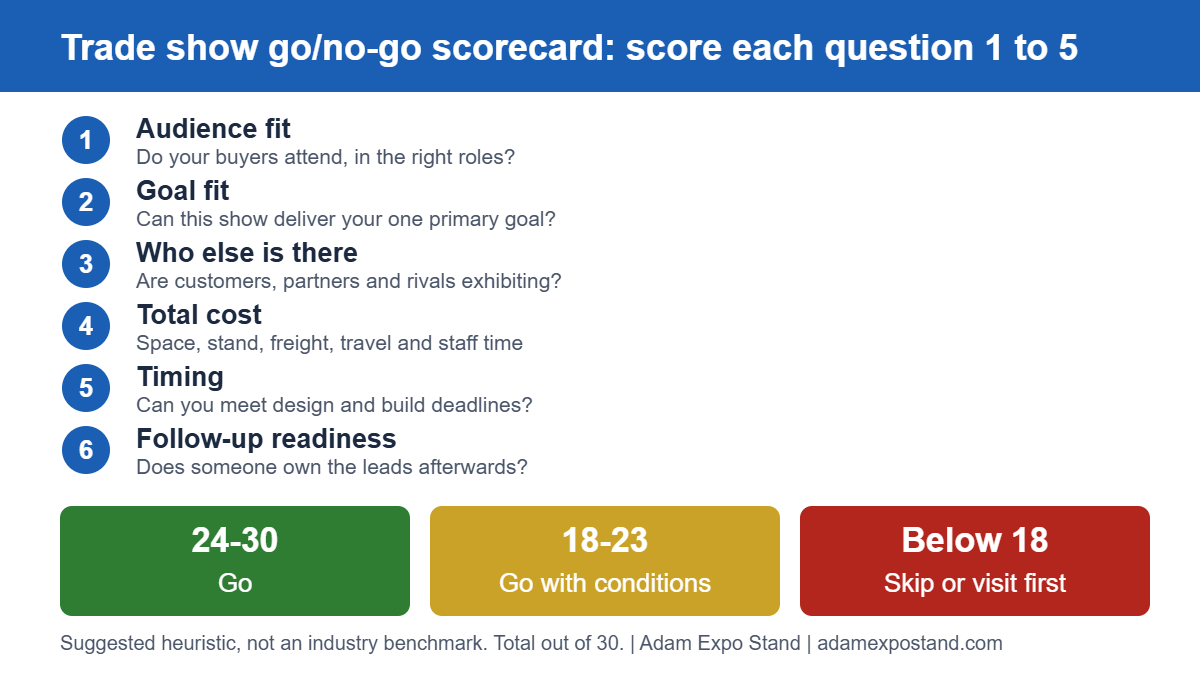
Quick answer: Score each trade show from 1 to 5 on six questions: audience fit, goal fit, who else is exhibiting, total cost, timing, and whether your team can follow up. A high total is a go, a middle total is a go with conditions (a smaller stand or pre-booked meetings), and a low total means skip it or visit as an attendee first.
Most exhibitors choose a trade show the way they choose a restaurant they have been to before: it is on the calendar, a competitor is going, the sales team likes the city. Then the stand is designed, freight is booked and the invoice for the space arrives. Only after the show does anyone ask whether it was the right room to be in.
Getting that decision wrong is expensive in a quiet way. A stand at the wrong show still costs the same to design, build, staff and dismantle, and it uses up a slot in your calendar that a better show could have had. Choosing well is usually cheaper than building well.
This guide gives you a six-question scorecard for deciding which trade show to exhibit at, and what to do when the answer is “maybe”. It sits before our guides on briefing a stand and budgeting for one: those help you build the right stand, and this helps you decide whether to build one at all.
What should you decide before you score any trade show?
Write down one primary goal for the next show you exhibit at, and score every candidate against it. “Brand awareness” and “leads” and “launch” and “meet existing clients” all point to different shows, and a show that is excellent for one can be poor for another.
Pick the goal by asking what would make this show a success in your own words six months from now: a number of qualified meetings, a distributor signed, a product seen by the right buyers, or existing customers met face to face. If you cannot name it, you are not ready to choose a show, and no scorecard will fix that.
Which six questions belong on a trade show scorecard?
Score each question from 1 (weak) to 5 (strong), using evidence rather than the organizer’s brochure wherever you can get it.
| Question | What to look for | Where to get evidence |
|---|---|---|
| 1. Audience fit | Do the people who buy, specify or recommend what you sell actually attend, and in which roles? | Ask the organizer for visitor profile data by role, sector and country; look at the previous edition’s exhibitor list; speak to two past exhibitors |
| 2. Goal fit | Can this show realistically deliver your one primary goal, for example meetings with distributors or a product launch audience? | Compare the program, hall layout and visitor mix with the goal you wrote down |
| 3. Who else is there | Are your customers, partners, distributors or direct competitors exhibiting? Is the right crowd in your hall or on another floor? | Exhibitor list and floor plan from the previous edition |
| 4. Total cost of participation | Space, stand design and build, freight, hotels, staff time, venue services, and the follow-up that comes after | Organizer rate card, venue service price lists and a stand budget, covered in our European stand cost guide |
| 5. Timing and lead time | Are the design, approval, production and freight deadlines achievable before the show, and does the date suit your launch or sales cycle? | Exhibitor manual deadlines, your own production calendar and your product roadmap |
| 6. Team and follow-up readiness | Do you have staff who can talk to visitors well, and someone who owns follow-up when the show ends? | Your staffing plan and a follow-up process such as our 14-day lead follow-up plan |
Questions 4 and 6 are the ones exhibitors most often skip. The first is easy to understate because the space invoice is only one part of the cost. The second decides whether the leads you pay for are ever used.
How do you turn the scores into a go or no-go decision?
Add up the six scores, for a total out of 30, and then apply a simple rule. The bands below are our suggested starting point, not a published standard, so change them if your situation calls for it.
| Total score | Suggested decision | What it usually means |
|---|---|---|
| 24 to 30 | Go | The show matches your goal and audience, and you can afford to do it properly |
| 18 to 23 | Go with conditions | Choose a smaller stand, pre-book meetings, share a stand, or attend once first as a visitor |
| Below 18 | Skip, or attend as a visitor | Money and team time are better spent on a different show or another channel |
One rule matters more than the total: a score of 1 or 2 on audience fit or on total cost should stop a “go” even when the other numbers are high. A show with great logistics and the wrong audience is still the wrong show.
Key takeaway: Decide the goal first, score the show second, and design the stand third. Doing it in the reverse order is how exhibitors end up with a beautiful stand at the wrong show.
How can you gather evidence without paying for a stand first?
You can learn most of what you need cheaply. Ask the organizer for the visitor profile and, if they have one, a post-show report from the last edition, and note whether the numbers come from registration data or an independent audit, because those are not the same thing. Read the exhibitor manual to see the deadlines and the technical rules, which tells you how much lead time you really have.
Then talk to people. Two phone calls to companies that exhibited last year, ideally one similar to you and one not, will usually tell you more than the brochure. Ask what they would do differently, how many of their meetings were new contacts, and what they spent beyond the space.
If the show still scores in the middle, visiting as an attendee for a day is a legitimate choice. You see the hall, the crowd and the stands that work, and you spend a fraction of what a stand costs.
What does the stand have to do with the decision?
More than it seems, because the stand is usually the largest controllable cost. A show that scores “go with conditions” often becomes a clear “go” when the stand is sized and specified to match the goal. A modest, well-planned stand at a good show frequently beats a large stand at an average one.
That is also where honest advice matters. If the scorecard says the show is a weak match, the best stand for it may be none, and we would rather you reached that conclusion before briefing a builder than after. When the answer is “go”, our guide to stand sizes helps you match the footprint to the number of conversations you want to hold, and our meeting capacity guide helps you plan the space inside it.
What does a scorecard look like in practice?
Here is an illustrative example, not a real client. A company selling industrial sensors is choosing between two shows. Show A is a large general consumer-electronics fair in a city the sales team likes. Show B is a smaller industrial trade fair with a visitor list made up of plant engineers and distributors.
On audience fit and goal fit, Show B scores 5 and 5 while Show A scores 2 and 2. Show A wins on name recognition but loses on who is in the room. The cost of the larger fair is also higher, and nobody on the team has time to follow up hundreds of contacts who will never buy. The scorecard makes the trade-off visible, and the team can still choose Show A on purpose, for a stated reason, instead of by habit.
Which mistakes make exhibitors choose the wrong show?
- Following competitors. A competitor being there is a signal to check, not a reason to go.
- Choosing by city or by brochure. Attendee quality matters more than the venue or the organizer’s headline numbers.
- Ignoring the cost beyond the space. Stand, freight, travel and staff time often outweigh the space rate.
- No follow-up plan. Leads that nobody owns are cost without return; plan this before you commit.
- Booking too late. A good show with an impossible build timeline is a weaker show than the score suggests.
- Never saying no. A scorecard is useful only if some shows score low and you act on it.
Related video: budgeting for a stand at IFEMA Madrid
This short video from our channel covers stand budgeting for IFEMA Madrid. It is a budgeting video rather than a show-selection tutorial, so use it as context for question 4, the total cost of participation.
Frequently asked questions
How do I decide which trade show to exhibit at?
Write down one primary goal, then score each candidate show from 1 to 5 on audience fit, goal fit, who else is exhibiting, total cost, timing and follow-up readiness. Use evidence such as visitor profile data and conversations with past exhibitors rather than the brochure alone.
Is it worth exhibiting at a trade show I have never attended?
Often the most sensible first step is to visit as an attendee. You see the visitors, the hall and the best stands for a fraction of the cost of exhibiting, and you can score the show on what you observed.
How many trade shows should a small company exhibit at in a year?
There is no correct number. Fewer shows done well, with a clear goal and a follow-up process, usually serve a small team better than many shows done thinly. Let the scorecard and your team capacity decide.
What should I do if the score is in the middle?
Look for ways to lower the risk: a smaller or modular stand, pre-booked meetings, a shared stand, or attending once as a visitor. Then rescore with what you learn.
Shortlisted a show and ready to plan the stand?
Tell us the event, dates and stand size, and we will discuss how the layout can support the conversations you want to have.
Recommended reads
Adam Expo Stand designs, produces and installs exhibition stands from Madrid for trade shows in Spain and across Europe.
Follow our exhibition planning guides
Choose Adam Expo Stand as a preferred source to help you find our exhibition guides and updates on Google.
Add as a preferred source on GoogleGoogle may ask you to sign in and confirm your choice.