Why Reusable Booth Displays Drive Trade Show ROI
Every time your team dismantles a single-use trade show booth and tosses it into a dumpster, you’re not just losing materials. You’re losing budget, brand equity, and a chance to build something smarter. European exhibitors are under growing pressure from both procurement teams demanding cost efficiency and regulators pushing stricter sustainability standards. Reusable booth displays solve both problems at once, and the numbers behind them are more compelling than most marketing managers expect. This guide breaks down the real financial case, the regulatory landscape, and the operational flexibility that makes reusable systems a strategic asset, not just a green gesture.
Table of Contents
- What are reusable booth displays?
- The long-term cost advantage: How reusables save money
- Sustainability and compliance: Meeting EU expectations
- Flexibility in action: Adapting to any event or venue
- ROI and professional impact: How reusables elevate your brand
- When are custom or single-use booths still a smart choice?
- Ready to elevate your trade show presence?
- Frequently asked questions
Key Takeaways
| Point | Details |
|---|---|
| Significant cost savings | Reusable booths reduce overall exhibition costs by up to 30 percent over multiple events. |
| Sustainability advantage | They lower carbon emissions and waste, helping brands meet strict EU regulations. |
| Flexible branding | Modular setups adapt easily to changing booth sizes and marketing messages. |
| Strong ROI | Professional reusable displays achieve ROI benchmarks of three times return on investment. |
What are reusable booth displays?
Reusable booth displays are modular structures engineered to be used at multiple events without losing visual impact or brand consistency. Unlike traditional custom-built stands that are designed for a single show and then discarded, these systems are built around interchangeable components. Frames, panels, lighting rigs, and graphic skins can all be swapped, reconfigured, or scaled depending on the venue.
As reusable booth displays demonstrate across hundreds of European events, the core value is adaptability. The same structural system that anchors a 6×3 meter inline booth at a regional trade fair can expand into a 10×10 island configuration at a flagship industry expo. That kind of flexibility is not possible with single-use builds.
Key features that define reusable booth systems:
- Swappable graphic panels that update messaging without replacing the frame
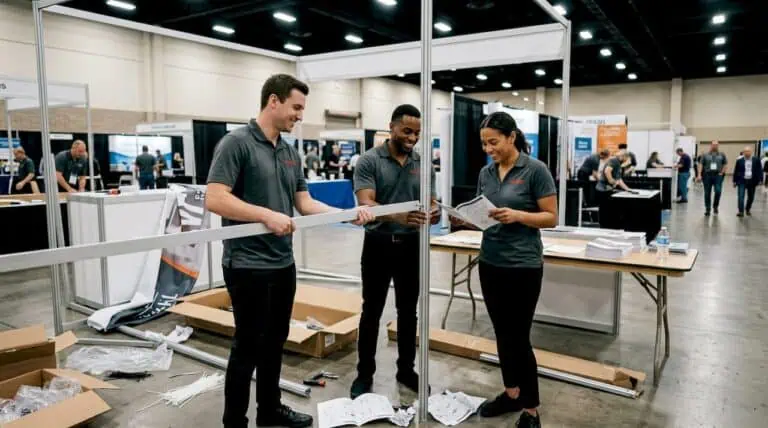
- Tool-free or low-tool assembly that reduces labor time on-site
- Scalable layouts that adjust to different floor plan sizes
- Durable materials rated for dozens of setups and teardowns
- Modular storage that reduces shipping volume and freight costs
As reusable booth displays can be reassembled, customized, and transported for use across many trade shows, the per-event cost drops significantly with each deployment. This also aligns directly with EU sustainability regulations, including the Packaging and Packaging Waste Regulation (PPWR) and the Ecodesign for Sustainable Products Regulation (ESPR), which are reshaping how brands approach event materials across Europe. Exploring eco-friendly booth design is no longer optional for brands with serious ESG commitments.
The long-term cost advantage: How reusables save money
The most common objection to reusable booth systems is upfront cost. Yes, a well-engineered modular system costs more than a cheap pop-up display. But that comparison misses the point entirely. The right question is: what does each event actually cost you over three years?
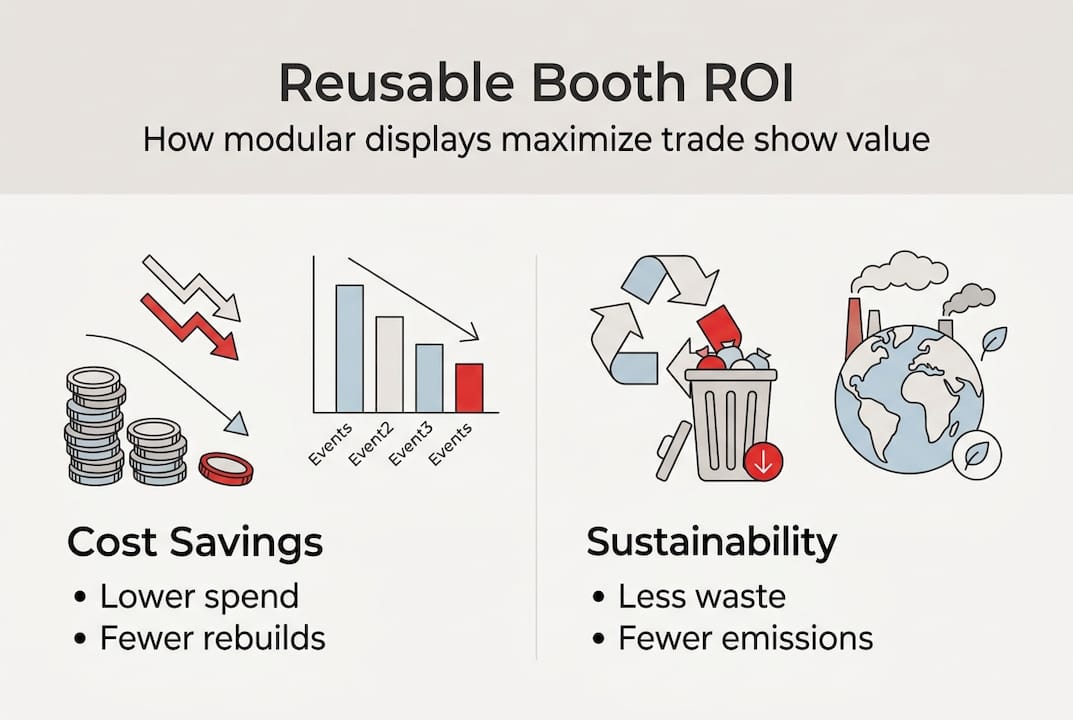
The data is clear. Modular systems deliver a 24% reduction in per-show design costs compared to custom booths, with up to 30% total exhibition cost savings and up to 80% cost reduction compared to rebuilding a stand from scratch every show. Separately, empirical three-year ROI benchmarks show a 14 to 30% reduction in total cost of ownership for brands that commit to modular systems.
| Cost category | Single-use custom booth | Reusable modular booth |
|---|---|---|
| Design and build (per show) | High, full rebuild each time | Low, amortized over many shows |
| Shipping and freight | Heavy, bulky materials | Compact, optimized crates |
| Drayage and labor | High, complex assembly | Reduced, tool-free setup |
| Graphic updates | Full reprint required | Panel swap only |
| Three-year total cost | Highest | 14 to 30% lower |
Think about drayage, which is the fee charged by convention centers to move your freight from the loading dock to your booth space. It is calculated by weight and volume. A reusable modular system ships in purpose-built crates that are lighter and more compact than the raw lumber and custom-cut panels used in traditional builds. That alone can save thousands per event.
Pro Tip: Treat your booth like a capital asset, not a marketing expense. Depreciate it over three to five years across your event calendar, and the per-show cost becomes a fraction of what you’re spending on single-use builds today. Explore modular booth ROI scenarios to model your own numbers before committing to a build.
For a deeper breakdown of how modular booth savings compound over time, the math consistently favors reusable systems for any brand attending three or more events per year.
Sustainability and compliance: Meeting EU expectations
Cost savings matter, but in Europe in 2026, sustainability is a compliance issue, not just a brand story. The EU’s PPWR, EPR (Extended Producer Responsibility), and ESPR regulations are tightening requirements on how companies use and dispose of materials at events. Brands that ignore this face reputational and regulatory risk.
Reusable booth systems directly address these requirements. Instead of generating tons of MDF waste, foam, and single-use printed materials after every show, a modular system reuses the same core components event after event. The environmental math is striking: up to 70% CO2 emission reduction and major landfill waste reduction at UK and EU events have been documented for brands switching to reusable display systems.
“Reusable exhibition systems are not just a sustainability choice. They are increasingly a compliance requirement for brands operating in regulated European markets.”
Here is how reusable booths stack up on key environmental metrics:
| Environmental metric | Single-use booth | Reusable modular booth |
|---|---|---|
| CO2 emissions per event | High | Up to 70% lower |
| Landfill waste generated | Significant after each show | Minimal, materials reused |
| Material sourcing frequency | Every show | Once, then maintained |
| PPWR and ESPR compliance | Difficult to achieve | Strongly supported |
Beyond compliance, EU sustainability compliance is becoming a procurement filter. Buyers, partners, and event organizers increasingly ask exhibitors to demonstrate their environmental credentials. A reusable booth system gives your brand a concrete, verifiable answer.
Additional sustainability benefits of reusable systems:
- Eco-materials such as recycled aluminum, FSC-certified wood, and PVC-free fabrics
- Reduced packaging waste from fewer shipments and optimized crating
- Lower carbon footprint from lighter freight and fewer production runs
- Longer material lifecycle that supports circular economy principles
For brands navigating exhibition stand regulations across multiple European markets, working with a partner who understands both design and compliance is essential. The reusable displays study confirms that scalable, sustainable alternatives are already outperforming traditional materials in both cost and environmental performance.
Flexibility in action: Adapting to any event or venue
One of the most underestimated advantages of reusable booth systems is operational agility. Marketing managers juggling a five-show European calendar, each with different floor plans, audience profiles, and brand objectives, need a booth that can keep up.
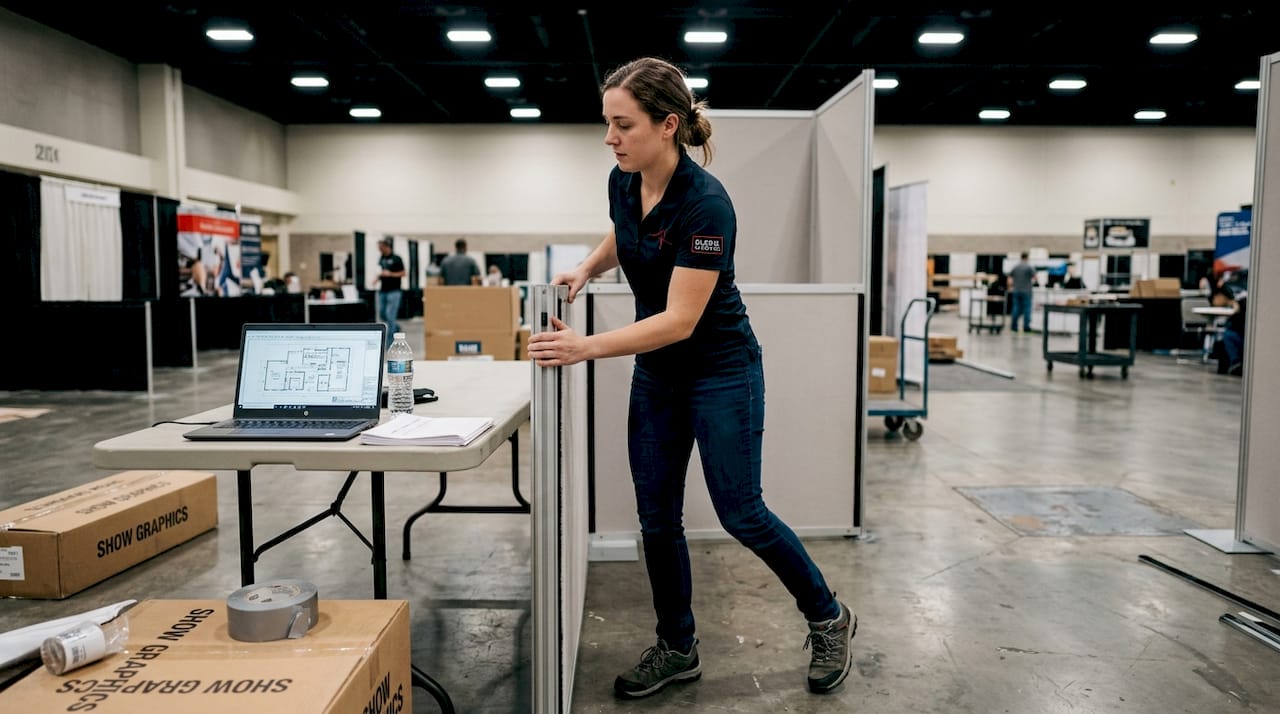
Modular systems are built for exactly this. Modular systems can cut setup time by 60% and adapt booth sizes and styles for different events with minimal friction. That means your team spends less time on logistics and more time on what actually drives results: engaging visitors.
Here is how a typical multi-event deployment works in practice:
- Design once, configure often. Your base structure is designed with flexibility built in. Panels, counters, and lighting can be rearranged without new fabrication.
- Update graphics between shows. Swap printed fabric panels or tension displays to reflect new campaigns, product launches, or event-specific messaging.
- Scale for the venue. Use a compact 6×3 layout for smaller regional shows and expand to a full island configuration for flagship events like Hannover Messe or Mobile World Congress.
- Ship smarter. Optimized crates reduce freight volume, which lowers both cost and carbon impact per event.
- Set up faster. Tool-free systems mean your booth is show-ready in hours, not days.
Pro Tip: Map your annual event calendar before finalizing your booth design. A good modular system should be able to serve at least 80% of your events without modification. That is the benchmark that separates a smart investment from an expensive compromise.
Brands using modular trade show booths across Europe consistently report that the ability to rebrand quickly between shows is one of the most valuable features they did not anticipate when they first made the switch.
ROI and professional impact: How reusables elevate your brand
Let’s talk about what happens on the show floor. A well-designed reusable booth does not look like a compromise. Modern modular systems use tension fabric graphics, integrated LED lighting, and precision-engineered frames that deliver the same visual impact as a fully custom build. Visitors cannot tell the difference. What they do notice is a polished, professional presence.
The business case is strong. Benchmarks show a 3:1 revenue-to-cost ROI and a 3x lead increase from professional exhibits, with reusable design delivering custom-level aesthetics at a fraction of the ongoing cost. That is not a marginal improvement. That is a structural advantage.
“A professional booth is not about how much you spend. It is about how consistently you show up. Reusable systems make consistency affordable.”
What drives this performance lift:
- High-resolution graphics that maintain brand standards across every event
- Integrated lighting that draws attention and creates atmosphere
- Consistent brand architecture that builds recognition across multiple shows
- Flexible product display zones that adapt to different campaign focuses
- Professional finish that signals credibility to buyers and partners
For inspiration on what is possible, examples of professional booth designs show how modular systems can achieve striking visual results without the cost of a full custom rebuild. If you want to maximize exhibition ROI, the combination of lower per-show cost and higher lead performance is the most reliable path.
When are custom or single-use booths still a smart choice?
Reusable modular systems are the right answer for most exhibitors. But not all. There are genuine scenarios where a custom or single-use booth makes strategic sense, and it is worth being honest about them.
Custom booths cost 30 to 50% more and are mainly suited for single-use, high-impact campaigns where visual uniqueness is the primary objective and the event will not be repeated.
| Scenario | Best booth type | Reason |
|---|---|---|
| Annual flagship launch event | Custom or hybrid | Maximum visual impact, one-time investment |
| Multi-show European tour | Reusable modular | Cost efficiency, adaptability |
| Regional trade fair circuit | Reusable modular | Scalability, lower logistics cost |
| One-off brand activation | Custom or disposable | Unique creative, not reused |
| Tight deadline, multiple venues | Reusable modular | Fast setup, consistent delivery |
When does custom make sense?
- One-time product launches where the booth concept is inseparable from the campaign
- Highly immersive experiences that require bespoke architecture or technology integration
- Events where brand differentiation is the single most important objective and budget is not a constraint
For everything else, the custom booth stand benefits need to be weighed honestly against the compounding cost and waste of rebuilding every show. For most brands attending three or more European events per year, the math rarely favors single-use.
Ready to elevate your trade show presence?
You have seen the data on cost savings, sustainability compliance, and lead performance. The next step is finding a partner who can translate that potential into a booth that actually works for your brand, your calendar, and your budget. At Adam Expo Stand, we design and build modular and reusable booth solutions for brands across Europe, from compact inline displays to full island configurations. Our team handles everything from initial 3D concept through on-site installation, so you can focus on your event strategy rather than logistics. Whether you are planning your next flagship show or building a system to carry you through a full European tour, we can help you get there with less waste, lower cost, and stronger results. Reach out for a personalized consultation and let’s build something worth keeping.
Frequently asked questions
What is the main advantage of reusable booth displays?
Reusable booths cut costs by 24 to 30% while reducing waste and meeting EU regulatory expectations for sustainability. They also deliver consistent brand presence across multiple events without the cost of rebuilding.
How do reusable booths help with sustainability?
They dramatically reduce material waste and carbon emissions by reusing structural components event after event. Up to 70% CO2 reduction has been documented at UK and EU events for brands switching to reusable systems.
Are reusable booths difficult to adapt for different events?
No. Modular systems are engineered for fast reconfiguration, graphic updates, and venue-specific scaling. Setup time can be reduced by 60%, making them highly practical for brands with active multi-event calendars.
Is a custom booth ever a better choice?
Yes, for one-off, high-impact campaigns where visual uniqueness outweighs cost and sustainability concerns. Custom booths cost 30 to 50% more and are best reserved for single-use, flagship activations rather than recurring event programs.