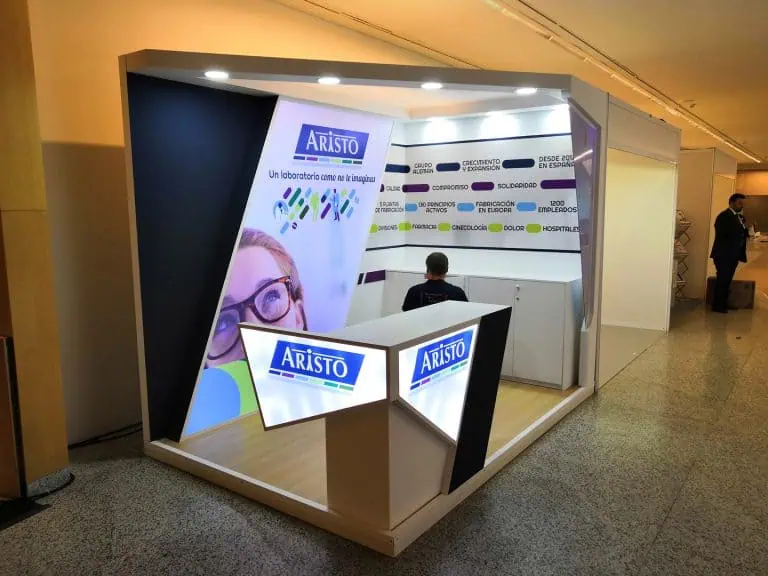
Custom display stands can adapt product presentation, graphics and visitor activities to a specific brief. Their value depends on what the tailored design allows you to do, how well it is delivered and its complete cost. A custom label does not establish higher lead generation, better recall or a financial return.
First clarify whether you need a product display fixture, a branded backdrop or an entire exhibition stand. Those are different scopes. Compare suitable standard, hired, modular and bespoke options against the same requirements.
Which benefits can custom display stands provide?
Treat each proposed benefit as a design requirement to demonstrate, rather than a promised outcome. A tailored solution may be appropriate when an available standard item cannot support the product, activity or brand presentation you need.
| Potential benefit | What the proposal should show | How to review it |
|---|---|---|
| Product presentation | Suitable display position, support and access | Review actual product dimensions, operating needs and a mock-up where useful |
| Brand consistency | Approved message, graphics and finish samples | Check legibility and appearance from intended viewing positions |
| Working space | Room for staff, visitors and support functions | Test simultaneous activities on a scaled plan |
| Integrated equipment | Power, ventilation, cable routes and service access | Review requirements with the equipment and technical teams |
| Future use | Documented configurations, replaceable parts and packing | Check the proposed programme and complete cost of each adaptation |
Design around the product and the visitor’s question
Decide what visitors need to inspect, compare or understand. Show a physical product where that answers the question effectively. Use screens, samples or a demonstration when they solve a specific limitation, such as a product too large to bring.
Define which surfaces visitors may touch, what staff operate and what must remain protected. Give the responsible designer the product’s dimensions, mass, connections and operating conditions. A display that looks suitable in a render still needs appropriate technical review.
Prepare a clear message and evidence the team can explain. Custom shapes, multiple screens and sensory features are optional; each should earn its place through a useful task and a workable support plan.
Check materials, graphics and finish
Ask for samples and an agreed specification. Review edges, joints, stability, cleaning, repair and the expected handling process. Materials should suit their actual function; glass, acrylic, timber, metal and fabric are not interchangeable merely because each can produce an attractive visual.
Check colour and legibility with the intended substrate and lighting. Do not promise an exact physical colour match from an image on a screen. Obtain the printer’s production requirements and approve final artwork separately from concept views.
The custom booth design process guide explains how to separate concept decisions, specification and delivery responsibilities.
Compare complete costs with standard alternatives
Request itemised offers for the same activities, event dates and delivery scope. Include design, technical work, fabrication, graphics, equipment, packing, transport, handling, installation, support, removal and taxes as applicable. Identify what the organiser supplies and which services remain separate.
For repeat use, model your actual programme. Add storage, inspection, repairs, replacement graphics, adaptations and transport for each planned event. A bespoke fixture may be reusable; a modular display may need additional parts. Neither category automatically wins the cost comparison.
Keep assumptions beside the totals. If future bookings are uncertain, compare that scenario too. A lower theoretical cost per use does not demonstrate a saving when the intended uses never happen.
Evaluate interaction and financial results separately
Agree observable tests before the event: can visitors understand the message, inspect the product and complete the intended activity? Record relevant conversations and requested next steps using your approved data process. Note delivery issues and practical improvements.
Review attributable commercial results over a defined period against the complete participation cost. Dwell time, scanned badges and positive comments can inform evaluation, but they are not financial profit. Avoid assigning a fixed uplift to a custom stand without comparable evidence.
Plan reuse and environmental evidence
Ask how the display will be dismantled, protected, stored, repaired and used again. Identify ownership, missing-part replacement, spare graphics and who maintains the inventory. Check the proposed next layout before committing to reuse.
Support environmental claims with evidence for the specified products and project. Record quantities, actual retained components, transport and end-of-use arrangements. Recycled content or a reusable frame alone does not establish the footprint of the complete display.
The AUMA briefing guidance is a useful reference when agreeing objectives and responsibilities with suppliers.
Frequently asked questions
Do custom display stands always generate more leads?
No. Results depend on the audience, offer, activity, staff, follow-up and other factors. Review the design against your tasks and measure relevant outcomes.
Can a custom display use modular components?
Yes. A tailored design can combine standard system parts and bespoke elements. Confirm the actual configurations, technical requirements and future adaptation costs.
When is a standard display enough?
When it safely supports the required product, message and activity within the approved space and budget. Compare complete suitable offers rather than assuming that custom construction is necessary.
How do I request a useful proposal?
Send your product information, event and plot, activities, brand files, budget and proposed reuse programme. Ask the supplier to demonstrate the required functions and state the complete scope.
Follow our exhibition planning guides
Choose Adam Expo Stand as a preferred source to help you find our exhibition guides and updates on Google.
Add as a preferred source on GoogleGoogle may ask you to sign in and confirm your choice.