Last updated:
Quick answer: Sort your trade show leads into tiers within two days, message your best leads personally within three, send everything you promised by day five, and keep a short, useful sequence going until about day 14. Speed matters less than relevance: every message should refer to the actual conversation you had at the stand.
The show ends, the stand comes down, and a box of business cards, badge scans and half-legible notes lands on someone’s desk. That is usually where good conversations go cold. The stand did its job of starting them. What happens in the next two weeks decides whether they continue.
Follow-up is also the part of exhibiting that the stand cannot do for you. A well-planned layout gives your team room to talk, record and qualify. It still takes a clear process afterward to turn those notes into meetings.
This guide gives you a practical trade show lead follow-up plan you can adapt to your own sales cycle: how to sort contacts, what to say first, and what a realistic 14-day sequence looks like. It builds on our guides to lead capture and data checks and booth staff training.
What should you do in the first 48 hours after a trade show?
Sort and annotate your leads before you write a single email. Do it while your team still remembers faces and conversations, because notes lose detail quickly. Export every scan, merge duplicates, and add what each person actually said they needed.
If several people worked the stand, ask each of them to add two things per contact: what the visitor wants to solve, and what you promised to send. That second field prevents the most common slip, which is a promise nobody owns.
Key takeaway: A lead without a note about the conversation is just a name. Record the need and the promise first, then decide who follows up.
How do you sort trade show leads into follow-up tiers?
Use three tiers based on what the visitor told you, not on how impressive their company is. The table below is a simple starting point. Rename the tiers or change the signals to fit your product.
| Tier | Signal from the conversation | Next step |
|---|---|---|
| A: ready to talk | Named a project, a budget owner, a date or a specific problem you can solve | Personal message within three days, with a proposed call or meeting |
| B: interested | Asked good questions, took material, but gave no timeline | Send the promised material, then a short sequence of useful follow-ups |
| C: early or unclear | Scanned or collected a card with no real conversation | Light-touch message or newsletter, and only if your data rules allow it |
Marketing emails to people you met at a show are subject to data protection rules that vary by country and by how you collected the contact. Check your approach with your data protection advisor, and see our lead capture and GDPR guide for the capture side.
What should the first follow-up message say?
Mention the conversation, give one useful thing, and ask for one next step. A reader who remembers you from the show will open a specific message. A generic “thanks for visiting our stand” blends into the rest of their inbox.
Here is a structure you can adapt. It is a sample, not a template to send unchanged:
Keep it short enough to read on a phone. Put the ask at the end, make it easy to say yes, and avoid attaching more than the visitor requested.
What does a 14-day follow-up sequence look like?
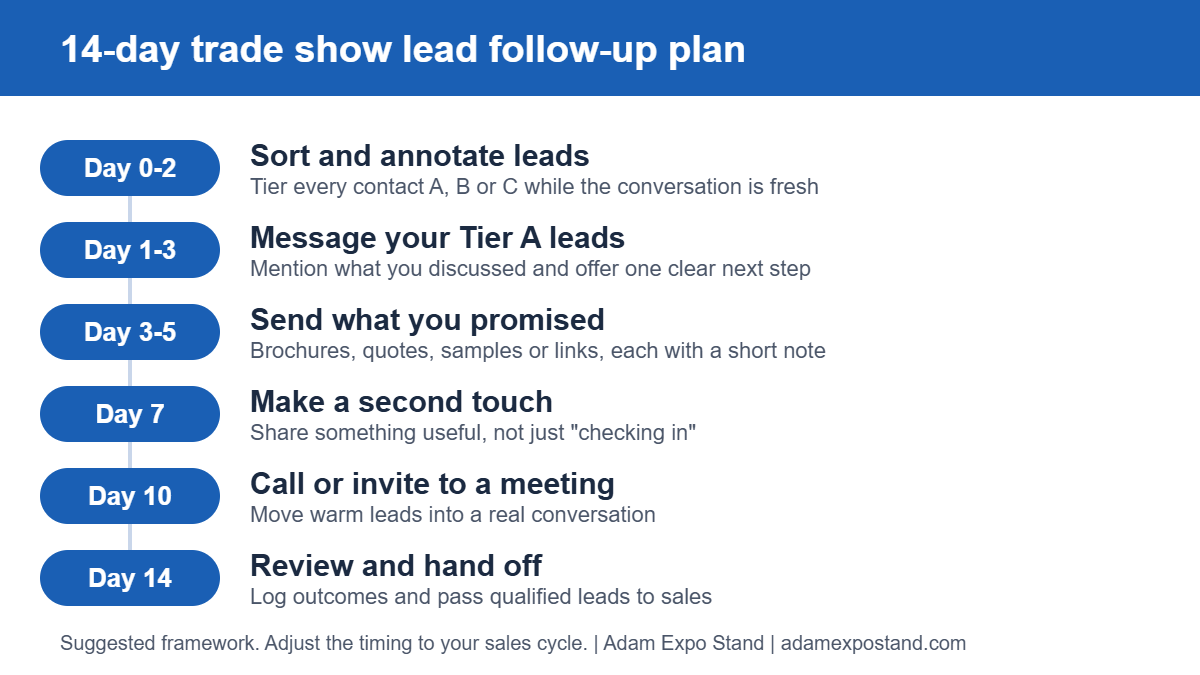
The sequence below matches the graphic at the top of this page. Treat the day numbers as a starting rhythm. Long B2B sales cycles may stretch it, and a simple product enquiry may compress it.
- Days 0 to 2: Sort and annotate every lead, and assign a tier.
- Days 1 to 3: Send a personal message to every Tier A lead, referring to what you discussed.
- Days 3 to 5: Deliver everything you promised: brochures, quotes, samples or links.
- Day 7: Make a second contact that adds value, such as a short guide or a relevant example, rather than a bare reminder.
- Day 10: Call Tier A leads or invite them to a meeting. Move warm Tier B leads to a call only if they have responded.
- Day 14: Review outcomes, log what happened, and hand qualified leads to sales with the conversation notes attached.
If a lead has not responded after the full sequence, stop. Move them to a longer-term list rather than sending reminders indefinitely.
Which mistakes slow trade show follow-up down?
- Waiting for a perfect list. Start with Tier A contacts while you clean the rest.
- No owner for each promise. Assign one named person per lead before the team scatters.
- Treating all leads the same. A visitor with a dated project and a visitor who scanned a badge need different messages.
- Skipping the review. Without a short debrief, you cannot tell which conversations, materials or stand features produced real meetings. Count meetings and qualified opportunities, not only scans.
A well-organized stand can support this. Space for private conversations, a clear spot to record notes, and tested materials all make the first 48 hours easier. For stock you hand out, see our guide to trade show sample inventory.
Related video: custom stand design tips
This short video from our channel covers design ideas for standing out at trade shows. It is a general design video rather than a follow-up tutorial, so use it as context for planning your next stand.
Frequently asked questions
How soon should you follow up after a trade show?
Start sorting leads within the first two days and message your most promising contacts within about three days. These are planning guidelines rather than fixed rules, so adjust them to your sales cycle and the nature of the conversations.
How many follow-up messages should you send?
Plan a short sequence rather than a single message, such as a first message, the promised material and one valuable second touch. If there is no response after the full sequence, move the lead to a longer-term list instead of continuing to chase.
Who should follow up with trade show leads?
Whoever had the conversation, if possible, because the visitor will recognize them. If sales takes over, pass along the conversation notes so the first message still refers to what was actually discussed.
Planning your next trade show stand?
Tell us your event, dates and stand size, and we will discuss how the layout can support the conversations you want to have.
Recommended reads
Adam Expo Stand designs, produces and installs exhibition stands from Madrid for trade shows in Spain and across Europe.