


Last updated:
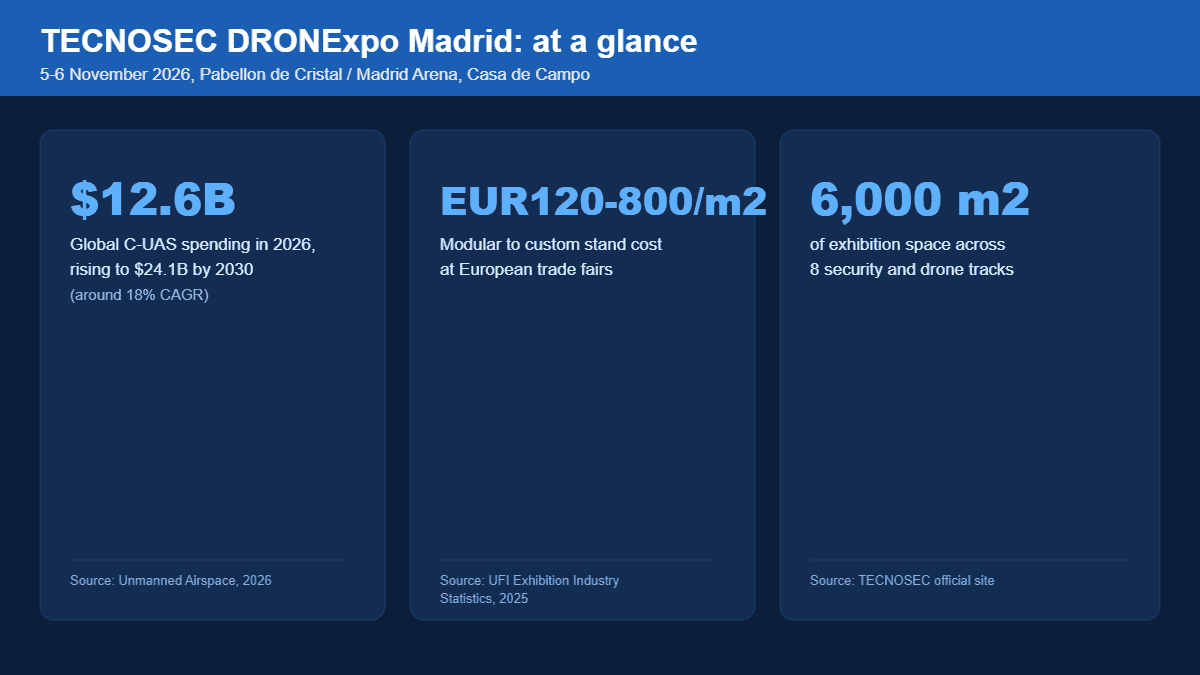
Quick answer: TECNOSEC DRONExpo, Spain’s dedicated fair for security, intelligence, drone and counter-drone (C-UAS) technology, runs 5-6 November 2026 at the Pabellon de Cristal and Madrid Arena complex in Casa de Campo, Madrid, across roughly 6,000 m² of exhibition space. A custom stand for this sector typically costs €250-€800/m², while a modular or hybrid build starts from around €120/m² (UFI Global Exhibition Industry Statistics, 2025); space rental itself is booked separately through the organiser.
What is TECNOSEC DRONExpo and where is it held in Madrid?
TECNOSEC DRONExpo is Spain’s specialist trade fair for high-security, intelligence, police, drone and counter-UAS (C-UAS) technology, running 5-6 November 2026 at the Pabellon de Cristal and Madrid Arena complex in Casa de Campo, Madrid, across roughly 6,000 m² of dedicated exhibition space for the sector.
The event merges what were previously two separate shows, TECNOSEC and DRONExpo, into roughly 6,000 m² of exhibition space, and it draws a buyer audience of security forces, government procurement teams, critical infrastructure operators and defence integrators rather than the general public.
The fair is organised around eight sector tracks: police, security and intelligence technology; communications, command and control; cybersecurity and cyber defence; platforms and sensors; critical infrastructure protection; border security and major-event security; emergency response; and forensics and criminology (source: TECNOSEC official site).
The C-UAS segment specifically is growing fast: global counter-drone spending is estimated at $12.6 billion in 2026, rising to $24.1 billion by 2030 at roughly an 18% CAGR (source: Unmanned Airspace), which is part of why the fair now runs as a combined security-and-drone event rather than two smaller shows.
Quick check: TECNOSEC DRONExpo readiness
How far out should you lock in the electrics and overhead rigging plan if your stand will run a live drone or C-UAS demo unit?
- What is TECNOSEC DRONExpo and where is it held?
- TECNOSEC vs SICUR vs FEINDEF: what is different
- Hall realities at Pabellon de Cristal and Madrid Arena
- Stand costs at TECNOSEC DRONExpo
- Stand design for security and C-UAS exhibitors
- Planning timeline
- Why an in-house Madrid build team matters
- Turning your stand into qualified leads
- Which strategy fits your situation?
Most European trade-fair guides assume you are heading to IFEMA Madrid or Fira Barcelona. TECNOSEC DRONExpo is not at either: it runs at the Pabellon de Cristal and Madrid Arena complex in Casa de Campo, Madrid, a venue with its own floor-load limits, ceiling heights and metro access, and a buyer audience of security forces and government procurement teams who do not respond to the same stand cues as a consumer trade show.
Get the venue or the sector wrong and the cost is not just a wasted stand. A hall rated to 400 kg/m² cannot take a C-UAS radar mast built for a 2,000 kg/m² ground floor; a stand with no lockable back-of-house area cannot host the confidential procurement conversations this sector runs on; and a design built for footfall, not vetted appointments, wastes the one thing a government buyer has least of, which is time.
This guide sets out what TECNOSEC DRONExpo actually costs to exhibit at, what the Pabellon de Cristal and Madrid Arena halls can and cannot take, a realistic build timeline, and how a Madrid-based in-house team that has already built for a defence exhibitor at FEINDEF applies that experience to a TECNOSEC DRONExpo stand.
TECNOSEC vs SICUR vs FEINDEF: what is actually different
TECNOSEC DRONExpo, SICUR and FEINDEF are three separate Spanish security-sector fairs with different venues, frequency and focus, and treating them as interchangeable in a stand budget or design brief is one of the most common planning mistakes exhibitors make when moving between Spain’s security-sector trade fairs.
TECNOSEC DRONExpo runs annually at the Pabellon de Cristal and Madrid Arena in Casa de Campo, and concentrates specifically on security, intelligence, police, drone and C-UAS technology. SICUR is IFEMA Madrid‘s broader biennial security showcase, with its 2026 edition held 24-27 February at IFEMA, not Casa de Campo, covering the wider security industry from physical access control to cybersecurity. FEINDEF, also at IFEMA, is Spain’s dedicated defence-industry fair for the armed forces and defence contractors rather than the civil security and policing buyers TECNOSEC DRONExpo targets.
The practical consequence is that a stand package designed for an IFEMA hall does not transfer to Casa de Campo without changes: the venue, loading access, technical services contractor and exhibitor manual are all different. Companies that exhibit at both FEINDEF and TECNOSEC DRONExpo in the same year, such as defence and electronic-warfare suppliers, generally need two separate technical plans even when the graphics and messaging carry across.
What are the hall realities at the Pabellon de Cristal and Madrid Arena?
The Pabellon de Cristal, connected by tunnel to Madrid Arena in the Casa de Campo exhibition park, offers around 20,200 m² across three levels, of which TECNOSEC DRONExpo occupies roughly 6,000 m². The ground floor covers 8,272 m², the mezzanine 4,033 m² and the top floor 7,895 m² (source: Madrid Destino, the venue operator, and the TECNOSEC organiser).
Ceiling height and floor load vary sharply by level, and both matter more here than at a typical trade fair because C-UAS jamming rigs, radar masts, vehicle platforms and drone displays are heavy and often need overhead mounting. The ground floor takes 2,000 kg/m² and reaches 10.6-13 m under the high bays, the mezzanine is rated to 500 kg/m² with 4.9-7 m clearance, and the top floor is limited to 400 kg/m² with a 7.4 m ceiling. Confirm your assigned level and its rating with the organiser before finalising a stand design that includes heavy hardware or overhead rigging, rather than after.
Visitor access runs through Madrid Metro Line 6 (Alto de Extremadura) and Line 10 (Lago), plus bus routes into Avenida de Portugal; neither line sits directly outside the door in the way IFEMA’s own Metro stop does, so factor a short walk or shuttle into staff and VIP scheduling.
Key takeaway: Get your assigned hall level and its floor-load rating from the organiser before you design in heavy hardware or overhead drone rigging; the Pabellon de Cristal’s three levels are not interchangeable.
How much does a stand at TECNOSEC DRONExpo cost?
A custom-built stand at a Spanish trade fair such as TECNOSEC DRONExpo typically costs €250-€800 per m², while a modular or hybrid system starts from around €120 per m² (UFI Global Exhibition Industry Statistics, 2025); space rental itself is quoted separately by the organiser and is not included in either figure.
For a security or C-UAS exhibitor, the build cost is rarely the full picture once sector-specific extras are added.
Beyond the base build rate, budget for: additional power circuits and, where the organiser permits it, compressed air for live demo hardware; overhead rigging for drone units or signage, priced by weight and height rather than a flat fee; AV for briefing screens, since most halls do not allow live indoor drone flight and a recorded or live-feed demo is the practical substitute; lockable back-of-stand storage for sensitive equipment; any additional liability cover the organiser requires for demonstrating UAS or C-UAS hardware on the show floor; and dismantling plus removal of any drone units under the same transport rules that applied to bringing them in.
| Option | Best for | Typical cost | Trade-off |
|---|---|---|---|
| Custom build | Exhibitors demonstrating live drone/C-UAS hardware or needing a controlled, credibility-first presence | €250-€800/m² | Highest cost and longest lead time, but the only route that reliably supports secure back-of-stand meeting rooms and heavy-equipment rigging |
| Modular system | First-time TECNOSEC exhibitors or companies also showing at SICUR/FEINDEF who want to reuse the structure | From €120/m² | Less design flexibility for large-format hardware displays or discreet meeting areas |
| Shell scheme + upgrades | Smaller, space-only allocations focused on lead capture rather than live demos | Lowest entry cost; upgrades billed separately | Shared wall panels and limited ceiling rigging rule out overhead drone displays |
How we approach this: Adam Expo Stand runs an in-house Madrid build team across design, production and on-site installation. Apply the checklist above to any shortlist of builders, including us.
Key takeaway: Treat the €250-€800/m² custom range as a starting point, not a quote. Rigging, AV and liability cover for live demo hardware are where security-sector stands diverge most from a standard trade-fair budget.
What does stand design need to do for a security, intelligence or C-UAS exhibitor?
A stand for TECNOSEC DRONExpo needs to do two things a general trade-fair stand does not: signal credibility to a specialist procurement audience without resorting to bright, consumer-style branding, and physically separate an open, public-facing area from a private space for vetted meetings.
Getting the balance wrong either turns the stand into an unapproachable box or leaves confidential conversations happening in the open.
A controlled visitor journey typically means a demonstration or reception zone at the front, screens running live-feed or recorded footage of drone and C-UAS hardware in action rather than live indoor flight, and a lockable, sight-screened meeting area at the rear for the kind of procurement conversation this sector runs on. Finish quality reads as credibility here more than colour: matt, structured materials and clear technical signage tend to land better with a government or defence buyer than a busy graphic wall. Where a stand displays physical hardware, mounting and cable management need to be resolved at design stage, not on the show floor, because heavy units cannot simply be repositioned once rigging is signed off.
What is a realistic planning timeline for TECNOSEC DRONExpo?
Exhibitors typically need 12-16 weeks before TECNOSEC DRONExpo to move from booking space to a stand that is designed, produced, cleared and installed, and the tightest points in that timeline are technical sign-off for rigging and, for international exhibitors, cross-border freight for hardware. Working backwards from the 5-6 November show days keeps the schedule realistic.
- 12-16 weeks out: confirm space, hall level and floor-load rating with the organiser.
- 10-12 weeks out: lock the design concept, including any overhead rigging or heavy-hardware plan, so it can go to the venue technical services team for approval.
- 6-8 weeks out: move into production, and start any staff accreditation or hardware documentation the organiser requires for a security-sector show.
- 3-4 weeks out: finalise freight and, for international exhibitors bringing hardware across borders, customs paperwork.
- Final week: installation within the Casa de Campo build-up window ahead of the show, followed by dismantling immediately after close on 6 November.
Why does a Madrid-based in-house build team reduce risk for security-sector exhibitors?
An in-house Madrid build team removes a layer of subcontracting risk that matters more at a security-sector fair than most, because problems that would be a minor fix elsewhere, such as a rigging-approval query or a last-minute hardware substitution, need someone on-site who can resolve them without routing the question through a third-party contractor first.
Adam Expo Stand runs design, production and on-site installation as one team based in Madrid, the model used on a 50 m² stand built for L3 ESSCO at FEINDEF, IFEMA Madrid, a defence and electronic-warfare exhibitor with the same requirement TECNOSEC DRONExpo exhibitors have: a stand that reads as authoritative in public while keeping space for confidential meetings with procurement stakeholders (case study: L3 ESSCO at FEINDEF).
Our verdict: From that FEINDEF build and comparable work in the defence and security space, the recommendation is straightforward: do not treat a security-sector stand as a smaller version of a consumer-show stand. Budget the extra time for technical sign-off, and use a build team that has actually handled the credentialing and confidentiality requirements this sector expects, not just the graphics.
How do you turn a TECNOSEC DRONExpo stand into qualified leads?
Lead generation at TECNOSEC DRONExpo works differently from a consumer trade fair because most attendees are public administration staff, security forces or government procurement teams working to a fixed schedule, so the stand needs to support pre-booked meetings rather than rely purely on footfall.
Badge scanning still has a role for general enquiries, but the higher-value activity is a bookable private meeting slot, agreed before the show with the specific agencies or integrators a company is targeting. Given the sensitivity of some attendee organisations, follow-up communication should stick closely to what was agreed on the stand and to standard GDPR practice rather than broad marketing lists. A short, factual leave-behind, ideally a technical spec sheet rather than a glossy brochure, tends to travel further inside a procurement organisation than a general company profile.
Insider tips from 15+ years on the show floor
- Request the exhibitor manual for TECNOSEC DRONExpo early and check the rigging and power rules before finalising a design that includes heavy hardware.
- Confirm in writing whether live indoor drone flight is permitted on your stand; most exhibition halls restrict it for safety, and screens are the fallback most security-sector exhibitors use.
- Build in a private, sight-screened meeting area even on a modest stand footprint; procurement conversations in this sector rarely happen in the open.
Which strategy fits your situation?
First-time TECNOSEC DRONExpo exhibitor
If this is your first Spanish security-sector fair, start with the venue, not the design: confirm hall level, floor-load rating and rigging rules with the organiser before briefing a stand designer. A modular system from around €120/m² keeps risk contained while you learn the show, and it can be reused at SICUR or FEINDEF later.
Drone or C-UAS hardware company needing a demo zone
A live hardware display needs its rigging, power and liability cover resolved 8-10 weeks out, well before the general 10-12 week design deadline, because overhead-mounting approval is the longest lead item on the checklist. Screens for demo footage are the practical substitute for live indoor flight.
Established defence contractor scaling from FEINDEF or SICUR
Reusing structural elements between shows is possible, but the technical services contractor, floor-load rules and even the exhibitor manual differ between IFEMA and Casa de Campo, so treat TECNOSEC DRONExpo as a separate technical plan even when the branding stays the same.
Small-footprint, lead-generation-focused exhibitor
On a modest stand, a shell-scheme-plus-upgrades approach keeps entry cost lowest. Concentrate the budget on a private meeting corner and a clear technical leave-behind rather than a large graphic wall, since the buyer audience here responds to substance more than scale.
Key takeaway: TECNOSEC DRONExpo, SICUR and FEINDEF are not interchangeable technical plans. Confirm which venue, floor and rigging rules apply before reusing a stand design from one Spanish security fair at another.
Frequently asked questions
When is TECNOSEC DRONExpo 2026?
TECNOSEC DRONExpo 2026 runs 5-6 November at the Pabellon de Cristal and Madrid Arena complex in Casa de Campo, Madrid.
Where exactly is TECNOSEC DRONExpo held?
It is held at the Pabellon de Cristal, connected by tunnel to Madrid Arena, in the Casa de Campo exhibition park on Avenida de Portugal, Madrid, reachable via Metro Line 6 (Alto de Extremadura) or Line 10 (Lago).
Is TECNOSEC the same fair as SICUR?
No. SICUR is IFEMA Madrid’s broader biennial security showcase, last held in February 2026, while TECNOSEC DRONExpo is a separate, annual fair at Casa de Campo focused specifically on security, intelligence, drone and C-UAS technology.
Can I fly a drone indoors on my stand?
Check with the organiser directly. Most exhibition halls restrict live indoor drone flight for safety reasons, and the practical alternative most exhibitors use is a screen running live-feed or recorded demo footage.
How much does a custom stand cost at TECNOSEC DRONExpo?
Custom builds for Spanish trade fairs typically run €250-€800 per m² (UFI, 2025), with security-sector extras such as rigging, additional power and liability cover for demo hardware often adding to that range. Space rental is quoted separately by the organiser.
How long does a security-sector stand take to build?
Budget 12-16 weeks from booking space to a fully installed stand, with the tightest points being technical sign-off for rigging and, for international exhibitors, cross-border freight for hardware.
Recommended reads
Adam Expo Stand: exhibition stand design and build for European trade fairs. Based in Madrid, Spain, serving IFEMA Madrid, Fira Barcelona, Messe Frankfurt and 50+ fairs across Europe. Contact: [email protected] / +34 697 715 015.
Planning a stand for TECNOSEC DRONExpo?
Get an itemised quote and a 3D concept from an in-house Madrid build team.


