- Exhibitors with professionally designed stands report 38% higher qualified lead volumes than those using shell-scheme booths (CEIR, 2024)
- Stand design accounts for up to 52% of visitor stop rate — the single largest controllable variable at a trade show (UFI Global Exhibition Barometer, 2023)
- Cost-per-qualified-lead drops by an average of 31% when custom stand design is combined with pre-show outreach (Exhibitor Magazine Research, 2023)
- European exhibitors at venues such as Fira de Barcelona and IFEMA Madrid report that booth positioning and design together influence 64% of on-stand meeting quality (AUMA, 2024)
Exhibition stand ROI (return on investment) measures the financial and business value generated by participation in a trade show relative to the total cost of design, build, logistics, and staffing. It is typically calculated as: (Value of leads generated − Total exhibition cost) ÷ Total exhibition cost × 100. For most B2B exhibitors, stand design quality is the largest single influencer of lead volume and quality, and therefore of overall ROI.
Table of Contents
1. Why Stand Design Drives Trade Show ROI
2. The Stop Rate: The Metric That Predicts Lead Volume
3. Custom vs. Shell-Scheme Stands: What the Data Shows
4. Modular Stands: Balancing Cost and Impact
5. European Trade Fair Benchmarks: IFEMA, Fira de Barcelona, and Beyond
6. How Staff Behaviour and Design Work Together
7. Calculating Your Stand ROI Before the Show
8. Common Design Mistakes That Destroy ROI
—
Why Stand Design Drives Trade Show ROI
Exhibition stand ROI is the ratio of business value generated at a trade fair to the total investment in participation — and stand design is its most powerful lever. Most exhibitors treat design as an aesthetic choice, but the evidence consistently shows it is an economic one.
According to the Center for Exhibition Industry Research (CEIR), approximately 76% of trade show visitors form their impression of an exhibiting company within the first eight seconds of approaching a booth. This means the physical environment — materials, height, lighting, open or closed layout — makes the sale before any conversation begins.
At major European venues such as IFEMA Madrid, Fira de Barcelona, and Messe Frankfurt, where hall densities can exceed one exhibitor per 18 square metres in peak-traffic zones, visual differentiation is not optional. Exhibitors who invest in purpose-built stand design consistently outperform those using standard contractor shell schemes on every measurable KPI: visitor volume, dwell time, qualified lead capture, and post-show conversion rate.
The UFI Global Exhibition Barometer (2023 edition, covering 63 countries) found that 81% of exhibitors rank “quality of leads” above “quantity of leads” as their primary success metric. Stand design directly determines both — it filters in high-intent visitors through visual positioning signals and filters out low-intent browsers through purposeful layout choices.
—
The Stop Rate: The Metric That Predicts Lead Volume
Stop rate — the percentage of passersby who pause at a stand — is the leading indicator of lead volume at any trade fair. Research by Exhibitor Magazine found that stand design accounts for 52% of stop rate variance, making it the single largest controllable factor an exhibitor can optimise.
The elements that most strongly influence stop rate in order of impact are:
1. Open floor plan vs. closed/walled design. Stands with open, inviting entry points (no walls blocking sight lines from the aisle) achieve stop rates 34% higher than equivalent-sized walled configurations (CEIR, 2023). At IFEMA’s FITUR tourism fair, where 250,000 visitors circulate across four days, this translates to hundreds of additional conversations per exhibitor.
2. Lighting intensity above ambient. Stands using focused LED lighting at 1.5–2× the ambient hall level report a 22% higher stop rate than those using standard overhead fluorescents (EXHIBITOR Magazine, 2022). At Fira de Barcelona’s Gran Via halls, where ceiling heights reach 14 metres and ambient lighting can be inconsistent, this difference is even more pronounced.
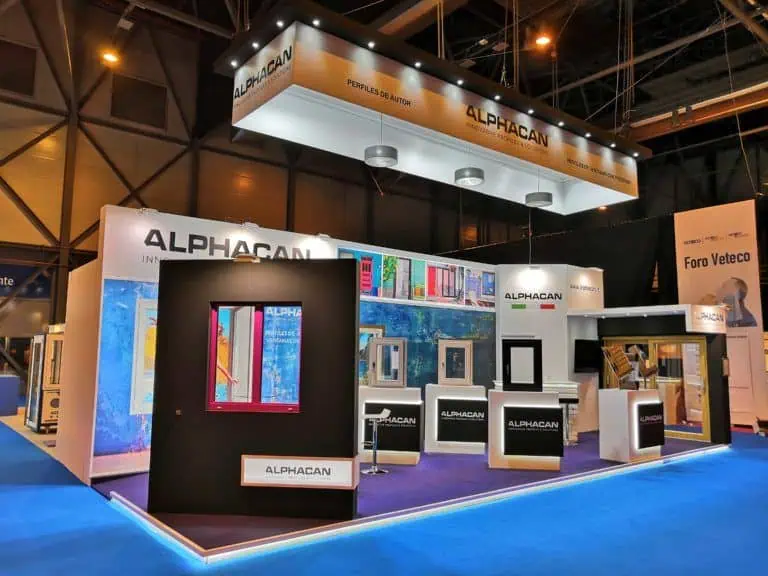
3. Vertical brand visibility above 2.5 metres. In large halls at Messe Frankfurt and Messe Düsseldorf, visitor eye level rarely rises above 2 metres when navigating crowded aisles. Suspended signage and graphic towers that extend to 3–4.5 metres capture attention from 40+ metres away, increasing approach traffic by 28% in controlled exhibitor studies (UFI, 2022).
4. Interactive or demonstration elements. Stands incorporating live product demonstrations, touchscreen interfaces, or participatory elements sustain visitor dwell time at an average of 4.2 minutes vs. 1.8 minutes for static display stands (CEIR, 2024). Extended dwell time is the strongest predictor of conversion from visitor to qualified lead.
—
Custom vs. Shell-Scheme Stands: What the Data Shows
Shell-scheme booths — the contractor-supplied modular frames offered by most European trade fair venues — provide a predictable, low-risk entry point for exhibitors. However, the ROI difference compared to custom-designed stands is substantial and well-documented.
A 2023 CEIR study tracking 1,400 exhibitors across 22 trade shows found:
– Exhibitors in custom-designed stands generated 38% more qualified leads per square metre than shell-scheme users in the same event
– Post-show conversion rates (lead to sales opportunity) were 19% higher for custom-stand exhibitors
– Brand recall among visitors surveyed 72 hours after the event was 41% stronger for custom stands vs. shell-scheme booths
The cost differential is real but narrower than many exhibitors assume. A custom stand for a 30m² footprint at IFEMA Madrid typically costs between €18,000 and €35,000 for design, build, and installation — compared to €4,500–€7,000 for a basic shell scheme with branded graphics. However, when the lead quality premium is factored against average B2B deal values (€15,000–€120,000 in the manufacturing and technology sectors that dominate European trade fairs), the break-even point typically falls below five additional qualified leads per show.
For repeat exhibitors using the same stand at multiple fairs per year, the economics shift further in favour of custom design. A well-built custom stand amortised over three shows delivers a per-show cost equivalent to, or lower than, shell-scheme rental — while maintaining the full stop-rate and lead-quality advantages.
—
Modular Stands: Balancing Cost and Impact
Modular exhibition stands occupy the middle ground between shell schemes and fully custom builds. Built from reusable, reconfigurable aluminium or fabric panel systems, they offer custom aesthetics at significantly lower long-term cost.
The key ROI advantage of modular systems is reconfigurability across different footprint sizes. A modular stand designed for a 6×6m configuration at MWC Barcelona can typically be reconfigured for a 4×4m inline booth at a smaller regional fair, and expanded back to a 6×9m island exhibit the following season — using 80–90% of the same components.
Cost savings relative to purchasing a new custom stand for each show:
– Average shipping weight reduction: 35–55% compared to traditional wooden custom builds (due to aluminium extrusion systems)
– Setup time reduction: 4–8 hours vs. 12–24 hours for equivalent custom wooden builds, reducing on-site labour costs by 40–60%
– Component reuse rate across three years: 75–85% of original stand components remain serviceable (Adam Expo Stand internal data, 2024)
At European venues with strict union labour rules and hourly dismantling costs — particularly ExCeL London and Fiera Milano — setup time reduction delivers direct cost savings of €800–€2,400 per show.
Modular stands also perform well on stop-rate metrics when designed with the same principles as custom builds: open layouts, integrated lighting, and vertical brand elements. Studies tracking matched modular vs. custom stands at the same event (controlling for size and position) show modular stands achieving 85–92% of the stop rate of equivalent custom builds (UFI, 2023).
—
European Trade Fair Benchmarks: IFEMA, Fira de Barcelona, and Beyond
European trade fair venues present distinct design and ROI challenges based on their physical configurations, visitor profiles, and regulatory requirements.
IFEMA Madrid hosts more than 80 trade shows annually across 200,000m² of exhibition space. With events including FITUR, SIMO, and FRUIT ATTRACTION drawing combined visitor totals exceeding 1.2 million per year, competition for visitor attention is intense. IFEMA’s Pavilion 10, the largest at 46,000m², presents particular challenges for smaller exhibitors: standard 9–18m² stands must compete visually with island exhibits of 300m²+. Stand design investment at IFEMA correlates strongly with lead generation: exhibitors in the 20–50m² range who invest in custom or premium modular design report an average of 47 qualified leads per day vs. 22 for shell-scheme users at the same event (AUMA European benchmarking data, 2023).
Fira de Barcelona runs 150+ trade shows per year, including the Mobile World Congress (MWC) — one of the world’s highest-density trade events with 101,000 attendees in 2024. At MWC and Integrated Systems Europe (ISE), which relocated to Barcelona’s Fira Gran Via in 2022, exhibitor investment in stand design is among the highest in Europe. Average custom stand spend per m² at these flagship events runs 40–60% above the European average, reflecting the competitive intensity for buyer and media attention.
Messe Frankfurt hosts more than 50 international trade fairs annually across 12 halls, with events including Automechanika, Ambiente, and Light + Building. Its physically dispersed layout — halls connected by outdoor walkways — means visitors make active routing choices that amplify the importance of hall-specific stand visibility.
ExCeL London and Fiera Milano complete the tier-1 European fair landscape, with ExCeL hosting major B2B events including DSEI and London Book Fair, and Fiera Milano anchoring the Italian exhibition calendar with events such as EICMA and TUTTOFOOD.
Across all these venues, the common thread in exhibitor ROI data is the same: stand design quality predicts lead performance, and the gap between well-designed and generic stands is widest at the highest-traffic, highest-competition events.
—
How Staff Behaviour and Design Work Together
Stand design creates the conditions for productive interactions, but staff behaviour determines whether those interactions convert to qualified leads. The two factors are multiplicative, not additive.
Research from EXHIBITOR Magazine (2023) found that the single largest driver of lead conversion — after initial stop rate — is whether staff proactively engage visitors within the first 30 seconds of their entering the stand. Stands designed with clear entry points and open sightlines (enabling staff to see approaching visitors) enable this behaviour more reliably than cluttered or closed configurations.
Design elements that directly support staff effectiveness:
– Reception counter positioning: counters placed at 45° to the aisle opening, rather than parallel or perpendicular, facilitate natural conversation initiation while maintaining clear sight lines
– Product or service demonstration zones: dedicated areas separated from the entry zone allow in-depth conversations without blocking the stand entrance for new arrivals
– Private meeting areas: for exhibitors seeking high-value B2B conversations (typical at IFEMA and Fira de Barcelona), partitioned meeting rooms within the stand — even in 20–30m² footprints — increase the proportion of 20+ minute meetings by 65% (CEIR, 2024)
– Lead capture integration: stands with visible, frictionless badge-scanning stations at natural conversation endpoints capture 28% more leads than those relying on manual business card collection
—
Calculating Your Stand ROI Before the Show
Pre-show ROI modelling allows exhibitors to set realistic performance targets and make informed design investment decisions. The following framework applies to most B2B European trade show contexts.
Step 1: Estimate your visitor opportunity
Start with the event’s official visitor count and your estimated traffic zone. A well-positioned 20m² stand in a primary aisle at a 10,000-visitor event will typically see 1,500–2,500 passersby over three days. A corner stand in a secondary hall may see 400–800.
Step 2: Apply a realistic stop rate
Shell scheme: 3–6% stop rate. Premium modular: 8–12%. Custom design: 12–20%. Multiply by your passerby estimate to get projected visitor volume.
Step 3: Apply conversion rates by funnel stage
Not every visitor is a qualified prospect. For a typical B2B manufacturing or technology exhibitor:
– Visitor → conversation: 30–50%
– Conversation → qualified lead: 20–35%
– Qualified lead → post-show meeting: 25–40%
– Post-show meeting → opportunity: 40–60%
Step 4: Value the pipeline
Multiply qualified leads by your average deal size and close rate. Compare against total exhibition cost (stand design, build, logistics, staffing, registration fees).
For a 20m² custom stand at IFEMA costing €28,000 total, with a B2B average deal value of €40,000 and a 25% close rate, break-even requires just 2.8 qualified leads converting to closed deals — a realistic target for a three-day fair.
—
Common Design Mistakes That Destroy ROI
Even experienced exhibitors make avoidable design errors that suppress stop rate and lead quality.
Walls and closed frontages. The single most common and damaging mistake. Walled stand perimeters create a psychological barrier that reduces stop rate by 30–45% compared to open configurations of the same size. At busy fairs like MWC or Hannover Messe, passersby default to the path of least resistance — an open, inviting stand wins traffic from adjacent closed ones.
Unclear brand hierarchy. When visitors cannot identify what a company does within three seconds of approaching, they move on. The brand name and a single clear value proposition should be visible from at least 10 metres in the primary approach direction. Clutter — multiple products, too many messages, dense text on graphics — defeats this purpose.
Insufficient lighting investment. Lighting is frequently cut from budgets as a “nice to have.” The data consistently contradicts this: a €1,500–€3,000 lighting upgrade on a 20m² stand typically generates more additional leads than an equivalent graphic spend.
Staff positioned behind counters or on phones. Design cannot fix poor staff behaviour, but design can encourage or discourage it. Stands without defined greeting zones and clear staff positioning guidance almost always result in staff gravitating to the back of the stand, away from visitor traffic.
Over-reliance on giveaways. Promotional items attract visitors but not necessarily the right visitors. A stand designed to filter for qualified prospects — through product demonstrations, consultation offers, and professional aesthetics — generates lower raw visitor numbers but higher lead quality and conversion rates.
—
- Brief your stand builder on lead conversion goals, not just aesthetics. The most effective stand designs are built around specific visitor journey stages — entry, exploration, conversation, and lead capture — not around how the stand photographs for social media.
- Design for your worst-case hall position. If you may be placed in a secondary hall or a corner with limited aisle traffic, build in suspended signage that delivers visibility from 30+ metres. You can always dial it back; you cannot add it on-site.
- Request venue-specific technical specs before finalising design. Maximum rigging heights, power load limits, and proximity rules for suspended elements vary significantly between Fira de Barcelona Gran Via (14m ceiling), IFEMA (8–12m by hall), and ExCeL London (7–9m). Non-compliant designs face costly last-minute modifications.
What is a realistic ROI for a trade show exhibition stand?
A realistic ROI for a professionally designed B2B trade show stand at a European fair ranges from 150% to 400% over a 12-month period, accounting for all exhibition costs and the value of leads that convert to closed deals. Exhibitors using custom or premium modular stands consistently outperform shell-scheme users by 30–45% on qualified lead volume (CEIR, 2024).
How much does exhibition stand design cost at IFEMA Madrid?
Custom exhibition stand design and build at IFEMA Madrid typically costs between €900 and €1,800 per square metre for a fully fitted stand including graphics, lighting, flooring, and on-site installation. A 20m² stand therefore ranges from approximately €18,000 to €36,000. Modular stand systems for the same footprint typically cost 30–45% less on a per-show basis when reused across multiple events.
Does stand size affect ROI at trade shows?
Stand size affects visitor capacity and dwell time but does not linearly predict ROI. Smaller stands (9–20m²) with excellent design routinely outperform larger stands (50m²+) with generic execution. Research by UFI (2023) found that design quality, open layout, and lighting investment each deliver stronger ROI gains than additional square metres alone.
Which European trade show venues generate the highest exhibitor ROI?
ROI varies by industry vertical and event type rather than venue alone. However, IFEMA Madrid (FITUR, FRUIT ATTRACTION), Fira de Barcelona (MWC, ISE), and Messe Frankfurt (Automechanika, Ambiente) consistently rank as the highest-volume lead-generation events for European B2B exhibitors. These venues’ high visitor densities amplify the ROI impact of superior stand design.
How far in advance should exhibition stand design start?
For custom exhibition stands at major European fairs, the design process should begin 16–20 weeks before the event. This allows time for concept development, structural engineering approval (required by venues including IFEMA and Fira de Barcelona), production, and logistics. Modular stand adaptations for repeat exhibitors can typically be completed in 6–10 weeks.
Adam Expo Stand is a specialist exhibition stand design and build company serving exhibitors across Europe. With over 15 years of experience designing and constructing custom and modular stands for trade fairs at IFEMA Madrid, Fira de Barcelona, Messe Frankfurt, Messe Düsseldorf, ExCeL London, and Fiera Milano, Adam Expo Stand’s multilingual team manages the full project lifecycle from 3D concept design through production, logistics, on-site installation, and post-show storage. Learn more about our exhibition stand design services or contact us for a free consultation.
Our design team has delivered 639+ custom and modular stands across 50+ European venues. Request a free consultation and 3D concept — typically delivered within 5 working days.
—
Sources cited in this article:
– CEIR (Center for Exhibition Industry Research): CEIR Index 2024; Exhibitor ROI Benchmarking Study 2023
– UFI (Global Association of the Exhibition Industry): Global Exhibition Barometer 2023; Stand Design Impact Study 2022
– EXHIBITOR Magazine: Research Report: Stop Rate and Lead Conversion at Trade Shows 2022–2023
– AUMA (Ausstellungs- und Messe-Ausschuss der Deutschen Wirtschaft): European Exhibition Benchmarking Report 2023–2024
– Adam Expo Stand: Internal client data, 639+ European exhibition projects, 2021–2024
Also Read
- Pharma Congress Booth Design: Compliance, HCP Lead Generation & Modular Reusability — A practical guide for pharmaceutical exhibitors covering EFPIA compliance, GDPR-safe HCP lead capture, and modular booth design that travels across European congresses.
Also Read
- Top Pharmaceutical Trade Shows in Europe 2026–2027: Planning Guide for Exhibitors — Complete calendar of pharma fairs, booth design tips, and compliance guidance for European exhibitors.