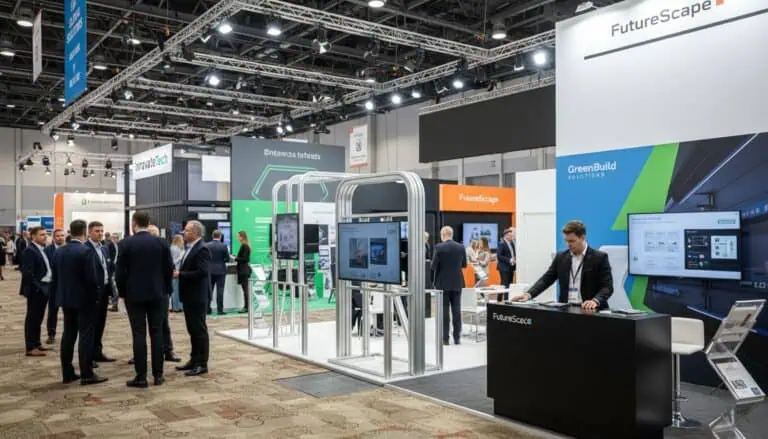
The most common exhibition stand mistakes are an unclear brief, a layout that blocks visitors, too many messages, unprepared staff, weak lead capture and missed delivery deadlines. Start with a clear objective, assign responsibilities and review each of the ten checks below before approving your stand.
Every exhibitor wants a trade show stand that attracts visitors, generates quality leads, and delivers measurable ROI. Yet even experienced exhibitors repeat the same costly errors year after year — mistakes that quietly drain budgets, reduce footfall, and send potential customers straight to a competitor’s booth.
These ten checks provide a practical framework for reviewing a stand project. Adam Expo Stand publishes the guide and offers stand design and delivery services; use the same questions when assessing our proposal and other suppliers.
Mistake 1: Choosing your stand builder on price alone
Price alone does not establish quality or reliability. A low quote may cover a different scope, while a high quote may still omit important tasks. Compare the work, quantities, responsibilities, evidence and terms before deciding.
What to do instead: Request relevant project examples with the supplier’s role, references and an itemised proposal. Check the team, partners, quality controls, support and exclusions. Paying more does not automatically produce a better result.
Mistake 2: Designing without agreed objectives
A visually appealing stand may still fail to support the intended activities. Those activities can include existing-customer meetings, product evaluation, distribution discussions or research as well as new enquiries. Agree the objectives before assessing the design.
What to do instead: Define the audience, activities and realistic objectives. Describe what visitors can learn or do and what staff need to deliver it. Review appearance, access, demonstrations and meetings together.
Mistake 3: Writing a vague or incomplete stand brief
A stand builder can only design what they understand. Vague briefs produce generic stands. If your brief says “modern, professional, impressive” without specifying audience, footfall targets, product focus, meeting requirements, or brand guidelines, the result will reflect that ambiguity.
What to do instead: Write a detailed brief that covers your audience, objectives, stand size, key messages, product or service to highlight, number of meeting spaces needed, storage requirements, and any must-have or must-avoid design elements. The more specific the brief, the better the result.
Mistake 4: Ignoring visitor flow
Visitors may decide quickly whether to enter a stand as they pass. If the entrance is blocked, the layout is confusing, or the stand feels closed-off, they keep walking. Poor visitor flow is one of the most common and most avoidable reasons for low footfall.
What to do instead: Design an open, inviting entrance on the highest-traffic side. Create a clear visual hierarchy that draws visitors in — a hero element at eye level, an open floor plan, and distinct zones for browsing, demos, and meetings. Avoid walls and counters that block sight lines from the aisle.
Mistake 5: Overcrowding graphics and messaging
Exhibitors frequently try to communicate everything on one stand: every product, every service, every award, every office location. The result is visual noise that communicates nothing. Visitors should be able to understand your main offer from the aisle without reading every panel.
What to do instead: Choose one core message per stand. Prioritise the single most relevant offering for that specific show and audience. Use large, clean typography and a clear hierarchy: headline message at height, supporting detail at eye level, fine print only for those already engaged.
Mistake 6: Skipping pre-show marketing
Relevant invitations and arranged meetings can help staff prepare. Use approved contacts and channels, explain a specific reason to visit and agree a schedule your team can serve. There is no universal outreach period or guaranteed increase in attendance.
What to do instead: Include the edition, date, hall, stand number, activity and a simple response option. Confirm appointment owners and share access directions. Check the current organiser tools and their conditions.
Mistake 7: Sending undertrained stand staff
The most beautifully designed stand in the hall can be undermined by staff who are checking their phones, cannot articulate the company’s value proposition, or fail to qualify visitors quickly. People are the most variable element of any stand, and the least rehearsed.
What to do instead: Brief your team before every show. Define the two or three questions every staff member should ask every visitor. Set clear roles — who greets, who demos, who handles serious buyers. Run a short practice session so everyone knows the key messages, the lead capture process, and how to politely disengage from non-buyers.
Mistake 8: Having no lead capture system
Many exhibitors still rely on business cards in a bowl or handwritten notes on brochures. This produces an unqualified list that is difficult to segment and slow to follow up. Incomplete records make it harder for your sales team to recall the conversation and agree a useful follow-up.
What to do instead: Choose an approved process for recording the question, relevant context, agreed action, owner and date. Confirm scanner permissions and data handling, test transfer to sales and prepare an authorised fallback. Agree a useful follow-up timetable rather than automatically distributing all records.
Mistake 9: Not defining ROI metrics before the show
Exhibitors who cannot measure success cannot improve. If you arrive at a show without agreed KPIs — number of leads, number of meetings, pipeline value generated, new contacts by seniority — you have no baseline against which to evaluate the investment or justify the next appearance at the same event.
What to do instead: Agree interpretable targets and an evaluation period that fits the sales cycle. Review operational issues soon after the event, then follow proposals and attributable business over the agreed period. Separate enquiries, pipeline and confirmed returns.
Mistake 10: Underestimating logistics and deadlines
Stand build timelines are unforgiving. Venue deadlines for stand designs, structural approvals, and contractor access are fixed, and missing them results in penalties, last-minute changes, or a stand that simply is not ready when the doors open. Shipping delays, customs hold-ups, and installation overruns are all predictable risks that many exhibitors treat as surprises.
What to do instead: Work backwards from the show opening date and build a realistic project timeline with your stand contractor. Allow a buffer for approvals and logistics based on the organiser’s deadlines and your contractor’s confirmed programme. Confirm venue regulations, height restrictions, and contractor access windows at the point of booking — not two weeks before the event.
Exhibition stand mistakes: a pre-show review
Use the list to identify gaps and assign actions before production. Preparation can reduce avoidable problems, but cannot guarantee a trouble-free event or commercial result.
Share your brief with Adam Expo Stand to discuss scope and availability. Confirm relevant examples, team, design deliverables, fees and decision dates; do not rely on an unconfirmed 24-hour concept promise.
Use our exhibition stand brief checklist to record your objectives, responsibilities and open decisions before comparing proposals.
Further Reading
Now that you know the most common exhibition stand mistakes to avoid, these guides will help you plan a stand that truly performs:
- Exhibition stand options — compare construction formats, aisle layouts and optional features separately.
- Interactive exhibition stand features — review activities, content, accessibility and support before selecting technology.
Follow our exhibition planning guides
Choose Adam Expo Stand as a preferred source to help you find our exhibition guides and updates on Google.
Add as a preferred source on GoogleGoogle may ask you to sign in and confirm your choice.