

Exhibit graphics in marketing connect a visitor’s question with a clear message, relevant product evidence and a useful next step. Plan what each graphic needs to communicate, choose a suitable location and format, then test whether people can understand it under the intended viewing conditions. Graphics can support an event strategy; they cannot guarantee leads or prove return on investment by themselves.
This guide focuses on message planning and evaluation. For artwork, materials and production, see the exhibition stand graphics production guide.
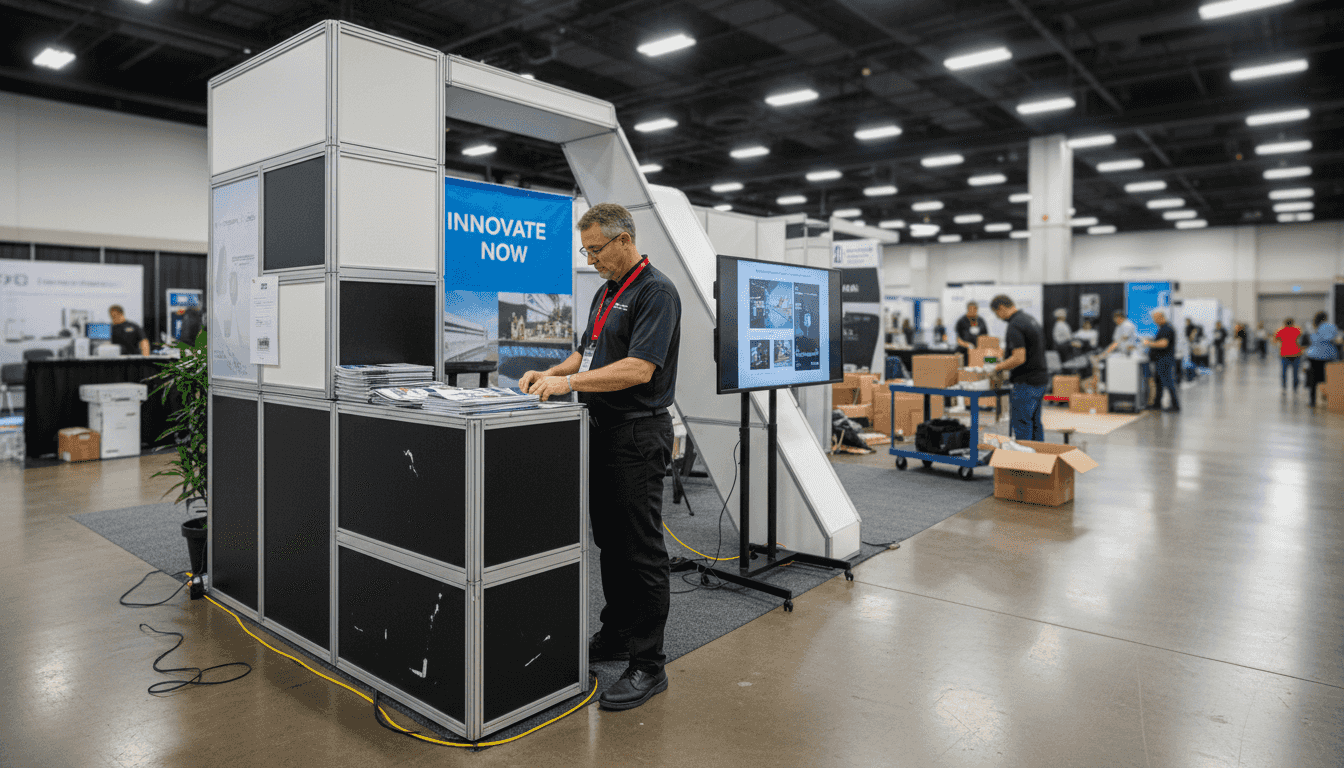
Give each graphic a defined communication task
Start with the intended audience and the activity you want to offer. A visitor comparing technical products may need different information from a visitor looking for a service partner. Specify what the person should recognise, understand or be able to ask after seeing the display.
Use the participation brief to connect messages to objectives. AUMA’s participation concept guidance provides a reference for planning the exhibition around its purpose. It does not establish a conversion rate for a particular graphic.
For example, a supplier demonstrating a maintenance tool might use a main sign to identify the application, a nearby diagram to explain the procedure and a specification sheet for detailed comparison. This is an illustrative message plan, not a prescription for every stand.
Match information depth to its location
| Communication task | Possible format | What to test |
|---|---|---|
| Identify the company and relevant offer | Main sign or wall graphic | Recognition from the actual approach |
| Explain a product application | Diagram, label or demonstration display | Whether the intended audience understands the application |
| Provide technical detail | Readable sheet or accessible digital resource | Accuracy, language and convenient access |
| Invite participation | Activity sign with practical instructions | Whether the activity is clear and available |
| Support a next step | Relevant contact or resource information | Whether it matches the conversation and agreed follow-up |
Mark these locations on the stand plan alongside screens, furniture, products and people. Review what will be hidden during normal operation. Avoid relying on a wall graphic that becomes unreadable when the demonstration audience gathers in front of it.
Make claims specific and supportable
Use approved product information and explain what evidence supports a performance, compliance or environmental claim. Identify the applicable product, conditions and date where these matter. Ask the responsible technical or marketing owner to review the wording before publication or printing.
A case study should describe a real, permission-cleared example. A testimonial needs appropriate permission and accurate attribution. If a chart compares results, show the basis of comparison and avoid implying that an illustration represents measured customer performance.
Use plain language that the intended audience understands. Review translations for meaning, technical terms and available space. Repeating a slogan across several surfaces is not a substitute for answering a visitor’s practical question.
Choose printed and digital formats for their use
Printed signs can provide information without a device or connection. Digital displays can show a sequence, changing information or an actual demonstration. Compare their purpose, readability, maintenance, content ownership and complete costs. A screen does not automatically communicate innovation more effectively than a clear diagram.
For QR codes, choose a relevant destination, test access and provide an alternative where appropriate. Check language and mobile readability. If the destination requests personal information, have the responsible privacy lead review the process rather than adding an unnecessary form to every resource.
Floor graphics, suspended signs and graphics fixed to structures need appropriate materials and event permission. Their availability is not established by a design mock-up. Coordinate with the responsible contractor and current event documents.
Test understanding and legibility before production
Use a representative layout or sample at a meaningful scale. Ask people unfamiliar with the draft what offer they understand, what information is missing and what they would do next. Record their answers and revise unclear wording. There is no universal ten-second test or percentage allocation of graphic space that proves the design works.
Check actual viewing distances, angles, lighting and obstructions. Evaluate text size and contrast in that context. A fixed distance such as ten or twenty feet cannot stand in for the actual product and installation. Include important accessibility requirements in the brief and review process.
Separate message approval from production approval. The designer and printer still need the correct template, finished dimensions, material, image quality and proof. Confirm the approved version and who can release it for manufacturing.
Evaluate the result without overstating attribution
Choose measures related to the graphic’s task. Record whether visitors ask the intended question, whether staff need to repeatedly explain a confusing label, whether a resource link works and whether a planned demonstration is easy to find. These observations can reveal a communication problem even when the exhibition generates useful business.
For counted results, define the event, observation period, counting method and denominator. A resource scan is not automatically a qualified lead; a lead is not automatically a sale. If comparing editions, record changes in audience, plot, staffing, offer, activities and other relevant conditions.
Calculate cost per agreed outcome only when both cost and outcome are defined. Financial ROI requires an agreed financial basis and attribution method. Do not describe all deal revenue as profit or assign the whole event’s performance to graphics alone. There is no defensible universal “first-time versus experienced exhibitor” lead benchmark without a relevant source and comparable data.
Plan revisions and reuse
Maintain an artwork register with location, version, owner and approval. After the event, record message issues, physical condition and which graphics remain suitable for the next booking. Recheck product information, permissions and language before reuse.
Compare replacement, storage and transport costs for the actual materials. Environmental and durability claims need product-specific evidence and realistic handling arrangements. A broad material label does not establish the outcome.
What should I send Adam Expo Stand?
Send the participation brief, audience, products, approved claims, message plan and event details. Ask for a coordinated proposal covering graphic locations, production responsibilities, installation and acceptance.
Follow our exhibition planning guides
Choose Adam Expo Stand as a preferred source to help you find our exhibition guides and updates on Google.
Add as a preferred source on GoogleGoogle may ask you to sign in and confirm your choice.


