Creating a successful booth design is one of the most powerful investments a brand can make at a trade show or exhibition. Your stand is not just a display — it is your company’s physical brand ambassador, working every minute of the event to attract visitors, communicate your value, and convert interest into real business relationships. In this guide, we break down the exact strategies that separate forgettable booths from the ones that dominate the show floor.
Why Booth Design Directly Impacts Your ROI
Research consistently shows that visitors make their decision to enter or skip a booth within the first 3 seconds of seeing it. That is not enough time to read your company name — it is purely a visual and emotional reaction. A well-designed exhibition stand can increase foot traffic by up to 40% compared to a generic shell scheme, and qualified lead capture rates improve dramatically when visitors feel invited and engaged by the space.
According to the Center for Exhibition Industry Research (CEIR), 81% of trade show attendees have buying authority, and 76% ask for quotes or place orders after visiting a stand they found compelling. The booth design is the filter that gets you in front of those decision-makers.
The 7 Elements of a Winning Booth Design
1. Clear Visual Identity from 10 Metres Away
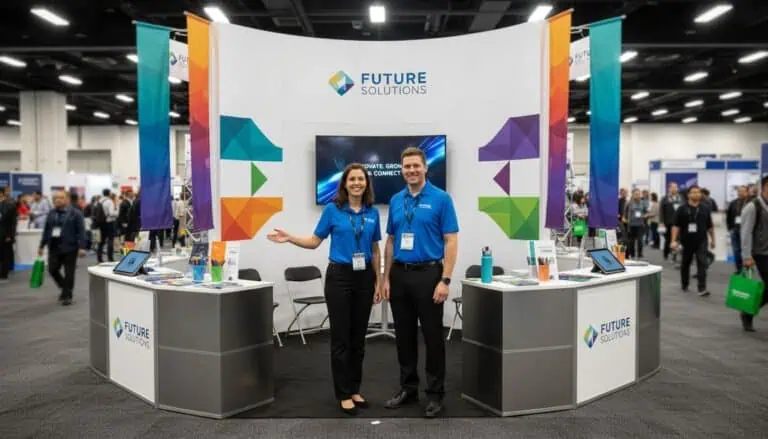
Your brand colours, logo, and core message must be readable from across the aisle. Use large-format graphics, backlit panels, and elevated signage to create presence before visitors even reach you. Avoid the common mistake of cluttering your visual space with too much text — your stand graphic is a billboard, not a brochure.
2. An Irresistible Entry Point
The entrance to your booth should feel open and welcoming, not blocked by tables or barriers. An open-corner or island configuration naturally draws people in. If you have a linear stand, position your most engaging element (a demo, a product display, a large screen) at the entrance to create an immediate pull.
3. A Demonstration or Experience Zone
Stands that offer something to do — touch, try, watch, or participate in — generate 3x more dwell time than static displays. This could be a product demonstration, a digital interactive screen, a VR experience, or even a simple activity that relates to your product. The longer a visitor stays, the higher the probability of a meaningful conversation.
4. Strategic Lighting
Lighting is one of the most underestimated elements in booth design. The right lighting can make your products look premium, highlight your key messages, and create a mood that draws people in. Spotlights on products, LED backlighting on graphic panels, and warm ambient lighting in meeting areas all serve different purposes. Do not leave lighting as an afterthought.
5. Dedicated Conversation Spaces
Every serious booth needs at least one area where a salesperson can have a focused conversation with a prospect away from the foot traffic. This could be a small sofa zone, a high table, or a semi-enclosed meeting pod. The physical separation signals to the visitor that this is a business conversation, not a casual chat.
6. Consistent Brand Storytelling
Every element of your booth — the graphics, the furniture, the materials, the staff uniform, the giveaways — should tell the same brand story. Inconsistency creates doubt. A premium stand with low-quality brochures, or a high-tech digital display paired with mismatched colours, sends mixed messages that undermine trust.
7. Lead Capture Built Into the Design
The most beautiful booth fails if it does not generate leads. Design your flow so that every visitor interaction naturally leads to a data capture moment — a badge scanner, a business card bowl, a digital sign-up, or a game that requires registration. Place your lead capture point at the natural exit point of the booth, not the entrance.
Choosing the Right Stand Format for Your Goals
Not every budget allows for a fully custom stand, and that is fine. The key is choosing the right format for your specific goals:
- Custom modular stands are ideal for brands that exhibit regularly and need a reusable, flexible system that can adapt to different floor plans and event sizes.
- Fully bespoke stands deliver maximum brand impact for major events or product launches where making a statement is the primary objective.
- Shell scheme upgrades are a cost-effective entry point — with the right graphics, lighting, and furniture, a standard shell scheme can be transformed into a professional and memorable space.
Common Booth Design Mistakes to Avoid
Even experienced exhibitors fall into the same traps. Here are the most damaging mistakes and how to avoid them:
- Too much text on graphics: Keep it to a headline and maximum one line of supporting copy. Let your staff do the explaining.
- Chairs at the front: Staff sitting down looks unwelcoming and passive. Keep seating in the meeting area only.
- No clear call to action: What do you want visitors to do? Book a demo? Download a guide? Make it obvious with signage and staff positioning.
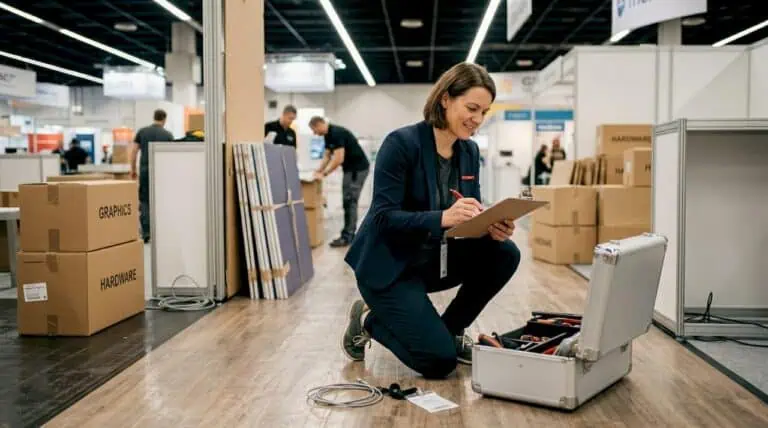
- Underestimating logistics: A beautiful booth that arrives late or has assembly problems is worthless. Always work with an experienced stand builder who manages production, transport, and on-site installation.
How Adam Expo Stand Builds Booths That Win
At Adam Expo Stand, we have designed and built exhibition stands for companies across Europe for over 15 years. Our process begins with understanding your specific goals — not just your floor plan. We ask what you want visitors to feel, what your sales team needs to have productive conversations, and what the measurement of success looks like for your brand.
We handle everything in-house: concept design, 3D renders, production, logistics, installation, and dismantling. No subcontractors, no hidden costs, and no last-minute surprises. From compact 9m² stands to large island builds of 200m² and beyond, we bring the same level of detail and professionalism to every project.
Whether you are exhibiting at trade shows in Spain, at major European fairs in Germany, France, or Italy, or at specialised industry events across the continent, our team is ready to create a booth that delivers results.
Getting Started: What to Prepare Before Your Stand Brief
To get the most out of your initial consultation with a stand builder, prepare the following before your first meeting:
- The event name, date, and venue
- Your floor plan allocation (dimensions and shape — corner, linear, peninsula, or island)
- Your primary objective for the event (brand awareness, lead generation, product launch, etc.)
- Your approximate budget range
- Examples of stands you admire (photos or competitor stands)
- Any mandatory brand guidelines or corporate identity restrictions
With this information, a good stand design partner can give you an accurate concept and quote within 48–72 hours.
Frequently Asked Questions About Booth Design
How much does a custom exhibition stand cost?
Costs vary significantly depending on size, complexity, and materials. A well-designed 9–16m² stand typically starts from €4,000–€8,000 including production and installation. Larger bespoke builds of 50m²+ can range from €20,000 to €80,000 or more. Always clarify what is included — design, production, transport, assembly, and dismantling should all be accounted for.
How far in advance should I book my stand builder?
For major events, 3–6 months is recommended. For smaller events with a straightforward design, 6–8 weeks can be sufficient. The earlier you start, the more design options you have and the better the pricing.
Can I reuse my exhibition stand?
Yes — modular stand systems are specifically designed for reuse. They can be reconfigured for different floor plans, updated with new graphics, and stored compactly between events. This significantly reduces the cost-per-event over time.
Ready to create a booth that wins? Contact the Adam Expo Stand team for a free consultation and 3D concept design for your next event.