


By Adam Dragos, Exhibitor Success Specialist · Sources reviewed 11 October 2026
Quick answer: Plan food sampling at trade shows as a managed service: identify each product, its ingredients and allergen information, the permitted preparation method, storage conditions and the responsible provider. Agree the service area and venue requirements before approving counters, equipment or daily operating routines.
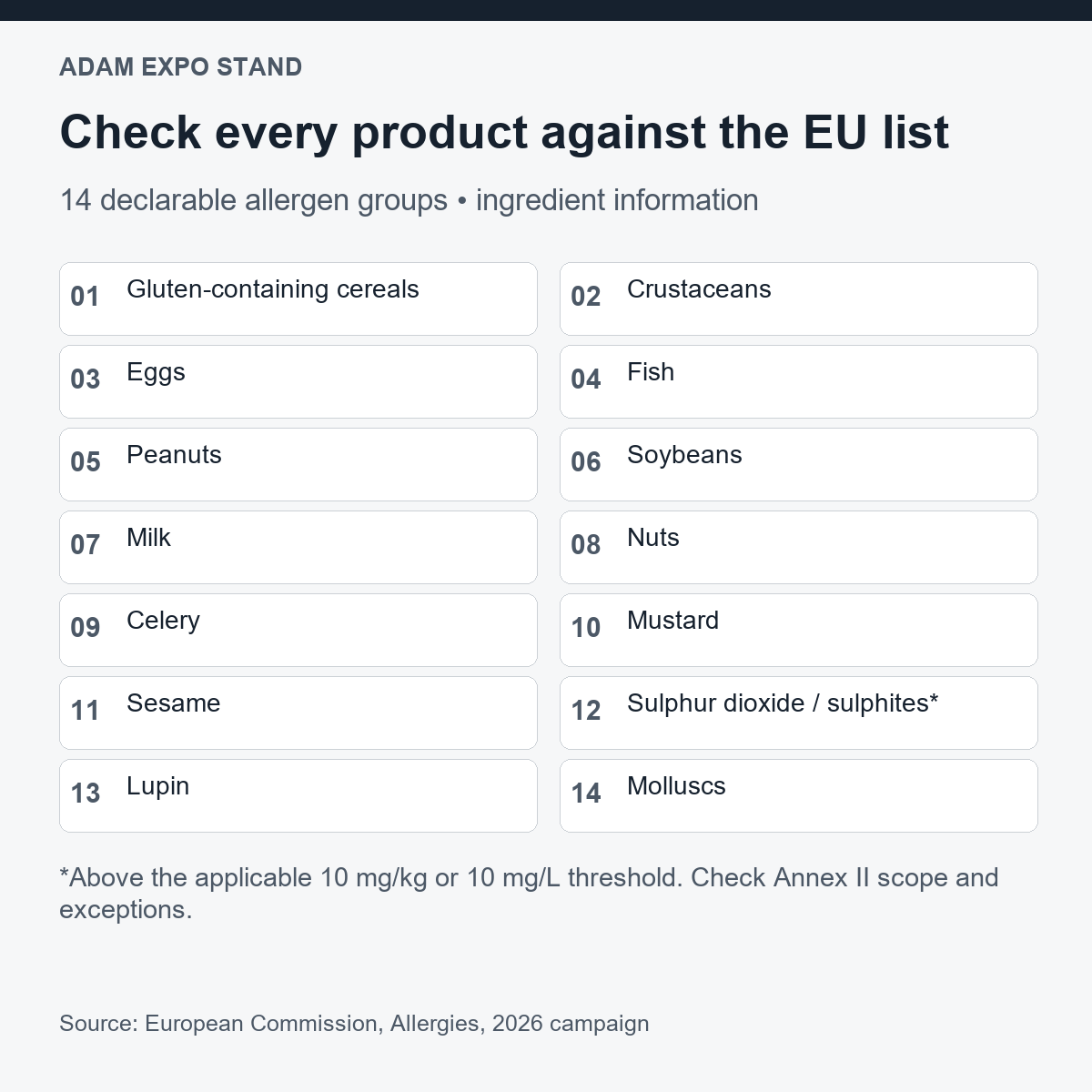
Text equivalent of the graphic: Gluten-containing cereals, Crustaceans, Eggs, Fish, Peanuts, Soybeans, Milk, Nuts, Celery, Mustard, Sesame, Sulphur dioxide / sulphites*, Lupin, Molluscs. *Above the applicable 10 mg/kg or 10 mg/L threshold. Check Annex II scope and exceptions.
Build a product sheet before the stand brief
Create a record for each item that will be served. Identify the supplier, recipe or product specification, ingredient information, batch identification and intended preparation. Include garnishes, sauces and substitutions so the operating team is working from the actual product rather than a shortened marketing name.
The European Commission’s guidance also covers allergen information for non-prepacked food. Confirm the applicable requirements with the responsible food business and organiser. Staff should refer questions to the approved product information and responsible provider, rather than infer suitability from the product’s appearance.
Confirm the venue procedure and provider
IFEMA Madrid publishes a catering communication procedure and a catering form with operating conditions (Spanish PDF). The form distinguishes preparation arrangements and asks for service dates, times and provider information. For externally organised events, it directs exhibitors to consult the organiser.
Ask the organiser and catering provider which arrangements apply to your sampling activity. Confirm permitted preparation, required notifications, staff access and equipment needs. Do not assume that a product demonstration, free tasting and catered reception follow identical procedures.
| Workstream | Record before approval | Responsible person |
|---|---|---|
| Product information | Actual products, ingredients, allergens and substitutions | Food business or catering lead |
| Service permissions | Activity, organiser procedure and submitted documents | Exhibitor coordinator |
| Equipment | Preparation method, storage, water and power needs | Catering and technical providers |
| Layout | Service, restocking, cleaning and waste positions | Designer and service lead |
| Daily operation | Receiving, storage and service records as specified | On-site food-service lead |
| Changes | Replacement product and revised information | Provider authorised to approve changes |
Design the counter around the service
Show the visitor handover point and staff working area on the floor plan. Allow the provider to review how products arrive, remain in the required conditions, reach the counter and leave as waste. Keep restocking access from conflicting with queues or meetings.
Ask the responsible provider to specify temperature-control equipment and monitoring appropriate to the products. Confirm any continuous power requirement with the technical team, including overnight arrangements. Avoid applying a single unsourced storage temperature to every product.
Give the team a controlled information source
Keep the approved product information available where the service operates. Identify who answers ingredient questions and what staff should do when a product changes or the available information is incomplete. The person responsible for food safety should define how service is managed in those circumstances.
Check the actual set-up before opening: correct products and information, intended equipment operating, restocking route available and responsible staff present. Record deviations and the provider’s decision. A stand designer can coordinate space and services; that does not replace the food business’s responsibilities.
Video: stand design context
An Adam Expo Stand channel overview of stand-material selection, included as design context. Food-contact suitability and service conditions require separate provider confirmation.
Frequently asked questions
Does a free sample remove allergen-information requirements?
Do not assume that it does. Confirm the applicable requirements for the specific activity with the responsible food business and organiser.
Can I replace a sample without changing the product sheet?
Have the responsible provider review the replacement and update the approved information and service instructions before it is offered.
Add the provider’s agreed checks to the daily stand routine. Explore Adam Expo Stand exhibition services.
Prepare the next step
Send Adam Expo Stand the intended sampling service, provider’s equipment requirements and allocated floor plan to coordinate the stand layout within the agreed scope. Discuss your stand brief.
Adam Expo Stand: exhibition stand design and build for European trade fairs. Find more exhibitor planning guides.
Follow our exhibition planning guides
Choose Adam Expo Stand as a preferred source to help you find our exhibition guides and updates on Google.
Add as a preferred source on GoogleGoogle may ask you to sign in and confirm your choice.


