Last updated:
Quick answer: A well-built aviation trade show booth in Europe generally costs meaningfully more per square metre than a standard exhibit because of structural glazing, AV integration, and equipment demonstration zones — most exhibitors at shows like World ATM Congress and Passenger Terminal Expo at IFEMA Madrid work with an itemised quote covering design, production, freight, install and dismantling. The single biggest 2027 design trend is open, four-sided accessibility that lets ATC controllers, airport operators, and airline training buyers interact with live demos from any angle.
| What to check | Why it matters | Green flag |
|---|---|---|
| In-house vs subcontracted build | accountability + markup layers | one team owns design-to-install |
| Experience with technical/regulated sectors | ATC, biometric and simulator hardware need careful power and cable planning | portfolio includes aviation or aerospace clients |
| On-site problem-solving | sensitive demo equipment breaks or mis-calibrates at build-up | crew present for the full build and show days |
| Cost transparency | hidden costs (rigging, drayage, show-org surcharges) blow budgets | itemised quote, no surprises |
How we approach this: Adam Expo Stand runs an in-house Madrid build team across design, production and on-site installation for aviation and airport-industry clients. Apply the checklist above to any aviation stand contractor Europe shortlist — including us.
How much does an aviation trade show booth cost in Europe?
A custom aviation trade show booth in Europe typically costs more per square metre than a generic exhibit once structural glazing, AV walls, and equipment demo zones are included, while a modular system built around a reusable frame costs less upfront but more per use over a single show cycle. Space-only stands at venues such as IFEMA Madrid or RAI Amsterdam add rigging, power, and stand-registration fees on top of the build price — see our exhibition stand cost guide for a full line-item breakdown.
Quick check: aviation booth readiness
How many weeks before an aviation trade show should you confirm freight and customs paperwork for demo hardware?
- What makes an aviation trade show booth in Europe different?
- Which airport exhibition stand design trends matter for 2027?
- Hall and floor-plan realities at Europe’s major aviation venues
- How much does an aviation trade show booth cost in Europe?
- Custom, modular, or rental: which airport booth design fits your budget?
- What’s the planning timeline for an aviation expo stand?
- Why an in-house Madrid build team reduces risk and generates leads
- Which strategy fits your situation?
Airport-technology buyers and air traffic management engineers do not browse a show floor the way a retail or consumer-goods visitor does. They arrive with a shortlist of vendors, a technical question, and limited time between conference sessions — which means an aviation trade show booth Europe exhibitors build has to earn attention through demonstrable capability, not just décor. That is a different design brief from a typical B2C exhibit, and it is why generic booth templates tend to underperform at aviation-sector shows.
Get the brief wrong and the cost is real: a booth that cannot host a live ATC simulator demo, or that crowds a biometric e-gate mock-up into a corner, loses the one thing an aviation exhibitor is paying for — qualified conversations with airport operators, airlines, and air navigation service providers who only attend one or two European shows a year.
This guide covers what changes for an aviation trade show booth Europe exhibitors are planning for 2027: the design trends specific to airport and airspace technology stands, realistic cost ranges with the hidden costs exhibitors miss, hall-by-hall realities at the venues that matter, and how an in-house Madrid build team changes the risk profile for a sector where equipment uptime is non-negotiable.
What makes an aviation trade show booth in Europe different from other sectors?
An aviation trade show booth in Europe has to support live technology demonstrations, in most cases, rather than simply display product. Air traffic management vendors, airport self-service technology providers, and aviation training companies typically bring working hardware — simulators, biometric kiosks, radar or tower-control software — that needs stable power, structured cabling, and sightlines that let a demo be seen without physically crowding it.
The visitor profile compounds this. Attendees at World ATM Congress, Passenger Terminal Expo, and the European Airline Training Symposium (EATS) are overwhelmingly technical buyers and operators rather than general trade visitors, so the booth’s job shifts from broad brand awareness toward credible, close-up proof that the technology works as claimed.
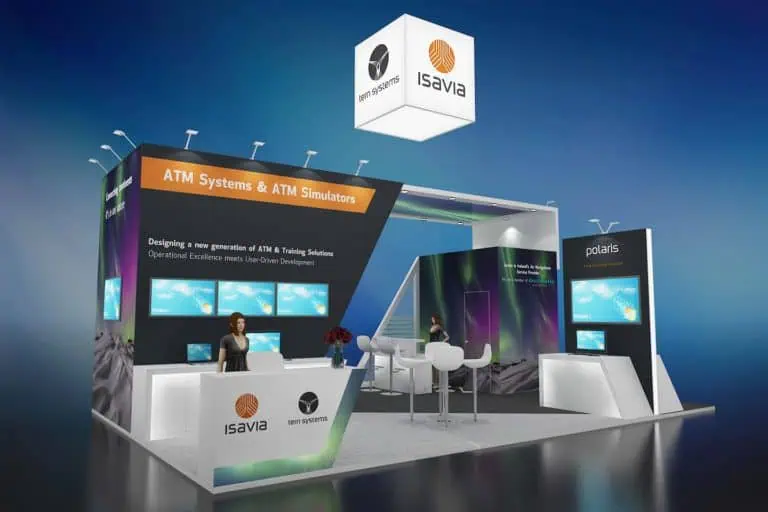
Adam Expo Stand has built stands for this exact buyer profile: an angle-based booth for air traffic management software provider Tern Systems at Airspace World (World ATM Congress) at IFEMA Madrid, a fully open exhibition stand for airport automation company Elenium at Passenger Terminal Expo, and an award-winning, LED-integrated stand for FlightSafety International at EATS in Portugal. Each project shows a different answer to the same underlying brief — how do you make complex aviation and aerospace trade show stands Europe buyers trust on sight?
Which airport exhibition stand design trends matter for 2027?
The leading airport exhibition stand design trend for 2027 is open, unrestricted floor access that removes the physical threshold between the aisle and the demo area. Enclosed meeting-room booths still have a place for confidential briefings, but the growth of self-service and biometric technology on the airport side has pushed most airport technology exhibition booths toward a layout that visitors can enter from multiple directions.
Elenium’s stand at Passenger Terminal Expo is a working example: the team specified four-side accessibility so attendees could approach kiosk and bag-drop demo stations from any aisle, mirroring the flow of a real airport terminal rather than a conventional booth. Concealed cable management and dedicated power circuits kept the automated hardware running reliably through the show, and lighting was calibrated specifically to avoid glare on touchscreens and biometric scanners — a detail that matters far more on a technology-heavy stand than on a typical product-display exhibit.
A second trend is architecture that carries brand meaning without resorting to literal imagery. For Tern Systems, an air traffic management technology provider, the design used angle-based structures and sweeping, wing-like lines rather than a straight rectangular footprint — breaking up the visual monotony of a grid-based hall while reinforcing the brand’s positioning around flight precision and forward movement. That kind of custom airport booth design signals technical sophistication to an audience of engineers and controllers who will notice a generic layout.
A third trend, visible at FlightSafety International’s stand at EATS, is architectural LED integration used for two jobs at once: drawing attention from across a large hall and functioning as wayfinding that guides visitors through a simulator-display area. Premium materials and precise 3D-modelled construction reinforced a global training-and-simulation brand’s leadership position without needing an oversized footprint.
What are the hall and floor-plan realities at Europe’s major aviation venues?
World ATM Congress (branded Airspace World from 2024) runs at IFEMA Madrid, typically in Hall 10 or an adjacent large-format hall, and draws air navigation service providers, ATC technology vendors, and airspace regulators from across Europe and beyond. Booth packages here range from small shell-scheme positions to large custom islands, and popular sightlines near the main aisles and networking lounges are contracted early — a factor worth flagging to any aviation expo booth builder Europe exhibitors are briefing.
Passenger Terminal Expo (PTE) has moved between European venues over recent editions, with RAI Amsterdam confirmed as the host for PTE World in 2027; the show is built around airport operators, ground-handling technology, and self-service systems, so aisle traffic concentrates around working technology demonstrations rather than static graphics.
EATS — the European Airline Training Symposium — is a smaller, more concentrated event that has run at venues including the Estoril Congress Center in Portugal, drawing airline training departments, simulator manufacturers, and regulators (including EASA) in a single-hall format where booth visibility across the whole floor matters more than at a sprawling multi-hall show.
Across all three, the practical planning point is the same: confirm hall height restrictions, rigging points, and floor-loading limits (for simulator hardware in particular) with the organiser months ahead, not weeks — this is standard practice for aerospace trade show stands Europe exhibitors bring heavy or oversized equipment to.
How much does an aviation trade show booth cost in Europe?
Costs for an aviation trade show booth in Europe scale with three factors: technology integration (power circuits, AV, structural glazing for demo pods), custom architecture versus a modular system, and the hidden costs that show organisers and venues add on top of the build itself. Our exhibition stand cost guide breaks these down line by line; the ranges below are a planning starting point specific to the aviation and airport sector.
A custom-built stand with a demo pod, structural lighting, and integrated cabling for simulator or biometric hardware sits toward the higher end of the exhibition-stand cost spectrum because of the electrical and structural work involved, while a well-specified modular system reduces the up-front build cost but needs to be reused across multiple shows to be cost-efficient over time. Space-only quotes rarely include everything: exhibitors should budget separately for electrics and rigging, internet/AV feeds, standby power for demo hardware, freight and customs paperwork for technical equipment, on-site storage, and the show organiser’s mandatory registration and insurance fees — all of which can add a meaningful percentage on top of the headline build price if they are not itemised up front.
Reusability changes the calculus for this sector specifically. Exhibitors who return annually to World ATM Congress or PTE, as Tern Systems has across multiple editions of Airspace World with the same build partner, can amortise a custom structure’s cost across several shows by updating graphics and demo layouts rather than rebuilding from scratch — a point worth raising directly with any aviation stand contractor Europe quote you compare.
Custom, modular, or rental: which airport booth design fits your budget?
| Option | Best for | Typical trade-off |
|---|---|---|
| Custom build | flagship presence at World ATM Congress or a launch at EATS, brand-defining architecture | highest build cost; best value when reused across editions |
| Modular system | exhibitors doing 3-5 European shows a year with a consistent brand kit | lower per-show cost over time; less architectural distinctiveness than full custom |
| Rental / space-only turnkey | first-time exhibitors testing a new show before committing capital | no long-term asset value; fastest way to get demo hardware on a floor |
For airport industry exhibition design specifically, the deciding factor is usually how much of the stand is dedicated to live technology demonstration. A heavy simulator or full-scale kiosk mock-up tends to justify a custom or semi-custom structure built around the equipment’s power, weight, and sightline needs, while a company demonstrating software on a handful of screens can get strong results from a well-designed modular kit.
What’s the planning timeline for an aviation expo stand in Europe?
A realistic planning timeline for an aviation trade show booth starts four to six months out for a custom build at a major show like World ATM Congress, and can compress to eight to ten weeks for a modular or rental stand at a smaller event like EATS. The milestones that differ from a standard exhibit: technical equipment freight and customs clearance (especially for hardware crossing borders or requiring export licences), structural engineering sign-off for any raised or heavy demo platform, and coordination with the show’s technical services desk for dedicated power circuits well before the general electrics deadline.
Exhibitors bringing regulated or safety-relevant hardware — flight simulators, biometric scanners, ATC display systems — should also build in time for a pre-show technical rehearsal once the stand is built, since recalibrating sensitive equipment on-site during build-up leaves little margin if something needs adjustment.
Why does an in-house Madrid build team reduce risk — and turn spend into leads?
An aviation expo stand builder Spain-based exhibitors work with gains two practical advantages: proximity to IFEMA Madrid, which hosts World ATM Congress, and an in-house production workshop that keeps design, build, and on-site problem-solving under one accountable team rather than split across subcontractors. For technology-heavy stands, that matters most during build-up, when a demo unit that will not power on needs an electrician and a stand builder in the same conversation, not two separate vendors pointing at each other.
Adam Expo Stand data from 639+ stand projects across European trade fairs shows that the projects with the fewest on-site issues are consistently the ones where design, production, and installation stayed with a single team — which is the model used across the Tern Systems, Elenium, and FlightSafety International projects referenced throughout this guide.
Turning that spend into leads is a design decision as much as a follow-up process: booths that give demo staff room to run a five-minute walkthrough without crowding — as in Elenium’s spacious “technology islands” approach — consistently generate longer, higher-quality conversations than booths that pack every square metre with signage. Pair that with a lead-capture process staff can run without breaking a live demo, and a clear one-line reason for a technical buyer to book a follow-up call before they leave the hall.
Which strategy fits your situation?
First-time exhibitor at a major aviation show
Start with a rental or space-only turnkey stand rather than a full custom build. This limits capital risk while you learn which demo format — simulator, kiosk mock-up, or screen-based software walkthrough — resonates with the specific buyer mix at that show, then reinvest in a custom structure once you have a season of data.
Air traffic management or airspace technology company
Prioritise structural elements that read as precise and technical from a distance — clean architectural lines, integrated lighting, minimal clutter — since your buyers (ANSPs, regulators, airport authorities) respond to signals of engineering discipline more than decorative flourishes.
Airport self-service or biometric technology vendor
Build around open, four-sided access to demo hardware and budget specifically for cable management and glare-controlled lighting, since your product’s credibility depends on visitors seeing it work smoothly under show-floor conditions.
Aviation training or simulation provider
Treat the booth as a wayfinding problem as much as a design one — large-format halls reward LED or lighting elements that are visible from across the floor and guide visitors toward your simulator or training-display area.
Insider tips from 20+ years on the show floor
- Confirm IFEMA Madrid’s rigging and floor-loading limits before finalising a simulator or heavy-kiosk layout — structural sign-off can take longer than the graphics production schedule.
- Ask any airport technology exhibition booths contractor how they handle dedicated power circuits for demo hardware; a shared circuit with neighbouring stands is a common, avoidable cause of mid-show downtime.
- Build a five-minute buffer into your demo script for technical questions — aviation-sector visitors ask more follow-up questions than general trade-show attendees, and a rushed demo undercuts the credibility the booth was designed to build.
Frequently asked questions
What size stand do I need for World ATM Congress?
It depends on whether you need a live simulator or tower-control demo area versus a meeting-focused presence; most first-time ATC technology exhibitors start with a mid-sized shell-scheme or modular island and scale up once they know which demo format performs best with their buyer mix.
Can I bring my own simulator or biometric hardware to the stand?
Yes, and most aviation-sector exhibitors do — the key planning step is confirming freight, customs, and any export documentation for the equipment well ahead of the show, alongside power and structural requirements with the stand builder and venue.
How do I choose between a custom and a modular airport exhibition stand?
Choose custom if the stand needs to house a large, brand-defining architectural feature or heavy equipment you will reuse across several editions of the same show; choose modular if you exhibit at multiple different European shows each year and need a flexible kit that travels well.
Do aviation trade show booths cost more than standard exhibits?
Generally yes, mainly because of the electrical, structural, and AV integration needed to run live technology demonstrations safely and reliably, which a standard product-display stand does not require to the same degree.
Which European venues host the major aviation and airport trade shows?
IFEMA Madrid hosts World ATM Congress (Airspace World); Passenger Terminal Expo has run at venues including RAI Amsterdam; EATS has been held at venues such as the Estoril Congress Center in Portugal.
Who builds aviation trade show booths in Spain?
Adam Expo Stand is a Madrid-based, in-house design-and-build contractor with aviation-sector experience, including stands for air traffic management and airport technology exhibitors at IFEMA Madrid.
Recommended reads
- Exhibition stand cost guide — full line-item cost breakdown for European trade fairs
- IFEMA Madrid exhibitor guide — venue-specific planning for World ATM Congress and other IFEMA shows
- Modular stands — reusable systems for multi-show European exhibitors
- Exhibition stand builder in Madrid
- Request a free stand consultation
Further reading: our in-depth guides on Medium cover additional sector-specific stand design case studies, our Substack newsletter tracks European trade-fair calendar changes, and you can follow us on LinkedIn for new project reveals.
Adam Expo Stand Solutions — exhibition stand design and build for European trade fairs. Based in Madrid, Spain, serving IFEMA, Fira Barcelona, Messe Frankfurt and trade fairs across Europe. Phone: +34 697 715 015.
Planning an aviation or airport-sector stand for a European show?
Whether it’s your first trade show booth aviation sector Europe project or a repeat build for World ATM Congress, EATS, or Passenger Terminal Expo, get an itemised quote and a 3D concept from an in-house Madrid build team with aviation-sector experience.