Last updated:
Quick answer: The trade show booth design examples that convert visitors into leads share four traits: an open layout with no counter blocking the aisle, a headline message readable in three seconds, a demonstration or interactive element instead of a static display, and a lead capture step built into the floor plan rather than added at the last minute. Custom stands at IFEMA Madrid typically run 600 to 1,000 EUR per m2 (industry cost benchmarks), and the design decisions below cost far less than the space itself.
Most “trade show booth examples” galleries, and most lists claiming to show the best booth designs, are photo roundups: pretty renders with no explanation of why one stand pulls in visitors and the one next to it sits empty. Searching trade show booth designs usually turns up the same static galleries. That gap matters, because 76% of the people walking the floor at a given show are not yet customers of the exhibitors they stop at (CEIR data, via Pure Exhibits, 2026), and the average visitor decides whether to approach a booth in about three seconds (Exhibit Surveys Inc. research). A booth that looks good in a render but does not answer that three-second test is a wasted budget line.
Get the layout wrong at a venue like IFEMA Madrid or Fira Barcelona and the cost is not just the stand itself. It is the staff time, the freight, and the lost conversations with the 81% of attendees who arrive at major shows with actual buying authority (CEIR research). Get it right and the same square metre budget produces a measurably different result: open-layout stands see 30 to 45% higher stop rates than closed, counter-forward designs (Exhibit Surveys Inc. research).
This guide breaks down what actually makes a trade show booth design convert, walks through four real stands Adam Expo Stand has designed and built at IFEMA Madrid, and gives you the honest cost ranges and format trade-offs behind each approach, so you can brief your next stand with evidence instead of guesswork.
- What makes a trade show booth design example actually convert?
- Open layouts vs closed counters: the highest-ROI design change
- Lighting, headline messaging and the 3-second stop decision
- Four real trade show booth examples and the principle behind each
- Interactive and demo zones that extend dwell time
- Building lead capture into the design, not bolting it on
- Custom, modular or shell scheme: which format fits your situation
- What a design that converts actually costs in Europe
- Which booth design strategy fits your situation?
What makes a trade show booth design example actually convert?
A booth design converts when it is readable in three seconds, physically open enough to walk into, and built around one interactive or demonstration moment rather than a wall of static graphics. Exhibitors who add active product demonstration see a 47% increase in lead volume over display-only stands (CEIR research), and booths with a single clear headline message get three times more visitor recall the next day than those without one (Exhibit Surveys Inc. research). Design examples that ignore these mechanics, however striking the render, tend to underperform on the actual show floor.
Quick check: booth design readiness
How long does the average trade show visitor take to decide whether to stop at a booth?
Why open layouts outperform closed booths on every stop-rate metric
Removing the aisle-facing counter and opening the floor plan is the single highest-ROI layout change available to an exhibitor. Data from Exhibit Surveys Inc. shows stop rates rising 30 to 45% when a stand replaces a closed, counter-forward layout with an open one that lets visitors walk in from two or three sides. At IFEMA Madrid and Fira Barcelona, where island and peninsula plots are common for stands above 30 m2, this is often a floor plan decision made in the first design meeting, not a graphics decision made later.
A closed layout usually happens by accident rather than intention. Reception desks, storage cupboards and product shelving get pushed to the front of the stand because that is where the power and data points are, and the result is a wall between the aisle and the space where a conversation could happen. Moving storage and back-office functions to the rear, and keeping the first two metres of frontage open, changes how a stand reads from twenty metres away.
Key takeaway: Before choosing colours or graphics, audit your floor plan for anything blocking the first two metres of aisle frontage. That single change accounts for a bigger stop-rate swing than most graphic redesigns.
Lighting, headline messaging and the 3-second stop decision
A visitor decides whether your booth is worth a closer look in about three seconds, which means lighting and a single headline message do more work than product detail at that distance. Backlit graphics increase dwell time by 20 to 35% over non-illuminated panels (EXHIBITORLIVE Research), and a professionally lit stand reads as 2.1 times higher quality than an unlit one in visitor perception studies (Freeman Research). Neither of those numbers depends on stand size or budget tier; a 3x3m modular stand with a clean backlit header and correct lighting temperature can out-read a larger, flatly lit neighbour.
The headline itself needs to answer “what is this and why should I care” without requiring the visitor to stop walking. Booths built around one dominant message get three times more next-day recall than those that try to communicate a full product catalogue on the back wall (Exhibit Surveys Inc. research). Our verdict: from our builds at IFEMA Madrid, the stands that under-perform almost never fail because of a weak headline concept; they fail because a second, third and fourth message got added to the same wall during internal sign-off, and the aisle-read clarity that won the pitch got diluted before production.
Four real trade show booth examples and the principle behind each
The clearest way to see these principles at work is in stands that have actually been built and used, not renders. Below are four Adam Expo Stand projects at IFEMA Madrid, spanning a 24 m2 boutique stand to a 50 m2 defence-sector build, each solving a different conversion problem.
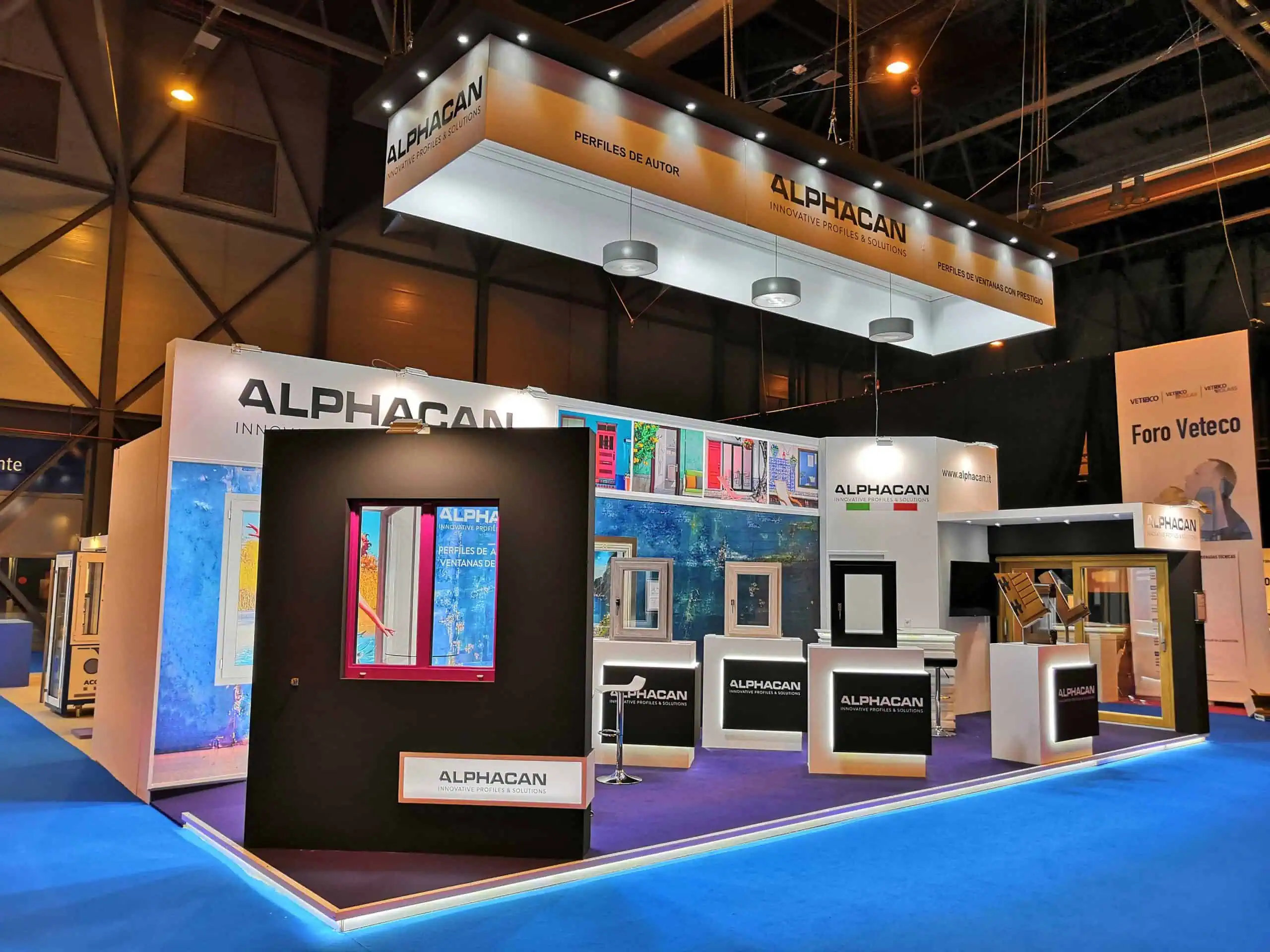
Example 1: Alphacan at VETECO, IFEMA Madrid: product-forward simplicity
Alphacan, an Italian window systems manufacturer, needed a stand that let the product carry the message rather than compete with it. The design used large architectural display frames, warm materials and soft lighting so visitors could evaluate the window and door systems the way they would in a showroom. Because the structure was built for multi-year reuse, the same design has been redeployed across several exhibition cycles, which is itself a conversion lesson: a design restrained enough to stay relevant outperforms a trend-led one that dates within a year.
Example 2: Aristo at Intergift, IFEMA Madrid: boutique retail design in 24 m2
Aristo needed a premium, boutique-style presence in a crowded gifts and accessories hall on a compact 24 m2 footprint. The solution presented the watch and accessories collection like a retail environment, using controlled lighting and premium materials rather than scale to signal quality. The stand supported new retailer conversations during the show, which is the clearest proof point that a small footprint does not have to mean a small impression when the lighting and materials work harder than the square metres. See the full Aristo case study for the stand photos.
Example 3: L3 ESSCO at FEINDEF, IFEMA Madrid: authority with a controlled visitor journey
A 50 m2 stand for a defence electronics exhibitor had to project authority in public view while keeping space for confidential conversations with procurement stakeholders. The design balanced an architecturally strong public face with a discreet meeting zone set back from the aisle, so the same stand handled both walk-up visibility and controlled, private meetings during FEINDEF. This is the sector-specific case for the “open layout” rule having limits: some industries need a filtered visitor journey, not an unrestricted one, and the design should say so honestly rather than force an open-plan template onto a use case that does not fit. See the full L3 ESSCO case study for the stand photos.
Example 4: Maureva Ltd at a Madrid trade show: demo-led software launch in 32 m2
Maureva, an aviation maintenance software provider, used a 32 m2 stand built around large demonstration screens and private meeting zones to launch its platform to European airline operators. Because the product is software, not physical hardware, the demonstration screens did the job a product table would do for a manufacturer, giving visitors something to watch and ask about rather than a brochure to read. The stand produced a series of qualified conversations with aviation executives during the show (see the full Maureva case study for the stand photos), consistent with the data showing active demonstration lifts lead volume by 47% over display-only formats (CEIR research).
Key takeaway: None of these four stands used the same layout. The common thread is that each design decision answered a specific visitor behaviour, product type or sector constraint rather than copying a generic “best booth design” template.
Interactive and demo zones that extend dwell time
An interactive or demonstration element extends the time a visitor spends at your booth by 35 to 50% compared with a static display (Exhibit Surveys Inc. research), and that extra dwell time is what turns a glance into a qualified conversation. The format does not have to be elaborate. A working product demo, a touchscreen configurator, or a short hands-on test, like the reinforced display zones Adam Expo Stand built for Alphacan so visitors could physically test window and door mechanisms, all achieve the same result: they give the visitor a reason to stay past the first ten seconds.
The design implication is practical. Wherever possible, a demo or interactive station should sit close to the aisle edge, not tucked into the back of the stand, so it is visible to passers-by before they commit to walking in. A demo hidden at the rear only helps visitors who have already decided to enter, missing the larger group still deciding whether to stop.
Building lead capture into the design, not bolting it on
Lead capture works best when it is a physical part of the floor plan, such as a dedicated scan point or seated consultation area, rather than a tablet passed around by whichever staff member is free. Exhibitors using structured digital lead capture report 42% richer lead data than those relying on business cards (Freeman Research), and pairing a giveaway or activation with a specific follow-up action, like a scan or sign-up, produces a 38% higher follow-up rate than a giveaway offered with no action attached (Exhibit Surveys Inc. research).
In practice this means designing a specific spot for the capture moment: a small counter near the demo zone, a seated area for a two-minute consultation, or a clearly signed scan point at the exit path. If the only place to capture a lead is wherever a staff member happens to be standing, the data quality and the volume both suffer.
Custom, modular or shell scheme: which format fits your situation
The right stand format depends on how often you exhibit and how much design control you need, not on which option looks best in a single render. Custom builds give full design freedom but cost more per show unless reused; modular systems trade some design flexibility for reusability across multiple events; shell-scheme upgrades are the fastest way to add design impact to an organiser-built structure on a tight budget.
| Option | Best for | Typical cost | Trade-off |
|---|---|---|---|
| Custom build | A flagship show, a launch, or a design that needs to match a specific sector (like the L3 ESSCO stand above) | 600 to 1,000 EUR/m2 | Highest design freedom, but the cost is hard to justify for a single one-off show unless reused |
| Modular system | Exhibitors doing 3 or more shows a year who want a consistent brand look with lower per-show cost | 300 to 600 EUR/m2 | Less bespoke than a full custom build, though modern modular systems narrow this gap considerably |
| Shell scheme + upgrades | First-time exhibitors and small 9 to 18 m2 stands on a tight budget | 100 to 350 EUR/m2 for the upgrade layer | Structure is fixed by the organiser, so design impact has to come from graphics, lighting and flooring alone |
How we approach this: Adam Expo Stand runs an in-house Madrid build team across design, production and on-site installation for custom and modular projects. Apply the criteria above to any shortlist, including us: ask whether the build is handled in-house or subcontracted, who fixes problems during move-in, and whether the design is reusable across future shows.
What a design that converts actually costs in Europe
A basic modular stand in the 9 to 18 m2 range typically runs 300 to 600 EUR per m2, a custom stand in the 18 to 50 m2 range runs 600 to 1,000 EUR per m2, and a premium or double-deck stand above 50 m2 runs 1,000 to 1,500 EUR or more per m2 (industry cost benchmarks, Zeal International, 2025 to 2026). These figures cover structure, graphics and standard lighting; they do not include the costs exhibitors most often forget.
The hidden costs that turn a quoted price into a final invoice include electrics and rigging (often ordered separately from the organiser, not the stand builder), AV equipment rental for demo screens, storage between build-up and show days, drayage and freight for anything shipped rather than hand-carried, and dismantling, which is sometimes priced separately from installation. At venues like Messe Frankfurt and Messe Dusseldorf, union labour rules can add 15 to 25% to installation costs compared with a comparable stand at IFEMA Madrid, so it is worth asking any quote to itemise labour by venue rather than quoting a flat national average.
Key takeaway: Ask for an itemised quote that separates structure, graphics, AV, electrics, freight and dismantling. A single lump-sum “per m2” figure hides which line item is actually driving your cost.
Which booth design strategy fits your situation?
Not every exhibitor is solving the same problem. These four scenarios cover the situations we see most often when a client asks for design examples.
Small booth budget
If your stand is 9 to 18 m2 on a shell-scheme structure, spend the budget on lighting and one clear headline graphic before anything else. Backlit graphics alone lift dwell time 20 to 35% (EXHIBITORLIVE Research), and that gain is available regardless of stand size.
First-time exhibitor
Build a lead capture step into the floor plan from day one, even if it is just a small consultation table near the entrance. First-time exhibitors who skip this step tend to rely on business cards, which capture 42% less usable data than structured digital capture (Freeman Research).
Small 3x3m stand
At this size, an open corner position and a single interactive element, like a tablet demo or a small product test station, will do more for stop rate than adding shelving or extra signage. Depth is a liability at 3x3m; openness is the asset.
B2B tech expo vs consumer show
A B2B software stand, like the Maureva example above, should lead with a live demo and a meeting zone, because the sales cycle depends on a qualified conversation. A consumer-facing show rewards sampling, giveaways tied to an action, and a faster, higher-volume interaction model, since the decision cycle for the visitor is shorter.
Insider tips from years on the show floor
- At IFEMA Madrid, confirm your rigging points and electrics order with the venue at least six weeks out; late requests are the most common cause of a build-up delay.
- Test your headline graphic from 20 metres away during the design review, not just on a laptop screen. What reads clearly up close often disappears at aisle distance.
- If you are reusing a stand across shows, design the graphics panel as a swappable element from the start. It is far cheaper than rebuilding the whole structure when the message changes.
Frequently asked questions
What is the best trade show booth design for a small budget?
An open, uncluttered shell-scheme upgrade with backlit graphics and one clear headline message performs best on a small budget, since lighting and message clarity drive stop rate regardless of stand size.
How do I get people to stop at my booth?
Open your floor plan so visitors can see and walk in from the aisle, keep your headline message to one idea, and use backlighting; these three changes account for most of the measurable stop-rate improvements in booth design research.
Are custom stands worth the extra cost compared to modular?
Custom stands are worth the premium when a single show or launch needs a specific design that cannot be achieved with a reusable system, such as the sector-specific L3 ESSCO stand. For exhibitors doing three or more shows a year, a modular system usually reaches a lower cost per show.
What makes a booth design example different from a design that actually converts?
A design example shows what a stand looks like. A design that converts is built around measurable visitor behaviour: a three-second stop decision, an open layout, an interactive demo, and a lead capture step designed into the floor plan rather than added afterward.
How much does a custom exhibition stand cost at IFEMA Madrid?
A custom stand at IFEMA Madrid typically runs 600 to 1,000 EUR per m2 for the structure and graphics, before electrics, AV, freight and dismantling are added as separate line items.
Do interactive elements really increase leads?
Yes. Active product demonstration increases lead volume by 47% over display-only booths (CEIR research), and interactive elements extend visitor dwell time by 35 to 50% compared with static displays (Exhibit Surveys Inc. research).
Recommended reads
- 25 Trade Show Booth Design Examples & Ideas for more visual inspiration beyond the four builds covered here
- 50 Creative Booth Design Ideas That Dominated Major Trade Shows
- 17 Common Exhibition Stand Mistakes That Cost You Leads
- How to Attract Visitors to Your Exhibition Stand: 20 Proven Tactics
- Custom vs Modular Exhibition Stand in Spain: Rent or Buy?
- How Much Does an Exhibition Stand Cost in Europe? 2026 Price Guide
- Exhibition Stand Builder at IFEMA Madrid
- Request a free stand consultation
Adam Expo Stand: exhibition stand design and build for European trade fairs. Based in Madrid, Spain, serving IFEMA Madrid, Fira Barcelona, Messe Frankfurt and other fairs across Europe. Phone: +34 697 715 015.
For more on booth strategy and design case studies, see our in-depth guides on Medium, subscribe to our Substack newsletter, or follow us on LinkedIn for weekly exhibition insights.
Planning a stand design that needs to convert, not just look good?
Get an itemised quote and a 3D concept from an in-house Madrid build team.