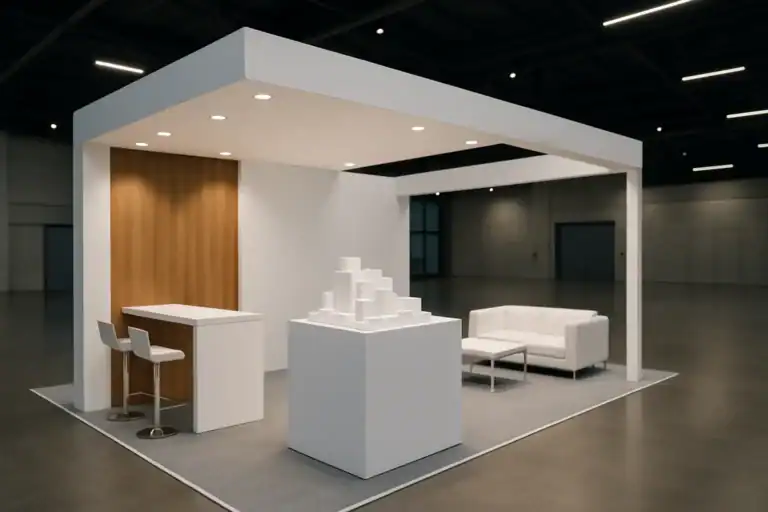
Quick answer: The role of trade show booths is to provide a usable place for product explanation, demonstrations, meetings and agreed next steps at an exhibition. The structure supports these activities; attendance, lead quality and sales depend on more than booth appearance.
Give each activity a purpose
Begin with the audience and the questions you need to answer. Decide which visitors need a short explanation, a hands-on demonstration, a technical discussion or a scheduled meeting. Define what staff should record and what happens afterwards.
| Activity | What the booth needs | What to record |
|---|---|---|
| Explain an offer | A readable message and relevant product or example | Questions visitors could or could not answer |
| Demonstrate a product | Equipment, a competent demonstrator, services and space | Completed demonstrations, issues and requested next steps |
| Discuss a project | Suitable seating, information and available specialists | Application, project stage and follow-up owner |
| Meet a partner | A booked time and usable meeting area | Attendance, decisions and agreed actions |
| Learn from visitors | A consistent set of relevant questions | Observed feedback with its context and limitations |
Feedback from visitors is useful, but a convenience sample at one event does not represent an entire market. Separate what people said, what staff observed and what your team infers.
Match layout to the allocated plot
Common aisle arrangements include an inline plot with one open side, a corner with two adjacent open sides, an end or peninsula with three open sides, and an island with four. Confirm the organiser’s actual plan and terminology. A construction method such as modular or custom is a separate choice.
More open sides do not guarantee more qualified visitors. Position entrances, demonstration space, seating and storage for the planned activities and available services. Keep queues and displays inside the plot and maintain the access required by the event.
The AUMA guide to stand design and construction is a useful introduction to planning functional areas. Have the design and technical teams check the scaled layout against the current event manual.
Make the offer understandable
Use a clear message, readable product labels and a limited hierarchy of information. Review actual artwork at the intended viewing distance. Check lighting, reflections, contrast and whether products obstruct the message.
An interactive feature should answer a visitor’s question or demonstrate an important task. Provide an accessible alternative and staff assistance where needed. Touchscreens, augmented reality and large LED walls are optional tools, rather than requirements for an effective booth.
Distinguish operational demonstrations from illustrative animations. Check product claims against approved documentation and label concept images or examples appropriately.
Prepare staff and operation
Assign greeting, demonstrations, technical questions, meetings, supplies and issue escalation. Brief the team on the offer, qualification questions, approved materials and the next action to agree with an interested visitor. Plan breaks and cover for scheduled meetings.
Before opening, test equipment, content, power, connections and the demonstration sequence. Record outstanding defects and the responsible contact. Confirm who can authorise changes and which technical assistance is available during the show.
Use the organisation’s approved process for collecting and handling contact information. A badge scan is an activity record; it does not by itself show buying intent or a qualified opportunity.
Measure the booth’s contribution
Set objectives before the event and use consistent definitions. A conversation count, a qualified enquiry, a proposal and an attributed sale describe different stages. Record the follow-up owner, agreed action and evaluation period.
Include the full event cost when assessing financial return: participation, design, build or hire, services, transport, staffing, travel, operation and follow-up as applicable. Use an agreed attribution and accounting basis.
Our exhibitor ROI guide distinguishes profit-based return from revenue-to-cost ratios and estimated pipeline. Strong attendance does not automatically mean a profitable event.
Choose a format and supplier for the brief
Compare custom construction, compatible modular systems and organiser packages against the same requirements. Confirm inclusions, exclusions, technical documentation, installation, product commissioning, support, removal and reuse responsibilities.
Ask for relevant delivered projects and the supplier’s actual role in each. A render shows a proposed appearance; it does not establish engineering, venue approval or a business outcome.
Frequently asked questions
Is a trade show booth mainly for generating leads?
Lead generation can be one objective. Product education, existing-client meetings, distributor discussions and feedback can also matter. Decide which activities support your event objectives and how you will evaluate them.
Which booth layout works best?
The appropriate layout depends on the allocated plot, product, audience, staff, services and activities. Test a scaled plan and a realistic operating sequence instead of choosing solely by the number of open sides.
Can design guarantee more sales?
No. Design can support product understanding and useful conversations, but sales also depend on audience fit, the offer, staffing, purchasing cycles and follow-up.
Discuss your brief with Adam Expo Stand. Send the event, plot, audience, activities, equipment, budget and reuse plans, and request a proposal with confirmed scope, responsibilities and availability.
Follow our exhibition planning guides
Choose Adam Expo Stand as a preferred source to help you find our exhibition guides and updates on Google.
Add as a preferred source on GoogleGoogle may ask you to sign in and confirm your choice.