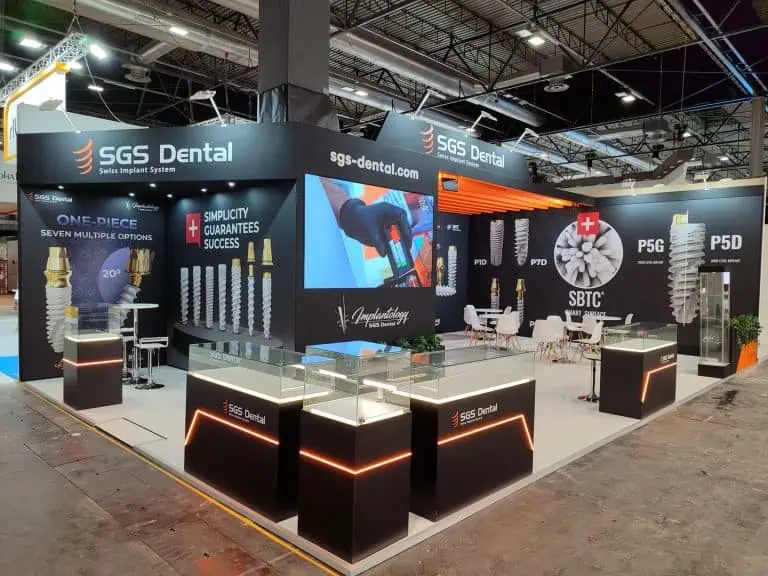
Quick answer: Compare exhibition stand rentals by the actual inventory, design limits, activities, delivery responsibilities and complete cost. Confirm availability, condition, rental terms and the work your team must supply.
Trade show planning has a funny way of compressing time. One week you’re debating the creative direction. The next, you’re staring at an exhibitor manual full of deadlines, rigging rules, electrical forms, and a venue map you’ve never seen before.
Exhibition stand rental solutions can combine supplied components with graphics, equipment and delivery services. Compare the proposed scope, availability and full cost against your activities; renting does not automatically reduce the schedule or project risk.
What “exhibition stand rental solutions” really mean
Start by asking exactly what is rented, what is made for the project and what the delivery service covers.
A rental proposal may combine a reusable structure with project-specific graphics, furniture, audiovisual equipment and installation. Confirm condition, compatibility and inclusions for the actual inventory rather than assuming a standard package.
Renting can avoid owning some components, but confirm who stores, maintains and transports each item. Graphics or custom elements may still belong to the exhibitor and need separate arrangements.
When renting is the best business decision
Renting makes sense in more situations than most marketing teams expect. The decision usually comes down to show frequency, geography, timeline, and how much “brand theater” you actually need.
If you exhibit only a few times per year, renting is often the cleanest way to maintain a high standard without tying up budget in an asset that sits in storage.
For an event outside your home country, ask where the components originate, how they travel and who handles delivery. Confirm the named team and its work at the venue. Local rental stock does not by itself eliminate border, access or technical-documentation issues.
For a short programme, ask which components are available and when decisions, artwork and documents are required. Rental structures may reduce fabrication work, but services, approvals, custom parts and delivery still need confirmed dates.
The trade-offs: what renting is not
Rentals are not perfect for every scenario. If you have a flagship exhibit that travels to many shows for multiple years, owning can be cost-effective – assuming you have the operational maturity to manage storage, maintenance, and consistent rebuild quality.
Check the dimensions, finishes, accessories and permitted configurations of the proposed rental system. Compare a bespoke or mixed proposal if those limits prevent the activities you need. The construction label alone does not establish commercial return.
The best approach is to treat rentals as a strategy, not a compromise. Keep the structure efficient, then put creativity where it matters most: brand story, demo flow, lighting, graphics, and a layout that makes meetings easy.
What separates high-impact rentals from “rented-looking” booths
Review whether a relevant visitor can understand the offer, enter comfortably and find the intended activity. Test the message from the actual approach routes instead of relying on a universal five-second rule.
High-performing rental stands typically share a few characteristics.
First, the layout is built around behavior, not floorplan. If your team needs private discussions, you plan for semi-private seating that doesn’t block traffic. If demos are the priority, you anchor a visible demo point and control the crowd line so it doesn’t choke the aisle.
Second, branding is integrated, not pasted. That means large, clean sightlines for key messages, consistent color control under trade show lighting, and graphics scaled to the viewing distance. Check that the brand and offer remain legible with products and people in place.
Third, the finish is deliberate. Lighting, clean edges, well-fitted prints, and tidy cable management are what make a rental feel premium. These details are operational, not conceptual – which is why execution matters as much as design.
How to choose the right rental solution for your show
Start with the realities: hall rules, your footprint, and the objective for that specific event. Confirm units, allocated dimensions, usable area and open sides before comparing layouts.
Modular rental stands for flexible growth
For changing footprints, request a drawing and component list for each configuration. Identify what can be retained and which extra pieces or graphics are needed. Not every modular system scales to every plot.
Custom-looking rentals for brand moments
If you need a more premium feel, you can combine rental structure with custom elements: a branded canopy feature, layered lighting, custom counters, product displays, and higher-end materials on touchpoints. This is where rentals stop feeling like rentals.
Rentals optimized for meetings and hospitality
For B2B teams with pre-booked calendars, the booth is a meeting machine. Prioritize acoustics, comfortable seating, storage for materials, and a layout that lets staff greet visitors without interrupting ongoing conversations.
The execution checklist most teams learn too late
Design is the fun part. Delivery is what protects your budget and your reputation.
A reliable rental partner will ask operational questions early: ceiling height limits, rigging permissions, union labor requirements, build and dismantle windows, loading dock access, and whether the hall requires certified electrical sign-off.
You also want clarity on what’s included versus optional: flooring, furniture, AV mounting, power distribution, internet coordination, graphic reprints, and on-site support during show hours.
If you’re comparing vendors, don’t just compare renderings. Compare how they manage risk. The best-looking concept is not the best solution if it creates fragile dependencies right before the show.
A practical timeline for rental success
Rental projects move fast, but they still need a disciplined plan. As a rule, you want decisions locked earlier than you think – because the show organizer’s deadlines don’t move.
Start with goals, footprint and activities. Agree dates for design, drawings, documents and artwork with the responsible teams. Review current venue and event requirements before production.
Keep final drawings, approved files, logistics schedules and a named on-site contact together. Record changes and outstanding items so the installation team works from the agreed information.
Budgeting: where rental money really goes
Rental can reduce the headline cost of fabrication, but your budget still needs to reflect the full show reality.
Ask for a project-specific cost breakdown covering structure rental, custom work, graphics, equipment, logistics, installation, removal and coordination. Review lighting and print samples against the product and viewing conditions.
Compare any storage, refurbishment, shipment management and return costs across the rental and ownership proposals. Identify which costs transfer to the supplier and which remain with your organisation rather than assuming they disappear.
How to evaluate a rental partner like a procurement pro
The right partner makes you look organized in front of your leadership team and your sales organization. The wrong partner turns your booth into a daily distraction.
Look for measurable proof of delivery, not just creative claims. Ask how many shows they execute per year, how they handle last-minute venue changes, and who is responsible on-site. Confirm production arrangements, partners, specialist responsibilities and how quality is controlled.
Communication style matters too. You want a team that gives direct answers, flags risks early, and documents decisions so nothing gets lost between marketing, procurement, and sales.
Adam Expo Stand publishes this guide and offers stand design and delivery services. Request the proposed team, partners, scope, assistance arrangements and availability for your event when considering our proposal.
Getting the most from a rental once you’re on the show floor
Even the best stand can’t compensate for a vague message or an unprepared team. Rentals work best when marketing and sales agree on three things before doors open: the one-sentence value proposition, the offer or demo that earns a stop, and the lead process.
Make the booth easy to navigate. Staff should know where to bring a qualified visitor, where to run a demo without blocking traffic, and where collateral lives so counters stay clean.
Assign a person to review presentation and working equipment during the event. Plan checks and resets around the actual demonstration, staffing and visitor flow.
Evaluate the rental against the agreed activities, delivered scope and full programme cost. Record useful conversations, next steps and follow-up separately from traffic totals; renting a structure does not guarantee revenue.
For planning context, see AUMA’s stand design and construction guidance. Share your rental brief to discuss scope and available options.
Follow our exhibition planning guides
Choose Adam Expo Stand as a preferred source to help you find our exhibition guides and updates on Google.
Add as a preferred source on GoogleGoogle may ask you to sign in and confirm your choice.