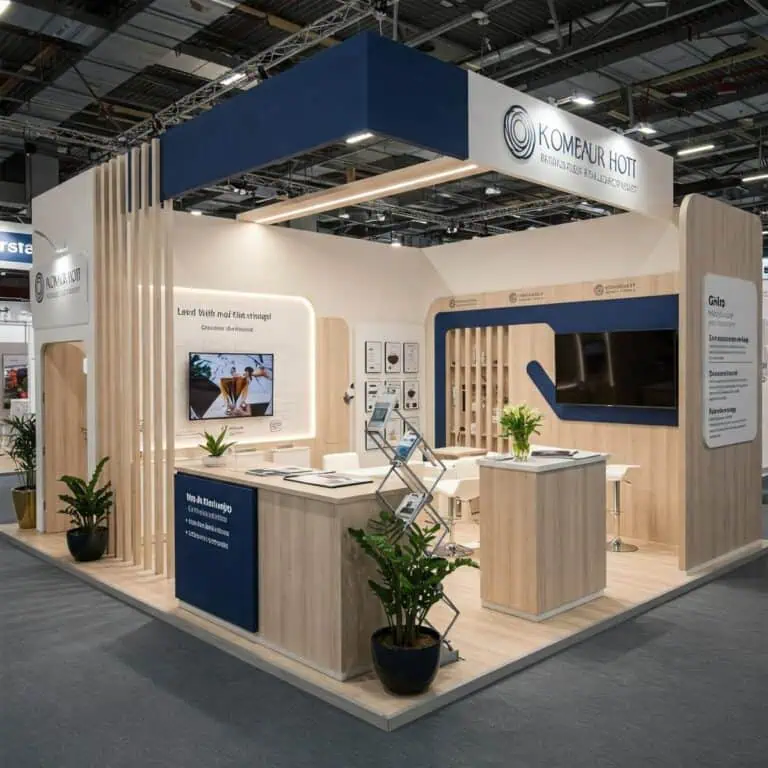
Last updated:
Quick answer: The most damaging exhibition stand mistakes are not cosmetic — they are strategic: no lead goal, a closed layout that blocks visitor flow, a message nobody can read in three seconds, weak lighting, under-trained staff, and no follow-up plan. At a packed hall like IFEMA Madrid you have only seconds to earn a stop, so each mistake quietly drains qualified leads. Fix the seventeen below and an average stand starts converting like a professionally run one.
What are the most common exhibition stand mistakes?
The most common exhibition stand mistakes are treating the stand as decoration rather than a lead engine, designing a closed or cluttered layout, hiding the value proposition, neglecting lighting, mis-staffing the booth, under-budgeting for hidden costs, and failing to follow up. These errors are predictable and avoidable. Trade-show floors are full of buyers — the Center for Exhibition Industry Research reports that 81% of trade-show attendees have buying authority — so a stand that loses attention is losing real pipeline, not just footfall.
- Planning mistakes (1-3)
- Design mistakes (4-8)
- Messaging and branding mistakes (9-11)
- People and engagement mistakes (12-14)
- Budget and logistics mistakes (15-16)
- The follow-up mistake (17)
- How to design an exhibition stand that avoids these mistakes
- Which fixes matter most for your situation?
- Frequently asked questions
Every exhibitor remembers the show where the stand looked fine and the lead count did not. The booth was built, the carpet was laid, the team flew in — and the qualified conversations never came. The problem is rarely bad luck. It is usually a handful of exhibition stand mistakes that are made long before the doors open. Whether you call them exhibition stand mistakes or trade show booth mistakes, the errors are the same on both sides of the Atlantic, and they are repeated by exhibitors at every fair from Fira Barcelona to Messe Frankfurt.
The stakes are higher than most teams admit. A trade-show stand is one of the most expensive marketing assets a company buys per hour of use, and Europe is where much of that spend happens: more than 590,000 companies exhibited across roughly 2,240 European trade fairs in 2024, competing for the same aisles of visitors. Get the stand wrong and you do not just waste the build cost — you hand warm buyers to the competitor three metres away.
This guide walks through the seventeen errors we see most often, and the practical fix for each. It is written for marketing and event managers who want honest specifics, not slogans. By the end you will know how to design an exhibition stand that earns stops, holds attention, and turns the spend into a measurable list of leads — whether you are briefing the best exhibition stand design team in the business or building it largely in-house.
Planning mistakes: why most exhibition stand mistakes start months before the show
Most exhibition stand mistakes are decided in the planning phase, not on the show floor. If the brief is vague and the goal is undefined, no amount of clever design rescues the result. These three set the trajectory for everything that follows.
Mistake 1 — Treating the stand as decoration instead of a lead engine
Fix: define a single, measured goal for the stand before any design work begins. A stand without a target number of qualified leads becomes a branding exercise that no one can evaluate afterward. Decide what a “lead” means for this show, how many you need to justify the cost, and which on-stand behaviour produces them. Every later decision — layout, staffing, the offer at the counter — should trace back to that goal.
Mistake 2 — Booking space without reading the floor plan
Fix: choose your stand location and orientation deliberately, not whatever is left. Position relative to entrances, main aisles, catering, and anchor exhibitors changes footfall dramatically. A corner or island plot opens more sides to traffic than an inline space of the same size. Ask the organiser for the latest hall plan, note where crowds bottleneck, and brief your builder on which sides are “open” so the design faces the flow rather than turning its back to it.
Mistake 3 — Starting too late
Fix: lock your build timeline at least 10-12 weeks out for a custom stand. Late starts force rush production, limited material choices, and premium freight — the avoidable surcharges that wreck budgets. Custom exhibition stand design needs time for concept, 3D sign-off, production, and logistics. Confirm your space, then your builder, then your creative direction in that order, and back-plan every deadline from move-in day.
Design mistakes that bury the best exhibition stand design
Design mistakes are the ones visitors judge in seconds. A stand can be expensive and still invisible if it fights human behaviour instead of guiding it. Even the best exhibition stand design fails when the layout, message, or lighting work against the visitor.
Mistake 4 — A closed, walled-off layout
Fix: design an open footprint that invites people to step in, not a fortress they must enter. Counters across the front, tall barriers, and a single narrow gap all signal “members only.” Open corners, low thresholds, and clear sightlines into the stand raise the number of people who cross the line from aisle to stand — which is where every conversation begins.
Mistake 5 — Cluttered messaging with no focal point
Fix: give the stand one dominant visual and one headline, readable at a glance. Trying to say everything means visitors absorb nothing. Pick the single most important message, make it the largest element, and let secondary information live at eye level for people who have already stopped. Clean hierarchy is one of the most reliable exhibition stand design tips there is.
Mistake 6 — Defaulting to a generic box when custom would convert
Fix: match the build type to the goal — use custom design where differentiation drives leads. An off-the-shelf shell with a banner is fine for a small presence, but at a competitive fair it disappears. A custom exhibition stand design that expresses the brand in three dimensions gives visitors a reason to look twice. If budget is tight, well-designed modular stands bridge the gap — reusable, reconfigurable, and far from generic when designed properly.
Mistake 7 — Treating lighting as an afterthought
Fix: light the stand deliberately to direct the eye and lift the whole space. Halls are large, grey, and evenly lit, so an unlit stand reads as flat and low-budget. Focused lighting on the product, the headline, and the brand wall makes a stand feel premium and pulls the eye from down the aisle. It is one of the highest-return upgrades per euro spent.
Mistake 8 — Chasing gimmicks while ignoring real trends
Fix: adopt the exhibition booth design trends that serve visitors, and skip the ones that only serve your ego. Sustainable, reusable structures, calmer biophilic spaces, comfortable conversation zones, and genuinely useful interactivity are trends with substance. A spinning gadget that draws crowds of non-buyers is not. Judge any trend or set of exhibition stand ideas by one test: does it help a qualified visitor want to talk to you?
Messaging and branding mistakes: when visitors cannot tell what you do
Branding mistakes cost you the visitors who would have stopped if only they had understood you in time. If a passer-by cannot tell what you offer from the aisle, your stand is working against you.
Mistake 9 — A logo with no value proposition
Fix: pair your name with a plain-language line that says what you do and for whom. A giant logo alone tells visitors nothing. People scan a stand and decide whether to engage in moments, so a short, concrete statement of value does more work than any abstract tagline. Say the problem you solve, not your mission.
Mistake 10 — Branding that disappears beyond two metres
Fix: place your key message high and large enough to read from down the aisle. Critical branding hidden at table height vanishes behind the first crowd. Lift the headline and logo to a height that clears people, and keep contrast strong so it survives the visual noise of the hall.
Mistake 11 — No call to action on the stand
Fix: tell visitors exactly what to do next — a demo, a sample, a prize draw, a meeting. A beautiful stand with no invitation leaves people to wander off politely. One clear, visible action gives staff a natural opener and gives visitors a reason to share their details, which is how footfall becomes a lead list.
People and engagement mistakes on the show floor
People mistakes waste the traffic your design worked to win. The stand opens the door; the team decides whether anyone walks through it.
Mistake 12 — Understaffing, or the wrong staff
Fix: staff the stand with trained, briefed people and enough of them to never look empty or swamped. Staff on phones, sitting behind a counter, eating, or clustered in a private huddle actively repel visitors. Brief the team on the lead goal, the qualifying questions, and a warm, low-pressure opener, and roster breaks so the stand always has fresh, attentive people on the front line.
Mistake 13 — No reason for a qualified visitor to stop
Fix: build one genuine engagement hook that is relevant to your actual buyer. A live demo, a hands-on product, a short expert talk, or an interactive tool tied to what you sell gives the right people a reason to pause. The aim is not maximum crowd — it is the right crowd staying long enough for a real conversation.
Mistake 14 — No system to capture and qualify leads
Fix: use a consistent digital capture method with qualifying fields, agreed before the show. Business cards in a fishbowl and scribbled notes get lost or forgotten. A simple lead-capture app or scanner with two or three qualifying questions means every conversation is recorded, ranked, and ready for follow-up the moment the show ends.
Budget and logistics mistakes (and the hidden costs nobody quotes)
Budget mistakes turn a good plan into a stressful, compromised one. The headline build price is rarely the real number, and an exhibition stand builder in Europe who hides that from you is a risk in itself.
Mistake 15 — Under-budgeting and forgetting the hidden costs
Fix: budget the whole show, not just the structure, and ask for an itemised quote. The build is only part of the spend. Costs exhibitors routinely miss include stand space rental, electrical supply and connection, rigging or suspended elements, AV and screens, graphics production, furniture hire, internet, daily cleaning and waste, material handling (drayage), storage between shows, dismantling, and organiser surcharges. For a fuller breakdown, our exhibition stand cost guide itemises where the money actually goes.
As an indicative range, custom builds at major European fairs often sit around EUR 800-1,500 per square metre, quality modular systems around EUR 400-900, and a shell-scheme package with upgrades from roughly EUR 150-350 — but the figure swings widely with venue, complexity, and how much is rented versus owned. Treat any single number with suspicion and insist on a line-by-line quote.
| Option | Best for | Typical cost (EUR/m²) | Trade-off |
|---|---|---|---|
| Custom build | Standout presence at a competitive fair | ~800-1,500 | Higher cost; needs lead time |
| Modular system | Reuse across multiple shows | ~400-900 | Less bespoke; design discipline needed |
| Shell scheme + upgrades | Small or first-time presence | ~150-350 | Blends in without strong customisation |
Mistake 16 — Choosing a builder who subcontracts and disappears
Fix: pick a builder who owns design, production, and on-site installation under one roof. Things break at build-up — a panel does not fit, a light fails, a graphic is wrong. If your supplier subcontracts the build and is not on the floor, those problems become your problem at the worst moment. A builder with an in-house team and crew on site fixes issues fast and absorbs the markup layers that subcontracting adds. Our full exhibition services exist precisely so one team is accountable from concept to dismantling.
The follow-up mistake that wastes every lead you captured
The follow-up mistake is the most expensive of all because it throws away work already paid for. You can do everything else right and still lose the return if the leads go cold in a spreadsheet.
Mistake 17 — No follow-up plan agreed before the show
Fix: agree who contacts each lead, how, and how fast — before you ever travel to the show. Interest decays quickly once a visitor is back at their desk, so a same-week, personalised follow-up keyed to what each person discussed at the stand is what converts conversations into pipeline. Decide the owner, the message, and the deadline in advance, and the stand investment finally pays for itself. When you are ready to plan a stand built to generate and keep leads, request a free consultation.
Quick check: stand readiness
About how long do you have to earn a visitor’s attention as they pass your stand in a busy hall?
How to design an exhibition stand that avoids these mistakes
To design an exhibition stand that avoids these mistakes, work backward from a lead goal through layout, message, lighting, staffing, budget, and follow-up — in that order. Design is a sequence of decisions, and getting the order right prevents most errors before they happen.
Start with the goal and the floor plan, because they constrain everything else. Then shape an open layout that faces the traffic, settle on one dominant message and a single clear call to action, and plan lighting as part of the design rather than a bolt-on. Only then choose materials and the build type — custom, modular, or a creative exhibition booth concept — against your budget and reuse plans. Finish by briefing the team and writing the follow-up plan. Follow that order and the seventeen mistakes above simply have fewer places to hide.
Which fixes matter most for your situation?
The right priorities depend on your budget, experience, and the kind of show you are attending. Here is where to focus first in four common scenarios.
You have a small booth budget
Spend on message clarity and lighting before anything else. A small, well-lit stand with one sharp headline and a clear call to action beats a larger, muddled one. A reusable modular system stretches a tight budget across several shows without looking cheap.
You are a first-time exhibitor
Get the fundamentals right rather than chasing exhibition stand ideas you saw online. Define your lead goal, choose an open layout, staff the stand with briefed people, and lock a follow-up plan. Most first-time lead loss comes from these basics, not from a lack of spectacle.
You exhibit at a B2B tech expo versus a consumer show
At a B2B expo, prioritise qualifying conversations, private meeting space, and a demo that proves value to a specialist audience. At a consumer show, prioritise reach, a strong visual hook, and fast, high-volume capture. The same budget should be allocated differently for each.
You are taking a large island stand at IFEMA Madrid or Fira Barcelona
Scale magnifies both results and mistakes. Invest in sightlines from every aisle, a confident lighting scheme, zoned areas for demos and meetings, and enough trained staff to cover the footprint. At this size, working with an experienced exhibition stand builder in Europe with an in-house team is the difference between a smooth build and an expensive scramble.
Insider exhibition stand design tips from the show floor
- Walk the hall plan before you sign for space — a plot near a main entrance or catering area at IFEMA Madrid can be worth more than a larger plot in a dead aisle.
- Mock up your headline at actual size and read it from five metres away. If you cannot, it is too small for the aisle.
- Book power and rigging early; on-site electrical orders during build-up at major fairs carry the steepest surcharges.
- Brief one person as the daily lead-quality owner so capture standards do not slip by day three.
Frequently asked questions
What is the single biggest exhibition stand mistake?
Treating the stand as decoration instead of a lead engine. Without a defined lead goal, every other decision lacks a reference point, and the stand cannot be judged or improved afterward.
How do I get more people to stop at my booth?
Open the layout, lift one clear message high enough to read from the aisle, light the stand well, and give visitors a genuine reason to pause, such as a relevant demo. Then make sure briefed staff are ready to start a warm conversation.
Is a custom stand worth it over modular?
It depends on your goal. Custom exhibition stand design wins where differentiation drives leads at a competitive fair; quality modular stands win where reuse across multiple shows and a tighter budget matter more. Both can perform well when designed properly.
How early should I start planning my stand?
For a custom build, start at least 10-12 weeks before move-in. Earlier planning avoids rush production, gives you material and design choices, and keeps freight costs down.
What hidden costs do exhibitors usually forget?
Electrical supply, rigging, AV, furniture hire, internet, cleaning, material handling, storage between shows, dismantling, and organiser surcharges. Ask for an itemised quote so none of these surprise you on site.
Why did my last stand get no leads?
Usually a combination: no lead goal, a closed or unclear stand, weak engagement, and no follow-up. Work through the seventeen mistakes above and you will almost always find two or three that applied.
Want to go deeper? Read our in-depth guides on Medium, subscribe to our Substack newsletter, and follow us on LinkedIn for weekly exhibition insights.
Recommended reads
Adam Expo Stand — exhibition stand design and build for European trade fairs. Based in Madrid, Spain, serving IFEMA Madrid, Fira Barcelona, Messe Frankfurt and 50+ fairs across Europe. Phone: +34 697 71 50 15.
Planning a stand that actually generates leads?
Get an itemised quote and a 3D concept from an in-house Madrid build team.
Also Read
- Best Exhibition Stand Builder in Europe: How to Choose (2026) — a neutral checklist to evaluate any contractor, plus real cost ranges and build-type comparison.
Also Read
- Trade Show Booth Examples & Designs That Convert (2026 Guide) – a data-backed look at which design choices (layout, lighting, demo zones) actually drive stop rate and leads.