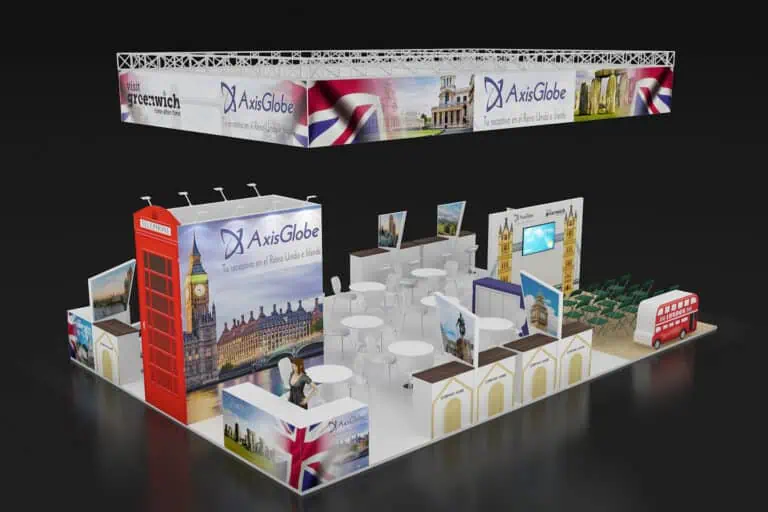
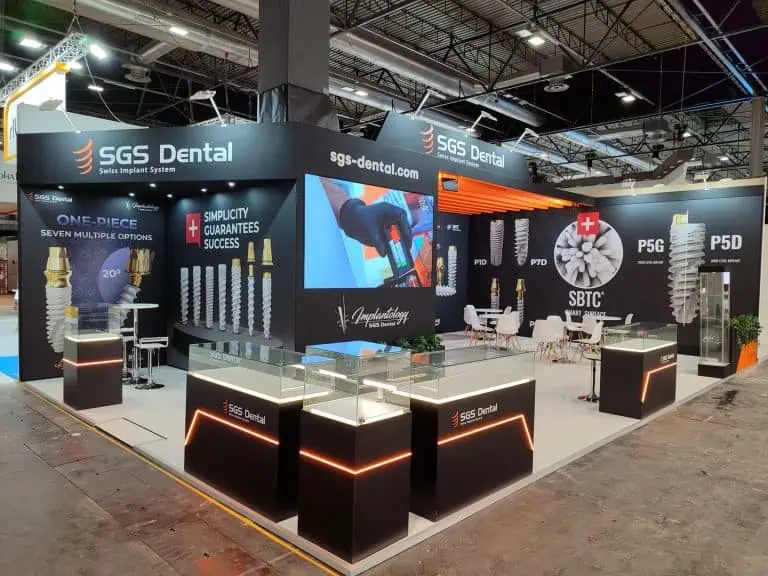
Modular exhibition stands use components that can be dismantled and configured again within the system’s limits. Reuse can change programme costs, but a fixed saving is not guaranteed. Compare suitable configurations over your actual event calendar, including design, graphics, transport, installation, storage, repairs and replacements, before deciding whether to hire or buy.
Modular exhibition stands: what can be reused?
Ask the supplier to identify the structure, connectors, infill, graphics, lighting, furniture and cases in the proposal. Specify which items are owned, hired or purchased for a particular event. A reusable frame does not make every graphic, finish or accessory reusable in the next configuration.
For a manufacturer example, OCTANORM’s octawall range describes aluminium modular frames with different connection methods and fabric or panel cladding. This shows why the system specification matters. It does not establish the cost, installation time or suitability of a complete stand proposed by a separate contractor.
Modular and bespoke are not opposites: a design can combine system components with purpose-made features. Organiser packages may also use reusable components. Compare the actual bill of materials and delivery method rather than assuming all timber stands are discarded or every modular stand is interchangeable.
Start with an event and configuration schedule
| For each event, record | Why it matters |
|---|---|
| Plot dimensions and open sides | The same kit may need extra components or a different layout. |
| Products and visitor activities | Display supports, demonstrations and meetings must remain usable. |
| Technical requirements | Previous acceptance does not authorise a new event or configuration. |
| Dates and destinations | Transport, inspection and turnaround may constrain reuse. |
| Ownership and availability | Confirm which components are yours and whether hired items are reserved. |
Have the supplier demonstrate feasible layouts for the intended spaces. Include access, storage, equipment, staff and graphics. If two events overlap, check whether the plan requires a second kit. Treat an unconfirmed future event as a scenario, not a certain use.
Compare the full programme cost
For each suitable option, add initial design and purchase or hire charges, per-event delivery costs, graphics, adaptation, storage, maintenance and final disposition. Include transport, handling, installation, support and removal wherever they are not already covered. Use the same currency, tax basis, scope and period.
Cost per completed appearance = total programme cost ÷ completed appearances. For a forecast, label the denominator as planned appearances. A zero count has no defined per-appearance result. Show common participation costs separately when they are identical, and include any that differ between options.
A hypothetical comparison, with the assumptions visible
The following is an arithmetic illustration, not a quotation or industry benchmark. Assume both options support the same four events and activities. Amounts use one currency and tax basis. Participation charges common to both are excluded from this stand comparison; real quotations must identify any differences.
| Stand programme item | Purchase-and-reuse option | Hire option |
|---|---|---|
| Initial design and kit | €18,000 | Included in event packages |
| Delivery, graphics and services for four events | 4 × €4,000 = €16,000 | 4 × €10,000 = €40,000 |
| Storage and maintenance for the period | €2,000 | Included in event packages |
| Total | €36,000 | €40,000 |
| Cost per planned appearance | €9,000 | €10,000 |
Under these assumptions, the purchase-and-reuse option costs €4,000 less, or 10% of the hire total. If only two events happen and the initial and period costs stay unchanged, its total becomes €28,000, compared with €20,000 for two hire packages. It then costs €8,000 more. Actual cancellation terms, storage periods and residual value may change the comparison.
Do not describe the lower stand cost as financial ROI or assume equal lead quality. Commercial return requires the event’s complete cost and an appropriate attributed outcome measure. Use the European stand budget guide to check missing cost headings.
Verify freight and installation assumptions
Obtain packed dimensions, weights, package counts and handling requirements for each configuration. Request route-specific transport and site handling quotations. Weight alone does not establish freight cost: volume, route, service, access, handling and timing can all affect the offer.
Ask for an installation programme and crew scope covering unloading, assembly, graphics, services, testing and handover. A connector described as tool-free does not make the complete project suitable for untrained self-assembly. Avoid universal four-hour installation claims or invented European labour tariffs.
Plan maintenance and future changes
Create an inventory with component identification and condition checks. Agree dismantling, packing, storage, access, insurance responsibilities and repair approval. Keep instructions and compatible replacement details. Verify availability before making a future event dependent on a particular part.
Separate physical condition from design suitability. A sound component may no longer fit the new plot, product range or brand requirements. Budget graphic updates and adaptations from actual requirements instead of assuming a guaranteed ten-year life or fixed replacement cycle.
Support environmental claims with project evidence
Record what was retained, reused, repaired, replaced and discarded. Request relevant material information and the actual waste route. Recyclability in principle does not demonstrate collection and processing after your event.
If reporting carbon or environmental comparisons, identify the method, boundary, transport assumptions, uses and end-of-life treatment. A lighter package or reusable aluminium frame alone does not quantify the complete stand’s footprint. Avoid zero-waste claims and savings percentages unsupported by a project assessment.
Choose against the brief and the calendar
Consider purchase, hire and mixed arrangements against the same activities and confirmed events. A one-off project can include hired reusable components; a recurring programme can still require bespoke work. Check configuration limits, technical review, supplier capability and complete costs before choosing.
Request relevant completed-project evidence and a named delivery lead. Apply the same questions to Adam Expo Stand. Send your plots, calendar, products and budget scope through our project contact form and request itemised ownership, services, exclusions and programme assumptions.