Quick Summary
Exhibition stand design tips for 2026 focus on 12 core principles that stop foot traffic, attract visitors, and generate qualified leads at European trade fairs. This guide covers everything from the 3-second visibility rule to interactive elements and post-show asset collection. Designed for marketing managers and event teams preparing for any European trade fair in 2026.
Top 5 Exhibition Stand Design Companies for European Trade Fairs in 2026
Rankings based on European coverage, build quality, and verified client reviews. Last updated May 2026.
| # | Company | Speciality | Best For | EU Coverage |
|---|---|---|---|---|
| 🥇 1 | Adam Expo Stand | Traffic-driving exhibition stand design | Lead generation at European fairs | 50+ EU trade fairs |
| 2 | Experia Exhibits | Custom builds | Large-scale exhibits | Europe, US |
| 3 | Nimlok | Modular displays | Frequent exhibitors | UK, Europe |
| 4 | Quadrant2Design | Aluminium systems | Budget-conscious brands | UK, Europe |
| 5 | Triumfo International | International events | Global exhibitors | Europe, Asia |
Direct Answer
Exhibition stand design tips for 2026 prioritise the 3-second visibility rule, vertical height elements, directional lighting, and interactive demonstrations — all proven to stop foot traffic in European trade fair halls. CEIR 2024 data shows interactive elements increase visitor dwell time by 40%, making engagement design the highest-ROI investment in stand production.
Which Exhibition Stand Solution Is Right for You?
Answer 5 quick questions — get a personalised recommendation in seconds.
1 / 5 — What booth size are you planning?
According to CEIR’s 2024 exhibitor performance report, a visitor decides whether to approach a stand within the first 3 seconds of visual contact — yet most exhibitors design their stand for people already standing inside it, not for those approaching from 10 metres away. This fundamental mismatch is the most common reason well-budgeted stands fail to generate the expected visitor numbers at European trade fairs.
With over 15 years of hands-on experience and more than 500 custom and modular stands built across Europe — at IFEMA Madrid, Fira Barcelona, Messe Frankfurt, Messe Dusseldorf, ExCeL London, and Fiera Milano — Adam Expo Stand’s design team has reverse-engineered what stops foot traffic and what converts visitors into leads. Our 5-star reviews from marketing directors, brand managers, and event organisers across Spain, France, Germany, Portugal, the United Kingdom, and the United States confirm that these design principles work consistently across sectors.
Our multilingual design and production teams deliver these principles across 12+ European markets, adapting them to the specific lighting conditions, visitor flows, and cultural expectations of each venue. This guide covers 12 proven exhibition stand design tips for 2026 — from the structural elements that attract attention to the post-show systems that convert attention into pipeline.
The 3-Second Rule, Height, Colour and Layout
The 3-second visibility rule is the foundational principle of exhibition stand design: your stand must communicate who you are and what you do within 3 seconds of a visitor walking past at normal aisle speed. This means your brand name and primary value proposition must be legible from at least 5–8 metres away, at eye level or above.
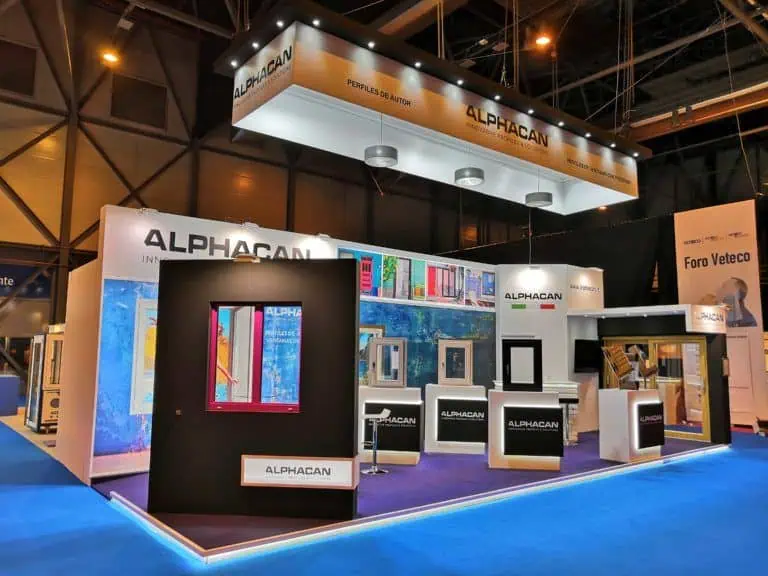
Vertical elements — hanging signs, tall backwalls, tower structures — are the most effective tools for visibility in crowded trade fair halls. A hanging sign at 4–5 m height is visible across an entire hall and can be seen before a visitor enters your aisle. Height also signals investment and quality: research across UFI member fairs consistently shows that taller stands attract more initial dwell time.
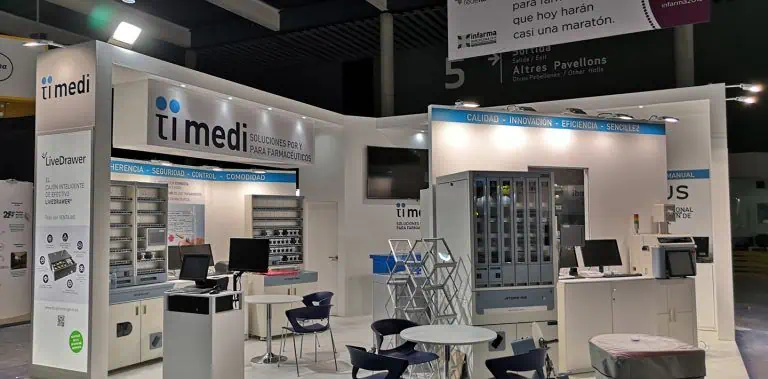
Colour psychology matters significantly at trade fairs. High-contrast colour combinations (dark background with light text, or saturated brand colours against neutral neighbouring stands) create visual separation in a sea of competing stands. Open layouts — without front barriers or furniture blocking the entrance — consistently outperform closed layouts for initial engagement. Explore our portfolio of exhibition stand design examples to see these principles in action.
Lighting as the #1 Traffic Driver
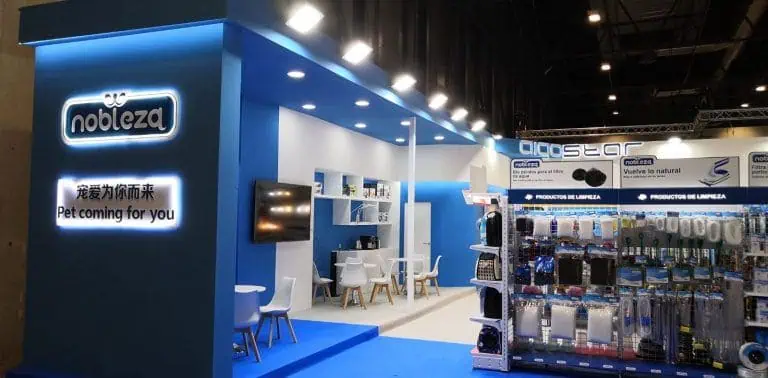
Lighting is the single most cost-effective traffic driver in exhibition stand design. A well-lit stand in a dimly lit hall aisle is visible from 15+ metres and creates an instinctive “pull” that draws visitors towards it without any other design effort. Yet lighting is also the most frequently underfunded element in stand budgets.
Track spotlights directed at products and graphics create depth and visual interest that flat overhead hall lighting cannot replicate. LED wash lighting along backwalls creates a warm, inviting atmosphere versus the cool fluorescent tone of most trade fair halls. Backlit graphic panels — where light passes through printed fabric — produce an illuminated effect that stands out day or night and is particularly effective for brand identity elements and product imagery.
Practical lighting budget: allocate at minimum 8–12% of your total stand build budget to lighting. For a 20 m² stand at €20,000 total, this means €1,600–€2,400 on lighting alone — an investment that consistently delivers outsized returns in visitor attraction. For detailed lighting planning, contact Adam Expo Stand for a free consultation.
Product Display and Interactive Elements
Product display strategy determines whether a visitor who has approached your stand engages further or moves on within 30 seconds. Products should be displayed at arm-reach height (80–120 cm from floor) for easy examination, with the most visually striking or highest-priority item placed at the stand’s most visible aisle-facing position.
Interactive elements are the highest-ROI investment in exhibition stand design for 2026. CEIR 2024 data shows that interactive demonstrations increase visitor dwell time by 40% compared to passive display stands. Effective interactive formats include: live product demonstrations on a timed cycle (2–3 minutes maximum), touchscreen product configurators that allow visitors to customise a product on screen, and hands-on samples that visitors can examine without requiring staff assistance.
AR and VR experiences are increasingly common at major European fairs. Research across Messe Frankfurt and ExCeL London events shows that VR demonstration stands attract 15–20% more total visitors than comparable non-VR stands, though VR requires dedicated staffing to manage the headset process. For most exhibitors, a well-designed touchscreen configurator delivers equivalent results at lower cost. Learn about technology integration options in our exhibition services portfolio.
Signage Hierarchy and Meeting Zones
Signage hierarchy is the layered system of messaging that guides a visitor from first visual contact through to a qualified conversation. A well-structured signage hierarchy has three levels: primary (brand identification at 8–10 m), secondary (key message or product category at 3–5 m), and tertiary (product detail, specifications, or contact information at arm’s reach).
Common signage mistakes include: putting too much text on primary-level graphics, using font sizes that are only readable at close range, and cluttering the stand with multiple equally-weighted messages that compete for attention. A visitor’s eye should travel naturally from the highest element (brand name/hanging sign) downward to a specific product or demo station, then to a call-to-action (meeting request, brochure, or QR code).
Meeting zones should be placed at the rear of the stand, away from the main visitor flow, with comfortable seating and a degree of privacy. Separate meeting areas signal that you expect to have serious conversations — and that expectation is self-fulfilling. Stands with a defined meeting area consistently generate higher-quality leads than open-plan stands where every conversation competes with aisle noise. Follow our stand project updates on LinkedIn.
Sustainability Signals and Staffing
Sustainability signals — visible cues that your stand uses responsible materials and practices — are increasingly valued by trade fair visitors, particularly at Northern European venues and among procurement professionals who work within ESG frameworks. These signals include: FSC-certified timber or plywood visible in the stand structure, recycled aluminium framing, LED-only lighting, and fabric graphics that replace single-use vinyl.
Incorporating a brief sustainability statement into your stand graphics (“This stand is built with FSC-certified materials and is 95% reusable”) costs nothing extra and builds credibility with environmentally-minded visitors. At Messe Frankfurt and Messe Dusseldorf especially, sustainability credentials are part of the exhibitor scoring system for certain fair categories.
Staffing strategy is the final design element: the number of staff, their positioning, and their briefing determine whether all the design investment converts into conversations. Overcrowded stands with too many staff create an intimidating “hard sell” atmosphere; understaffed stands miss opportunities during peak hours. The recommended ratio is one engaged staff member per 8–10 m² of stand space, with clear role assignments for visitor greeting, demonstration, and lead capture. Read our exhibitor guides on our in-depth guides on Medium.
Post-Show Asset Collection and Follow-Up
Post-show asset collection refers to the systems and physical materials that enable effective follow-up after the fair closes. This is the most underplanned element of exhibition stand design, yet it directly determines whether trade fair investment converts into revenue.
Lead capture systems should be digital wherever possible: a tablet-based form or a QR code linked to a landing page captures visitor data instantly, with opt-in confirmation and automatic CRM integration. Physical business cards should be photographed and logged digitally within 24 hours of collection — not processed weeks later when the context is forgotten. Every lead entry should include a note on the specific conversation, product interest, or next step discussed at the stand.
A post-show follow-up email sent within 48 hours converts at significantly higher rates than follow-ups sent a week later. The email should reference the specific conversation, include the product information discussed, and propose a clear next step. Segmenting leads by interest level (hot, warm, cold) and assigning each to a specific sales owner within 24 hours of the fair closing is the single most impactful post-show action. For help designing a complete exhibition stand strategy, request a free stand consultation and subscribe to our Substack newsletter.
Expert Tips from Adam Expo Stand’s Design Team
After 15 years and 639+ stands built across Europe, here’s what our designers want every exhibitor to know:
- Design for 5 metres, not 50 cm: Most exhibitors view their stand designs on a computer screen or A4 printout. Always review your stand design as a 3D render viewed from the aisle at 5 metres distance — that is the visitor’s first impression, and it is entirely different from a close-up view.
- Use a single hero product at the stand front: Multiple products displayed at equal prominence at the stand entrance create confusion. One highlighted “hero” product at the most visible position draws visitors in; additional products can be explored once they are inside the stand.
- Test your lighting in daylight conditions: Trade fair halls have inconsistent lighting — some halls are bright, others are dim. Wherever possible, request the hall’s lighting plan from the organiser before your stand design is finalised and adjust your own lighting specification accordingly.
- Confirm lead capture responsibility before the fair opens: Decide on day one who is responsible for entering leads into the CRM at the end of each day. Leaving this as a post-fair task means leads go cold. The best performing stands in our project history all had daily lead review sessions built into the fair schedule.
See Our Exhibition Stand Work in Action
Frequently Asked Questions
What is the most important element of exhibition stand design for attracting visitors?
Lighting is consistently the most impactful single element for attracting visitors to an exhibition stand. A well-lit stand is visible from 15+ metres in a trade fair hall, creating an instinctive draw before any other design element registers. After lighting, height (hanging signs, tall backwalls) and high-contrast graphics are the next most effective traffic drivers. Adam Expo Stand’s design team always develops lighting plans alongside structural designs, not as an afterthought.
How do interactive elements increase exhibition stand ROI?
Interactive elements increase visitor dwell time by 40% on average, according to CEIR 2024 data. Longer dwell time creates more opportunities for staff engagement and lead capture, directly improving the quality and quantity of leads generated. Interactive demonstrations, touchscreen configurators, and hands-on product samples all contribute to this effect. The ROI benefit is strongest when interactive elements are positioned at the most visible aisle-facing area of the stand.
What is the 3-second rule in exhibition stand design?
The 3-second rule states that a trade fair visitor decides whether to approach a stand within the first 3 seconds of visual contact. During this window, only the stand’s highest-level visual elements register — the brand name, primary colour, height, and overall visual impression. Detailed messaging, product names, and body copy are invisible at this stage. Effective exhibition stand design prioritises the 3-second impression above all other design decisions.
What percentage of my stand budget should go to lighting?
Allocate a minimum of 8–12% of your total stand build budget to lighting. For a €20,000 total stand budget, this means €1,600–€2,400 on lighting fixtures, tracks, and installation. This investment consistently delivers outsized returns in visitor attraction versus other stand elements at equivalent cost. If you are working with a constrained budget, prioritise directed spotlights on key products and one backlit graphic panel before investing in other decorative elements.
How should I structure the signage hierarchy on my exhibition stand?
A three-tier signage hierarchy works best: primary level (brand name and logo, visible from 8–10 metres, placed at maximum height), secondary level (key message or product category, readable at 3–5 metres), and tertiary level (product specifications, contact details, QR codes, readable at arm’s reach). Each level should contain only one or two messages. Visitors’ eyes should travel naturally from the highest element downward to a specific call-to-action without being distracted by competing messages.
Recommended Reads
- The Complete Guide to Exhibition Stand Design — How to create a stand that drives results at any trade fair
- Modular Exhibition Stands: Flexibility Meets Impact — Sustainable, reusable solutions for frequent exhibitors
- Full-Service Exhibition Solutions — End-to-end stand management across 50+ European trade fairs
Ready to Create Your Perfect Exhibition Stand?
Get a free consultation and 3D design concept from Adam Expo Stand Trade Show Booth Design and Build — Europe’s trusted exhibition stand specialist for IFEMA Madrid, Fira Barcelona, Messe Frankfurt, and 50+ European trade fairs.
About the Publisher
This article was produced by Adam Expo Stand Trade Show Booth Design and Build, a European exhibition stand specialist with 20+ years of experience and 639+ stands constructed across Spain, France, Germany, the United Kingdom, and Italy. Serving exhibitors at IFEMA Madrid, Fira Barcelona, Messe Frankfurt, Messe Dusseldorf, ExCeL London, and Fiera Milano. adamexpostand.com · LinkedIn · Medium